
Best ACH Payment Processing for Small Business: The 2026 Strategic Buyer’s Guide

Why are you still sacrificing 3% of every sale to credit card processors when your business has already done the heavy lifting? It is a common frustration for owners who see their thin margins eroded by transaction fees and hidden batch charges. You likely agree that waiting five business days for funds to clear is an outdated relic of a slower era that your cash flow simply cannot afford.
Finding the best ach payment processing for small business shouldn't feel like a second job. We believe you deserve a solution that does more than just move money; you need a partner that protects your time. This guide will show you how to select a processor that slashes costs, secures next-day deposits, and removes the friction of manual data entry between your payment app and QuickBooks. If your current provider makes you feel like just another account number, it is time for a more supportive, transparent approach.
We are breaking down the 2026 NACHA fraud monitoring requirements and showing you how to automate your entire bookkeeping workflow. You will learn how to identify providers who favor your operational health over their own bottom line, ensuring the path from an invoice being sent to a reconciled bank balance is as short as possible.
Key Takeaways
- STOP THE FEE DRAIN. Learn how bank-to-bank transfers replace high percentage-based card fees with predictable flat-rate costs to protect your margins.
- ACCELERATE YOUR CASH. Identify the best ach payment processing for small business that offers next-day deposits to eliminate the traditional 3-5 day waiting period.
- AUTOMATE YOUR WORKFLOW. Discover how direct integration with QuickBooks and payroll systems removes the burden of manual data entry and reconciliation.
- STRATEGIZE YOUR PAYMENTS. Gain a clear framework for balancing ACH cost savings with customer preferences for credit card protections.
- SIMPLIFY YOUR BACK OFFICE. See how a concierge-style partnership can solve complex bookkeeping challenges and streamline your tax compliance.
What is ACH Payment Processing and Why Does Your Small Business Need It?
You likely started your business to solve problems for your customers, not to spend your afternoons chasing paper checks or calculating how much of your profit just vanished into credit card fees. ACH is essentially the digital version of a check, but it is faster, more reliable, and significantly more secure. The Automated Clearing House (ACH) is a centralized network that moves money directly between bank accounts, bypassing the expensive card networks like Visa or Mastercard.
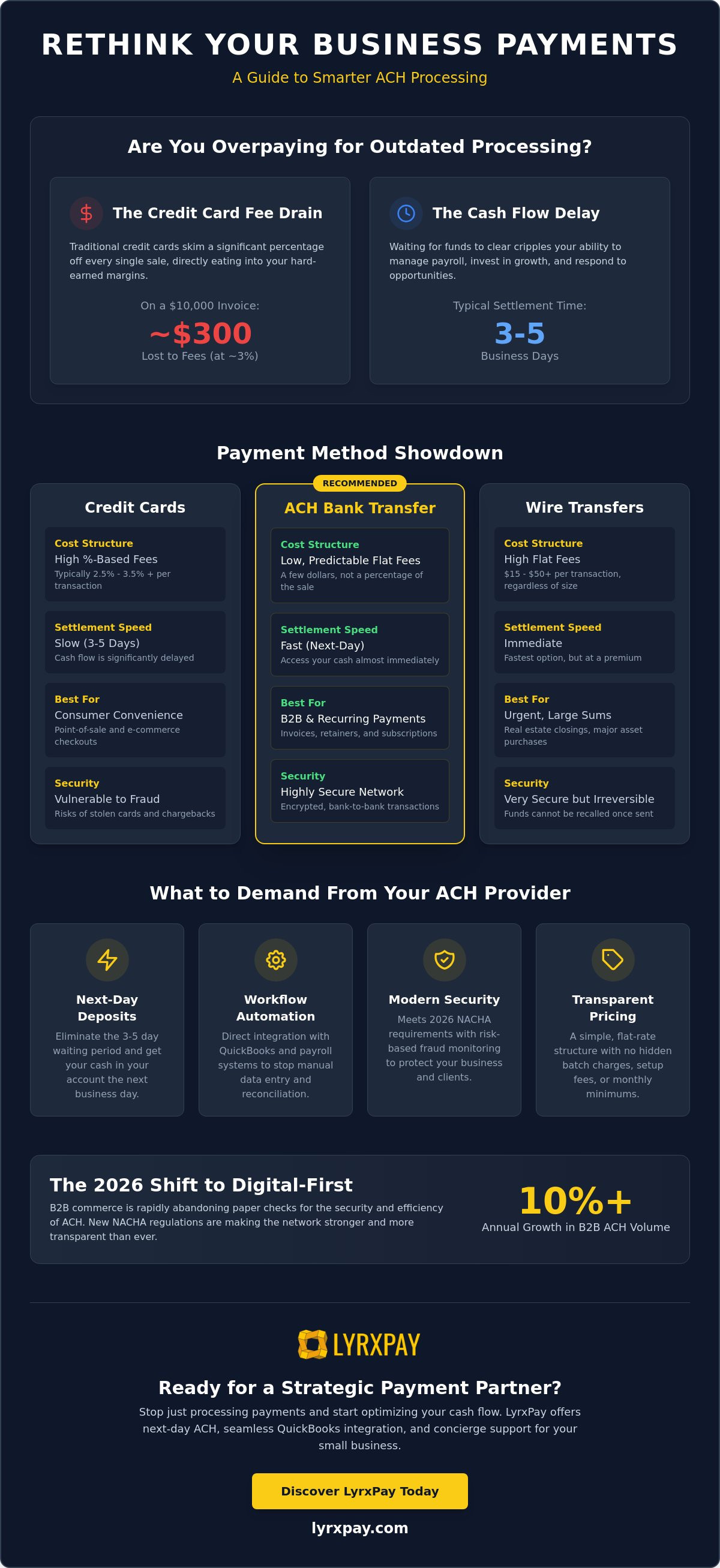
For most owners, the primary driver for switching is the immediate impact on the bottom line. While credit cards typically charge 2.5% or more per transaction, ACH costs are usually flat fees or a tiny fraction of a percent. If you are processing a $10,000 B2B invoice, a credit card fee could easily cost you $300. With the best ach payment processing for small business, that same transaction might only cost a few dollars. This cost structure makes it the logical choice for professional service retainers, high-ticket B2B invoices, and recurring subscriptions where margins are often tight.
Security is another major win that often goes overlooked. Direct bank transfers remove the risk of lost or stolen physical cards and eliminate the headache of expired credentials that lead to failed subscription payments. Because the connection is bank-to-bank, the data is encrypted and handled through a highly regulated system, giving you and your clients peace of mind.
ACH vs. Wire Transfers vs. Credit Cards
Think of these as different lanes on a financial highway. Wire transfers are the high-speed, high-cost lane; they are immediate but expensive and often require manual effort to initiate. Credit cards offer convenience and speed but come with a massive premium that scales as your revenue grows. ACH is the backbone of domestic B2B commerce in 2026, offering the perfect balance of reliability and affordability for non-emergency funds. It is the most cost-effective way to move money without sacrificing professional standards.
The 2026 Shift Toward Digital-First Payments
Paper checks are no longer just slow; they are a liability. They are prone to mail theft and manual entry errors that waste your team's time. Modern standard ACH processing for business has evolved into a real-time necessity, evidenced by the 10% growth in B2B ACH payments reported by the network in late 2025. New NACHA regulations effective June 19, 2026, have strengthened this network by mandating risk-based fraud monitoring for all originators. These rules, along with standardized descriptions like "PURCHASE" for e-commerce, ensure that your digital transition is both secure and transparent for everyone involved.
Key Features to Look for in the Best ACH Payment Providers
Most business owners assume that all ACH providers are essentially the same. They think a bank transfer is a bank transfer. This misconception is costly. The difference between a mediocre provider and the best ach payment processing for small business is measured in days of cash flow and hours of administrative labor. When you are evaluating your options, you need to look beyond the basic ability to move money and focus on the features that protect your time and liquidity.
Liquidity and Settlement Speed
Cash is oxygen. If your funds are locked in a 3 to 5 day settlement window, your ability to respond to opportunities or meet payroll is compromised. Settlement windows are the primary differentiator in B2B payment processing solutions. While standard ACH is reliable, you should prioritize providers that offer next-day deposits. It is important to understand that Same-Day ACH often carries a premium, typically ranging from $1 to $5 per transaction, but the benefit of immediate liquidity often outweighs this modest cost. If a provider cannot guarantee faster settlement than the traditional multi-day wait, they are likely not the right fit for a growing business.
Software Integration and Automation
How many hours does your team spend on manual reconciliation? If you have to export CSV files from your payment portal and upload them to QuickBooks or Xero, you are wasting resources. Look for native integrations. A native connection means that when a client pays an invoice, the payment is automatically recorded and reconciled in your ledger without any human intervention. You should avoid "bridge" software or third-party apps that sit between your processor and your accounting tools; these are just extra points of failure. Automating your recurring billing cycles through a modern ACH processing partner can turn a complex administrative burden into a background process that just works.
Batch Processing and Modern Security
As your volume increases, the ability to process transactions in batches becomes essential. This allows you to group hundreds of payments into a single file, reducing the complexity of your bank statements. Security features must also be proactive rather than reactive. Effective June 19, 2026, NACHA requires all non-consumer originators to have documented, risk-based fraud monitoring. The best ach payment processing for small business will provide built-in identity verification and behavioral analysis tools at the point of sale. These features ensure you are compliant with the latest regulations while preventing unauthorized returns, which NACHA strictly limits to a 0.5% threshold.
ACH vs. Credit Cards: Balancing Cost, Speed, and Customer Preference
Choosing between ACH and credit cards often feels like a tug-of-war between your profit margins and your customer's convenience. While cards are the default for many consumers, the best ach payment processing for small business allows you to reclaim a significant portion of your revenue without alienating your clients. The math is straightforward; credit cards typically demand 2% to 3% of every transaction. In contrast, ACH fees are often flat rates ranging from $0.20 to $1.50 or capped percentages that rarely exceed $6.00 per transaction. On a $5,000 invoice, that is the difference between losing $150 and paying less than the price of a cup of coffee.
Many owners worry about the speed of settlement, but the 'speed myth' is rapidly fading. With the 10% growth in B2B ACH volume recorded in late 2025, more businesses are adopting Same-Day ACH to rival the settlement times of traditional card networks. You don't have to wait a week for your money anymore. The hybrid approach is often the most effective strategy for a growing company. By offering credit cards for small, convenience-based purchases and incentivizing ACH for larger invoices, you provide the flexibility customers want while shielding your larger revenue streams from high fees. Some clients will always prefer credit cards for their chargeback rights and reward points, but most B2B partners understand and respect the shift toward more efficient bank-to-bank transfers.
The Hidden Costs of Credit Card Processing
Interchange fees, assessment fees, and processor markups create a triple threat that erodes your bottom line every single month. For high-ticket industries, these costs are particularly painful because they scale directly with your success. If a business switches just 50% of its credit card volume to ACH, the savings can amount to thousands of dollars in annual profit. This isn't just about saving pennies; it is about protecting your ability to reinvest in your own growth. By reducing your reliance on expensive card networks, you gain a competitive advantage that your peers, who are still paying the 'interchange tax,' simply don't have.
When to Insist on ACH Payments
Certain industries, like medical offices, wholesalers, and professional services, should make ACH their primary collection method. It is the ideal way to handle large one-time payments or recurring retainers without the 'interchange sting.' Understanding ach payment processing benefits helps you explain the value to your clients. You can show them that direct transfers are a more professional and secure way to handle significant B2B transactions. The technology driving the best ach payment processing for small business in 2026 includes advanced API integrations that verify account balances in real-time. This reduces the risk of non-sufficient funds returns, which NACHA monitors closely. When you insist on ACH for high-value services, you are using a system built specifically for the stability and security required in professional business environments.
Integrating ACH with QuickBooks and Payroll for Maximum Efficiency
Most business owners treat payments, payroll, and bookkeeping as three separate headaches. This fragmented approach silos your data and forces your team to spend hours on manual reconciliation. The best ach payment processing for small business isn't just a standalone tool; it's the connective tissue of your financial ecosystem. When your systems talk to each other without friction, you finally get to focus on your craft instead of your spreadsheets.
A single financial dashboard provides a level of clarity that disjointed apps can't match. Imagine a workflow where your ACH receipts automatically fund your payroll and update your ledger in real-time. This level of automation handles 1099 management and tax compliance in the background, ensuring you are always ready for tax season. By utilizing all in one business financial solutions, you eliminate the "double entry" errors that typically plague manual accounting. This isn't just about convenience; it's about building a scalable foundation for your 2026 growth.
The QuickBooks Connection
Many providers offer "out of the box" plugins that frequently break or sync incorrectly. We've seen owners lose days of work trying to fix a broken sync between their processor and their ledger. Expert-managed integration ensures your cash position is accurately reflected at the end of every business day. When your data is clean and categorized from the moment of the transaction, end-of-year audits become a routine check instead of a stressful marathon. If you want to stop guessing your bank balance, you need a partner who understands QuickBooks as well as they understand payments.
Payroll and ACH Synergy
Using your ACH account to fund payroll seamlessly removes the need for slow, external bank transfers. This synergy reduces the risk of payroll delays, which is critical for maintaining employee trust and operational health. There is a massive advantage in having your merchant service provider also handle your back-office tasks. You gain a single point of contact who acts as a defender of your time and resources. Faster settlement windows mean your revenue is available for payroll almost as soon as it is earned, providing the liquidity you need to stay agile in a competitive market. When your processing and payroll live under one roof, you aren't just moving money; you're managing your business with professional precision.
Why LyrxPay is the Strategic Choice for Small Business ACH Processing
Choosing the best ach payment processing for small business isn't just about finding a software provider. It's about finding an ally who understands that behind every transaction is a goal you're working toward. Many tech-first platforms offer a cold, clinical experience that leaves you searching through help docs when a sync fails or a deposit is delayed. We believe you deserve a concierge-style partnership that prioritizes your operational health and treats your time as your most valuable asset.
Our approach is built on four pillars of managed care for your business:
- TRANSPARENCY. We provide lower-fee structures designed specifically to beat the big aggregators who hide their markups behind complex tiers.
- EXPERTISE. Our team provides direct help with QuickBooks setup and bookkeeping to ensure your financial data is pristine from day one.
- LIQUIDITY. We offer next-day deposits as a standard feature, not a premium upgrade that requires a higher fee.
- ADVOCACY. You get national reach combined with personalized support from real people who know your business by name.
Lowering Your Total Cost of Processing
Are you tired of "statement fees" and "batch headers" that serve no purpose other than to pad a processor's bottom line? We help you lower merchant fees through the strategic use of ACH for high-ticket invoices and recurring billing. There are no hidden junk fees here; just clear, results-oriented pricing that keeps more profit in your bank account. LyrxPay acts as a dedicated defender of your business resources, ensuring every dollar is accounted for and every fee is justified.
Getting Started: A Seamless Transition
Switching your payment provider doesn't have to be a stressful ordeal. We handle the heavy lifting of the migration from your old processor, ensuring your customer data and recurring schedules remain intact. You won't be left talking to a bot when you have questions about your financial workflows. Our ongoing support is delivered by professionals who are deeply invested in your success. It's time to move away from transactional relationships and toward a partnership that actually supports your growth. Audit your current merchant statement and see how much you can save with LyrxPay.
TRANSFORM YOUR CASH FLOW TODAY
You now have a clear framework to move beyond the high costs of traditional credit card networks and the frustrating delays of outdated bank transfers. By implementing the best ach payment processing for small business, you protect your margins and simplify your daily operations. It's about more than just moving money; it's about building a financial ecosystem that supports your long-term vision and respects your resources.
Are you ready to see the direct impact of next-day deposits and seamless QuickBooks or Xero integration on your operational health? Our dedicated Texas-based support team is here to ensure your transition is smooth and entirely stress-free. Switch to LyrxPay and start saving on ACH processing today. We are excited to partner with you as you reclaim your time and focus on the craft that made you start your business in the first place.
Frequently Asked Questions
What is the difference between ACH and a wire transfer for a small business?
Wire transfers are designed for immediate, high-stakes transactions but come with high costs and zero reversibility. ACH is the more practical, cost-effective workhorse for routine business operations like payroll and vendor payments. While wires are settled individually in real-time, ACH moves in batches. This makes it the superior choice for any transaction that isn't a same-day emergency, saving your business significant money on every transfer.
How long does it typically take for ACH payments to clear in 2026?
Standard ACH clearing typically takes one to three business days, but the landscape has shifted toward much faster windows. Many modern providers now offer next-day or even same-day settlement as a standard part of their service. The 2026 NACHA infrastructure improvements have made these accelerated timelines more reliable than ever. If your cash flow requires immediate access to funds, you should look for a partner that guarantees next-day availability.
Are ACH payments safe for my small business to accept?
Accepting ACH is significantly safer than handling paper checks or storing sensitive credit card data. The network uses bank-to-bank encryption and is governed by strict NACHA rules that were updated in June 2026 to mandate risk-based fraud monitoring. These procedures are designed to catch unauthorized transactions and business email compromise before they impact your account. You get a secure, regulated environment that protects your revenue and your clients' data.
Can I integrate ACH payment processing directly into QuickBooks?
You can easily integrate the best ach payment processing for small business directly into your QuickBooks or Xero workflow. This native connection allows your invoices to be marked as paid automatically the moment the funds clear. It eliminates the tedious task of manual reconciliation and ensures your ledger is always an accurate reflection of your bank balance. Automation like this turns a complex bookkeeping chore into a background process that just works.
What are the typical fees for ACH processing compared to credit cards?
ACH fees are designed to be much lower than the 2.5% to 3.5% typically charged by credit card networks. Instead of a high percentage that eats into your profit, you usually pay a flat fee or a very small, capped percentage. This difference is especially noticeable on high-ticket B2B invoices. By switching your larger payments to an ACH model, you keep more of your hard-earned revenue while providing a professional payment experience.
Do I need a special merchant account to accept ACH payments?
You do need a merchant account or a specialized processor authorized to originate entries on the ACH network. While any business bank account can send a payment, receiving them professionally requires a specific setup to handle authorizations and returns. A concierge-style provider will manage this setup for you. They ensure your account is fully compliant with the latest 2026 banking regulations so you can focus on your actual work.
How do next-day deposits work with ACH processing?
Next-day deposits work by submitting your transaction files to the network during early processing windows. Your provider handles the batching and submission logic to ensure the funds are cleared and available in your bank account by the next business morning. This feature is a game-changer for liquidity management. It allows you to fund payroll or pay vendors with the revenue you just earned, rather than waiting a week for funds to settle.
Can I use ACH for international B2B payments?
Standard ACH is primarily a domestic US network, though International ACH Transactions (IAT) are available for certain cross-border needs. Most businesses find that the best ach payment processing for small business is optimized for domestic efficiency and cost savings. For international needs, you might require a specialized global transfer service. However, for your core US-based clients and vendors, ACH remains the most reliable and affordable path for moving money between accounts.