
What is an ACH Payment? The 2026 Guide to Efficient Business Transfers

What if you could stop paying a "convenience tax" on every single dollar your business earns? Most owners accept high credit card fees and manual check delays as a standard cost of doing business, but you don't have to. You're likely tired of watching a percentage of every transaction disappear before it even hits your bank account. If you've been wondering what is an ach payment and how it fits into your 2026 growth strategy, you're looking for a way to reclaim your margins and simplify your operations.
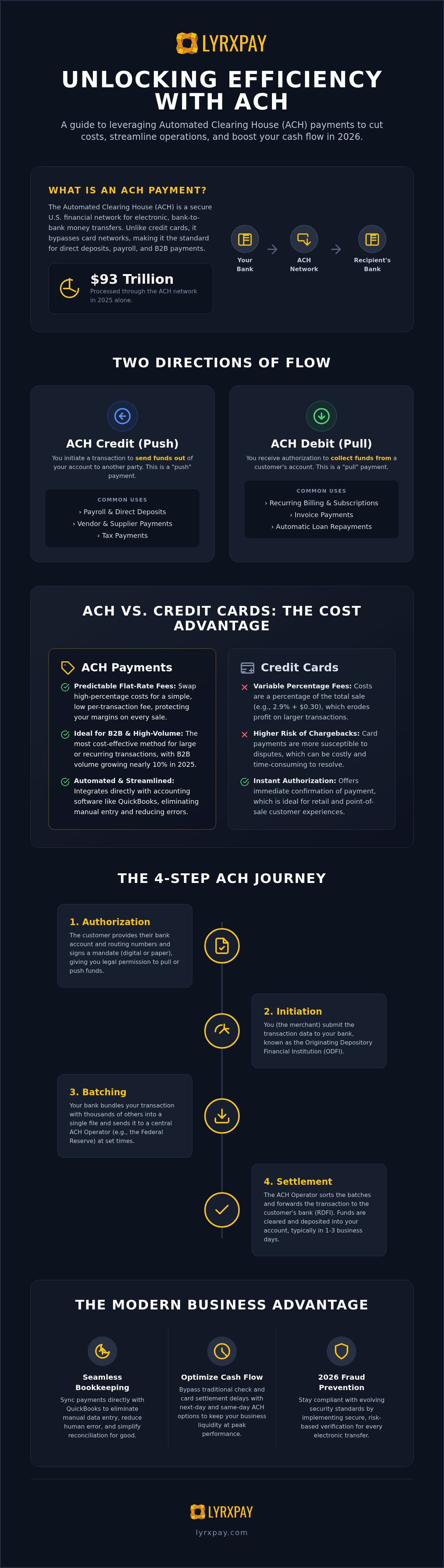
With the ACH network processing over $93 trillion in 2025 alone, this is no longer just a "slower check." It is a strategic liquidity tool designed for the modern era. We'll show you exactly how these transfers work, why they cost significantly less than credit cards, and how to use them to optimize your cash flow. You will learn how to implement the latest 2026 fraud prevention standards and sync your payments directly with QuickBooks to eliminate manual entry errors for good. Here is how you turn a simple bank transfer into your most efficient business asset.
Key Takeaways
- Understand exactly what is an ach payment and how this centralized electronic network powers everything from payroll to tax refunds.
- Learn why moving to ACH can slash your transaction overhead by replacing high-percentage credit card fees with predictable flat-rate costs.
- Discover how to eliminate manual accounting errors by syncing your payment processing directly with QuickBooks for seamless bookkeeping.
- Master the use of next-day deposits to bypass traditional settlement delays and keep your business liquidity at peak performance.
- Stay compliant with 2026 fraud prevention standards by implementing secure, risk-based verification for every electronic transfer.
UNPACKING THE ACH NETWORK: A CLEAR DEFINITION
To understand what is an ach payment, think of it as the invisible engine of American finance. The Automated Clearing House (ACH) is a centralized electronic network that handles billions of financial transactions in large batches rather than processing them one by one. If you have ever received a direct deposit from an employer or had the IRS send a tax refund to your bank account, you have already used this system. It is a secure, bank-to-bank transfer method that bypasses the card networks entirely, which is why it remains the gold standard for high-volume business transfers.
In 2026, the network is governed by NACHA, the National Automated Clearing House Association. This organization sets the "rules of the road" that every bank and processor must follow. For business owners, the evolution of this network has been a relief. While physical checks were once the only way to move money without high fees, they were prone to loss, forgery, and manual data entry errors. ACH replaces that clunky, paper-based process with a digital-first approach that is faster, more secure, and significantly easier to track through your accounting software.
The Two Primary Types: ACH Credit vs. ACH Debit
Understanding what is an ach payment also requires knowing the direction of the money. An ACH Credit is often called a "push" transaction. You initiate the transfer to send money out of your account to someone else. This is the standard for payroll or paying vendors. Conversely, an ACH Debit is a "pull" transaction. Here, you receive authorization to pull funds from a customer's account. This is the most common method for merchants who want to automate recurring billing or collect invoice payments without waiting for a check to arrive in the mail.
Why Businesses are Migrating to ACH in 2026
The shift toward ACH has accelerated as businesses look for ways to protect their margins. Traditional credit card processing fees have continued to climb, often taking a significant percentage of every sale. By moving to an ACH-first model, companies can swap those variable costs for more predictable, flat-fee structures. This is particularly vital in B2B industries, where transaction volumes grew by nearly 10% in 2025. As offices move toward entirely paperless environments, the "digital-first" nature of ACH allows for seamless integration into tools like QuickBooks, removing the administrative burden of manual bookkeeping and allowing you to focus on growing your craft.
HOW ACH PAYMENTS MOVE: THE STEP-BY-STEP PROCESS
Understanding the journey of a single dollar through the ACH network helps demystify what is an ach payment for your daily operations. Unlike a credit card transaction that seeks immediate authorization, ACH moves through a structured, multi-step cycle designed for security and accuracy. This journey begins with Authorization. Your customer must provide their bank account and routing numbers and sign a mandate. This mandate is a legal "green light" that gives you permission to push or pull funds. Without this digital or paper trail, the transaction cannot proceed.
Once you have that permission, the Initiation phase starts. You, the merchant, send the transaction data to your bank. In technical terms, your bank acts as the gatekeeper for the network. From there, the process moves into Batching. Your bank doesn't send your transaction alone; it bundles your request with thousands of others and sends them to a central ACH Operator, such as the Federal Reserve. Finally, Settlement occurs. The funds are cleared through the customer’s bank and deposited into your account. If you want to simplify this entire cycle, choosing a partner that offers streamlined ACH processing can save your team hours of manual oversight.
The Players Involved: ODFI and RDFI Explained
To navigate this system, you need to know the two main institutions involved. The Originating Depository Financial Institution (ODFI) is simply your business bank. They "originate" the request to the network. On the other side is the Receiving Depository Financial Institution (RDFI), which is your customer's bank. These two institutions communicate through the clearing house to verify that funds are available and that the account details are valid. This digital handshake ensures that money moves accurately between the right parties without the need for physical intervention.
Standard vs. Same-Day ACH Timelines
Speed is often the biggest concern for business owners. Standard ACH transfers typically settle within 3 to 5 business days, which allows the network time to check for errors or insufficient funds. However, 2026 standards have made Same-Day ACH a powerful reality for modern business. Currently, the per-transaction limit for Same-Day ACH is $1 million, allowing for much faster movement of significant capital. It is important to remember that the network only operates on business days. If you initiate a transfer on a Friday afternoon or a holiday, the "clock" won't start until the next business morning. Understanding these windows is a critical part of using business liquidity management tools to keep your cash flow healthy and predictable.
ACH VS. WIRE TRANSFERS: WHICH IS RIGHT FOR YOUR BUSINESS?
While both methods move money electronically between banks, they serve very different strategic roles in your financial toolkit. A wire transfer is built for speed and finality. It moves funds in real-time, making it the preferred choice for high-value transactions like real estate closings or international trade where trust must be established instantly. However, this speed carries a premium price tag, often ranging from $25 to $50 per transfer. If you're evaluating what is an ach payment for your standard business operations, it's best to view it as the high-volume, cost-efficient alternative. ACH transactions are batch-processed, which means they are grouped together and cleared at specific intervals. This shared processing model allows for a flat-fee structure that is significantly lower than wire fees.
Deciding which to use depends on your specific transaction needs. If you need to move $500,000 across the country by the end of the hour, a wire is your best bet. For almost everything else, ACH is the smarter move. It is the ideal choice for recurring billing, vendor payments, and domestic B2B invoices where a settlement time of one to three days is perfectly acceptable. By choosing the right tool for the right task, you protect your business from unnecessary overhead while maintaining a professional payment experience for your partners.
Cost Efficiency: Saving Your Bottom Line
For businesses with high-ticket sales or high-volume billing, the savings from ACH can be transformative. Credit card processors often take a percentage of every sale, which eats into your margins as your company grows. In contrast, ACH fees are typically flat rates that cost only cents per transaction. Transitioning your customers to ACH is one of the most effective ways to learn how to lower merchant fees and reclaim thousands of dollars in annual revenue. This shift moves your processing costs from a variable burden to a predictable, manageable expense.
Risk Management and Reversals
The most critical difference between these two methods involves how they handle errors. Wire transfers are generally "final" once sent; reversing one is notoriously difficult and often impossible. ACH provides a layer of protection through the "return" process. If an account has insufficient funds (often cited as an NSF return), the system notifies you so you can address the issue. While consumers have a 60-day window to dispute unauthorized ACH debits, businesses can protect themselves by using secure authorization mandates and bank verification tools. This balance of consumer protection and merchant cost-savings makes ACH a much more flexible tool for domestic commerce than the rigid finality of a wire transfer.
MAXIMIZING SECURITY AND SECURITY IN ELECTRONIC TRANSFERS
Is my data safe from hackers during a transfer? This is the most common question business owners ask when evaluating what is an ach payment for their operations. The short answer is yes. In fact, ACH transfers are often more secure than physical checks, which can be intercepted, altered, or forged. Modern electronic transfers rely on sophisticated data encryption and tokenization to protect sensitive banking information. By replacing actual account and routing numbers with a non-sensitive digital token, your system ensures that even if a breach occurs, the data stolen is essentially worthless to a criminal.
Speed and security also depend on how you verify bank accounts. The old method of micro-deposits, where you send two small amounts and wait days for the customer to confirm them, is becoming a relic. In 2026, instant verification has become the standard. This allows you to confirm account ownership and balance availability in seconds rather than days. If you want to move away from slow, manual verification, you can start using secure ACH processing today to protect your business and your customers with the latest encryption standards.
Fraud Prevention Strategies for Merchants
New Nacha rules effective March 20, 2026, require all originators to implement risk-based processes to detect fraudulent entries. You can stay ahead of these requirements by using "ACH Positive Pay," which allows your bank to cross-check incoming debit requests against a pre-approved list. It's also vital to monitor for suspicious return patterns. If you see multiple "Account Not Found" (R03) or "Invalid Account Number" (R04) codes in a short window, it may signal a fraudulent "probing" attack. Implementing multi-factor authentication (MFA) for your payment portal adds another layer of defense that keeps unauthorized users out of your financial data.
Reducing Return Rates and NSF Issues
Failed payments due to non-sufficient funds (NSF) are a major drain on business productivity. You can minimize these by scheduling your debits to align with common paydays, such as the 1st and 15th of the month, or every other Friday. Automated reminders are also a powerful tool. Sending a simple text or email alert 24 hours before a scheduled pull gives your customer a chance to ensure funds are ready. If a payment does fail, handle it with a "managed care" approach. Reach out with a supportive tone to resolve the issue quickly, which often preserves the long-term professional relationship better than a cold, automated collection notice.
STREAMLINING YOUR CASH FLOW WITH LYRXPAY ACH SOLUTIONS
Efficiency isn't just about saving money; it's about reclaiming your time. By now, you have a clear answer to what is an ach payment, but knowing the definition is only the first step. The real value lies in how you implement this technology to protect your margins. While traditional banks often hold your funds for three to five days, creating a bottleneck in your operations, LyrxPay changes that narrative. We prioritize your liquidity by offering next-day deposits, ensuring that the money you earn is available when you need it most.
While the technical definition of what is an ach payment focuses on the network, our focus is on the partnership. We provide a concierge-style support model that acts as a defender of your resources. This is especially vital for high-compliance industries that require precision and personal attention, such as merchant services for medical offices and professional firms. We don't just give you a login; we provide a dedicated ally deeply invested in your operational health.
We believe in transparency, especially regarding your bottom line. Big-bank processors often hide extra costs in complex statements, but our commitment is to provide lower transaction fees that respect your hard work. By switching to a streamlined ACH model, you move away from the "convenience tax" of credit cards and toward a sustainable, high-growth financial strategy.
QuickBooks and Xero: Automated Bookkeeping Integration
One of the biggest headaches for any business owner is the "manual entry mountain" that grows with every transaction. LyrxPay eliminates this burden through direct sync with QuickBooks and Xero. You will experience immediate "reconciliation relief" as your incoming payments automatically match your open invoices. If you want to see how this fits into a broader strategy, explore our all in one business financial solutions to see how automation can fuel your 2026 growth.
Getting Started: A Frictionless Setup
Applying for a LyrxPay merchant account is designed to be as painless as possible. We've removed the red tape that typically slows down business banking. For most standard businesses, our approval window is just 24 to 48 hours, allowing you to start optimizing your cash flow almost immediately. It's time to stop accepting slow settlements and high fees as the status quo. Audit your current processing costs today and make the switch to a model that works as hard as you do.
RECLAIM YOUR MARGINS AND MOMENTUM
Mastering the mechanics of what is an ach payment is the first step toward building a more resilient financial operation. You now know that these transfers offer a secure, flat-fee alternative to expensive credit card processing and the rigid finality of wire transfers. By aligning your payment schedule with modern fraud prevention standards and leveraging automated bookkeeping, you remove the administrative friction that often holds growing businesses back. You've seen how batch processing and next-day settlement can transform your liquidity from a source of stress into a competitive advantage.
It's time to stop letting high transaction fees and standard settlement delays dictate your cash flow. You deserve a partner who advocates for your resources and simplifies the complex. When you combine lower fees with seamless integration for QuickBooks and Xero, you finally gain the clarity needed to scale with confidence. Lower your processing costs today with LyrxPay ACH solutions and experience the relief of a managed financial workflow. Your business is ready for the next level of efficiency, and we're here to help you reach it.
Frequently Asked Questions
How long does an ACH payment take to process in 2026?
Standard ACH transfers usually take 3 to 5 business days to settle fully in your account. However, Same-Day ACH has become a primary tool for businesses needing faster liquidity, allowing for settlement within the same business cycle. It's important to remember that the network only processes on business days. Weekends and bank holidays will add to your total wait time regardless of the transfer speed you choose.
Are ACH payments reversible if a mistake is made?
Reversals are possible but are governed by strict Nacha rules and specific timeframes. Unlike wire transfers, which are virtually permanent, an ACH transaction can be reversed if there was a duplicate entry, an incorrect amount, or an unauthorized account was used. You must initiate a reversal request within five business days of the original settlement to ensure the network can process the correction successfully for your business.
What information do I need from a customer to start an ACH payment?
To initiate a transfer, you need the customer's bank routing number, their account number, and a signed authorization mandate. This mandate is a legal requirement that proves the customer has granted you permission to debit or credit their account. For those wondering what is an ach payment in a digital context, this authorization is often captured through secure online forms or e-signatures to speed up the onboarding process.
Is there a limit on how much money I can send via ACH?
The current per-transaction limit for Same-Day ACH is $1 million as of 2026. This limit is scheduled to increase significantly to $10 million in September 2027 to accommodate even larger B2B transactions and insurance claims. While the network itself has high limits, your individual payment processor or bank may set lower daily or monthly caps based on your business's history and typical transaction volume.
How much does it typically cost a business to process an ACH transaction?
Processing costs are typically structured as flat fees per transaction, making them far more predictable than credit card percentages. Most businesses pay a small fee that ranges from a few cents to a couple of dollars depending on the volume and speed of the transfer. This cost-efficiency is a major reason why B2B ACH volume grew by nearly 10% in 2025 as companies moved away from expensive card networks.
What is the difference between ACH and a direct deposit?
Direct deposit is simply a specific application of the ACH network used for pushing funds into an account. While the term is most often associated with payroll or government benefits, it uses the same underlying architecture as any other ACH credit. Understanding what is an ach payment helps clarify that direct deposits, tax refunds, and vendor payments are all different branches of the same electronic clearing house system.
Can ACH payments be used for international business transactions?
ACH is primarily a domestic network designed for banks within the United States. While International ACH Transactions (IAT) do exist, they are complex and require adherence to specific cross-border regulations and reporting standards. Most businesses find that wire transfers or specialized international payment platforms are more reliable for global trade. They typically reserve ACH for their domestic vendor and customer base to keep costs low and predictable.
What happens if an ACH payment is returned for non-sufficient funds (NSF)?
If an account lacks the necessary funds, the transaction will be returned with a specific code, such as R01 for NSF. Your payment processor will notify you of the failure, usually within two business days of the attempted settlement. You can then reach out to the customer to resolve the balance or re-initiate the debit after ensuring the funds are available. This helps you avoid repeated return fees and manual bookkeeping errors.