
7 Critical Signs You're Overpaying for Payment Processing in 2026

What if your payment processor is quietly pocketing the savings meant for your bottom line? Even with the 2025 settlement reducing average interchange rates by 10 basis points, many business owners are still seeing their monthly costs climb. It is incredibly frustrating to deal with cryptic, multi-page statements that seem designed to confuse rather than clarify. You likely know the feeling of watching fees increase while your sales volume stays steady, or the stress of waiting five days for funds to finally hit your bank account. Recognizing the signs you're overpaying for payment processing is the first step toward taking back control of your revenue.
We are here to help you audit your merchant statement like a pro and expose the hidden fees that simply shouldn't be there. This article provides a clear path to understanding your true effective rate and identifying "junk" charges like unnecessary statement fees or monthly PCI penalties. We will walk through seven critical red flags that indicate it is time for a more transparent, integrated financial workflow that actually respects your time and your profit margins.
Key Takeaways
- Learn to decode "alphabet soup" statements and understand why complex terminology is often used as a strategy to mask margin increases.
- Identify the common signs you're overpaying for payment processing, specifically focusing on the "tiered pricing" trap where teaser rates rarely apply to your actual transactions.
- Conduct a targeted junk fee audit to eliminate non-functional charges like monthly minimums and padded administrative costs that drain your revenue.
- Quantify the hidden costs of slow cash flow and discover how transitioning to next-day deposits can eliminate the "liquidity tax" on your operations.
- Understand how a professional side-by-side statement analysis reveals immediate savings and simplifies your path to a more integrated, transparent financial workflow.
The 'Alphabet Soup' Test: Is Your Statement Intentionally Confusing?
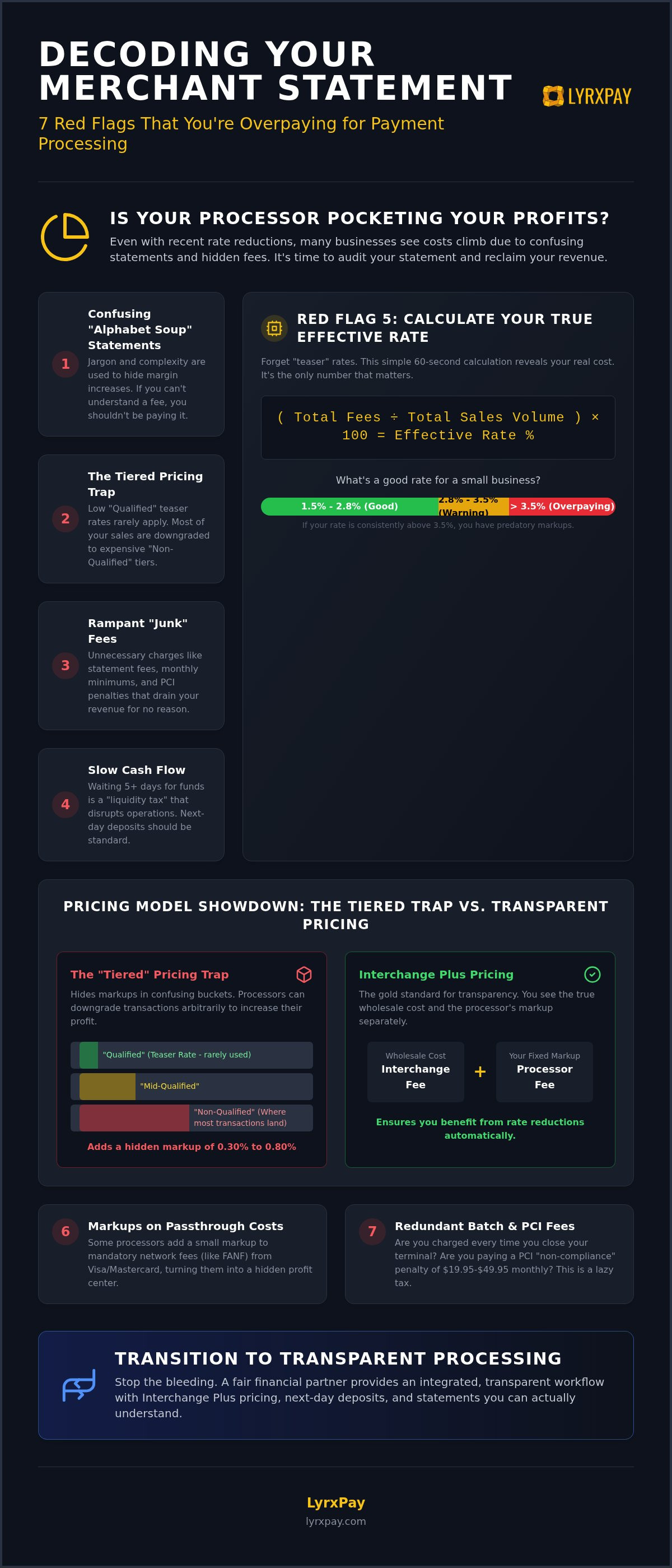
Transparency isn't just a nice feature; it is the foundation of a fair financial partnership. When you look at your monthly merchant statement, do you feel a sense of clarity or a headache coming on? Many processors rely on confusion as a core profit strategy. By burying margin increases under layers of technical jargon, they make it nearly impossible for you to spot where your money is going. This "alphabet soup" tactic is one of the most common signs you're overpaying for payment processing.
We believe in a simple "Plain English" rule: if your account representative cannot explain a specific fee in terms you understand, you should not be paying it. You deserve an ally who does the heavy lifting for you, not one who hides behind complexity. A Merchant Statement Audit is a vital quarterly business health check that ensures your processing costs remain aligned with your actual sales volume and industry standards.
Common Cryptic Acronyms to Spot
Identifying these fees is the first step toward reclaiming your revenue. Look closely at your statement for these three frequent offenders:
- PCI-DSS Non-Compliance: This is often a "lazy tax." If your provider isn't actively helping you certify your business, they are likely just collecting a monthly penalty fee, which typically ranges from $19.95 to $49.95.
- FANF and Network Access Fees: These are standard interchange fees and network costs passed down from Visa and Mastercard. However, some processors add a small markup to these passthrough costs, turning a mandatory fee into a quiet profit center.
- Batch Header Fees: You should not be paying multiple times for a single day of work. Watch for redundant charges every time you close out your terminal; these small hits add up quickly over a month.
The Effective Rate Calculation
The only number that truly matters in your audit is your effective rate. Forget the "teaser" rates promised in your initial contract. To find your real cost, take your total fees and divide them by your total sales volume. For example, if you paid $300 in fees on $10,000 of sales, your effective rate is 3%.
Most small businesses in 2026 should see an all-in rate between 1.5% and 3.5% per transaction. If your calculation consistently lands above 3.5%, or if you notice a gap between your quoted rate and your actual effective rate of more than 0.80%, you are likely dealing with predatory markups. You can perform this math in under 60 seconds with a calculator and your latest statement. It is the fastest way to confirm the signs you're overpaying for payment processing and move toward a more transparent, integrated financial workflow.
The Tiered Pricing Trap: Why 'Qualified' Rates Are a Myth
Have you ever signed up for a processing plan because of a low "qualified" rate, only to find your actual costs are much higher? This is one of the most classic signs you're overpaying for payment processing. These introductory rates often function as teaser rates that apply only to a tiny fraction of transactions, such as basic debit cards from small banks. In reality, the "qualified" bucket is shrinking every year.
Interchange Plus pricing is the gold standard for transparency because it separates the wholesale cost set by card networks from the processor's markup. This model ensures you benefit from legislative changes, such as the 2025 antitrust settlement that reduced average interchange rates by 10 basis points. Understanding the breakdown of Credit Card Processing Fees helps you see that tiered models are designed to pad margins, not save you money. If you aren't on an Interchange Plus plan, you're likely paying a hidden markup that ranges from 0.30% to 0.80% above the actual cost.
The Bait-and-Switch of Tiered Models
Tiered pricing feels simple, but that simplicity hides a complex system of buckets. Processors group transactions into "Qualified," "Mid-Qualified," and "Non-Qualified" tiers, and they have the power to move transactions between these buckets arbitrarily. In 2026, most consumers use high-reward or corporate cards. These almost always fall into the "Non-Qualified" bucket. If you see a "Non-Qualified" surcharge on your latest statement, you're paying a premium for no added benefit. We often find that a "qualified" rate of 1.5% quickly turns into an effective rate of 3.5% once the month ends.
Level 2 and Level 3 Data Gaps
For B2B merchants, missing out on Level 2 and Level 3 data is a massive drain on profit. These data fields provide extra transaction information that lowers the risk for card networks. By capturing this data, you can often save 0.5% or more on B2B and corporate card transactions. If your current hardware or software doesn't support these fields, you're essentially leaving money on the table. Adopting secure credit card processing solutions ensures you capture full transaction data and qualify for the lowest possible wholesale rates. A quick review of your current setup can determine if your equipment is actually working against your bottom line.
The Junk Fee Audit: A 5-Point Checklist for Merchants
Junk fees are the silent killers of your profit margins. These are non-functional charges that exist solely to pad a processor's revenue without providing a single benefit to your daily operations. When you are understanding credit card processing fees, it becomes clear that many line items are entirely optional markups. If your monthly bill is cluttered with fees that don't relate to a specific transaction, you've found one of the most obvious signs you're overpaying for payment processing.
One of the most predatory examples is the "Monthly Minimum" trap. This fee forces you to pay a set amount even if your sales volume is low for the month; essentially, you are paying for transactions you never processed. Combined with "Regulatory" or "Administrative" fees, which are often just disguised markups, these costs can quietly drain hundreds of dollars from your account every year. Use the following checklist to evaluate your current provider and stop the bleeding.
Audit Item 1-3: Hardware and Access
Hardware leases are a major red flag in 2026. If you are paying $50 a month for a terminal that retails for roughly $300, you've paid for that device twice over within a single year. Beyond the hardware, look for monthly PCI compliance fees. Are you being charged a penalty of $19.95 or more every month simply because your provider hasn't helped you certify? Finally, watch out for gateway fees. While necessary for online sales, these should be flat and transparent, not a hidden tax for simply connecting your digital and physical storefronts.
Audit Item 4-5: Service and Support
You shouldn't have to pay a premium just to get help with your account. Some processors charge "Customer Support Fees" or "Account Maintenance Fees" that offer no real value to the merchant. Perhaps the most dangerous junk fee is the Early Termination Fee (ETF). This "handcuff" clause is designed to prevent you from seeking better rates elsewhere. If your contract includes a hefty penalty for leaving, it is a sign that the provider knows their rates aren't competitive. If your statement is filled with these line items, it is time to recognize the signs you're overpaying for payment processing and demand a cleaner bill. For a deeper dive into reclaiming your revenue, check out our 2026 Strategic Guide on how to lower merchant fees to see how a transparent partner can help you eliminate these costs for good.
The Hidden 'Liquidity Tax' and Labor Costs
Overpaying for merchant services isn't always a visible line item on a confusing statement. Sometimes, the highest costs are hidden in the friction of your daily operations. If your funds take 3 to 5 business days to reach your bank account, you're paying a "liquidity tax" that restricts your ability to grow. This delay prevents you from reinvesting in your business, purchasing inventory, or meeting immediate obligations. Slow cash flow is one of the subtle signs you're overpaying for payment processing because it forces you to find alternative, often more expensive, ways to cover financial gaps.
Beyond the speed of money, there is the "Hidden Labor Tax" of disconnected systems. When your payment processor doesn't talk to your accounting software, your team is forced into hours of manual data entry. These operational inefficiencies are clear signs you're overpaying for payment processing through lost opportunity and wasted wages. A "cheap" processing rate becomes incredibly expensive the moment your bookkeeper has to spend their entire afternoon reconciling a single day's sales.
Next-Day Deposits as a Revenue Driver
Long wait times for deposits are essentially a free loan you're giving to your processor. While they hold your funds, they are earning interest on the "float" while your bank account sits empty. This is especially painful on Mondays when you are waiting for Friday and Saturday sales to clear. Faster access to capital through next-day deposits allows for more proactive business liquidity management. This speed enables you to secure early-pay discounts from vendors or handle payroll without the stress of pending transfers. You deserve a partner that prioritizes your liquidity over their own interest margins.
The Power of QuickBooks and Xero Integration
The true Total Cost of Ownership (TCO) of your payment system includes the labor required to manage it. By adopting all-in-one business financial solutions, you can automate the reconciliation process entirely. Most merchants save between 5 and 10 hours of manual bookkeeping labor every month when their processing integrates seamlessly with QuickBooks or Xero. This automation doesn't just save time; it drastically reduces human error in your financial records. If you are tired of the manual grind and slow deposits, explore our integrated processing solutions designed to give you back your time and your cash flow.
Stop the Bleeding: Transition to Transparent Processing
Identifying the signs you're overpaying for payment processing is only the first half of the battle. The second half is taking action without disrupting your daily operations. Many business owners hesitate to switch because they fear technical headaches or lost sales during the transition. We provide a concierge-style experience that handles the heavy lifting, ensuring your move to a transparent partner is smooth and stress-free. You shouldn't have to choose between lower fees and operational stability.
The most effective way to start is by requesting a side-by-side analysis. We take your current merchant statement and highlight exactly where the "alphabet soup" and hidden markups are draining your revenue. This isn't just a sales pitch; it is a clear, data-driven look at your real-world savings. By comparing your current effective rate against a transparent Interchange Plus model, you can make an informed decision for your business's 2026 growth.
The 3-Step Transition Strategy
We've refined the switching process into three manageable stages to protect your time and resources:
- Step 1: The Statement Audit. We review your latest bill to identify the junk fees and tiered traps discussed earlier. This establishes your baseline and reveals immediate opportunities for cost recovery.
- Step 2: The Integration Map. Our team looks at your existing workflow. We align your POS hardware, payroll solutions, and QuickBooks or Xero accounting to ensure everything communicates perfectly from day one.
- Step 3: The Seamless Switch. We handle the technical setup and onboarding. You'll move to next-day deposits and proactive support without the typical "switching friction" that plagues the industry.
Why LyrxPay is the Modern Choice
We combine Texas-based integrity with national-scale technology to act as a true defender of your resources. Our approach goes beyond simple transaction processing. By offering integrated payroll, bookkeeping, and POS solutions, we streamline your entire back office into a single, cohesive system. This reduces the signs you're overpaying for payment processing by eliminating the need for multiple, disconnected vendors who all charge their own "access" fees.
There are no hidden traps or confusing acronyms here. We pride ourselves on a transparent partnership that values your operational health as much as you do. When you work with us, you get a reliable ally who has already done the heavy lifting. This allows you to stop worrying about your merchant statement and start focusing on your craft. Let's position your business for a more profitable year with a financial workflow that actually works for you.
Reclaim Your Revenue and Simplify Your Workflow
Your hard-earned revenue should stay in your business, not disappear into a black hole of cryptic fees and technical jargon. By auditing your statements for "alphabet soup" and recognizing how tiered pricing models often function as a bait-and-switch, you've already taken the first step toward financial clarity. Remember that the true cost of processing includes the time your team spends on manual reconciliation and the opportunity cost of waiting days for your own funds to arrive. These operational bottlenecks are the definitive signs you're overpaying for payment processing.
You deserve a partner that acts as a defender of your resources. We offer Texas-based support with a national reach, ensuring you get personal attention without sacrificing top-tier technology. With next-day deposits standard for all merchants and seamless QuickBooks or Xero integration, we handle the administrative heavy lifting so you can focus on your craft. It's time to move toward a more transparent, efficient future for your business.
Stop Overpaying and Get Your Free Statement Audit from LyrxPay Today
Take control of your margins today; a more profitable and streamlined back office is well within your reach.
Frequently Asked Questions
What is a good effective rate for credit card processing in 2026?
A competitive effective rate for most small businesses in 2026 typically falls between 1.5% and 3.5% of your total sales volume. This percentage includes every charge, from the base interchange cost to the processor's markup and any monthly service fees. If your calculation consistently lands above 3.5%, it is one of the clearest signs you're overpaying for payment processing and should trigger an immediate statement audit.
How can I tell if I am on a tiered pricing plan or interchange plus?
You can identify your pricing model by looking for specific keywords on your monthly statement. Tiered plans use buckets like "Qualified," "Mid-Qualified," or "Non-Qualified" to group transactions, which often hides the true cost of each swipe. In contrast, Interchange Plus pricing explicitly lists the wholesale cost for each card type followed by a separate, transparent markup. This distinction is vital for seeing exactly how much your provider is pocketing.
Are PCI compliance fees legitimate or a junk fee?
PCI compliance is a mandatory security standard, but the fees associated with it are often used as profit centers. While a small annual fee for security tools is standard, a recurring monthly "Non-Compliance Fee" is a major red flag. This penalty usually means your processor isn't providing the concierge support needed to help you certify your business. You shouldn't pay a monthly fine for a lack of professional guidance.
What are the benefits of next-day deposits for my business liquidity?
Next-day deposits eliminate the "liquidity tax" of waiting three to five days for your funds to clear. By accessing your capital faster, you can manage payroll more effectively and take advantage of early-pay discounts from your vendors. This speed ensures your bank account isn't left empty on Mondays while you wait for weekend sales to hit. It is a proactive way to maintain a healthy, steady cash flow.
How does QuickBooks integration reduce my overall payment processing costs?
Integration reduces costs by eliminating the "hidden labor tax" of manual data entry and reconciliation. When your payments sync directly with QuickBooks or Xero, you save roughly 5 to 10 hours of bookkeeping labor every month. This automation also prevents costly human errors in your financial records. Recognizing these operational inefficiencies is key when looking for signs you're overpaying for payment processing through wasted administrative hours.
Can I switch merchant service providers if I have an existing contract?
You can almost always switch providers, though you must first check your current contract for an Early Termination Fee. In many cases, the monthly savings from a more transparent, integrated provider are so significant that they quickly offset the cost of the exit penalty. We often help merchants navigate this transition to ensure the long-term savings far outweigh the short-term switching costs and technical hurdles.
What is the difference between ACH processing and credit card processing fees?
ACH processing is generally much more cost-effective than credit card processing because it bypasses the expensive card networks. While credit cards carry interchange and assessment fees, ACH transactions typically involve a low flat fee or a very small percentage, often under 1%. Using ACH for recurring billing or high-ticket B2B sales is a strategic way to lower your overall expenses and keep more of your revenue.
Why do corporate and rewards cards cost more to process?
Corporate and rewards cards carry higher interchange rates because the card networks use those fees to fund the perks, cash back, and travel points cardholders enjoy. These cards also represent a higher risk and higher processing cost for the banks. If your business accepts a high volume of these cards, moving to an Interchange Plus model is essential to ensure you aren't being hit with arbitrary surcharges.