
AI Reducing Credit Card Fraud: 2026 Merchant Security Guide

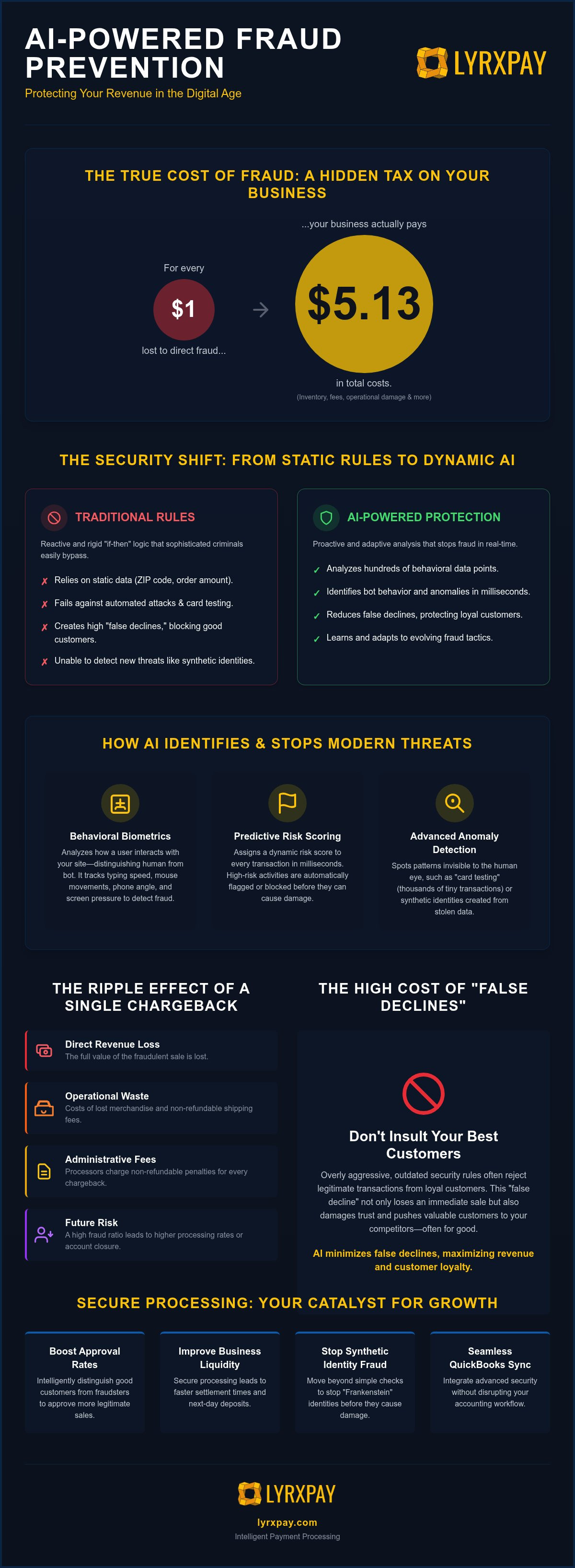
Did you know that for every dollar your business loses to direct credit card fraud, you're actually paying $5.13 in total costs? This "fraud multiplier" has finally crossed the five-dollar threshold, covering everything from operational damage to lost inventory. It's a heavy burden to carry, especially when you're also fighting "false declines" that turn away your best customers. You need a way to protect your margins without creating a digital fortress that scares people off. This is where understanding how AI can reduce credit card fraud for merchants becomes your biggest competitive advantage.
We know how frustrating it is to watch high chargeback fees eat your profits while you struggle to manage security across your web store and your physical POS system. You deserve a partner who simplifies these complexities. This guide shows you how artificial intelligence stops sophisticated fraud in real-time, ensures your legitimate sales go through, and keeps your revenue safe. We will preview the 2026 Nacha rule changes, explain how to boost your transaction approval rates, and show you how these security layers can sync perfectly with your QuickBooks accounting software.
Key Takeaways
- Move beyond outdated "if-then" security rules to stop sophisticated synthetic identity fraud before it impacts your margins.
- Understand how AI can reduce credit card fraud for merchants by using real-time behavioral biometrics to distinguish between genuine customers and bots.
- Protect your long-term revenue by eliminating false declines, ensuring your most loyal customers never face an "insulting" rejection at checkout.
- Leverage secure, AI-backed processing to improve your business liquidity through faster settlement times and next-day deposits.
- Discover how to integrate advanced security into your current operation while maintaining a seamless connection to your QuickBooks accounting software.
The 2026 Fraud Landscape: Why Traditional Rules are Failing
For years, merchants relied on simple, static rules to catch bad actors. You might have set your system to decline any order over $500 from a specific zip code or flag every transaction that didn't match a shipping address. While these "if-then" rules were a good start, they're now failing against the speed of modern crime. Criminals don't follow static patterns anymore. They use automation to test thousands of cards in seconds, making your rigid filters look like a screen door in a hurricane.
Understanding AI in fraud detection is no longer optional for business owners who want to protect their margins. Traditional security is reactive; it waits for a rule to be broken. In contrast, AI is proactive. It looks at the "why" behind the transaction, not just the "what." When you see how AI can reduce credit card fraud for merchants through adaptive learning, the limitations of old-school filters become obvious. This technology identifies subtle anomalies that a human or a basic script would never notice.
Synthetic Identities and Deepfakes in Payments
The biggest threat in 2026 is the "Frankenstein" identity. Criminals now use generative AI to combine real Social Security numbers with fake names and addresses to create synthetic identities. These profiles look perfectly legitimate to basic verification checks because they contain real data. Even worse, deepfake technology can now bypass visual "liveness" checks during account setup by mimicking human movement and speech.
We're moving away from a world where a signature or a PIN is enough. Security must now be behavior-dependent. Does the way this user navigates your site match a human or a bot? Are they typing at a speed that suggests they're copying and pasting stolen data? AI analyzes these micro-behaviors in milliseconds to stop the fraud before it ever reaches your bank. It's about recognizing the person, not just the credentials they provide.
The Cost of Outdated Security: Chargebacks and Lost Trust
When a fraudulent transaction slips through, the damage goes far beyond the price of the item. You're left dealing with a ripple effect of expenses that can quickly spiral. The true cost of a chargeback includes:
- Direct Revenue Loss: The actual dollar amount of the stolen sale.
- Operational Waste: The cost of the lost merchandise and the original shipping fees.
- Administrative Fees: Non-refundable chargeback penalties from your processor.
- Future Risk: Higher processing rates or potential account termination if your fraud ratio stays high.
The psychological toll is just as heavy. Constant fraud attempts force you to spend hours on manual reviews instead of growing your business. High-friction security also kills trust. If your static rules are too aggressive, you'll block legitimate customers who will likely never return. AI fraud detection is a dynamic, self-learning shield for merchant revenue.
How AI Reduces Credit Card Fraud Through Real-Time Analysis
Traditional security systems are like a gatekeeper with a rigid, printed checklist. If a visitor isn't on the list, they don't get in. AI acts more like an expert security detail that recognizes the subtle signs of trouble before a word is even spoken. This shift from static rules to dynamic learning is exactly how AI can reduce credit card fraud for merchants today. Instead of waiting for a rule to be broken, the system evaluates the context of every single transaction in the blink of an eye.
One of the most powerful tools in this arsenal is behavioral biometrics. This technology analyzes how a user interacts with your checkout page or POS terminal. It tracks the angle of a smartphone, the pressure of a finger on a screen, or the specific rhythm of a user's typing. Humans have unique physical patterns; bots and fraudsters do not. If a "customer" navigates your site with robotic precision or enters a 16-digit card number in half a second, the AI identifies the anomaly and pauses the transaction.
Velocity checks also get a massive upgrade with machine learning. Criminals often engage in "card testing," where they run thousands of tiny transactions across different merchant sites to see which stolen numbers are active. While a human reviewer might miss a flurry of $1.00 attempts, AI spots these patterns in milliseconds. It assigns a predictive risk score to every swipe or click. If the score indicates a high probability of fraud, the system can automatically trigger a multi-factor authentication (MFA) request or decline the attempt before the authorization is even complete.
Supervised vs. Unsupervised Learning Models
To stay ahead of criminals, modern systems use two types of learning. Supervised learning is like a student studying past exams; the AI is trained on millions of known fraud cases to recognize repeat attack patterns. Unsupervised learning is the explorer. It looks for brand-new, strange behaviors that have never been seen before. A hybrid approach is essential because it protects you from both the "greatest hits" of fraud and the emerging threats that haven't hit the news yet.
Omni-Channel Security: From Web to POS Terminal
Your security shouldn't have blind spots between your online store and your physical location. Modern integrated POS systems ensure that your protection is consistent across every channel. When your web data and in-store transactions live in the same ecosystem, the AI can spot a stolen card being used at your counter just minutes after it was flagged on your website. This unified view creates a seamless shield, protecting your revenue whether the customer is tapping a phone in person or clicking a button in a browser.
The Revenue Multiplier: Reducing False Declines with AI
Have you ever had a loyal customer call you, frustrated because their card was declined at your shop for no apparent reason? It's a painful experience for everyone involved. This is known as a false decline. It happens when over-cautious security filters flag a legitimate transaction as fraudulent. While you might think "better safe than sorry," the math tells a different story. Industry data reveals that for every $1 in fraud prevented, merchants often lose $10 to false declines. You aren't just losing a single sale; you're actively pushing revenue out the door.
This is where the "Insult Rate" comes into play. When a customer faces an unjustified rejection at your checkout, the psychological impact is immediate. They feel mistrusted and embarrassed. Many of these customers will never return to your business, choosing instead to shop with a competitor who offers a smoother experience. This highlights exactly how AI can reduce credit card fraud for merchants while simultaneously protecting legitimate sales. AI uses contextual awareness to understand the person behind the payment. It recognizes that a customer shopping in London today is the same one who bought a flight ticket yesterday, allowing the transaction to sail through without a hitch.
Balancing Friction and Security
The goal for 2026 e-commerce is "Frictionless Authentication." In the past, extra security layers like 3D Secure often felt like a series of hurdles for the shopper. Modern 3D Secure 2.0, powered by AI, changes that. It shares ten times more data with the card issuer than previous versions, allowing the system to verify the user in the background. Most customers won't even know it's happening. By automating these decisions, AI also reduces the need for manual reviews. You won't have to spend hours every week squinting at order logs or calling customers to verify their identities. The system does the heavy lifting for you.
Comparison: Rules-Based vs. AI-Driven Decisioning
The difference between old and new security methods is stark. Choosing the right path impacts your customer lifetime value (CLV) and your daily peace of mind.
- Rules-Based Systems: These are rigid and unforgiving. They use "if-then" logic, like "decline all out-of-state orders." This leads to high false-decline rates and requires constant manual updates to stay relevant.
- AI-Driven Systems: These are adaptive and intelligent. They learn from every transaction, resulting in higher approval rates. Because the system is self-maintaining through data feedback, it gets smarter every day without you having to lift a finger.
When your checkout flow is smooth, your customers feel valued. A seamless experience builds trust and keeps people coming back, turning your security setup into a genuine revenue generator.
Implementing AI Fraud Prevention in Your Business Workflow
Setting up advanced security doesn't have to be an overwhelming technical project. You can break the transition into manageable steps that protect your revenue while simplifying your daily operations. The first step is to audit your current chargeback and decline rates. Without a clear baseline, you won't know how much money you're saving once the new system is live. This audit helps you see exactly where your leaks are happening, whether it's through online card-testing or in-person POS anomalies. It's about finding the gaps in your current armor before you upgrade.
Once you have your data, the next move is choosing a merchant services provider that offers integrated AI-driven security. This is a critical part of how AI can reduce credit card fraud for merchants because it puts the heavy lifting on the technology rather than your staff. After the system is in place, connect your payment gateway directly to your accounting software like QuickBooks or Xero. This creates a unified data stream that makes your financial life much easier. Finally, ensure your team is trained to recognize physical card tampering and social engineering tactics that even the best AI might miss. Even the most advanced machine learning can be bypassed if an employee is tricked into a manual override, so human vigilance remains your final line of defense.
Synergy with QuickBooks and Bookkeeping
When your payment data flows directly into your bookkeeping software, reconciliation becomes a breeze. Instead of manually matching transactions to bank statements, the integrated system flags suspicious activity and organizes it for you automatically. This allows you to spot long-term fraud trends that might be hidden in your daily revenue reports. By using All-in-One Business Financial Solutions: Streamlining Your 2026 Growth, you can ensure your security and accounting work as one cohesive unit. This level of integration doesn't just stop fraud; it gives you back the hours you used to spend on manual data entry.
The Role of Human Oversight
AI is a powerful assistant, but it isn't a total replacement for your business judgment. You need to set 'Risk Thresholds' that make sense for your specific industry. For example, a high-ticket jewelry store will have much tighter security requirements than a fast-food restaurant. Risk thresholds are the dials you turn to balance safety and sales. You should also manage a feedback loop by reporting confirmed fraud back to the system. This helps the AI learn your specific business patterns and improves its accuracy over time. If you're ready to modernize your security, our team can help you find the right integrated POS and processing solutions to secure your future.
Secure Processing as a Catalyst for Cash Flow and Liquidity
Why does it sometimes feel like your own money is being held hostage by your payment processor? For many business owners, the answer lies in the perceived risk of their transactions. When you implement advanced security, you aren't just checking a box for compliance; you're building a profile of reliability that financial institutions reward. This is exactly how AI can reduce credit card fraud for merchants while simultaneously opening the door to next-day deposits. By proving your transactions are legitimate in real-time, you remove the barriers that slow down your access to capital.
When your system uses machine learning to verify every swipe and click, the likelihood of a high chargeback rate plummets. Processors feel more confident releasing funds quickly because the risk of a future reversal is minimal. This eliminates the need for large "reserve accounts" or held funds that can paralyze your working capital. At LyrxPay, we take a concierge approach to this transition. We help you handle the technical side of security so you can focus on your craft, ensuring your hard-earned revenue hits your bank account when you need it most. We're here to act as your defender, protecting both your time and your liquidity.
Protecting Your Merchant Account Standing
Maintaining a low fraud-to-sales ratio is the single most important thing you can do for your long-term merchant account health. If your ratio climbs too high, you risk being placed on a MATCH list or having your account terminated entirely. High security acts as a shield for your reputation. Over time, a clean history allows you to negotiate better terms and lower costs. To dive deeper into this strategy, check out our guide on How to Lower Merchant Fees: The 2026 Strategic Guide for Business Owners. A secure business is a more profitable one.
Liquidity: The Ultimate Benefit of AI Security
The hidden cost of fraud is the "Chargeback Lag." This is the period where funds are tied up in disputes, leaving you short on cash for inventory or payroll. AI security eliminates this friction by stopping the dispute before it starts. Predictable cash flow is the lifeblood of any growing business. When you know exactly when your deposits will arrive, you can make smarter decisions about your future. For more tools on managing your working capital, explore our Business Liquidity Management Tools: The 2026 Guide to Cash Flow Optimization. We pride ourselves on being the partner that manages the "how" of secure processing, giving you the freedom to lead your business with confidence.
Take Control of Your Business Security
The transition to AI-driven security is more than a technical upgrade; it's a fundamental shift in how you protect your time and resources. By moving away from rigid rules and embracing adaptive learning, you stop sophisticated criminals while welcoming your best customers with open arms. You've seen how AI can reduce credit card fraud for merchants by analyzing behavior in real-time and eliminating the revenue-killing frustration of false declines. This isn't just about stopping bad actors. It's about creating a frictionless environment where your cash flow is predictable and your merchant account remains in excellent standing.
You don't have to navigate these complex changes alone. Our Texas-based concierge team provides national support to ensure your security layers sync perfectly with your QuickBooks or Xero bookkeeping. We specialize in removing the technical headaches so you can focus on your craft. With next-day deposits available for qualified merchants, we help you turn secure processing into a powerful tool for growth. Secure your revenue and optimize your cash flow with LyrxPay—Get a free processing audit today.
The future of merchant security is proactive, intelligent, and deeply supportive of your bottom line. Let's build a safer path forward for your business together.
Frequently Asked Questions
Is AI fraud detection too expensive for a small business?
AI fraud detection is an investment that typically pays for itself by preventing the high costs of the $5.13 fraud multiplier. Small businesses often find that the revenue saved from stopping just a few major fraud attempts covers the service cost for the entire year. It's about protecting your hard-earned margins, not just adding another line item to your expenses.
Will AI security slow down my customers' checkout process?
AI analysis happens in milliseconds, meaning your customers won't notice any delay during their checkout experience. By using background data like device intelligence and behavioral biometrics, the system provides a frictionless experience for legitimate shoppers. You get the benefit of high-level security without the "spinning wheel" that often causes frustrated customers to abandon their carts.
How does AI distinguish between a fraudster and a legitimate customer traveling abroad?
AI uses contextual awareness to recognize travel patterns and previous purchase history. If a customer bought a plane ticket or booked a hotel recently, the system understands why they are suddenly shopping in a different country. This is a key example of how AI can reduce credit card fraud for merchants while preventing the "insult rate" of embarrassing false declines.
Can AI stop chargebacks entirely?
While no system can stop 100% of chargebacks, AI dramatically reduces them by identifying stolen cards and synthetic identities before the sale is finalized. It also helps you fight "friendly fraud" by providing a detailed data trail for every transaction you process. You'll spend much less time on stressful disputes and more time focusing on your business growth.
Do I need to be a tech expert to use AI-powered merchant services?
You don't need any technical background to benefit from these advanced tools. A concierge-style provider handles the heavy lifting, from the initial integration to ongoing security monitoring. We act as your expert ally, making sure your security is always up to date and functional so you can focus on your craft without the technical headache.
What is the difference between AI fraud detection and a standard payment gateway?
A standard payment gateway simply moves money from point A to point B using static, rigid rules. AI fraud detection is the "brain" that evaluates the risk of that movement in real-time. It learns from every single transaction across a global network, whereas a standard gateway stays the same until you manually change your settings.
How does AI help with ACH fraud compared to credit card fraud?
AI applies the same pattern-recognition logic to ACH transfers, which is vital for meeting the 2026 Nacha fraud monitoring requirements. It monitors for unusual account activity or suspicious company entry descriptions that deviate from your normal business patterns. This proactive approach is a primary way how AI can reduce credit card fraud for merchants and secure their bank-to-bank transactions simultaneously.
Does AI fraud prevention integrate with my existing QuickBooks setup?
Yes, modern AI-powered merchant services are designed to sync directly with your QuickBooks or Xero bookkeeping software. This integration allows your fraud data and transaction logs to flow into your accounting system automatically. It saves your team hours of manual reconciliation and ensures that your financial records are always accurate and ready for tax season.