
Cheapest Credit Card Processing: How to Find the Lowest Total Cost in 2026

That "simple" 2.9% flat rate you're paying is likely the most expensive mistake in your monthly budget. You've probably spent hours staring at a merchant statement that feels impossible to audit, wondering why the cheapest credit card processing you were promised still leaves you with slim margins and delayed cash flow. It's frustrating to wait several days for deposits while fees eat away at your bottom line. We understand that you're looking for more than just a lower number; you're looking for clarity and a partner who treats your revenue with the respect it deserves.
You deserve a transparent system where you know exactly what you're paying for and when that money will hit your bank account. We'll show you how to move beyond confusing flat rates and identify the processing models that actually protect your profits. This guide explores how switching to interchange-plus pricing and integrating your payments with software like QuickBooks can provide next-day deposits and eliminate manual bookkeeping. By the end of this article, you'll have a clear roadmap to securing the lowest total cost for your business in 2026.
Key Takeaways
- Learn why "simple" flat-rate pricing models often function as a hidden tax on your business growth by masking massive markups.
- Discover how an interchange-plus model provides the cheapest credit card processing by passing wholesale costs directly to you with total transparency.
- Identify the hidden expenses in hardware leases and total cost of ownership that standard merchant statements often obscure.
- Master five specific steps to audit your statements and optimize your checkout process for lower card-present rates.
- See how integrating payments with your accounting software and securing next-day deposits can immediately improve your daily liquidity.
Why "Cheapest" Credit Card Processing Often Costs You More
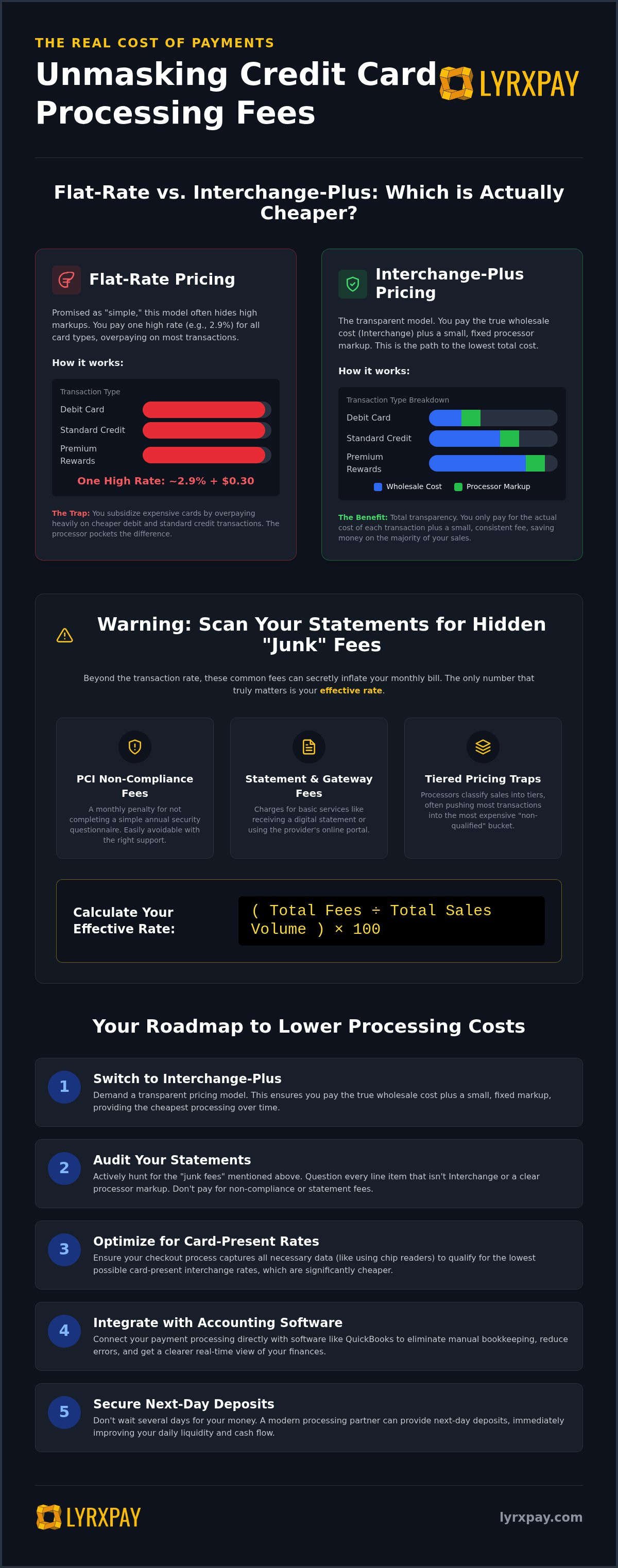
The word "cheap" is often the most expensive word in business finance. When you search for the cheapest credit card processing, you're usually led toward "Big Tech" solutions that promise simplicity through a single, flat-rate percentage. While a flat rate of 2.9% plus $0.30 sounds straightforward, it's actually a psychological trap designed to prioritize the processor's margins over your profit. This simplicity acts as a veil. It hides the reality that you're paying a premium for the privilege of not having to audit a complex merchant statement.
To understand why this happens, you have to look at the role of the payment processor in your daily operations. A processor manages the flow of data and funds between banks, but how they charge for that service varies wildly. If you're paying a flat rate, you're paying the same amount whether your customer uses a high-limit travel rewards card or a basic debit card. In the actual financial ecosystem, the wholesale cost of a debit transaction is significantly lower than a premium credit card. By choosing a flat rate, you're essentially subsidizing the processor's highest-margin transactions with your own hard-earned revenue.
The Hidden Cost of Flat-Rate Pricing
Flat rates are built for convenience, not for cost-efficiency. They make sense for very small businesses or side hustles processing less than a few thousand dollars a month because the setup is fast. But as your business scales, that "convenience tax" compounds quickly. You're overcharged on almost every debit transaction and basic credit card swipe. If your business primarily handles card-present sales where the customer is standing in front of you, a 2.9% rate is often a massive markup compared to what you could be paying with a more transparent model. Don't let the ease of setup blind you to the long-term drain on your cash flow.
Warning Signs of Hidden Merchant Fees
Beyond the headline transaction rate, "junk fees" can quietly bloat your monthly bill until your effective rate is much higher than promised. You should regularly scan your statements for these common red flags:
- PCI Non-Compliance Fees: This is often a monthly penalty for not completing a simple annual security questionnaire. It's a passive revenue stream for many processors that you can easily avoid with the right support.
- Statement and Gateway Fees: Some providers charge you just for the "privilege" of receiving a digital statement or using their online portal.
- Tiered Pricing Traps: This is where a processor classifies transactions as "qualified," "mid-qualified," or "non-qualified." They often move the goalposts so that most of your sales fall into the most expensive "non-qualified" bucket.
The only number that truly matters is your effective rate. This is the total amount of fees you paid divided by your total sales volume. If your promotional rate is 1.5% but your monthly statement shows an effective rate of 4% after all the extras are added, you haven't found a deal; you've found a trap. Finding the cheapest credit card processing requires looking past the marketing and into the actual math of your specific business model.
Interchange-Plus vs. Flat-Rate: Which Model is Actually Cheaper?
If the flat-rate model is a psychological trap, how do you find a path that actually protects your bottom line? The answer lies in transparency. While flat rates hide the true cost of every swipe, the interchange-plus model lays it all bare. For most growing businesses, this is the most reliable way to secure the cheapest credit card processing because it separates the base cost from the processor's markup. You stop paying a "convenience tax" and start paying for the actual service you receive. Identifying the cheapest credit card processing isn't about finding the lowest percentage on a marketing flyer; it's about finding the model that offers the lowest effective rate over time.
Every transaction has a non-negotiable base fee called interchange. This is the amount set by card networks like Visa and Mastercard that goes directly to the bank that issued the card. Government rules on electronic payments often influence these structures, but the core cost remains the same for every processor. In a flat-rate model, the provider pockets the difference when that base cost is low. In an interchange-plus model, you pay that exact base cost plus a small, fixed margin to your processor. It’s a pass-through system where you benefit when costs drop.
Deconstructing the Interchange-Plus Model
Think of this model as a "wholesale plus" pricing structure. The "interchange" is the wholesale price, and the "plus" is the processor's service fee. This setup is particularly effective for high-volume businesses or those with high average ticket sizes. Why? Because as your volume grows, your effective rate usually stays lower than a flat 2.9%. You can see exactly what the bank took and what your processor earned. If you want to see how this transparency impacts your specific margins, exploring transparent processing solutions is the first step toward reclaiming your profit.
The B2B Advantage: ACH and Level 3 Processing
For businesses dealing with large invoices, even the best credit card rates can feel heavy. This is where ACH payment processing becomes the ultimate "cheap" alternative. By moving funds directly from bank to bank, you bypass the card networks entirely, often paying a small flat fee instead of a percentage. Additionally, if you sell to other businesses or government agencies, you can utilize Level 2 and Level 3 data. By providing more transaction details (like sales tax or purchase order numbers), you can slash your interchange costs by up to 1%. It's about choosing the right tool for every transaction type to ensure you aren't leaving money on the table.
Calculating Your Total Cost of Ownership (TCO)
The lowest transaction rate in the world won't save your business if you're hemorrhaging money on hardware leases and manual bookkeeping. Finding the cheapest credit card processing involves looking at your bank statement as a whole, not just the individual transaction lines. If you're only focused on the percentage, you're missing the "Total Cost of Ownership" (TCO). This framework includes everything from the physical terminals on your counter to the software subscriptions and the cost of waiting for your funds to arrive. A comprehensive guide to credit card processing fees reveals that hidden markups often live in the places business owners forget to check.
Think about the time your team spends reconciling sales. If your processor doesn't talk to your accounting software, you're paying for manual labor that could be automated. That's a direct hit to your profit. True efficiency comes when your processing, POS hardware, and bookkeeping flow together. By shifting your focus from a "low rate" to a "low total cost," you protect your margins and free up your time to focus on growth.
POS Hardware and Software ROI
Beware the "free" terminal offer. In the merchant services world, "free" is usually code for a high-interest lease or a multi-year contract with expensive liquidated damages. You'll likely pay for that terminal ten times over through inflated transaction fees. Instead, consider the return on investment (ROI) of owning your hardware or using open-source tablet systems. Modern POS features do more than just swipe cards; they reduce shrinkage, manage inventory in real-time, and prevent the clerical errors that lead to costly chargebacks. Investing in the right hardware upfront is often the fastest path to long-term savings.
The Value of Next-Day Deposits
Cash that sits in a processor's account for three days is cash that isn't working for you. This is the "liquidity cost" of merchant services. When you have delayed deposits, you might find yourself leaning on high-interest credit lines to cover payroll or inventory. Utilizing business liquidity management tools ensures your money moves at the speed of your business. In 2026, 24-hour funding shouldn't be a luxury; it should be a baseline requirement. Getting your funds the next business day improves your cash flow and eliminates the opportunity cost of "lazy" capital. When searching for the cheapest credit card processing, always factor in the speed of settlement. If you have to wait for your money, it's not truly cheap.
5 Steps to Lower Your Processing Fees Immediately
Stopping the drain on your revenue starts with a shift from passive acceptance to active management. Many owners believe they're stuck with whatever rate they signed up for, but that's rarely the case. If you want the cheapest credit card processing, you have to treat your merchant statement like any other vendor invoice that needs regular auditing. You don't need to be a financial expert to reclaim your profit; you just need a structured approach to identifying where your money is leaking. By following a few strategic steps, you can often see a measurable reduction in your monthly expenses without changing how you do business.
Start by analyzing your current setup through these five lenses:
- Audit your statement: Look for fees that don't align with your transaction volume.
- Swipe, don't key: Ensure your team uses physical terminals whenever possible to get lower card-present rates.
- Negotiate your markup: Use your processing history as leverage to ask for a lower "plus" margin.
- Bypass the networks: Encourage high-dollar B2B clients to pay via ACH to avoid percentage-based fees entirely.
- Integrate your data: Switch to a provider that syncs with your bookkeeping software to eliminate manual entry costs.
How to Perform a Merchant Statement Audit
Your first task is to find the "Non-Qualified" surcharges hiding in the fine print. These usually happen when data is missing from a transaction or when you're using outdated equipment. To understand the damage, calculate your true cost. Your Effective Rate is the total fees divided by total sales. This single number tells you exactly what you're paying after all the "junk fees" are added in. If this number fluctuates wildly month-over-month, it's a sign that your processor is moving transactions into more expensive categories without your knowledge. Monitoring these shifts allows you to catch errors before they become permanent expenses.
Technological Optimizations for Lower Rates
Old hardware is a liability. If you aren't using EMV-compliant terminals, you aren't just risking fraud; you're likely paying higher interchange rates because the bank views those transactions as higher risk. Similarly, for online or over-the-phone orders, setting up Address Verification Service (AVS) is essential. Providing a zip code can lower your risk profile and qualify you for better rates from the card networks. Learning how to lower merchant fees is a continuous process of matching the right technology with the right strategy. If you're ready to stop the guesswork and see exactly where you can save, our team can provide a transparent audit of your current processing costs to find every hidden leak.
LyrxPay: Maximum Efficiency, Minimum Processing Costs
Finding the cheapest credit card processing shouldn't feel like a second job. You've already seen how the lowest rate on paper can be a mirage if it's buried under "junk" fees or slow settlement times. LyrxPay flips this script by acting as your advocate rather than just another vendor. We combine the wholesale advantages of interchange-plus pricing with a high-touch service model that treats your business health as a shared mission. It's about more than just a lower percentage; it's about a partnership that defends your time and resources.
We believe that transparency is the only foundation for a dependable relationship. If you're tired of "Big Tech" processors that hide behind automated chat bots and clinical service, you'll find our approach refreshing. We don't just give you a login and wish you luck. We provide the expertise you need to ensure your financial workflows are optimized for 2026 and beyond. By moving away from the cold, transactional feel of traditional merchant services, we help you reclaim the profit that is rightfully yours.
The Concierge Approach to Merchant Services
Most processors leave you to figure out the technical setup on your own, which often leads to costly configuration errors. We don't do that. We handle the heavy lifting of switching your processing so you don't lose a single day of sales or a single customer's trust. Our team performs personalized rate reviews based on your specific industry and transaction volume. You get direct access to experts who actually understand your financial workflow. This high level of personal attention ensures that you aren't just getting the cheapest credit card processing today, but that your rates stay competitive as your business scales.
Beyond Processing: A Holistic Financial Partner
True efficiency requires all in one business financial solutions that bridge the gap between your sales and your ledger. While many competitors offer generic integrations that fail to sync complex data, our native QuickBooks and Xero sync eliminates the labor cost of manual data entry. If your processing, payroll, and bookkeeping aren't talking to each other, you're paying a "labor tax" every single month in the form of administrative hours.
By integrating your payroll solutions and bookkeeping with your payment processing, you reduce overhead and gain total clarity. You'll see exactly where every dollar goes, from the moment a card is swiped to the moment it's used to pay an employee. This integrated approach provides next-day deposits for improved liquidity, allowing you to reinvest in your business faster. Low fees are just the beginning of your growth story. The ultimate goal is a managed care system for your business finances that allows you to step away from the spreadsheets and focus on your craft.
RECLAIM YOUR PROFIT AND SCALE WITH CONFIDENCE
Finding the cheapest credit card processing doesn't mean you have to compromise on service or settle for delayed access to your funds. You've learned that true savings come from a combination of low base costs and efficient, integrated workflows that remove the burden of manual bookkeeping. By moving toward a transparent interchange-plus model and auditing your "Total Cost of Ownership," you can finally eliminate the hidden markups that have been eating your margins for years. The path to better cash flow is paved with transparency and better technology.
It's time to stop guessing and start growing. You deserve a partner who provides next-day deposits for all merchants and expert QuickBooks or Xero integration to keep your operations running smoothly. We are here to help you decode your statements and identify every opportunity for optimization. If you're ready to see the difference that transparency and concierge-level support can make for your bottom line, Get a Free Merchant Fee Audit from LyrxPay today. Let's build a more profitable and efficient future for your business together.
Frequently Asked Questions
What is the absolute cheapest way to accept credit cards?
The most cost-effective strategy involves using an interchange-plus pricing model for daily transactions and ACH processing for high-dollar invoices. This combination ensures you only pay the non-negotiable bank cost plus a small, fixed margin. By directing B2B clients toward ACH, you bypass expensive card network percentages entirely. This strategy protects your margins by matching the most efficient payment method to each specific transaction type rather than relying on a single, expensive rate.
Is there such a thing as zero-fee credit card processing?
Zero-fee programs usually refer to surcharge or cash discount models where the transaction cost is passed directly to the customer at the point of sale. While this technically removes the fee from your ledger, it can negatively impact customer satisfaction and overall sales volume. It's often more sustainable to find the cheapest credit card processing through transparent pricing rather than risking your reputation with unexpected surcharges. Always check local regulations before implementing these programs.
How much should a small business pay for credit card processing?
A small business should focus on their "effective rate," which is the total fees paid divided by total sales volume, rather than a single promotional percentage. While costs vary based on your industry and average ticket size, you should aim for a transparent model that avoids "junk" fees like PCI non-compliance or statement penalties. If your effective rate is significantly higher than the wholesale bank costs, you're likely paying a massive markup for a flat-rate model.
Why are my processing fees higher than the rate I was quoted?
Fees often exceed the quoted rate because of "downgrades," which happen when transactions don't meet specific security criteria. If you key in a card manually instead of swiping it or fail to provide address verification, the bank reclassifies the sale as higher risk. Additionally, many flat-rate quotes don't include monthly fees like statement or gateway charges. Calculating your effective rate is the only way to see the true cost beyond the initial marketing percentage.
Can I negotiate my credit card processing rates?
You can definitely negotiate the "plus" or markup portion of an interchange-plus pricing agreement. While you can't change the base interchange rates set by the card networks, the processor's margin is flexible based on your processing volume and history. Providing three months of recent merchant statements allows you to demonstrate your value as a client and leverage your data. A professional audit is your strongest tool for securing a lower, more competitive markup.
How do next-day deposits help lower my business costs?
Next-day deposits lower your business costs by improving liquidity and reducing your reliance on expensive credit lines or short-term loans. When your funds are available within 24 hours, you can pay vendors faster and manage payroll without waiting for a processor to release your money. This eliminates the "liquidity cost" of lazy capital sitting in a third-party account. Faster access to your revenue means you can reinvest in your growth immediately without paying interest.
What is the difference between a merchant account and a payment aggregator?
A dedicated merchant account gives your business its own unique identification number, providing more stability and lower long-term costs. Payment aggregators group your sales with thousands of other businesses under a single ID. While aggregators are often easier to set up, they usually come with higher flat rates and a greater risk of sudden account freezes. For growing businesses, a dedicated account offers much better transparency, security, and lower total costs as volume increases.
How does QuickBooks integration save me money on processing?
QuickBooks integration saves you money by eliminating the labor costs associated with manual data entry and reconciliation. When your cheapest credit card processing solution syncs directly with your accounting software, your books are updated in real-time without clerical errors. This reduces the administrative hours your team spends on bookkeeping each month. It's a strategic way to lower your total cost of ownership by automating the most tedious and error-prone parts of your financial workflow.