
Automated Payroll: 2026 Strategic Guide for Small Business

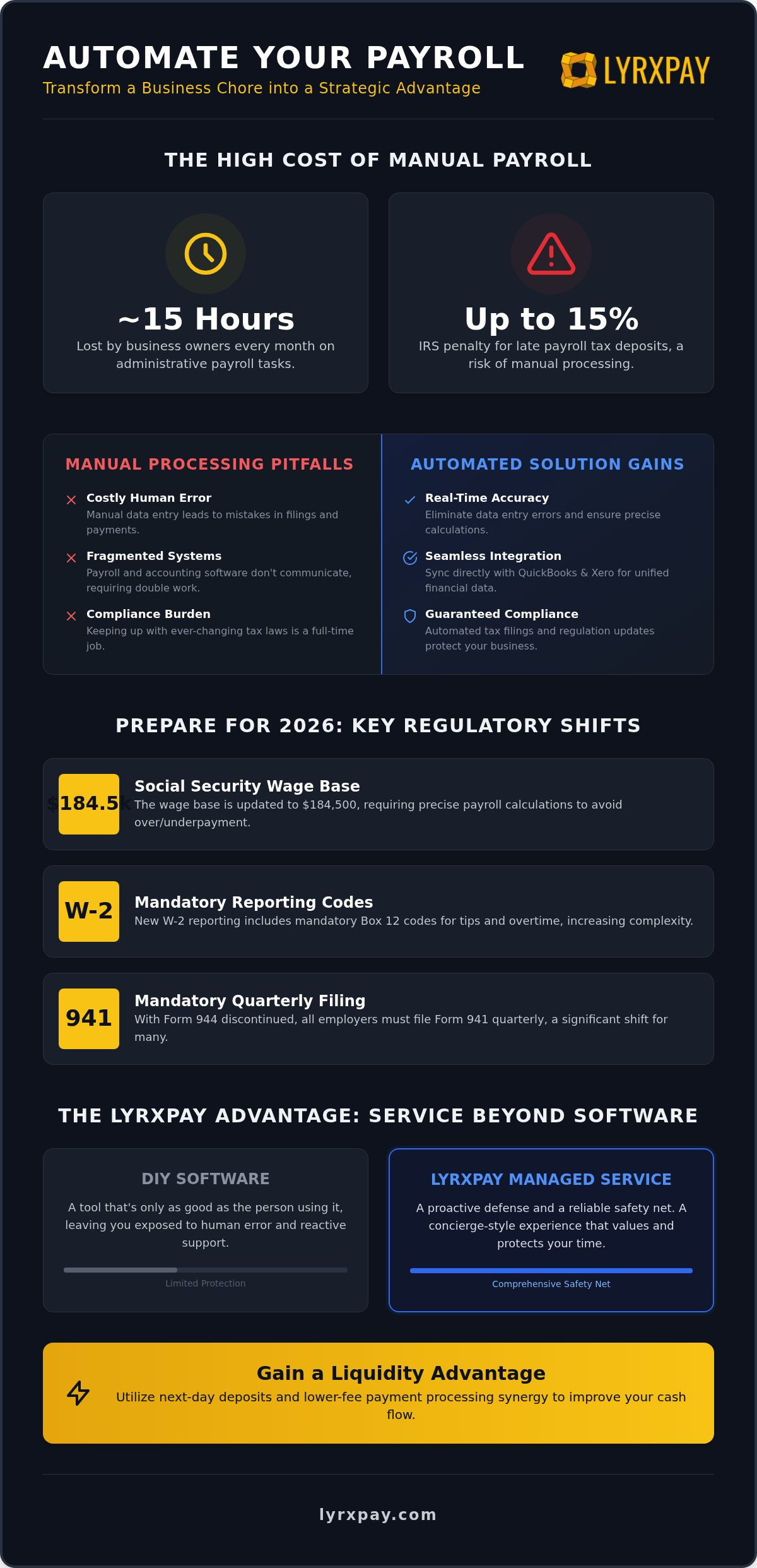
What if your payroll was no longer a source of dread, but a competitive advantage for your cash flow? For most owners, the reality is far messier. You're likely juggling manual data entry while worrying about the 15% IRS penalty for late deposits. It's exhausting to manage fragmented systems that don't talk to your accounting software. Transitioning to automated payroll for small business is the only way to stop losing sleep over the $184,500 Social Security wage base or the mandatory new 2026 W-2 reporting codes.
It's time to reclaim your schedule. Shifting to a modern system isn't just about cutting checks; it's about building a "set it and forget it" workflow that protects your time and your resources. This guide shows you how LyrxPay Payroll Solutions can transform this administrative grind into a strategic asset. You'll learn how to achieve seamless accounting software synchronization and leverage next-day deposits to improve liquidity. We'll walk through the 2026 regulatory shifts, ensuring your business stays compliant and your financial visibility remains crystal clear.
Key Takeaways
- Shift your perspective from simple check-cutting to a strategic Human Capital Management approach that prioritizes your time and resources.
- Quantify the true cost of manual management and learn how automated payroll for small business prevents costly 2026 IRS filing errors and penalties.
- Unlock real-time accounting accuracy by integrating your payroll directly with QuickBooks or Xero to eliminate manual data entry for good.
- Follow a structured framework to audit your administrative pain points and evaluate the technical depth of potential payroll software partners.
- Gain a significant liquidity advantage through LyrxPay Payroll Solutions by utilizing next-day deposits and lower-fee payment processing synergy.
Beyond the Paycheck: Redefining Automated Payroll for Small Business
For too long, business owners viewed payroll as a simple math problem: hours times rate equals check. By 2026, that narrow view is a liability. True automated payroll for small business is actually a strategic transfer of administrative burden. It moves the needle from simple check-cutting to comprehensive Human Capital Management. This shift allows you to focus on growth while a system handles the intricate details of compliance and employee health.
The Full Spectrum of Payroll Responsibilities
Success starts with understanding the basics of payroll and how they've evolved. In 2026, compliance isn't just about the right numbers; it's about the right codes. Your system must handle automated tax filing at federal, state, and local levels without your intervention. This includes managing the new mandatory Box 12 codes for tips and overtime, alongside the updated Social Security wage base of $184,500.
- Automated Tax Filing: Seamless execution of quarterly Form 941 filings, which are now mandatory for all employers since the discontinuation of Form 944.
- Benefits Management: Precision tracking of retirement plan contributions and health insurance deductions to keep your workforce stable.
- Labor Cost Reporting: Granular data that helps you understand exactly where your capital is going each month, driving smarter hiring decisions.
Software vs. Managed Services: Choosing Your Safety Net
Why settle for a faceless help desk ticket when you could have a dedicated ally? Many entrepreneurs fall into the trap of DIY payroll software, thinking it's the most cost-effective path. However, software is only as good as the person clicking the buttons. In an environment where the IRS penalty for late deposits can reach 15%, a software-only portal often leaves you exposed to human error.
Choosing "Managed Payroll" through LyrxPay Payroll Solutions provides a proactive defense. It's the difference between having a tool and having a result. A managed partner anticipates regulatory shifts and audits your data before it ever reaches the tax authorities. If you're looking for a concierge-style experience, you need a partner who values your time as much as you do. This approach transforms automated payroll for small business from a tech expense into a reliable safety net that protects your business liquidity and operational health.
Calculating the Real ROI: Why Manual Payroll is a Growth Killer
Manual payroll isn't just a chore. It's a drain on your most valuable resource: your time. When you're bogged down in spreadsheets, you're paying a hidden fee that doesn't show up on a bank statement. Between software subscriptions and the hours your staff spends on data entry, the true cost of in-house management is staggering. Most small business owners lose roughly 15 hours every month to these administrative tasks. Imagine what your leadership team could achieve if that time was redirected toward high-impact sales or product development.
Then there's the risk. The IRS doesn't accept "I was busy" as an excuse for filing errors. For 2026, the failure-to-deposit penalty starts at 2% for being just five days late and can climb to 15% if the amount remains unpaid after an IRS notice. Learning how to do payroll for your small business manually is a great foundational step, but relying on it long-term is a growth killer. Transitioning to automated payroll for small business ensures you never face these avoidable hits to your bottom line.
Mitigating Risk and Ensuring 2026 Compliance
Staying ahead of labor law changes is a full-time job. With the discontinuation of Form 944 and the new quarterly filing requirements for 2026, the complexity has never been higher. A dedicated payroll provider acts as a defender of your resources, handling the manual research so you don't have to. Professional oversight significantly reduces the probability of a costly audit, giving you the confidence to scale your team without ever increasing your administrative headcount.
Improving Business Liquidity and Cash Flow
Precise cash flow management is nearly impossible when your payroll is a black box. You need to predict outflows with total accuracy to avoid payroll-day surprises that can cripple your operations. By linking your payroll efficiency to business liquidity management tools, you gain real-time visibility into your capital. This level of transparency is vital when you're looking to secure business loans or attract new investments. If you're ready to stop the administrative grind and protect your resources, explore how LyrxPay Payroll Solutions can stabilize your cash flow.
Scalability is the ultimate goal. An automated system allows you to add ten, twenty, or fifty employees without adding a single minute to your weekly administrative routine. It’s an investment in your company's future that pays dividends in both peace of mind and actual capital.
The Integration Advantage: Syncing Payroll with QuickBooks and Merchant Services
Manual data entry is the silent killer of small business productivity. If your team is still spending hours copying hours from a POS report into a spreadsheet, you aren't just wasting time; you're inviting error. True automated payroll for small business demands a seamless handshake between your payment systems and your accounting software. When these systems talk to each other, your general ledger updates in real-time. This provides a level of financial clarity that manual systems simply cannot match, especially as you navigate the tighter 2026 quarterly filing deadlines.
Eliminating Accounting Friction
The "month-end crunch" is often a symptom of fragmented data. By syncing your payroll directly with QuickBooks or Xero, you eliminate the need for manual reconciliation. This integration prevents the "double-entry" errors that frequently plague merchants, particularly those managing complex tips or overtime. According to this payroll management guide, software that integrates with your existing tools is essential for maintaining accuracy as you scale. This streamlined workflow moves your business from the initial transaction to final tax filing without a single manual keystroke.
The Merchant Services Connection
Most owners don't realize that their payment processing and their payroll are two sides of the same coin. When you utilize all in one business financial solutions, you create a synergy that protects your liquidity. For instance, next-day deposits from your merchant account ensure the funds are available exactly when your payroll provider needs to initiate transfers. This prevents the stress of "payroll day" surprises and keeps your cash flow predictable.
You can even use the strategies found in how to lower merchant fees to fund your payroll outsourcing. By choosing a partner who manages both processing and payroll, you gain a single point of contact for your entire financial operation. This proactive approach automates the flow of POS data directly into your payroll system. It ensures hourly employees are paid accurately based on real-time data, allowing you to scale your team without adding to your administrative headcount.
A Strategic Framework for Selecting Your Payroll Partner
Choosing a provider for automated payroll for small business is a decision that dictates your operational health for years. It isn't just about finding the lowest monthly fee; it's about finding a defender of your time. If a system requires you to spend hours fixing "sync errors" every Friday, it isn't truly automated. You need a partner that anticipates regulatory shifts and removes the administrative grind from your plate entirely. Use the following five steps to vet your options and ensure you're making a strategic investment.
- AUDIT THE GRIND. Identify every manual touchpoint in your current process. If you're still chasing down paper time cards or manually calculating garnishments, you need a solution that targets those specific pain points.
- EVALUATE INTEGRATION DEPTH. Don't settle for "compatible." Demand a native, real-time sync with QuickBooks or Xero. Clunky API exports often lead to "double-entry" errors that can take hours to reconcile at the end of the month.
- DEMAND TOTAL TRANSPARENCY. Look for "gotcha" transaction costs. Some providers lure you in with a low base price only to tack on fees for every tax filing, W-2, or direct deposit transaction.
- TEST THE HUMAN ELEMENT. Call their support line before you sign. Is it a generic call center where you're just a ticket number, or do you get a dedicated concierge who understands your business?
- VET THE SECURITY STACK. Your payroll data is a prime target for fraud. Review their protocols for protecting sensitive employee information, including multi-factor authentication and data encryption standards.
ASK THE TOUGH QUESTIONS
When interviewing potential providers, move beyond the sales pitch. Ask if they offer next-day deposits and how that speed impacts your overall business liquidity. Speed is capital. You should also ask for industry-specific proof of performance. For instance, can they provide a case study for merchant services for medical offices? Finally, get a clear answer on their process for resolving tax filing discrepancies. You need to know exactly who is responsible if the IRS sends a notice.
CHOOSE TRANSPARENCY OVER TRICKS
Red flags in payroll contracts are often hidden in the fine print. Watch out for exit penalties or per-employee fees that increase as your team grows. A results-oriented service level agreement should be your non-negotiable standard. A provider who understands your specific industry is a strategic asset, not just a vendor. They help you navigate the nuances of automated payroll for small business while protecting your resources. If you're ready to stop the guesswork and secure a partner who values your time, Contact LyrxPay Payroll Solutions for a comprehensive audit of your current workflow.
LyrxPay Payroll Solutions: Transparent, Integrated, and Results-Oriented
Implementing automated payroll for small business shouldn't feel like another full-time job. Most providers offer you a login and a library of help articles, leaving you to solve your own problems when things go wrong. At LyrxPay, we believe you deserve a partner, not just a portal. Our approach is fundamentally supportive; we act as a defender of your time and resources so you can focus on the craft that started your business in the first place. Why settle for a faceless help desk when you can have a concierge-style experience that treats your operational health as a shared mission?
We move you from a state of administrative curiosity to total operational confidence. By stripping away the jargon and addressing your skepticism with honesty, we build a foundation of dependability. Our team has already done the heavy lifting of navigating 2026 regulatory shifts, allowing us to present the most efficient path forward for your specific team. It's a results-oriented relationship that prioritizes clarity and relief over clinical financial processing.
The LyrxPay Difference: More Than Just Processing
What happens when your payroll and payment processing work in perfect harmony? You unlock a level of business agility that competitors simply can't match. By utilizing our lower-fee payment processing synergy, you create a more liquid environment for your business. We prioritize next-day deposits because we know that speed is capital. If your funds are sitting in a clearing house, they aren't working for you. Our automated payroll for small business ensures those funds are where they belong: in your account, ready for the next growth opportunity.
- Expert Financial Sync: We provide expert setup for QuickBooks and Xero, ensuring your financial workflow is seamless and error-free from day one.
- Proactive Compliance: We don't just react to tax notices; we anticipate compliance needs before they become risks to your business.
- Managed Care: Our team provides a sense of "managed care" for your administrative tasks, acting as a reliable ally in your corner.
Your Path to Operational Freedom
Your journey toward a "set it and forget it" workflow begins with a transparent, results-driven payroll audit. We look at your current "grind" and identify exactly where friction is costing you money. By joining our community of merchants, you're choosing to prioritize growth over paperwork. We're here to prove that complex business operations don't have to be stressful when you have the right guide. If you're ready to experience the clarity of a truly integrated system, it's time to take the first step. Experience the relief of managed payroll with LyrxPay today and reclaim the hours you've been losing to the administrative grind.
SECURE YOUR OPERATIONAL FREEDOM FOR 2026
Transitioning from manual data entry to a fully integrated system is more than a technical upgrade; it's a commitment to your company's growth. By eliminating the administrative grind, you reclaim the hours necessary to focus on your craft and your clients. Automated payroll for small business serves as a proactive defense against human error while providing the real-time financial visibility you need to make confident decisions. Whether it's ensuring flawless compliance or syncing your general ledger with QuickBooks and Xero, the right partner turns a complex burden into a streamlined asset.
You don't have to manage these regulatory shifts alone. Speed is capital. LyrxPay Payroll Solutions offers a concierge experience that prioritizes your liquidity through next-day deposits and transparent, lower-fee merchant structures. It's time to move away from fragmented systems and embrace a partnership built on advocacy and results. You've done the heavy lifting to build your business. Now, let us help you protect it with managed care that anticipates your needs.
Streamline your business with LyrxPay’s integrated payroll solutions
Take the first step toward a simpler, more profitable future today. We're ready to help you thrive.
Frequently Asked Questions
What are the main benefits of automated payroll for small business in 2026?
The primary advantages include automated compliance with 2026 mandates like quarterly Form 941 filings and the mandatory new Box 12 reporting codes. By using automated payroll for small business, you eliminate manual data entry and protect your resources from the 15% IRS failure-to-deposit penalty. It also provides real-time labor cost reporting, allowing you to make smarter hiring decisions based on actual data rather than guesswork.
How much does it typically cost to outsource payroll for a small business?
While costs vary based on your team's size and complexity, the true value lies in the time you reclaim. Most owners save roughly 15 hours per month by outsourcing these administrative tasks. When evaluating providers, look for transparent fee structures that avoid hidden per-employee costs or exit penalties. This investment pays for itself by preventing costly audit risks and allowing your leadership to focus on revenue-generating activities.
Is my data secure when using an automated payroll provider?
Yes, reputable providers use bank-grade encryption and multi-factor authentication to protect sensitive employee data. Your payroll information is stored in secure, cloud-based environments that are far safer than local spreadsheets or paper files. These systems also maintain the mandatory four-year record-keeping standard required by the IRS, ensuring your business is always prepared for potential inquiries without the stress of manual filing.
Can automated payroll services integrate with QuickBooks and Xero?
Absolutely, native integration with QuickBooks and Xero is a standard feature of modern automated payroll for small business solutions. This sync eliminates the "month-end crunch" by automatically updating your general ledger after every pay run. It prevents double-entry errors and ensures your financial reporting is accurate in real-time, which is essential for securing business loans or managing your company's overall liquidity.
Will outsourcing payroll help my business stay compliant with the IRS?
Outsourcing is a proactive defense against IRS penalties and changing labor laws. A dedicated partner manages the transition to mandatory quarterly filings and stays ahead of the $184,500 Social Security wage base limit. They handle the complex task of withholding and depositing federal, state, and local taxes on your behalf. This reduces the probability of a costly audit and ensures your business remains in good standing.
What is the difference between payroll software and managed payroll services?
Payroll software is a DIY tool that still requires you to manage data entry and compliance checks. Managed payroll services provide a concierge-style partnership where experts handle the heavy lifting for you. While software leaves the liability on your shoulders, a managed service acts as a defender of your time. It offers a "set it and forget it" workflow that anticipates regulatory shifts before they impact your operations.
How does automated payroll improve my business liquidity?
Automation improves liquidity by providing precise, predictable cash outflows so you never face payroll-day surprises. When linked with next-day deposits from your merchant services, it ensures your capital is available exactly when it's needed. This transparency allows you to manage your cash flow with total accuracy. It turns your payroll into a strategic tool for growth rather than a source of financial stress.
What happens if there is an error in my tax filing by the provider?
If a discrepancy occurs, a professional provider will work directly with the tax authorities to resolve the issue. They act as your advocate, navigating the complex process of responding to IRS notices and providing the necessary documentation to correct the record. This managed care approach alleviates the anxiety of potential errors, giving you the professional confidence that your business resources are always protected by experts.