
When to Upgrade Your POS: 2026 Business Efficiency Guide
Your point of sale system isn't just a tool for swiping cards; in 2026, it's either the engine of your growth or the anchor dragging down your profit margins. Knowing when to upgrade your POS system is the difference between a business that scales and one that stalls under the weight of manual data entry. You likely started your business to focus on your craft, not to spend your evenings manually reconciling sales data or troubleshooting hardware glitches during your busiest hours. It's exhausting to watch high transaction fees eat into your margins while you wait days for credit card settlements to hit your bank account.
We understand that change feels risky, but staying with a failing system is even riskier. This guide will help you identify the critical signs that your current technology is costing you more than just a monthly subscription fee. We'll show you how a modern, integrated solution can transform your daily operations from a series of manual tasks into a streamlined, automated workflow. By the end of this article, you'll have a clear roadmap for achieving faster checkouts, lower fees, and the improved liquidity that comes with next-day deposits.
Key Takeaways
- Recognize the operational red flags, such as slow checkout speeds and frequent connectivity issues, that signal exactly when to upgrade your POS system.
- Eliminate the burden of manual data entry by choosing a system with native QuickBooks or Xero integration to streamline your daily bookkeeping.
- Improve your business liquidity with next-day deposits that put your hard-earned money to work immediately rather than waiting days for settlements.
- Protect your profit margins by moving away from high-fee aggregators toward a provider that offers lower transaction costs and modern security standards.
- Learn how a concierge setup approach can handle the heavy lifting of hardware and software transitions so you can focus on your craft.
Identifying the Red Flags: When Your POS Becomes a Liability
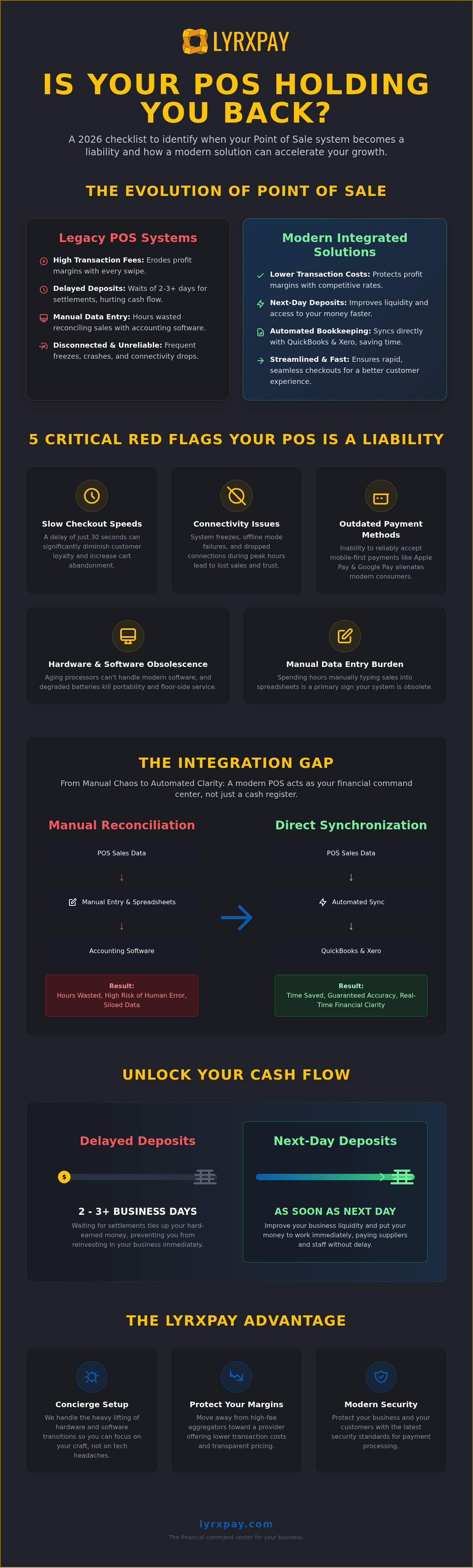
Your checkout counter is the final touchpoint of the customer journey, yet it is often where the most friction occurs. If your screen freezes during a Saturday rush or your card reader takes multiple swipes to register, you aren't just dealing with a minor glitch; you're dealing with a liability. Determining exactly when to upgrade your POS system requires looking past the hardware on your counter and examining how much friction it introduces into your daily life. A modern POS system should act as a silent partner that accelerates your workflow, not an obstacle that forces you to apologize to frustrated clients.
Connectivity issues are often the loudest warning sign. When your "offline mode" fails or the system drops its connection during peak hours, the result is more than just a delay. It leads to abandoned carts and lost trust. If you can't reliably accept modern payment methods like Apple Pay or Google Pay in 2026, you're effectively telling a growing segment of mobile-first consumers that your business isn't ready for their patronage. Dated, clunky hardware fails to reflect the quality of your brand and suggests to customers that your security protocols might be just as stagnant.
The Customer Experience Cost
Speed is a currency in the modern marketplace. Research into retail psychology suggests that even a 30-second delay at the point of purchase can significantly diminish a customer's likelihood of returning. Consumers expect a seamless, "tap and go" experience that mirrors the efficiency of their digital lives. By 2026, mobile-first payments aren't a luxury; they are the standard. If your current setup forces customers to fumble with chips that won't read or signatures on a faded screen, you are creating a psychological barrier to repeat business. High-performance systems remove these hurdles, ensuring the last thing a customer remembers is your excellent service, not a frustrating wait.
Hardware vs. Software Obsolescence
Software evolves much faster than plastic and silicon. You might notice your processor struggling to load basic menus or failing to support the latest security patches. This mismatch creates a bottleneck where your hardware can no longer handle the demands of modern, integrated software updates. Portable units often show their age through degraded battery life, tethering your staff to a power outlet and killing the flexibility of floor-side service. Technical debt in the context of legacy POS systems is the cumulative financial and operational cost of maintaining aging technology that hinders your ability to adopt newer, more efficient features. When the cost of "making it work" exceeds the investment in a new system, the choice becomes clear.
The Integration Gap: Why Manual Data Entry is a Sign of Obsolescence
Every hour you spend manually typing sales figures into a spreadsheet is an hour stolen from your growth strategy. If you find yourself reconciling paper receipts with QuickBooks at midnight, you've hit a wall. This "integration gap" is a primary indicator of when to upgrade your POS system. In 2026, a cash drawer that doesn't talk to your accounting software is a liability. It creates "siloed" data, which leads to inventory discrepancies and massive headaches during tax season. You aren't just looking for a way to swipe cards; you're looking for a financial command center that unifies your entire operation.
Relying on manual entry invites human error that can skew your financial health. When your POS operates in a vacuum, you lose the ability to see the "big picture" of your business. Modern systems bridge this gap by ensuring every transaction, refund, and tip is recorded automatically. This transition from a simple register to an integrated financial hub is what separates thriving businesses from those struggling to keep their heads above water.
QuickBooks and Xero: The Power of Direct Sync
Choosing when to upgrade your POS system often depends on how much time you waste on manual reconciliation. Direct synchronization eliminates the human error that often plagues manual sales tax reporting and income tracking. When your transactions flow automatically into your ledger, you gain immediate clarity on your net income without the need for a calculator. Utilizing all in one business financial solutions reduces administrative overhead by consolidating your financial data into a single source of truth. You stop relying on end-of-month reports that are already outdated by the time they hit your desk. Instead, you gain real-time visibility that allows for agile decision-making, ensuring you always know exactly where your cash flow stands at any given moment.
Automating Inventory and Payroll
A modern POS doesn't just track what you sell; it tracks what it cost you to sell it. By linking labor costs directly to sales volume through integrated payroll, you can see your true margins in seconds rather than days. Automated reordering features allow your system to manage your supply chain, triggering alerts or generating purchase orders when stock hits a specific threshold. This reduces the heavy "admin tax" on your personal time, finally freeing you from the mundane tasks of manual inventory counting. If your back-office work feels like a second job, it's time to explore how integrated bookkeeping support can simplify your life and let you focus on your craft.
Beyond Swiping: Evaluating Payment Flexibility and Security Standards
Payment technology is moving faster than most business owners can track. If your terminal only handles physical cards and basic chips, you're missing out on the efficiency of the modern merchant landscape. Today's customers expect to pay with RFID-enabled cards, smartphones, or even biometric identifiers. For service-based businesses or those selling high-ticket items, the rise of integrated ACH and B2B payment options is a total game changer. This flexibility is a primary factor in deciding when to upgrade your POS system. You need a platform that doesn't just accept payments but optimizes how you receive them while keeping every byte of data locked down.
Modern encryption does more than just check a box for your insurance provider. It serves as a shield against the rising cost of data breaches, which can be catastrophic for a small to mid-sized operation. By adopting a system that utilizes point-to-point encryption and tokenization, you ensure that sensitive cardholder data never actually touches your local network. This proactive stance on security protects your reputation and your bank account simultaneously. If your current setup feels like a patchwork of old security patches, it's a clear indicator that your technology has reached its limit.
Expanding Your Payment Horizon
Your POS should act as a versatile gateway rather than a restrictive bottleneck. Integrated ACH processing is particularly valuable for high-ticket service items because it allows you to bypass the higher percentage fees typically associated with credit card transactions. It provides a more secure way to handle large transfers and significantly reduces the risk of costly chargebacks. Modern authentication protocols, including 3D Secure and biometric verification, ensure that every transaction is legitimate. By offering a wider variety of ways to pay, you remove the final friction point between your customer and a completed sale. This level of curated service shows your clients that you value their convenience as much as their business.
Security as a Growth Strategy
Security isn't just a defensive measure; it's a legitimate growth strategy. Staying ahead of PCI DSS compliance and the specific security protocols of 2026 is essential for any business that wants to scale without unnecessary hurdles. There is also immense marketing value in being transparent with your customers about their data security. When people feel safe, they spend more freely. Maintaining current security compliance directly lowers your risk profile, which allows processors to offer you significantly lower transaction rates. Outdated security features often lead to higher processing fees because your business is viewed as a "high-risk" entity. Upgrading ensures you stay in the most cost-effective tiers while keeping your operational health in peak condition. If you're constantly worried about fraud or compliance, that is a definitive sign of when to upgrade your POS system to a more modern alternative.
The Cash Flow Catalyst: Next-Day Deposits and Liquidity Management
Cash flow is the lifeblood of your operation, yet many business owners remain tethered to outdated settlement cycles. Waiting three to five business days for your funds to arrive is a relic of a bygone era that can stifle your growth in 2026. If your money is constantly tied up in "processing limbo," you lose the ability to pay vendors on time or respond to unexpected opportunities. Determining when to upgrade your POS system often comes down to how quickly you can access your own revenue. A modern platform doesn't just record sales; it acts as a proactive business liquidity management tool that ensures your hard-earned capital is available when you need it most.
Faster settlement cycles reduce your reliance on high-interest short-term loans or credit lines to cover payroll and inventory costs. When your sales settle within 24 hours, your working capital stays fluid. This shift in settlement speed is a critical factor in when to upgrade your POS system, especially if you're looking to scale without the weight of unnecessary debt.
Optimizing Your Working Capital
The "opportunity cost" of slow merchant settlements is higher than most realize. Every day your money sits in a processor's account is a day it isn't earning interest or funding your next marketing campaign. We prioritize liquidity for growing businesses by offering next-day deposits, ensuring your bank account reflects your success in near real-time. It's vital to understand the difference between "funded" and "settled." While many legacy providers might show a transaction as settled in their dashboard, the funds aren't truly yours until they are funded into your bank account. We bridge this gap to keep your operations running at full speed without the typical administrative delays found in older systems.
Reducing Processing Fees
Many merchants fall for the myth of the "free" POS, only to find themselves trapped in legacy contracts with exorbitant hidden costs. These "free" units often come with locked-in, high-percentage flat-rate pricing that eats away at your margins over time. You can lower merchant fees by upgrading to efficient hardware that supports interchange-plus pricing models. Unlike flat-rate plans that charge the same high fee for every card, interchange-plus is transparent and passes the actual cost of the transaction through to you with a small, fixed markup. This switch alone can save a high-volume business thousands of dollars annually. If you're tired of opaque statements and high costs, it's time to request a transparent fee analysis from LyrxPay and see how much you could be saving.
The LyrxPay Advantage: Transitioning to a High-Performance POS Without the Friction
Deciding when to upgrade your POS system is only half the battle. The real anxiety for most owners lies in the transition itself. You might worry about losing a day of sales to a technical glitch or spending weeks retraining your staff on a complex interface. We developed our "Concierge" approach to eliminate these fears. We handle the heavy lifting of the setup, configuration, and software integration ourselves. This allows you to focus on your customers while we build the infrastructure for your next phase of growth.
We don't believe in one-size-fits-all hardware. Our team builds customized hardware and software bundles tailored to your specific industry requirements. This ensures you aren't paying for features you don't need while still getting the power of integrated bookkeeping and payroll. By moving toward a unified financial workflow, you gain the clarity and relief that comes with knowing your numbers are accurate. Our commitment is simple: transparent pricing and a lower total cost of ownership that helps your margins thrive.
A Seamless Switch Guarantee
Downtime is the enemy of progress. We minimize the risk of operational pauses by managing every detail of the hardware transition before the new system even hits your counter. Our onboarding process includes hands-on training for your entire team to ensure day-one success. You won't be left to figure things out through a series of automated emails. You get ongoing, Texas-based support that treats your business with the personal attention it deserves. We view ourselves as an advocate for your time, ensuring that your transition is as smooth as your daily workflow.
Your Future-Proof Financial Engine
A high-performance POS is a long-term investment in your operational health. As your business grows from a single location to ten, your financial engine should scale without requiring a total overhaul of your processes. This unified workflow provides a stable foundation for expansion, allowing you to replicate your success across new markets with ease. Choosing the right partner means you won't have to ask when to upgrade your POS system again for a very long time. You'll already have the most efficient path forward. Ready to upgrade? Get a custom POS quote from LyrxPay today.
RECLAIM YOUR TIME AND FUEL YOUR GROWTH
Your POS system should be the silent engine of your success, not a source of daily frustration. By now, you can see that deciding when to upgrade your POS system isn't just about getting new hardware; it's about reclaiming your personal time and optimizing your cash flow. Whether you are eliminating manual data entry through seamless QuickBooks and Xero integration or improving your liquidity with next-day deposits, the right technology gives you the freedom to focus on your craft. You've worked too hard to let high fees and slow settlements hold you back from the expansion you've earned.
We are here to help you navigate this transition with a concierge approach that puts your needs first. By choosing a partner that advocates for your operational health, you can lower your transaction fees and finally stop the "admin tax" on your evening hours. Upgrade Your Business with LyrxPay Merchant Services today to experience the relief of a truly integrated financial workflow. You deserve a reliable ally who values your resources as much as you do. Let's make 2026 the year your business operates at its full potential.
Frequently Asked Questions
How long does it typically take to switch to a new POS system?
Switching to a new system typically takes between three and seven business days, depending on the complexity of your inventory and menu. Our concierge team handles the configuration and software setup in advance to ensure your actual downtime is kept to a minimum. We prioritize a structured transition that includes staff training before the official launch, so your business doesn't miss a beat when it's time to go live.
Will I lose my historical sales data if I upgrade my POS?
You won't lose your historical sales data if you follow a proper migration plan during the upgrade. Most modern platforms allow for the export and import of CSV files containing your transaction history and customer lists. We assist in mapping this data accurately to your new system so you maintain a continuous record of your business performance. This continuity is a major factor in deciding when to upgrade your POS system without fear.
Do I need to buy all new hardware to upgrade my POS software?
You don't always need to buy entirely new hardware, as some software is compatible with existing tablets or terminals. However, upgrading your hardware is often necessary to support 2026 security protocols like biometric payments and advanced encryption. We evaluate your current equipment to see what's salvageable. If your current units can't support next-day deposits or seamless accounting sync, we recommend a modern hardware bundle tailored to your needs.
How much can I actually save by switching to a lower-fee processor?
Savings vary based on your monthly volume, but many merchants see a noticeable reduction in overhead by moving away from flat-rate aggregators. By switching to a transparent interchange-plus model, you avoid the hidden markups found in legacy contracts. These savings directly improve your profit margins and provide more capital for reinvestment. We provide a side-by-side fee analysis to show exactly where your current provider is overcharging you on every swipe.
What is the most important feature to look for in a 2026 POS system?
Real-time financial integration is the most critical feature to prioritize in 2026. A system that doesn't sync instantly with your bookkeeping and payroll software is already obsolete. You should look for a platform that offers next-day deposits and multi-layered security to protect against data breaches. These features transform your POS from a simple cash register into a comprehensive management tool that supports long-term liquidity and operational health.
Can my new POS system integrate with my existing QuickBooks account?
Yes, our systems are designed to integrate directly with your existing QuickBooks or Xero accounts. This connection allows your sales totals, taxes, and tips to flow into your ledger automatically every day. You'll stop spending hours on manual reconciliation and start seeing your true financial position in real-time. This seamless sync is one of the primary reasons merchants realize when to upgrade your POS system to stay competitive and organized.
Is next-day deposit available for all types of businesses?
Next-day deposits are available for the vast majority of retail and service-based businesses that meet standard underwriting criteria. This feature is a game changer for managing working capital and paying vendors promptly. While some high-risk industries may face different settlement timelines, we work closely with you to optimize your funding speed. Having access to your cash within 24 hours is a standard we strive to provide for all our merchant partners.
How does a modern POS system help with employee management and payroll?
Modern systems include built-in time clocks that track employee hours and link them directly to your payroll software. This allows you to monitor labor costs in relation to real-time sales volume, helping you make better scheduling decisions. By automating the transfer of hours to your payroll provider, you eliminate manual entry errors and ensure your team is paid accurately. It's a complete administrative solution that removes the stress of managing your staff's time and compensation.