
Best Payment Processor for Small Business: Top 2026 Rankings & Selection Guide

What if the "simple" flat rate you signed up for is actually the most expensive mistake in your ledger? It's frustrating to watch your hard-earned revenue get eaten by opaque fee structures that seem to change without notice. You deserve to know exactly where every cent goes. Finding the best payment processor for small business shouldn't feel like a guessing game. Most owners we talk to are tired of waiting three to five business days for their own funds to hit their bank accounts while they manually sync transactions between their POS and QuickBooks.
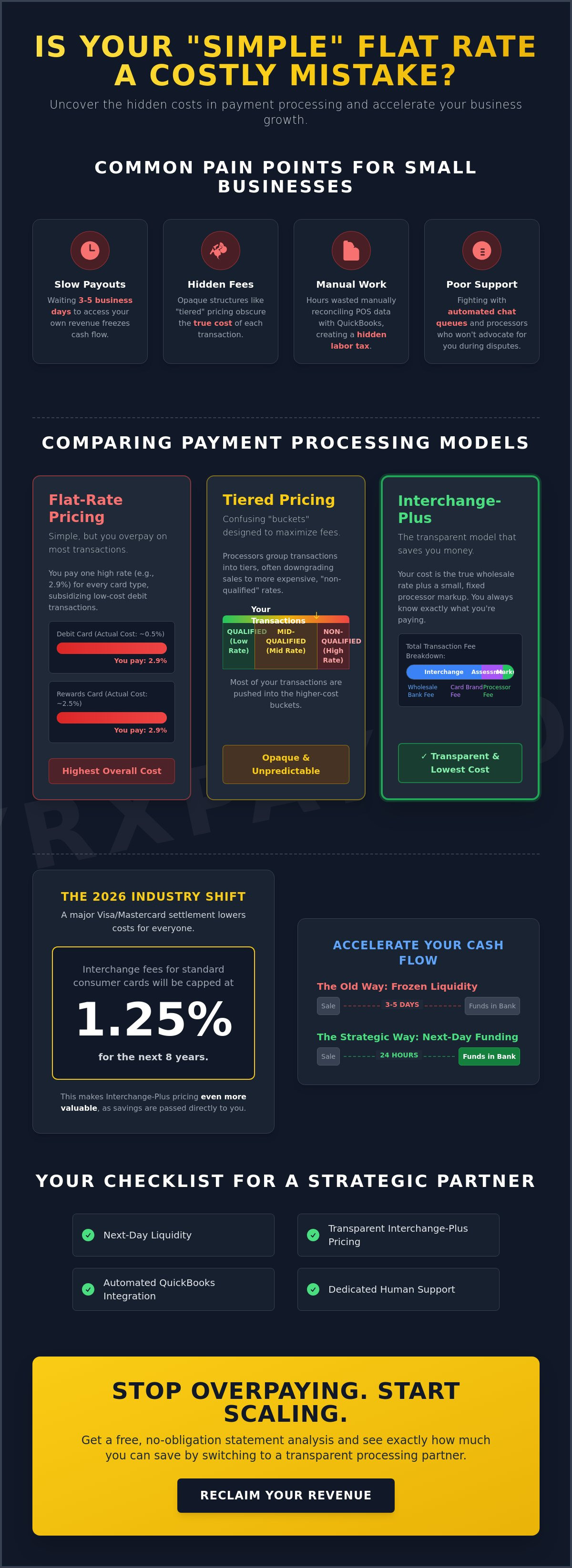
We've done the heavy lifting to help you reclaim your time and your margins. This guide reveals how to secure next-day liquidity and lower your effective transaction rates by leveraging the 2026 shifts in the industry. We'll examine the impact of the recent Visa and Mastercard interchange fee settlement, which capped standard consumer card rates at 1.25 percent for eight years. You'll get a clear comparison of top providers like Stripe, Square, and Helcim, alongside a roadmap to automate your bookkeeping. It's time to eliminate administrative friction and keep your cash flow moving as fast as your business does.
Key Takeaways
- Identify the hidden fees and administrative drag that slow down your cash flow so you can reclaim your time and revenue.
- Discover how to select the best payment processor for small business by weighing the simplicity of flat-rate plans against the wholesale savings of interchange-plus models.
- Align your processing solution with your specific industry needs, whether you require retail hardware sync or automated recurring billing for professional services.
- Capitalize on 2026 industry shifts, including the new interchange fee caps, to significantly lower your total cost of acceptance.
- Eliminate manual bookkeeping errors by integrating your payment data directly with QuickBooks for a faster, more accurate financial overview.
The Hidden Cost of Payments: Why Your Processor Choice Matters
Choosing a vendor for your transactions is more than a technical checkbox. It's a strategic decision that dictates how quickly you can reinvest in your growth. Many owners view their processor as a utility, but exploring What is a Payment Service Provider? reveals a deeper truth. A processor is actually your primary cash-flow partner. When you select the best payment processor for small business, you aren't just looking for a way to swipe cards. You're looking for a system that removes administrative drag. Manual reconciliation between your POS and QuickBooks consumes hours of productive time every week. If your team is stuck entering data by hand, you're paying a hidden labor tax on every transaction.
Beyond the spreadsheets, there's a significant psychological toll. When a dispute arises, do you have a human ally to call? Or are you stuck in an automated chat queue? Losing a transaction to a chargeback is painful enough. Losing hours of sleep because your processor won't advocate for you is an unnecessary burden on your mental energy. A transparent partner protects your resources and your peace of mind. It's about moving away from clinical financial services toward a relationship built on advocacy and results.
UNDERSTANDING CASH FLOW VELOCITY
Cash flow velocity is the speed at which money moves through your business. If your funds are held for three to five days, your liquidity is essentially frozen. Settlement delay is the time elapsed between a customer's payment and the actual availability of those funds in your business bank account, directly impacting your ability to cover immediate costs. Understanding merchant settlement timelines is vital for maintaining a healthy balance sheet. While some providers prioritize their own interest earnings, a true partner ensures your money is ready when you need to pay vendors or meet payroll. Fast access to capital is the fuel for your daily operations.
THE REALITY OF EFFECTIVE RATES
Don't be fooled by a simple 2.9% sticker price. While flat-rate models offer a sense of predictability, they often hide a higher effective rate than interchange-plus pricing. Why pay a premium on a basic debit card transaction just because the processor wants to simplify their marketing? You might also be subsidizing junk fees like PCI non-compliance charges or monthly statement fees that add no value to your operations. Conducting a merchant statement fee audit is the first step toward transparency. If you want to find the best payment processor for small business, you need to see the wholesale cost of every swipe and eliminate the bloat.
Comparing Payment Processing Models: Which is Right for You?
Why do most business owners settle for a "simple" rate when it might be siphoning away their profit margins? The truth is that the best payment processor for small business isn't always the one with the loudest marketing or the most intuitive app. It's the one that aligns its pricing model with your specific transaction volume. When choosing the right payment processor, you'll encounter four primary structures. Understanding the math behind these models is the only way to ensure you aren't overpaying for the "convenience" of a flat fee.
If you're currently using a tiered pricing model, you're likely stuck in a "bucket" system. These processors categorize transactions as Qualified, Mid-Qualified, or Non-Qualified. It sounds organized, but it's often a veil for hidden markups. You might see an attractive "teaser" rate, only to find that most of your actual sales fall into the higher-priced buckets. This lack of transparency makes it nearly impossible to predict your monthly expenses or reconcile your books without a headache.
INTERCHANGE-PLUS VS. FLAT-RATE
Flat-rate pricing is the "easy button" of the industry. You pay one percentage regardless of the card type. However, this convenience comes at a steep price for growing businesses. Interchange-plus pricing is far more transparent. It breaks your costs into three distinct parts: the interchange fee set by the banks, the assessment fee from the card brands, and the processor's markup. If you process high-ticket items, the best payment processor for small business will almost always be an interchange-plus provider. This model ensures you benefit from lower rates on basic debit cards rather than paying a premium to subsidize the processor's risk. To find your break-even point, simply compare your total monthly fees against the potential savings of a lower markup. Many owners find that once they cross $5,000 in monthly sales, the "simple" flat rate becomes a liability.
THE RISE OF WHOLESALE PROCESSING
For high-volume businesses, subscription or membership models are becoming the gold standard. Instead of paying a percentage-based markup on every single dollar, you pay a flat monthly fee for direct access to wholesale interchange rates. This effectively eliminates the "middleman" markup that eats into your liquidity. If your goal is to maximize cash flow, moving toward a wholesale structure is a logical step. Beyond just the rates, you should look for a partner that offers seamlessly integrated bookkeeping. By connecting your payments directly to QuickBooks, you eliminate the manual entry errors that often plague scaling businesses. This holistic approach ensures your processing model supports both your margins and your administrative health.
Top Payment Processors for Small Business in 2026
Selecting the right partner in 2026 requires looking past glossy interfaces to the hard math underneath. The market has split into distinct categories, each serving a different stage of business growth. While some owners prioritize immediate setup, others are focused on long-term scalability and fee reduction. Finding the best payment processor for small business means matching your specific transaction volume and technical needs to the right provider's DNA. It's not just about who can take a card; it's about who helps you keep more of every dollar you earn.
For those looking for a comprehensive solution that handles online, in-person, and mobile payments seamlessly, you can discover Strictly and their unified omni-channel platform.
THE ALL-IN-ONE GIANTS
Square remains a dominant force for retail and food service businesses that need a quick, integrated start. On their free plan, you'll see rates of 2.6% plus $0.15 for in-person sales, though online transactions jump to 3.3% plus $0.30. While their proprietary hardware is sleek, it creates an "ecosystem lock-in" that can make switching difficult later. Stripe continues to lead the e-commerce space with its robust API, charging 2.9% plus $0.30 for domestic online transactions. It's built for developers, but for some small teams, the lack of personalized support during a $15 dispute can feel isolating. Clover offers a middle ground with powerful hardware, yet it's often tied to specific merchant banks, which limits your ability to negotiate rates as you grow.
WHOLESALE AND INTERCHANGE-PLUS ALTERNATIVES
As your volume increases, the "Big Tech" markup starts to sting. This is where wholesale leaders like Helcim and Stax become attractive. Helcim uses an interchange-plus model with an automatic volume discount for businesses processing over $50,000 per month. Their standard in-person markup is interchange plus 0.40% and 8¢, providing a level of transparency that flat-rate providers can't match. Stax operates on a subscription basis, which is often the best payment processor for small business owners who have high revenue and want to pay a flat monthly fee for direct access to wholesale rates. These providers prioritize "next-day deposits" as a standard feature, ensuring your cash flow stays liquid and predictable.
THE INTEGRATED SPECIALISTS
Boutique providers like LyrxPay are winning by filling the gap between cold tech giants and complex wholesale models. We focus on a "concierge" style of service that combines competitive credit card and ACH processing with deep operational support. Instead of leaving you to navigate manual data entry, we prioritize seamless automation between your POS and bookkeeping software. This approach eliminates the administrative friction that plagues scaling businesses. By offering the transparency of wholesale rates alongside a dedicated partnership, we act as a defender of your time and resources, allowing you to focus on your craft while we manage the technical heavy lifting.
Selecting a Solution Based on Your Industry Needs
A generalist platform might work for a side hustle, but a growing enterprise needs a tailored fit. The best payment processor for small business isn't a "one-size-fits-all" software. If you're in retail, your priority is a POS system that syncs inventory in real-time across every location. For field services, you need mobile processing that turns a smartphone into a secure terminal for on-site invoicing. Why settle for a processor that treats a plumber the same way it treats a digital marketing agency? Each industry has unique friction points that the right partner can eliminate.
One often overlooked factor in industry-specific selection is settlement speed. A retail store can't wait five days to restock inventory, and a medical office can't delay payroll while funds sit in a processor's account. High-velocity businesses require next-day liquidity to stay competitive. While big tech platforms often hold your funds for 3-5 business days to mitigate their own risk, a concierge partner prioritizes your cash flow velocity. If your money isn't moving as fast as your business, your processor is actually holding you back.
MERCHANT SERVICES FOR PROFESSIONAL & MEDICAL OFFICES
Medical and dental practices face unique hurdles, specifically regarding HIPAA compliance and the protection of sensitive patient data. You need a secure way to manage patient payment data while ensuring a smooth, patient-friendly portal experience. Integrating payments directly with your Practice Management Software reduces manual data entry errors and improves your overall financial health. For a deeper look at how this works in a clinical setting, check out our insights on merchant services for medical offices. It's about creating a professional environment where the administrative side of the practice is as healthy as the clinical side.
B2B AND SERVICE-BASED BILLING
If you run a professional service firm, credit card fees are likely your largest controllable expense. Have you considered ACH processing? It's the secret weapon for lowering B2B costs because it bypasses expensive card networks entirely. By setting up recurring billing, you can automate your accounts receivable and stop chasing paper checks every month. For those times you need to take a payment over the phone, a virtual terminal provides a secure, web-based solution without the need for physical hardware. This flexibility is essential for maintaining a steady rhythm in your operations. If you're ready to stop waiting for your money and start scaling, it's time to optimize your industry-specific processing with a partner that understands your specific operational needs.
Why LyrxPay is the Strategic Choice for Scaling Businesses
Why settle for being just another account number in a massive corporate database? Most search results for the best payment processor for small business point you toward tech giants that prioritize their own shareholders over your local success. At LyrxPay, we've built a model designed to defend your resources rather than drain them. We provide lower-fee credit card and ACH processing by stripping away the unnecessary markups that big tech platforms use to fund their massive overhead. You get the efficiency of a global platform with the integrity of a dedicated ally who actually knows your business name.
Cash flow is the heartbeat of your operations. We understand that waiting three to five business days for your funds isn't just an inconvenience; it's an obstacle to your growth. That's why we provide a clear liquidity advantage through guaranteed next-day deposits for all our clients. When you make a sale, that money should be ready to work for you immediately. This commitment to speed ensures you have the capital needed to pay staff, restock inventory, or seize a sudden opportunity without the stress of a frozen bank balance. It's about moving your money at the speed of your ambition.
ELIMINATING THE ACCOUNTING HEADACHE
Manual data entry is the silent killer of productivity. If your team is stuck typing transaction numbers into a spreadsheet, they aren't focusing on your customers. Our seamless QuickBooks and Xero sync ensures that every transaction is recorded accurately and instantly. When a payment is made through our POS hardware or virtual terminal software, your books update in real-time. This deep integration provides total financial visibility without the need for late-night reconciliation sessions. By automating your bookkeeping, you eliminate human error and gain a clear, honest view of your financial health at any moment.
A PARTNERSHIP, NOT A UTILITY
We believe in radical transparency from day one. Our team provides detailed merchant statement audits to identify exactly where you're losing money to junk fees and hidden markups. As you scale from your first sale to national expansion, our Texas-based concierge support is there to guide you through every operational hurdle. We aren't just a utility you pay for; we're a proactive partner invested in your long-term success. We pride ourselves on making the complicated feel manageable, allowing you to focus on your craft while we handle the technical heavy lifting. See how LyrxPay can lower your fees and speed up your deposits today.
RECLAIM YOUR MARGINS AND YOUR TIME
Your choice of a processing partner is the difference between a business that simply survives and one that scales with confidence. We've shown that the best payment processor for small business isn't just about finding the lowest sticker price. It's about the velocity of your cash flow and the total removal of administrative drag. By leveraging the 2026 interchange fee caps and integrating your payments directly with QuickBooks or Xero, you can eliminate manual data entry and keep more of your hard-earned revenue.
You don't have to navigate these complex fee structures alone. Our Texas-based team is ready to act as your advocate, providing guaranteed next-day deposits and the personal attention your business deserves. We pride ourselves on turning a clinical financial transaction into a long-term professional relationship. Stop letting opaque fees and slow settlement cycles hold you back. Request a Free Merchant Statement Audit and Lower Your Fees today. You've done the hard work of building your business; now it's time to make sure your payment system works just as hard for you.
Frequently Asked Questions
What is the cheapest payment processor for a very small business?
The cheapest option depends entirely on your monthly sales volume. For businesses processing under $5,000 per month, a flat-rate provider might seem affordable because there are no monthly fees. However, once your revenue grows, the best payment processor for small business is usually one that offers interchange-plus pricing to lower your effective rate. We recommend a statement audit to see where your current provider is hiding markups that eat your profit.
Is there a difference between a payment gateway and a payment processor?
Yes, a payment gateway is the software that securely transmits transaction data, while a processor is the institution that actually moves the money. Think of the gateway as the digital handshake between your website and the bank. Many modern systems combine both into one package for simplicity. If you're selling online, you'll definitely need both to ensure your customer data remains encrypted and your funds arrive safely.
How long does it take to switch merchant service providers?
Switching providers usually takes between 24 and 48 hours for the initial application and approval process. If you need new physical POS hardware, you'll need to account for shipping times, which typically add another three to five business days. We work to make this transition as smooth as possible by handling the technical setup behind the scenes. This ensures your business keeps running without any downtime or missed sales.
What are hidden fees I should look for in my merchant statement?
You should look for junk fees like PCI non-compliance charges, monthly minimums, or excessive statement fees that don't add value. Some processors also hide markups by using tiered pricing, which groups transactions into expensive non-qualified buckets. Reviewing your monthly statement carefully is the only way to find these hidden costs. We provide transparent audits to help you identify and eliminate these unnecessary drains on your liquidity.
Can I use my existing POS hardware with a new payment processor?
Whether you can keep your hardware depends on if your current equipment is proprietary or universal. Systems like Square or Clover are usually locked to their specific networks and can't be used elsewhere. However, universal terminals from brands like Dejavoo or Ingenico can often be reprogrammed for a new processor. We'll help you evaluate your current setup to see if you can save money by keeping your existing machines.
Is ACH processing better than credit card processing for small businesses?
ACH processing is often a superior choice for B2B transactions or recurring billing because the fees are significantly lower than credit card rates. While credit cards charge a percentage of the total sale, ACH usually has a small, flat fee per transaction. It's an excellent way to protect your margins on high-ticket items. However, credit cards remain the best payment processor for small business retail environments where customers expect immediate point-of-sale convenience.
How do I get next-day deposits for my credit card sales?
You get next-day deposits by choosing a processor that prioritizes cash flow velocity rather than holding your funds for interest. Many big tech processors hold money for three to five business days to manage their own risk. A concierge-style partner ensures your funds are settled and available in your bank account within 24 hours. This immediate liquidity is vital for meeting payroll and paying your vendors without any stressful delays.
What is PCI compliance and why am I being charged for it?
PCI compliance is a set of security standards, currently governed by PCI DSS 4.0, designed to protect credit card data and prevent fraud. You're typically charged a fee if your business hasn't completed the annual self-assessment questionnaire or if your system isn't meeting current security requirements. It's not just a junk fee; it's a critical safety measure. We help you navigate the compliance process so you can stop paying non-compliance penalties and keep your data secure.