
All-in-One Business Financial Solutions: Streamlining Your 2026 Growth
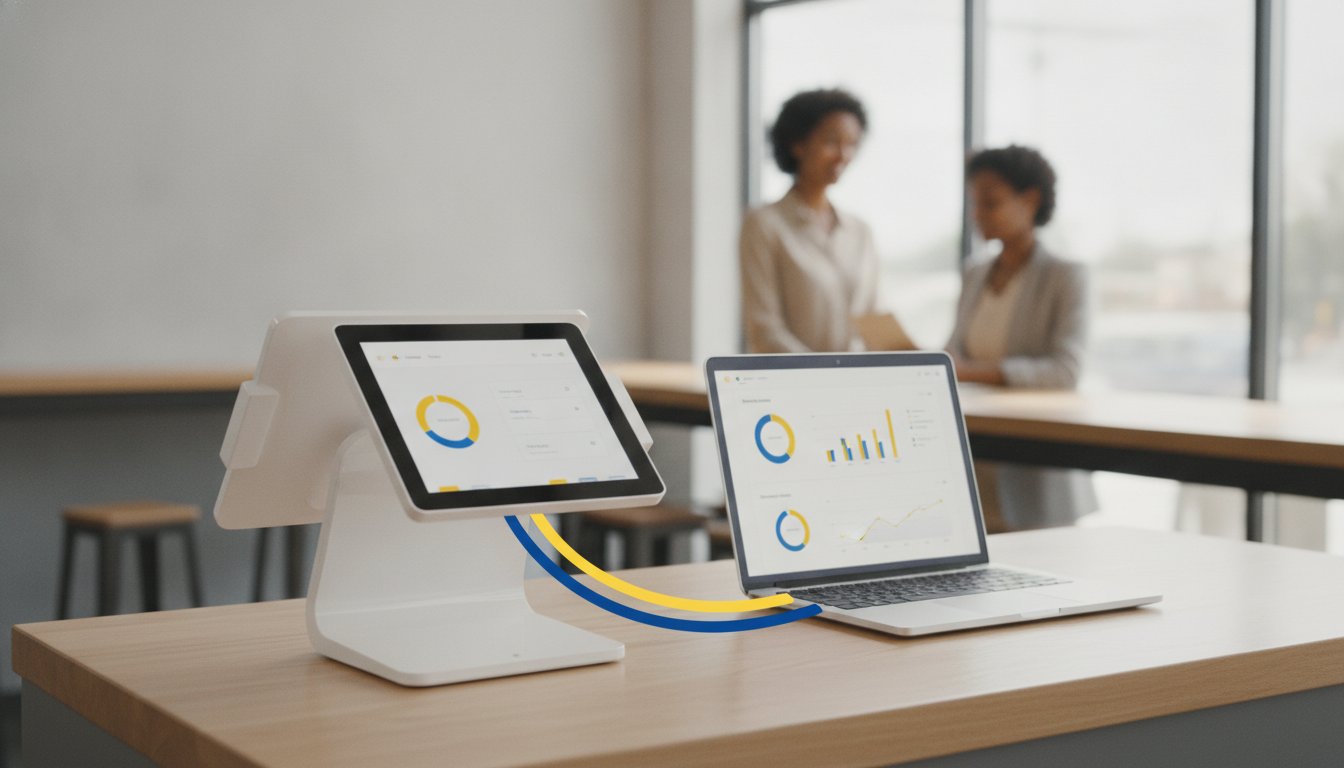
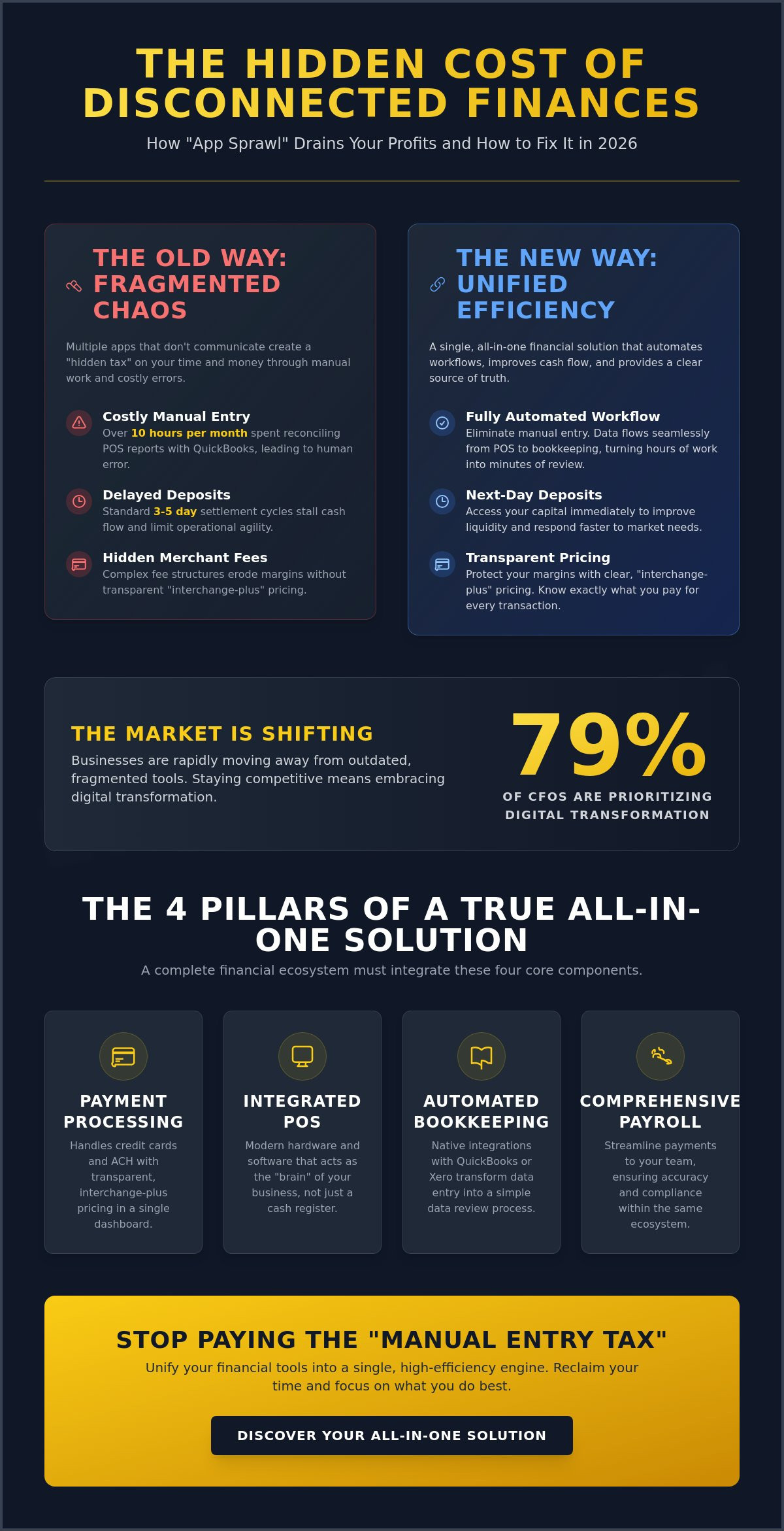
What if the biggest drain on your 2026 growth isn't your competition, but the "manual entry tax" hiding in your back office? If you're tired of reconciling POS reports with QuickBooks, you're likely searching for true all in one business financial solutions that actually deliver on their promise. Research shows that 79% of CFOs are now prioritizing digital transformation to eliminate these exact manual processes. Many business owners feel the constant sting of high merchant fees and the anxiety of delayed deposits that stall cash flow. You need your money available when you're ready to move, not several days after the sale.
If you're ready to stop the data entry loop, we're here to help. We believe your financial tools should work as a single, high-efficiency engine. This article explores how to unify your payment processing, payroll, and bookkeeping into a streamlined workflow that eliminates manual data entry entirely. We'll show you how to secure next-day deposits for better liquidity and lower your merchant fees to protect your margins. By the end of this guide, you'll have a clear path toward a single source of truth for all your financial data. This allows you to focus on your craft while your systems handle the heavy lifting.
Key Takeaways
- Uncover how "app sprawl" creates a hidden tax on your time and introduces costly errors into your financial records.
- Discover how all in one business financial solutions unify your payment processing and bookkeeping into a single, high-efficiency workflow.
- Identify the four essential pillars of a modern financial system, including integrated POS hardware and streamlined payroll solutions.
- Evaluate the true cost of ownership for fragmented subscriptions versus a unified pipeline that protects your margins.
- Follow a practical two-step audit to eliminate hidden merchant fees and transition your business toward next-day deposit liquidity.
The Fragmented Finance Problem: Why "App Sprawl" Is Costing You
The "Hidden Tax" isn't a government levy; it's the invisible cost of inefficiency. When your credit card processor, payroll provider, and bookkeeper don't communicate, you pay for it in lost time and reconciliation errors. This "app sprawl" creates a fragmented ecosystem where data is siloed. You find yourself manually exporting CSV files from your POS just to upload them into QuickBooks. This process is prone to human error, which often leads to missed tax deductions or, worse, inaccurate financial reporting. True all in one business financial solutions remove these silos by creating a direct pipeline from the customer's swipe to your final tax-ready ledger.
Traditional banks often promise simplicity, but they frequently fail to provide deep merchant-level integration. They might offer a checking account and a basic credit card, but they rarely bridge the gap between your point-of-sale hardware and your payroll software. This leaves you right back where you started; stuck in the middle of a disconnected mess. However, modern infrastructure from providers like Gemba is changing this by enabling businesses to launch their own branded financial services. Research shows that 79% of CFOs are now prioritizing digital transformation to eliminate these exact manual processes, yet many small businesses remain tethered to outdated, fragmented workflows.
The High Cost of Manual Data Entry
Think about the hours you spend on "QuickBooks cleanup" at the end of every month. For many business owners, this administrative burden consumes over 10 hours of productive time that could be spent on growth or customer service. Data friction is the primary barrier to scalability. It forces you to work in your business rather than on it. Beyond the numbers, there's a heavy emotional toll. The stress of knowing your books aren't quite right creates a constant background noise of anxiety that drains your creative energy and focus.
Liquidity Gaps and Settlement Delays
Standard 3-5 day settlement cycles are no longer enough for a fast-moving economy. With the annual inflation rate reaching 4.2% in May 2026, every day your capital sits in a "pending" state is a day it isn't working for you. Fragmented systems often cause these delays because the data must pass through multiple third-party verification layers before reaching your account. Moving to all in one business financial solutions allows for next-day deposits, providing the operational agility you need to restock inventory or cover unexpected expenses immediately. Real-time cash flow visibility isn't a luxury anymore; it's a requirement for survival in 2026.
The 4 Pillars of a True All-in-One Business Financial Solution
A solution is only "all-in-one" if it bridges the gap between your storefront and your ledger. Many providers offer accounting or banking, but they often leave the operational middle ground empty. To achieve true efficiency in 2026, your ecosystem must rest on four specific pillars: modern merchant services, integrated POS hardware, automated bookkeeping, and comprehensive payroll. When these components communicate, you stop being a data clerk and start being a strategist. If you are looking for a way to simplify this transition, exploring integrated financial management can help you reclaim your time immediately.
Unified Payment Processing and Merchant Services
Your dashboard should be a command center, not just a list of transactions. A robust provider must handle both credit card swipes and ACH transfers within a single interface. This unity is vital for managing margins, especially as high-volume merchants face shifting fee structures. You should demand "interchange-plus" pricing. This model offers total transparency by showing you the actual cost of the transaction plus a small, fixed markup. Without this clarity, hidden fees can quietly erode the benefits of the permanent 21% federal corporate tax rate, making your "all in one business financial solutions" less effective than promised.
Integrated POS and Accounting Workflows
Modern POS systems serve as the "brain" of your business. They shouldn't just ring up sales; they should feed data directly into your accounting software. Native integrations with QuickBooks or Xero are non-negotiable requirements for 2026 growth. This connectivity transforms your accounting team's role. Instead of spending weeks on manual data entry, they move into a "data review" phase. They verify the accuracy of automated entries rather than typing them from scratch. This level of precision is essential for maximizing the 20% QBI deduction or calculating interest limitations based on EBITDA, both of which require flawless financial records.
The final two pillars, automated bookkeeping and payroll, ensure your compliance is handled without constant supervision. With the 100% first-year bonus depreciation reinstated, your bookkeeping must track asset purchases with pinpoint accuracy from the moment of sale. Likewise, payroll solutions must integrate with your tax-readiness strategy to ensure every credit, like the increased $600,000 employer-provided childcare credit, is captured. By unifying these four pillars, you create a resilient financial foundation that scales as fast as your ambition allows.
Integrated vs. Fragmented Systems: A 2026 Comparison
Is the "best of breed" approach really the best for your bottom line? Many owners choose standalone apps for specific features, but they often ignore the mounting cost of integration maintenance. When you add up the monthly fees for your POS, payroll, and bookkeeping, the total cost of ownership often exceeds what you'd pay for all in one business financial solutions. Fragmented systems also demand more administrative hires. If your software doesn't talk to each other, you're forced to pay a human to act as the bridge. A unified system allows you to scale your revenue without proportionally increasing your back-office headcount, keeping your margins healthy as you grow.
Security and Compliance in Unified Systems
Every new login is a potential entry point for a breach. By consolidating your financial data into a single pipeline, you significantly reduce your "attack surface." You aren't managing five different password policies or worrying about which app has the latest security patch. All-in-one providers handle PCI compliance across the entire stack, ensuring that customer credit card data is protected from the swipe to the bank deposit. This centralization also simplifies the 2026 tax season. Instead of hunting through multiple dashboards, you have a single, centralized audit trail that provides total transparency. This is especially helpful given the IRS's increased use of AI-powered enforcement to identify discrepancies in small business filings.
Customer Support and the Concierge Model
Have you ever been stuck in a loop of "vendor finger-pointing"? It happens when your POS provider blames your payment processor for a failed sync, while the processor blames your internet connection. This fragmentation is exhausting. A unified solution eliminates this frustration by providing a single point of contact for your processing, POS, and payroll. It's a concierge model where one team is responsible for your entire financial health. If a transaction fails to sync, there's only one number to call. This level of partnership allows you to focus on high-level strategy, like learning how to lower merchant fees, rather than troubleshooting technical glitches between disconnected apps.
Ultimately, the choice between integrated and fragmented systems comes down to how you value your time. If you prefer a "DIY" approach that requires constant monitoring, standalone tools might work. However, if you want a reliable ally who has already done the heavy lifting, all in one business financial solutions provide the most efficient path forward. It offers the managed care your business needs to stay operationally healthy without the headache of managing a dozen different vendors.
How to Transition to a Unified Financial Solution
Moving your entire back office to a new system might feel like a daunting task, but the long-term relief of a streamlined workflow far outweighs the initial effort. Transitioning to all in one business financial solutions is a strategic migration that requires a clear roadmap. It's about moving from a state of "app sprawl" to a state of managed care. By following a structured approach, you can eliminate redundant fees and ensure your data remains accurate from day one. If you're ready to stop the administrative leak, you can schedule a consultation with our transition experts to begin your audit today.
Auditing Your Merchant Statement
The first step is identifying the "junk fees" that have likely crept into your monthly statements. Look for items like PCI non-compliance fees, statement fees, or vague "service charges" that all-in-one providers should eliminate. To find your true cost, calculate your effective rate by dividing your total fees by your total processing volume. Don't be fooled by teaser rates that only apply to a small fraction of your transactions. The lowest processing rate on a statement doesn't always translate to the lowest operational cost if the system lacks the integration needed to automate your bookkeeping. Transparency is the only way to protect your margins in a 2026 economy where every basis point matters.
Ensuring a Seamless QuickBooks Integration
Your new system must act as a direct extension of your accounting software. Before you flip the switch, you must map your chart of accounts to your new POS and processing system. This ensures that every sale, tax payment, and payroll deduction lands in the correct bucket automatically. Testing the "sync" with a small batch of transactions is vital before going live. This is where professional bookkeeping support becomes an asset. An expert can verify that your data is flowing correctly, allowing you to take full advantage of tax provisions like the permanent 21% corporate tax rate or the $1.32 million Section 179 expensing limit for 2026.
Once your integration is verified, execute a phased migration. Start with your payroll solutions to ensure your team is taken care of, then move to your POS hardware. This staggered approach minimizes operational downtime. Finally, consolidate your support channels. When you move to a unified solution, you replace five different help desks with a single point of contact. If a transaction fails to sync or a payroll run needs an adjustment, you have one reliable ally to call. This concierge-level service ensures that troubleshooting never distracts you from your primary mission of growing your business.
LyrxPay: Your Partner in Unified Financial Health
LyrxPay isn't just another vendor; we're a reliable ally in your operational health. We've done the heavy lifting of vetting hardware and software to present you with the most efficient path forward. By combining lower-fee processing with expert financial management, we help you move away from a mere transaction-based relationship toward a long-term partnership. Our all in one business financial solutions are designed to bridge the gap between your daily sales and your long-term growth strategies. We understand that for 2026 businesses, speed is everything. That's why we prioritize next-day deposits and integrated bookkeeping to ensure your cash flow remains liquid and your records stay tax-ready.
Transitioning from "managed transactions" to "managed growth" requires a shift in perspective. Instead of viewing your merchant services as a cost center, we help you see them as a data source. This data, when properly integrated, becomes the foundation for smarter budgeting and faster scaling. We provide the tools that allow you to stop chasing receipts and start chasing new opportunities.
Beyond Processing: The LyrxPay Concierge Experience
We act as a defender of your time and resources. Our team doesn't just hand you a card reader and wish you luck; we create a synergy between your POS hardware and your QuickBooks environment. This ensures that data flows without friction from the moment a customer pays until the final reconciliation. This level of managed care is particularly vital for high-compliance industries. For example, our merchant services for medical offices demonstrate how unified systems protect patient data while streamlining complex billing cycles. We handle the administrative heavy lifting so you can focus on your professional craft.
If you've ever felt like a number at a big bank, you'll find our approach refreshing. We offer a high-touch, concierge-style interaction that focuses on your specific operational needs. Whether you're running a professional practice or a high-volume retail shop, our solutions are tailored to the unique rhythms of your industry.
Getting Started with a Unified Workflow
Your journey begins with a custom financial workflow audit. We look at your current "app sprawl" and identify exactly where you're losing money to redundant fees or manual entry errors. This transparency establishes a foundation of honesty that is often missing in financial services. Once we identify the gaps, we present a structured plan to consolidate your processing, payroll, and bookkeeping into a single, high-efficiency engine.
As your business grows, our payroll and bookkeeping services scale with you. If your transaction volume doubles, your administrative workload shouldn't. We provide the structure you need to maintain clarity even during periods of rapid expansion. This proactive approach ensures you're always ready for the next tax season or the next big investment. Streamline your business finances with LyrxPay today.
SECURE YOUR OPERATIONAL HEALTH FOR 2026
You've seen how "app sprawl" quietly drains your margins and complicates your daily operations. By unifying your processing, payroll, and bookkeeping, you replace administrative chaos with a single, high-efficiency engine. Transitioning to all in one business financial solutions isn't just about adopting new software; it's about securing the operational health of your business for years to come. You deserve a system that offers next-day deposits for improved liquidity and lower transaction fees through transparent merchant services. Our team provides expert QuickBooks and Xero integration support to ensure your data flows perfectly from the very first swipe.
Are you ready to stop the manual data entry loop and focus on your true craft? We're here to act as your reliable ally, providing the managed care your back office needs to thrive. Get a Free Financial Workflow Audit from LyrxPay and discover the clarity of a truly managed financial ecosystem. Your growth is our shared mission, and we're excited to help you navigate the most efficient path forward. Let's make 2026 your most profitable year yet.
Frequently Asked Questions
What are all-in-one business financial solutions?
These are unified systems that combine payment processing, payroll, and bookkeeping into one high-efficiency workflow. Instead of managing separate vendors, you use a single platform where your customer transactions automatically update your accounting ledger and payroll records. This eliminates the need for manual CSV exports and ensures your financial data remains accurate and synchronized across every department in real time. True all in one business financial solutions act as a single source of truth for your entire operation.
Can an all-in-one solution really lower my merchant processing fees?
Yes, these solutions can significantly reduce your total costs by eliminating the redundant "junk fees" associated with multiple standalone providers. By consolidating your services, you often remove separate monthly statement fees and PCI non-compliance charges. Using a transparent interchange-plus model within a unified system helps protect your margins, ensuring you only pay a small markup over the actual cost of the transaction rather than a padded flat rate.
How does QuickBooks integration work with a unified payment processor?
Integration works by mapping your specific chart of accounts directly to your POS and payment processor. When a customer pays, the transaction data is categorized and pushed into your accounting software instantly. This shifts your team's role from manual data entry to simple data review. It ensures your books are always current, which is vital for calculating EBITDA-based interest limitations or tracking bonus depreciation on new equipment purchases during the 2026 tax year.
Is it difficult to switch my payroll and merchant services to a single provider?
Switching is a structured process that is manageable with the right concierge support. A reliable partner will guide you through a phased migration, typically starting with your payroll solutions to ensure your staff is taken care of before moving your POS hardware. This staggered approach minimizes operational downtime and allows for thorough testing of the data sync before you fully go live, ensuring a seamless transition for your team and customers.
What is the benefit of next-day deposits for my business cash flow?
Next-day deposits provide the operational agility needed to navigate a fast-moving economy. Instead of waiting for standard 3-5 day settlement cycles, your funds are available almost immediately to cover inventory costs or unexpected expenses. With the annual inflation rate reaching 4.2% in May 2026, faster access to your cash helps you maintain liquidity and keep your capital working for your business rather than sitting in a processing queue.
Do all-in-one solutions provide POS hardware as well as software?
Yes, a comprehensive solution includes both the POS hardware and the software required to run your daily operations. This includes everything from handheld card readers to full countertop terminals that are pre-configured to sync with your bookkeeping and payroll modules. Having hardware and software from the same ecosystem eliminates the technical glitches that often occur when trying to connect hardware from one vendor to software from another.
How do unified financial systems improve tax compliance and reporting?
Unified systems create a single, centralized audit trail that makes reporting faster and more accurate. This level of precision is necessary for taking full advantage of tax provisions like the permanent 20% QBI deduction or the reinstated 100% bonus depreciation. With the IRS using more AI-powered tools to identify filing discrepancies, having an integrated system ensures your records are transparent, consistent, and ready for the 2026 tax season.
Are all-in-one solutions more secure than using multiple specialized apps?
Consolidating your financial data into a single pipeline is generally more secure because it reduces your total "attack surface." You don't have to manage multiple logins or worry about which specialized app has the latest security patch. A unified provider handles PCI compliance across the entire stack, ensuring that your customer's sensitive data is protected by a consistent security protocol from the moment of the swipe to the final bank deposit.