
Business Liquidity Management Tools: The 2026 Guide to Cash Flow Optimization

What if the 2026 liquidity gap didn't have to be your business's breaking point? You've likely felt the tension of growing revenue paired with tightening bank lending, especially with the prime rate holding at 6.75% as of June 2026. It's frustrating to wait up to five days for credit card settlements or lose hours to manual reconciliation between your POS and QuickBooks, which is why choosing the right business liquidity management tools is now a survival skill rather than a luxury. You aren't alone in feeling this pressure; as of March 2026, 46% of organizations have proactively increased their cash balances to stay ahead of the curve.
We believe that managing your operational health shouldn't feel like a second full-time job. Our goal is to help you synchronize your payment processing, forecasting software, and automated accounting so you never have to worry about a sudden cash crunch again. In this guide, we'll show you how to achieve next-day access to your sales revenue and create automated financial reports that offer total clarity. You'll learn how to turn stale data into predictable cash reserves, allowing you to focus on your craft while your systems handle the heavy lifting.
Key Takeaways
- Move beyond monthly financial reviews by adopting real-time "look-ahead" systems that predict cash needs weeks in advance.
- Build a resilient financial foundation using modern business liquidity management tools that integrate forecasting software directly with your daily operations.
- Reduce your "Time-to-Cash" by transforming your payment processing from a static business cost into an active settlement optimization strategy.
- Identify and eliminate data silos where your capital is trapped by conducting a thorough audit of your current reconciliation and settlement workflows.
- Gain the confidence to expand your business through next-day deposit access and automated reporting that ensures your cash reserves are always visible.
Defining Business Liquidity Management Tools in the 2026 Economy
In the current financial climate, business liquidity management tools have evolved from optional accounting add-ons into essential survival systems. These tools are integrated digital environments that monitor your current cash position, forecast future needs, and actively accelerate the availability of your funds. In 2026, the traditional monthly "look-back" is dead. If you're only seeing your financial health through the lens of last month's reconciled statement, you're driving your business by looking in the rearview mirror.
The 2026 economy demands a "look-ahead" approach. With market volatility remaining a constant threat, liquidity serves as your primary defense. It provides the flexibility to pivot when supply chain costs spike or to pounce on an expansion opportunity without waiting for a bank's approval. Modern tools use integrated APIs to bridge the gap between your sales floor and your bank account, ensuring that the money you made an hour ago is already working toward your next objective. This shift from static spreadsheets to dynamic, live systems is what separates thriving enterprises from those struggling to keep up.
The Difference Between Profitability and Liquidity
It's a hard truth that profitable businesses fail every day. You can have a record-breaking sales month and still find yourself unable to meet payroll if those funds are trapped in processing limbo. This is the essence of liquidity risk; the danger that you won't have the cash on hand to meet your immediate obligations. To combat this, you need to shorten your Cash Conversion Cycle. This represents the time it takes for a dollar spent on inventory or labor to return to your pocket as realized revenue.
A major "cash trap" in this cycle is traditional merchant settlement. When a processor holds your funds for three to five days, they're effectively giving themselves a short-term loan with your capital. High-performance business liquidity management tools eliminate this lag by offering next-day settlements, turning "paper profit" into spendable cash almost instantly. By accelerating this flow, you ensure your business remains agile enough to handle any unexpected 2026 market shifts.
Why Excel is No Longer a Viable Liquidity Tool
We've all relied on spreadsheets at some point, but in 2026, Excel is a liability. The biggest issue is the "latency gap." The moment you save a spreadsheet, the data is already outdated. Manual data entry is also prone to human error, which can lead to disastrously inaccurate cash flow models. If one formula is off, your entire expansion plan could be based on a ghost balance that doesn't exist in your actual bank account.
Live data feeds are the new standard for business liquidity management tools. Instead of exporting CSV files and spending hours on manual reconciliation, modern tools pull information directly from your POS and banking APIs. This automation removes the friction of administrative tasks, allowing you to focus on your craft while the system ensures your financial data is accurate to the minute. If you want a predictable future, you can't build it on stale data.
The Three Pillars of an Effective Liquidity Management Stack
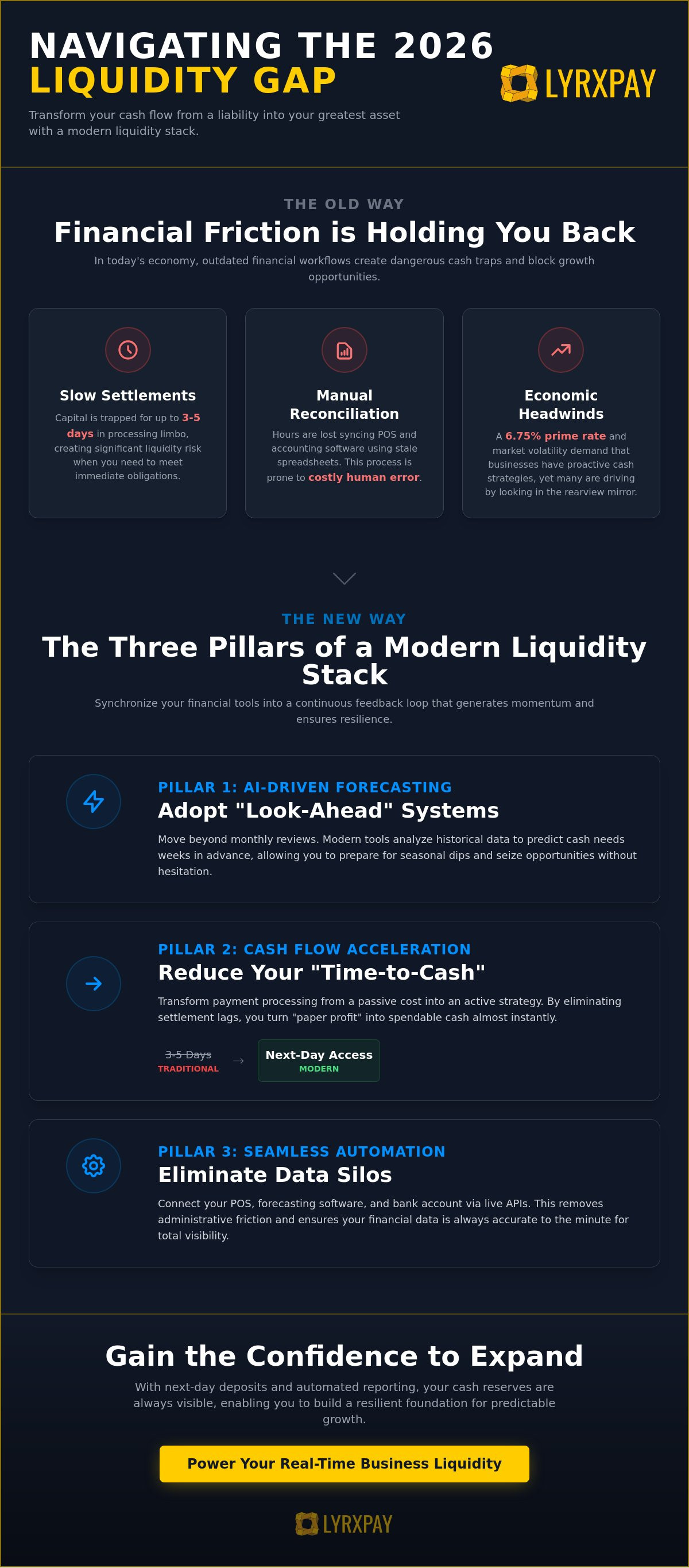
Building a resilient financial foundation requires more than a single piece of software. It demands a coordinated stack of business liquidity management tools that work in a continuous feedback loop. When these systems are synchronized, they do more than just record transactions; they generate the momentum needed to navigate the 6.75% prime rate environment of 2026. This stack relies on three specific pillars: forecasting, acceleration, and automation. If one pillar is weak, your entire cash position becomes unstable.
The feedback loop works like this: forecasting software predicts your future needs, payment acceleration tools ensure your current sales are converted to cash immediately, and automated accounting verifies the accuracy of your liquid reserves. This trio eliminates the "guesswork" that often leads to a cash crunch. By connecting these functions, you move from a reactive state of "hoping for the best" to a proactive state of "managed growth."
Forecasting Software: Scenario Planning for 2026
Modern AI-driven forecasting tools have moved far beyond simple linear projections. In 2026, these systems analyze historical data to predict seasonal dips and peaks with high precision, allowing you to prepare for a lean month before it actually hits. The most valuable feature of these business liquidity management tools is "What-If" analysis. This allows you to simulate major capital expenditures, such as hiring a new team or purchasing equipment, to see exactly how it will impact your bank balance three months down the line. Scenario planning is a vital risk mitigation tool for SMBs that provides a roadmap for safe expansion without overextending your resources.
Accounting Automation: The Bridge to Accuracy
Accuracy is the enemy of data silos. If your payment processor doesn't talk to your ledger, you're forced into manual reconciliation, which is where errors thrive. Your liquidity stack must integrate directly with platforms like QuickBooks or Xero to ensure your "book balance" matches your "bank balance" in real time. Automated bank reconciliation plays a critical role here by verifying your liquid positions daily rather than monthly. This level of transparency is essential for making confident, split-second business decisions. You can explore how these integrations work in our guide to All-in-One Business Financial Solutions.
By removing the friction between your sales data and your accounting records, you reclaim hours of administrative time. This is why we advocate for integrated merchant services that bridge the gap between the point of sale and the back office. When your data flows freely, your business stays liquid.
Payment Processing as a Critical Liquidity Tool
Many business owners view merchant services as a static line-item expense, much like rent or utilities. That's a mistake. In the 2026 economy, your payment processor is actually one of your most powerful business liquidity management tools. When you treat your processor as a strategic partner rather than a vendor, you unlock a concept known as Settlement Optimization. This strategy focuses on reducing the friction between a customer's swipe and your ability to spend that money on operations.
Traditional processing models often trap your capital in a 3 to 5 day settlement cycle. During this window, your money is essentially "frozen" in the financial system. By switching to a model that prioritizes settlement speed, you aren't just saving on fees; you're actively increasing your available working capital. This shift allows you to reinvest in inventory or cover immediate expenses without dipping into credit reserves.
The Power of Next-Day Deposits
Speed is the ultimate currency for liquidity. Consider the impact of having your Friday sales revenue available in your bank account by Monday morning. Under a standard settlement model, that money might not arrive until Wednesday or Thursday. This multi-day gap often forces businesses to rely on high-interest lines of credit to bridge the weekend's operational costs. By utilizing next-day deposits, you effectively eliminate the need for short-term debt, preserving your margins and your peace of mind. To understand the technical mechanics behind these windows, you can read our deep dive into Understanding Merchant Settlement Timelines.
ACH vs. Credit Card Processing for Cash Flow
While credit cards offer convenience, ACH processing provides a high-impact alternative for B2B liquidity. The fee structures for ACH are typically much lower than the percentage-based fees of credit cards. For high-ticket transactions, this difference can save thousands of dollars in a single quarter, directly increasing your net liquidity. Beyond cost, secure ACH is a cornerstone for predictable recurring revenue streams. It allows you to automate collections, ensuring that your cash flow remains steady and your forecasting software stays accurate. By balancing both methods, you can optimize for both customer preference and your own bottom line.
We've seen that the right combination of processing tools can turn a stagnant balance sheet into a dynamic growth engine. If your current processor still makes you wait nearly a week for your own money, it's time to reconsider your stack. Transitioning to a system that prioritizes speed isn't just about convenience; it's about keeping your business agile in a fast-moving market.
How to Evaluate and Implement Liquidity Tools
Selecting the right business liquidity management tools is a process of elimination. You aren't just looking for more software; you're looking for the shortest path between a completed sale and spendable cash. If your current setup feels like a patchwork of disconnected apps, it's time to streamline. Following a structured implementation plan ensures you don't trade one administrative headache for another.
- Audit your "Time-to-Cash": Measure the exact hours from a customer's payment to the moment those funds are available in your bank. If this window exceeds 24 to 48 hours, your liquidity is leaking.
- Map your data silos: Identify where your financial information lives. If your POS data isn't automatically flowing into your ledger, you've found a silo that's trapping your time.
- Demand native integration: Only choose tools that offer "plug-and-play" connectivity with your existing POS and accounting software. Manual data entry is a relic of the past.
- Verify fee transparency: Prioritize providers that offer simple, low-fee structures. Hidden "statement fees" or "gateway minimums" are direct hits to your net liquidity.
- Test the human element: Call the support line before you sign. When a settlement issue arises, you need a dedicated partner who understands your business, not a generic chatbot.
Key Features to Look for in 2026
The standard for 2026 is real-time dashboarding. Batch reporting, where you wait until the end of the day to see your totals, is no longer sufficient for agile management. You need a mobile-accessible view of your cash position so you can monitor liquidity while on the move. An API-first architecture is a requirement for scalability, as it allows your tools to grow and connect with new financial technologies as they emerge. If a tool doesn't offer live data feeds, it's already obsolete.
Avoiding the "Feature Bloat" Trap
Small and mid-sized businesses often fall into the trap of purchasing enterprise-level treasury systems. These tools are frequently over-engineered and require full-time administrators just to maintain the dashboards. Instead, look for "concierge-style" merchant services that offer personalized liquidity advice and simplified reporting. You need a system that does the heavy lifting for you, allowing you to focus on your craft rather than managing software. For a detailed breakdown of how to choose the right partner, check out our guide on the Best Payment Processor for Small Business.
Ready to stop waiting for your settlements and start growing? We can help you optimize your cash flow today with tools designed for the 2026 economy.
How LyrxPay Powers Real-Time Business Liquidity
While software helps you see your numbers, LyrxPay provides the actual mechanism to move them. We position ourselves as the "Liquidity Hub" for modern US businesses by combining the three pillars of cash management into a single, high-performance ecosystem. By integrating low-fee credit card and ACH processing with expert bookkeeping, we transform your financial operations from a source of stress into a strategic advantage. We don't just provide business liquidity management tools; we provide the partnership needed to execute them.
One common objection to upgrading financial systems is the perceived cost of change. However, when you analyze the math, the switch often pays for itself. By securing lower processing fees, you're directly increasing your liquid reserves with every transaction. These small percentage gains accumulate into significant capital that stays in your bank account rather than being siphoned off by a legacy processor. It's a simple equation: lower overhead equals higher liquidity.
Next-Day Deposits: Your Liquidity Secret Weapon
We understand that timing is everything. That's why the LyrxPay commitment to next-day deposits is designed to eliminate the "weekend cash gap" that plagues so many industries. If you process a high volume of sales on a Friday or Saturday, you shouldn't have to wait until the following Wednesday to access those funds. This specific feature ensures that your revenue is available when you need it most. With faster settlement, you can pay your vendors, manage your payroll solutions, and handle unexpected expenses without waiting for a processor to release your hold. It's your money; you should be able to use it.
The LyrxPay "Concierge" Advantage
Most big banks offer a clinical, detached experience that leaves you feeling like just another account number. LyrxPay takes a different approach. Our Texas-based expert support team acts as a professional ally, offering a "concierge" style of service that prioritizes your operational health. We don't just set up your POS; we ensure your QuickBooks integration is seamless and your bookkeeping is accurate. This integrated approach provides a 360-degree view of your liquidity, allowing you to make expansion decisions with total confidence. We've done the heavy lifting of building the infrastructure so you can focus entirely on your craft.
Optimize your business liquidity with LyrxPay’s next-day deposits and low-fee processing.
Master Your Cash Flow for 2026 and Beyond
You've seen how the right stack of business liquidity management tools can transform your daily operations from a source of stress into a competitive advantage. By moving away from stale spreadsheets and embracing real-time data feeds, you gain the clarity needed to expand with total confidence. You now understand that your payment processor isn't just a cost of doing business; it's the high-speed engine that determines how quickly you can reinvest your hard-earned revenue into your next big move.
LyrxPay is here to act as your reliable ally and defender of your time. Our Texas-based expert support team ensures your QuickBooks or Xero integration remains seamless, while our next-day deposits keep your funds moving as fast as your business does. Don't let your revenue get trapped in multi-day processing delays or manual reconciliation errors. It's time to take control of your financial health with a partner who cares about your success as much as you do.
Get Started with LyrxPay: Lower Fees & Next-Day Deposits
You have the vision to grow. Now, you have the tools to make it happen. Let's secure your financial future together.
Frequently Asked Questions
What is the most important business liquidity management tool for a small business?
The most important tool for a small business is an integrated payment processor that offers next-day deposits. While forecasting software is helpful for planning, a fast settlement system actually provides the cash you need to operate. This immediate access allows you to respond to operational demands or inventory needs without waiting for a bank's traditional settlement window to close.
How do next-day deposits improve my company’s liquidity?
Next-day deposits improve your liquidity by dramatically shortening your cash conversion cycle. Instead of waiting three to five days for credit card settlements, you receive your funds within 24 hours. This eliminates the "weekend cash gap" where Friday sales are often trapped until the following Wednesday, allowing you to pay vendors or meet payroll without using high-interest debt.
Can I integrate my payment processor directly with QuickBooks for better cash flow tracking?
You can and should integrate your payment processor directly with QuickBooks or Xero for real-time tracking. Modern business liquidity management tools use native APIs to sync sales data automatically, which removes the risk of manual entry errors. This bridge ensures your accounting records reflect your actual bank balance, giving you an accurate "look-ahead" view of your finances rather than a stale historical report.
What is the difference between cash flow forecasting software and liquidity management?
Cash flow forecasting software is a predictive tool used to estimate future income and expenses, whereas liquidity management is the broader execution of your financial strategy. Forecasting tells you what might happen next month based on historical data. Liquidity management includes the active acceleration of funds, the reduction of fees, and the verification of liquid reserves to ensure you can meet those future obligations.
How much do business liquidity management tools typically cost in 2026?
The cost of business liquidity management tools varies based on the volume of your transactions and the complexity of your integrations. Most providers offer custom-tailored proposals rather than flat-rate pricing to ensure you only pay for the specific services you need. Investing in these tools is often offset by the reduction in processing fees and the elimination of the interest costs associated with short-term lines of credit.
Is ACH processing better for liquidity than credit card processing?
ACH processing is often better for net liquidity on high-ticket B2B transactions because it typically carries much lower fees than percentage-based credit card charges. While credit cards are essential for consumer convenience and speed, ACH preserves your margins on larger invoices. Using a mix of both allows you to optimize for both customer preference and maximum cash retention on your balance sheet.
What happens if my business liquidity is too low?
When business liquidity is too low, you enter a "liquidity gap" where you may be profitable on paper but unable to meet immediate obligations. This can lead to missed payroll, strained vendor relationships, or an inability to purchase inventory for new orders. It often forces business owners into expensive emergency financing that can erode long-term profitability and limit your ability to expand when opportunities arise.
How often should I audit my merchant statement fees to preserve liquidity?
You should audit your merchant statement fees at least quarterly to ensure your liquidity isn't being drained by hidden costs or rate hikes. Market conditions and interchange rates can shift, so a regular review helps you verify that you're still receiving the most competitive fee structure. This proactive approach ensures that every possible dollar of your sales revenue stays working for your business rather than going to a processor.