
Cash Flow Forecasting: 2026 Service Business Guide

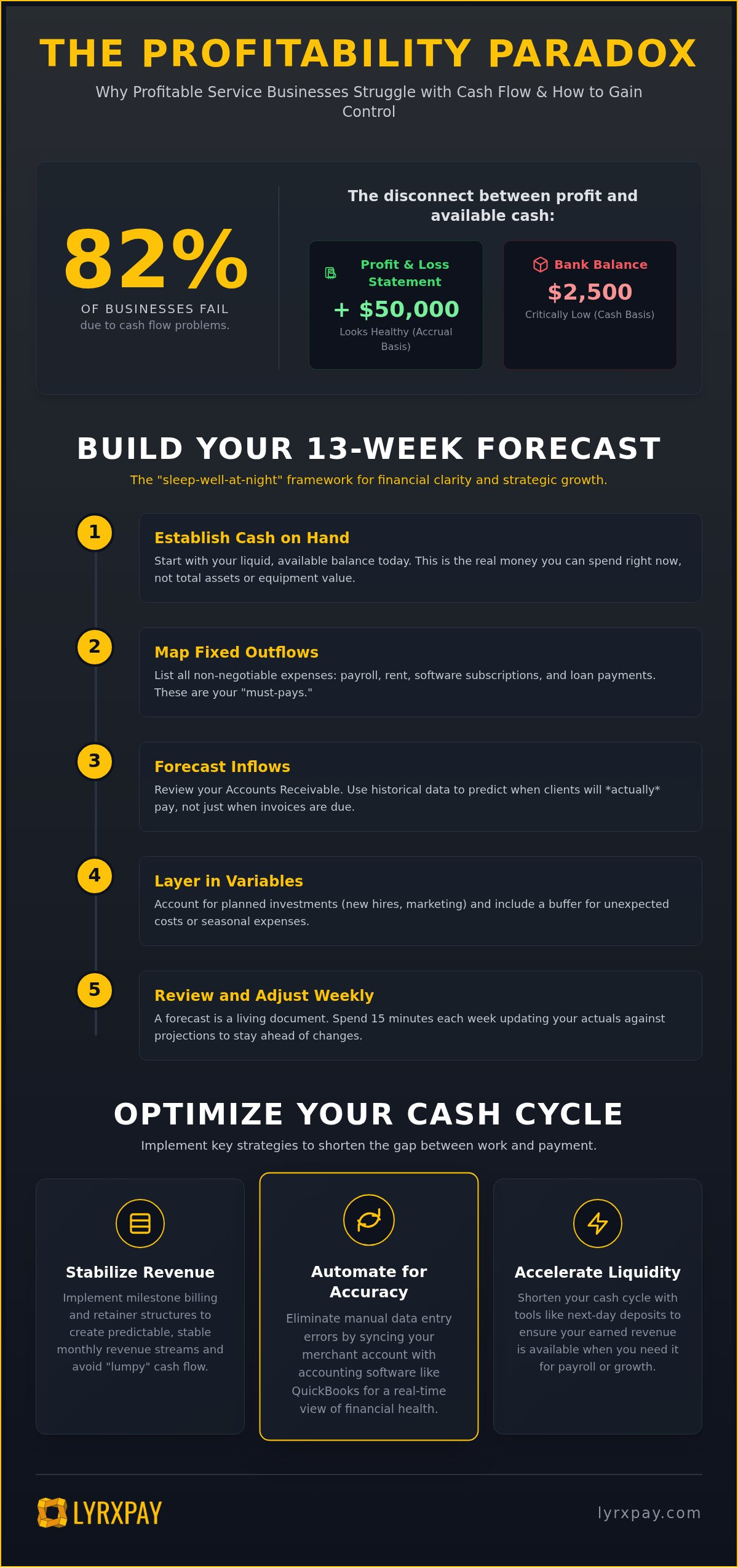
82% of businesses fail because of cash flow problems, according to the Tory Burch Foundation, even when their profit and loss statements look healthy. It's a frustrating paradox that many service providers face every month. You're working harder than ever and landing new contracts, yet you're still staring at a low bank balance when payroll is due on Friday. You've likely felt that spike of anxiety when a surprise tax bill arrives or when you want to hire a new lead but can't tell if the cash will be there in sixty days. Mastering cash flow forecasting for service businesses is the only way to break this cycle and reclaim your time.
We believe that managing your money shouldn't feel like a second job. This guide is designed to help you eliminate financial stress and optimize your liquidity so you can focus on your craft. You'll learn how to create a "sleep-well-at-night" 90-day view of your finances that lets you plan for growth instead of just reacting to crises. We'll show you how to automate your workflows and use tools like next-day deposits to get faster access to your earned revenue. By the end of this article, you'll have a clear roadmap to scale your business with total confidence.
Key Takeaways
- Master a 13-week framework for cash flow forecasting for service businesses to gain a clear, "sleep-well-at-night" view of your upcoming bank balance.
- Bridge the gap between payroll and accounts receivable by implementing milestone billing and retainer structures that stabilize your monthly revenue.
- Eliminate manual data entry errors by syncing your merchant account with QuickBooks for an automated, real-time look at your financial health.
- Shorten your cash cycle and improve liquidity using next-day deposits to ensure your earned revenue is available when you need to scale.
The Profitability Paradox: Why Service Businesses Struggle with Cash Flow
Why does a business with a packed calendar and glowing reviews still struggle to meet its obligations? This is the profitability paradox. At its core, cash flow forecasting is the art of predicting the exact timing of when cash enters and exits your bank account. For service providers, this isn't just an accounting exercise; it's a strategy for survival. You might show a significant profit on your books, but if that money is trapped in accounts receivable while your team's payroll is due on Friday, your business is at risk. This gap between paying for labor and receiving client funds is the number one reason cash flow forecasting for service businesses is so essential for long-term health.
Success in this area relies on three critical pillars: Invoicing, Collections, and Processing Velocity. If any of these pillars crumble, your liquidity disappears. While often associated with tech startups, the concepts of "Burn Rate" and "Runway" are vital for service companies too. Your burn rate is the total cash you spend each month to keep the doors open, while your runway is the number of months you can operate before running out of cash if no new revenue comes in.
Revenue vs. Cash: Understanding the Disconnect
Your Profit and Loss (P&L) statement is a historical document that tells you what happened in the past. In contrast, your forecast is a roadmap for the future. Many owners fall into the trap of relying solely on accrual accounting, which records revenue the moment a contract is signed or a service is performed. While this is great for taxes, it's dangerous for daily management. Project-based billing often creates "lumpy" cash cycles where expenses are consistent but income is erratic. Implementing cash flow forecasting for service businesses allows you to see these valleys before you're standing at the edge of them.
The High Cost of Waiting: Labor and Overhead
Service businesses face a unique challenge: they have far less "flex" in their expenses than retail or manufacturing. You can't simply return "unsold" labor to a shelf. Your payroll, rent, and software costs are fixed and recurring, regardless of whether a client pays their invoice on time. This rigidity means your weekly cash floor is often higher than you realize. Net Cash Flow is the difference between your total cash inflows and outflows over a specific period, representing the true pulse of your firm's financial health.
Building Your 13-Week Cash Flow Forecast Framework
To move from financial anxiety to operational authority, you need a repeatable system. Building a framework for cash flow forecasting for service businesses isn't about perfectly predicting every cent; it's about identifying trends and potential bottlenecks before they happen. This process transforms your bank balance from a source of stress into a tool for strategic growth. Follow these five steps to build your initial model:
- Step 1: Establish Cash on Hand. This is your liquid, available balance today. Do not include total assets or equipment value. Only count the funds you can actually spend this week.
- Step 2: Map Fixed Outflows. List every non-negotiable expense. This includes payroll, rent, software subscriptions, and recurring debt payments. These are your "must-pays" that occur regardless of sales volume.
- Step 3: Forecast Inflows. Look at your current Accounts Receivable (AR). Use historical data to predict when those clients will actually pay rather than when the invoice is technically due.
- Step 4: Layer in Variables. Account for planned growth investments, such as new equipment or marketing campaigns. Include a buffer for unexpected repairs or "lumpy" seasonal costs.
- Step 5: Review Weekly. A forecast is a living document. Spend 15 minutes every Monday morning updating your actuals against your projections to account for client delays.
Choosing Your Forecasting Horizon
While a one-to-four-week view is helpful for immediate survival, it doesn't allow for strategic movement. Conversely, an annual forecast often becomes pure guesswork for a growing firm. The 13-week model is the "Goldilocks" zone. It aligns with a full fiscal quarter, providing enough runway to see the impact of a new hire or a marketing push while maintaining a high degree of accuracy. If you can see 90 days into the future, you can make hiring decisions with total confidence.
Forecasting Inflows: Reality vs. Optimism
The biggest mistake in cash flow forecasting for service businesses is being too optimistic about payment dates. To combat this, apply a "Collection Factor" to your projections. If your data shows that clients typically pay ten days late, adjust your forecast to reflect that reality. Categorize your clients by reliability; treat a "slow payer" differently than a "net-30" corporate account. If you want to shorten the gap between service delivery and cash availability, choosing a partner with next-day deposit capabilities can simplify your entire forecast by removing settlement delays.
Optimizing the Service Cycle: Retainers, Milestones, and Invoicing
Your forecast is only as strong as the billing strategy that feeds it. If your revenue is unpredictable, your 13-week view will always feel like a guess rather than a roadmap. Retainers are the gold standard for cash flow forecasting for service businesses because they provide a guaranteed baseline for your monthly inflows. By securing a fixed amount upfront, you create a financial floor that covers your recurring expenses, such as payroll and software, without the stress of waiting for project-based sign-offs.
For larger, time-intensive projects, milestone billing is your best defense against the "profitability paradox." It ensures that cash flows into your account in alignment with your labor output. Stop treating "Net 30" as the default for your firm. It's essentially an interest-free loan you're giving to your clients while you carry the risk of overhead. If your team is paid bi-weekly but your clients pay monthly, you're creating a liquidity gap that restricts your ability to scale. Professionalizing your collections through modern B2B payment processing helps close this gap and ensures your business is treated as a priority, not an option.
The Role of ACH in B2B Service Collections
Paper checks are a major obstacle to forecast predictability. They get lost in the mail, sit on desks for days, and require manual trips to the bank. ACH is superior because it provides a digital trail and a predictable settlement date, making your cash flow forecasting for service businesses much more accurate. For high-value service contracts, ACH processing also allows you to keep more of your hard-earned cash by significantly reducing transaction fees compared to credit cards. Understanding The Ultimate Guide B2B Payments can help you choose the right infrastructure to support these larger transfers while maintaining your margins.
Automating the Invoicing Workflow
Days Sales Outstanding (DSO) is the metric that tracks how long it takes to get paid after a service is rendered. A high DSO is a silent growth killer. Automated reminders take the social friction out of collections, ensuring your invoices remain at the top of a client's inbox. By offering multiple payment options through integrated digital links, you remove the barriers that cause clients to procrastinate. When a client can pay an invoice with a single click via credit card or ACH, your cash cycle accelerates. Speeding up this process by even a few days can provide the necessary liquidity to fund your next big hire or marketing initiative.
Leveraging QuickBooks and Automated Bookkeeping for Accuracy
Accuracy is the bedrock of any financial projection. If you're building a forecast on month-old data, you're essentially driving by looking in the rearview mirror. Manual data entry is the primary enemy here; it's slow, prone to human error, and creates a lag that makes real-time decisions impossible. Centralizing your data through all in one business financial solutions ensures that every transaction is captured as it happens. For cash flow forecasting for service businesses, this level of precision is the difference between a confident "yes" to a new project and a stressful "maybe" when payroll looms. Daily reconciliation in a fast-moving service environment isn't a luxury; it's a requirement for maintaining an accurate pulse on your liquidity.
QuickBooks Integration: The Single Source of Truth
Syncing your merchant account directly with QuickBooks creates a single source of truth for your entire firm. This integration allows you to map payment fees automatically to your general ledger, providing a granular view of your net margins. By Integrating level 3 B2B rates into your Quickbooks Invoices, you can further optimize your processing costs while keeping your records pristine. This technical "handshake" between your payments and your books eliminates the dreaded month-end surprise where your bank balance fails to match your P&L expectations. When your data flows continuously, you can spot cash gaps weeks before they manifest, giving you the time to adjust your collections strategy or delay a non-essential expense.
Automated Bookkeeping: From Reactive to Proactive
Moving from manual spreadsheets to automated bookkeeping frees up your most valuable asset: your time. As a business owner, your energy belongs on high-level strategy and client relationships, not chasing down missing receipts or reconciling credit card statements. Since payroll is the largest expense for most service providers, integrating your payroll solution directly into your accounting software is non-negotiable for an accurate 13-week forecast. This setup provides an investor-ready view of your financials, proving to lenders or partners that you have a firm grip on your operational health. A proactive bookkeeping system anticipates your needs, allowing you to focus on your craft while the administrative heavy lifting happens in the background. If you're ready to stop guessing and start growing, explore our integrated QuickBooks solutions to see how real-time data can transform your business.
Accelerating Liquidity: The LyrxPay Advantage for Service Firms
The ultimate success of cash flow forecasting for service businesses depends on more than just setting up a spreadsheet; it relies on the actual velocity of your capital. If your payment processor holds your funds for three to five business days, your forecast is perpetually lagging behind your reality. We position ourselves as a defender of your time by shortening this gap and ensuring your money is where it belongs: in your bank account. Utilizing business liquidity management tools allows you to stop playing defense and start making proactive investments in your firm's growth.
Next-Day Deposits and Forecast Precision
Traditional processing often feels like a black hole where your earned revenue disappears for days at a time. Next-day deposits provide the psychological relief of knowing that the work your team completed on Friday is available in your bank account by Monday morning. This 24-hour settlement cycle removes the guesswork that often plagues cash flow forecasting for service businesses, replacing it with hard data you can trust. When you know exactly when funds will land, you can schedule vendor payments and payroll with precision. This speed reduces your reliance on expensive short-term lines of credit or predatory factoring services that eat into your long-term stability.
Auditing Your Processing Costs
Every dollar lost to unnecessary processing fees is a dollar removed from your operating capital. Many service providers suffer from subtle cash "leaks" caused by hidden fees buried in complex monthly statements. By lowering merchant fees, you're effectively giving your business an immediate cash infusion that requires no extra labor. While a 1% reduction in transaction fees might sound small, it scales into thousands of dollars in annual liquidity that stays in your business instead of going to a bank. Identifying these leaks ensures that your net cash flow remains healthy enough to support your next big hire.
We don't just see ourselves as a vendor; we're a reliable ally in your operational health. Our goal is to provide the infrastructure that makes your financial projections accurate and your growth sustainable. By integrating lower-fee processing with next-day deposits and expert bookkeeping, we help you master the timing of your revenue. This managed care for your administrative tasks allows you to focus on your craft while we handle the complexities of your cash cycle.
TAKE COMMAND OF YOUR GROWTH
Mastering the timing of your revenue is the difference between a business that merely survives and one that scales with absolute confidence. By implementing a 13-week framework and shifting toward billing models like retainers and milestones, you eliminate the "lumpy" cycles that cause payroll anxiety. We've explored how moving from manual entry to real-time automation creates a single source of truth, allowing you to make strategic hiring decisions based on actual bank balances rather than optimistic guesses.
Effective cash flow forecasting for service businesses depends on the velocity of your capital. At LyrxPay, we act as a dedicated ally for your operational health by providing next-day deposits for all merchants and seamless QuickBooks and Xero integration. Backed by our Texas-based support team, we ensure your earned revenue is available when you need it most. See how LyrxPay accelerates your cash flow with next-day deposits and integrated bookkeeping.
You've built a service business your clients value. Now, it's time to build the financial clarity that lets you enjoy the rewards of your hard work. You have the roadmap; it's time to lead with confidence.
Frequently Asked Questions
Is cash flow forecasting different for service businesses than retail?
Cash flow forecasting for service businesses is unique because you don't have physical inventory to liquidate. In retail, you can stop buying stock to save cash, but you can't easily pause payroll for your professional team. Service firms face high fixed labor costs that must be paid regardless of client timing. This makes predicting the exact date of high-value receipts critical for staying ahead of your bi-weekly wage obligations.
Can I use a simple spreadsheet for my 13-week forecast?
You can start with a spreadsheet, but it often becomes a liability as your firm grows. Manual data entry is slow and prone to errors that hide your true liquidity. While a template helps you visualize the 13-week framework, transitioning to an automated system is better. Systems that sync directly with your merchant account ensure your projections are based on real-time facts rather than outdated manual inputs.
How much cash reserves should a service business maintain?
Most industry experts recommend maintaining three to six months of operating expenses in reserve. For a service firm, this means enough cash to cover payroll, rent, and software without a single dollar of new revenue. Having this runway protects you from the timing gaps inherent in project-based billing. It also gives you the confidence to turn down low-value work that doesn't fit your long-term growth strategy.
What happens if a major client pays 30 days late?
A late payment can create an immediate liquidity crisis if you haven't built a buffer. Without a forecast, you might not realize the danger until your bank balance hits zero. If you see this delay coming through your 13-week view, you can proactively adjust your accounts payable. You might also offer the client an incentive for immediate ACH payment or use a line of credit to bridge the temporary gap.
How does QuickBooks integration help with forecasting?
QuickBooks integration acts as your single source of truth by pulling in every transaction automatically. It eliminates the need for manual reconciliation and provides a real-time view of your net margins. By syncing your merchant processing data, you can see exactly how much cash is landing in your account after fees. This allows you to build a forecast based on net liquidity rather than gross sales figures.
Can next-day deposits actually improve my business liquidity?
Next-day deposits significantly improve liquidity by increasing the velocity of your capital. Instead of waiting three to five days for funds to settle, you get access to your money within 24 hours. This speed allows you to pay vendors faster and meet payroll without the stress of settlement delays. It also reduces your reliance on expensive short-term financing options that can eat into your long-term profitability.
Is ACH processing safer than credit card processing for large service invoices?
ACH processing is highly secure and often preferred for large B2B transactions because it uses direct bank-to-bank transfers. It carries a lower risk of chargebacks than credit cards and provides a clear digital trail for your bookkeeping. Additionally, ACH is much more cost-effective for high-value invoices. This allows you to keep more of your revenue as operating capital instead of losing it to percentage-based merchant fees.
What is the most common mistake in service business forecasting?
The most common mistake is being too optimistic about when clients will actually pay. Owners often forecast based on invoice due dates rather than historical payment behavior. To make cash flow forecasting for service businesses accurate, you must account for slow payers and apply a collection factor. Overestimating your cash inflows is a fast way to fall victim to the profitability paradox, leaving you with profit but no cash.