
Understanding Your Merchant Statement: The 2026 Guide to Decoding Fees

The 2026 Visa and Mastercard settlement was supposed to simplify your overhead, but for most merchants, the promised savings are buried under a mountain of new, creative surcharges. If you feel like your processor is hiding behind "Digital Enablement Fees" or "Location Data Validation" charges while your costs continue to climb, you aren't alone. Most business owners find that understanding your merchant statement is the single most frustrating part of their financial week. It's exhausting to watch your hard-earned revenue disappear into a black hole of opaque descriptions that never seem to match your actual bank deposits.
You deserve a partner who acts as a defender of your resources instead of a drain on them. This guide will show you how to audit your statement in minutes, spot the "junk" fees that shouldn't be there, and calculate your true Effective Rate with total confidence. We'll break down the latest 2026 interchange caps and the new "honor-all-cards" rules so you can finally reclaim control over your processing costs. From decoding complex markups to streamlining your QuickBooks reconciliation, we're providing the roadmap you need to stop overpaying and start growing.
Key Takeaways
- Learn why industry jargon is often used to mask processor margins and how to peel back the layers of your monthly report card.
- Master the art of understanding your merchant statement by distinguishing between the high-level summary view and the critical transaction details where fees are hidden.
- Discover why Interchange-Plus remains the gold standard for transparency and how to escape the high markups common in Tiered pricing models.
- Follow a simple 15-minute audit to calculate your "Effective Rate," which is the only metric that reveals your true processing costs.
- Explore how a concierge-style partnership can unlock next-day deposits and eliminate manual data entry through expert QuickBooks integration.
Why Your Merchant Statement Feels Like a Mystery
Imagine receiving a monthly report card for your business where the grades are written in a language you don't speak. That's the reality for most owners when they open their processing documents. A Merchant Account is the foundation of your digital sales, but the statements it generates are often designed to be opaque. Processors frequently use vague industry jargon to hide their own margins, creating a disconnect between the revenue you see on your POS system and the actual cash that hits your bank account. If you aren't actively understanding your merchant statement, you are likely leaking thousands of dollars annually in unnecessary "junk" fees that provide zero value to your operations. This "Advocacy Gap" exists because most providers profit from your confusion; they'd rather you just pay the bill than ask why your costs are rising without explanation. You deserve a partner who acts as a defender of your resources, not a drain on them.
The Purpose of Monthly Reporting
Your statement should be a tool for growth, not a source of anxiety. When used correctly, it acts as a diagnostic health check for your business. Beyond just listing fees, it serves three critical functions for your operational health. If you can bridge the gap between these numbers, you gain total clarity over your cash flow.
- Reconciling Deposits: It tracks your total sales volume against your actual net deposits. This helps you spot discrepancies between what you swiped and what arrived in your bank account.
- Monitoring Trends: It tracks chargeback activity and fraud trends. Identifying these early allows you to adjust your security protocols before they impact your bottom line.
- Identifying Payment Behavior: It shows seasonal shifts in how your customers pay. You might notice a sudden spike in premium rewards cards or digital wallets, which directly affects your processing costs.
Common Jargon Decoded
To stop the financial bleed, you have to speak the language of the industry. If you can distinguish between what the card networks charge and what your processor pockets, you gain the upper hand in negotiations. Don't let complex terminology intimidate you; it's simpler than it looks once you break it down.
- Assessment Fee versus Markup: Assessment fees are non-negotiable costs paid directly to Visa or Mastercard. The "Markup" is the extra slice your processor takes. This is the only part of the fee structure that is truly flexible.
- The Discount Rate: This isn't a "sale" for your business. It's the percentage of every transaction that the processor keeps for themselves. It's a cost, not a benefit.
- Settlement and Liquidity: Settlement refers to the actual transfer of funds. Understanding these timelines is vital for your liquidity. If your settlement takes three days while your bills are due today, your cash flow is at risk.
The Anatomy of a Modern Merchant Statement
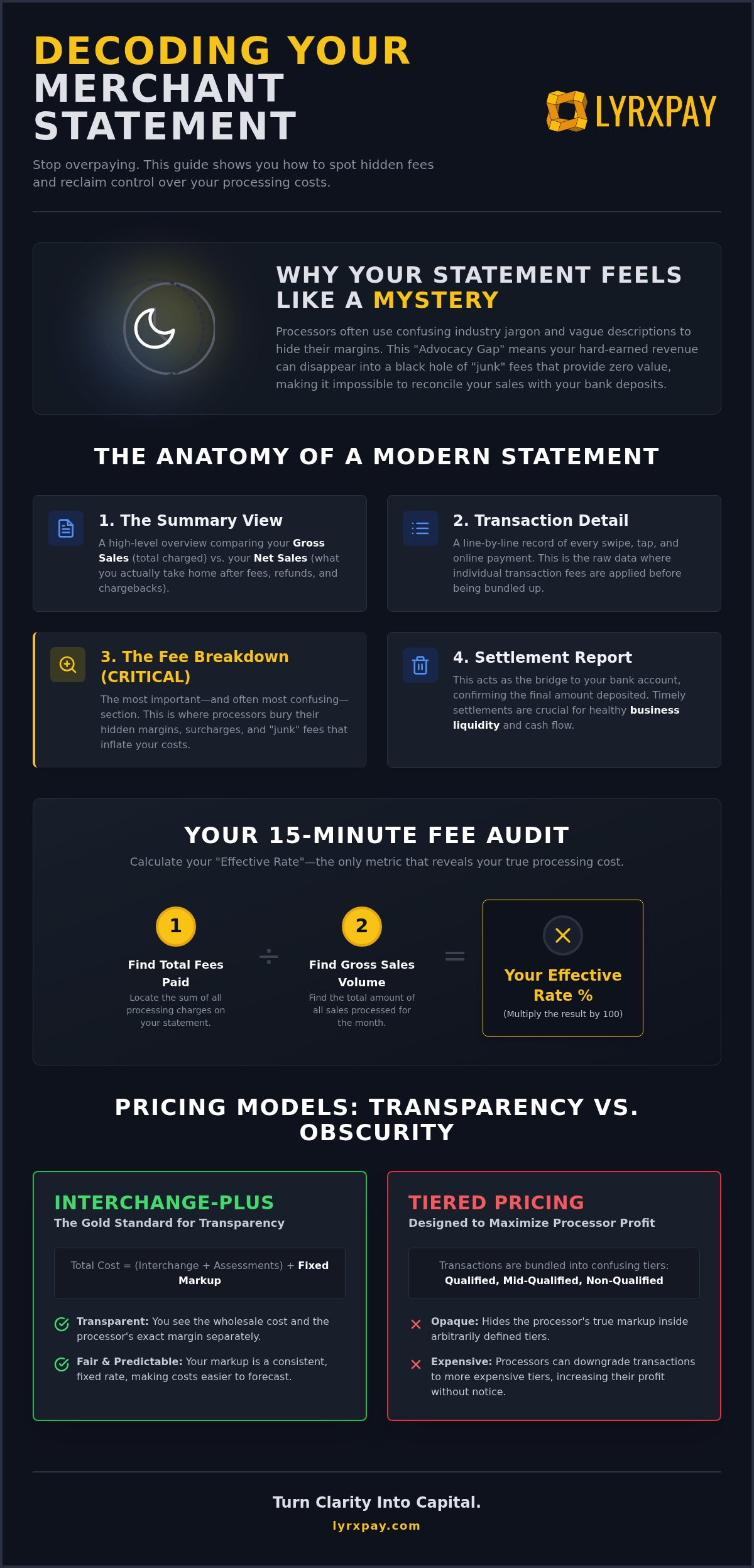
Opening your monthly report shouldn't feel like a chore. If you know where to look, it becomes a strategic map for your cash flow. A well-organized document usually breaks down into four distinct zones. Understanding your merchant statement starts with recognizing these layers so you can spot exactly where your money is going. First, the Summary View gives you the monthly high-level performance. Second, the Transaction Detail records every swipe and tap. Third, the Fee Breakdown is where most processors bury their hidden margins. Finally, the Settlement Report is the bridge to your bank account, acting as one of your primary business liquidity management tools for daily operations.
The Summary: Net vs. Gross Sales
Your gross sales figure is the total amount you charged your customers. It looks great on paper, but it isn't what you take home. Your net sales are what remains after refunds, chargebacks, and processing fees are stripped away. Many business owners face a bookkeeping nightmare because they try to reconcile gross sales from their POS with net deposits in their bank. If these numbers don't align, you're likely seeing the impact of delayed settlements or unrecorded reversals. Checking this section daily ensures your expectations match reality. It's the first step in maintaining a healthy, predictable cash flow.
Interchange vs. Processor Markup
Think of Interchange as the "wholesale" cost of doing business. It's the fee paid directly to the banks that issue your customers' cards. In 2026, Visa and Mastercard assessment fees sit around 0.14% and 0.1375% respectively, following the landmark settlement that reduced average interchange rates by 10 basis points. These are costs every processor pays. The Processor Markup is the "retail" price you pay for the service itself. This is where the advocacy gap often widens. Transparent providers like LyrxPay show these as separate line items, ensuring you see exactly what the networks charge versus what the processor earns. If your current provider lumps these together, they might be pocketing the recent 0.10% rate reduction instead of passing it to you. You can request a transparent fee review to see if your current markup is actually fair.
Decoding Pricing Models: Interchange-Plus vs. Tiered
Your pricing model is the lens through which you view every transaction. If that lens is blurry, you'll never truly master understanding your merchant statement. While the 2026 Visa and Mastercard settlement reduced average interchange rates by 10 basis points, many merchants won't see a dime of that savings because of how their processor structures their bill. Choosing the right model is the difference between having a transparent partner and a provider that treats your revenue as their own. For those seeking low fee credit card processing, the structure of your agreement matters as much as the percentage itself.
Flat-rate pricing is often marketed as the "simple" choice for small businesses. You pay one percentage regardless of the card type. However, for high-volume merchants, this simplicity carries a hidden tax. The processor sets the rate high enough to cover the most expensive premium cards, meaning you overpay significantly on every basic debit transaction. Subscription or membership pricing is a newer alternative where you pay a flat monthly fee plus the wholesale cost of interchange. This can be highly effective for established businesses with consistent volume, as it removes the percentage-based markup entirely.
How to Spot Tiered Pricing on Your Bill
Tiered pricing is the most common way processors hide their margins. If your statement contains phrases like "Qual," "Mid-Qual," or "Non-Qual," you're in a tiered system. This model groups transactions into buckets based on the processor's arbitrary criteria. While they might hook you with a low "Qualified" rate, that price often applies to less than 20% of your actual swipes. You'll frequently find yourself in the "Downgrade" trap. This happens when a customer uses a business card or a rewards-heavy premium card, and the processor instantly bumps the transaction into a higher-priced tier. It's an opaque system designed to make auditing nearly impossible for the average owner.
The Benefits of Interchange-Plus
Interchange-Plus is the gold standard for transparency. It passes the wholesale cost from the card networks directly to you, adding a small, fixed markup on top. This model ensures that when interchange rates drop, like they did in early 2025 and 2026, your costs drop automatically. You gain clear visibility into exactly what the processor earns on every transaction. This clarity is essential when integrating all in one business financial solutions into your workflow. By seeing the raw costs, you can reconcile your books faster and make informed decisions about your long-term growth without the headache of hidden markups.
How to Conduct a 15-Minute Fee Audit
You don't need a degree in finance to stop the bleeding in your bank account. Most business owners ignore their statements because they look like encrypted code, but understanding your merchant statement only requires four logical steps. If you spend fifteen minutes once a month reviewing these areas, you'll prevent the small, incremental price hikes that processors love to hide in the fine print. Follow this simple checklist to reclaim your margins:
- Step 1: Calculate your "Effective Rate" to see the big picture.
- Step 2: Identify "Junk Fees" that offer no operational value.
- Step 3: Analyze Interchange Downgrades to catch technical processing errors.
- Step 4: Compare month-to-month totals to identify "Fee Creep."
Analyzing downgrades is vital for your bottom line. If you see high volumes of "Standard" or "Non-Qualified" transactions, your system might be skipping address verification (AVS) or other security steps that qualify you for lower rates. Finally, compare this month's statement to the last three. Processors rarely raise rates by a full percentage point all at once. Instead, they use "Fee Creep," adding 0.05% here or a $5 service fee there, hoping you won't notice the slow climb over time.
The Effective Rate Formula
Your Effective Rate is the only number that tells the truth. Processors often brag about a 1.9% or 2.5% rate, but that's usually a "teaser" that doesn't include the dozens of ancillary costs tacked on at the end. To find your real cost, take the Total Fees Paid and divide them by your Total Sales Volume. For example, if you processed $50,000 and paid $1,750 in fees, your Effective Rate is 3.5%. In 2026, the average total cost for credit card processing typically ranges from 1.5% to 3.5%. If your math reveals a number north of 3.8% or 4%, you're likely paying for a provider's high overhead instead of your own growth.
Spotting and Eliminating Junk Fees
Junk Fees are any cost that provides zero value to your processing efficiency. These are the low-hanging fruit of a fee audit because they're often entirely avoidable. Look for "PCI Non-Compliance" charges first. This is a penalty fee, often ranging from $30 to $100 per month, simply because your account hasn't been certified as secure. It's a "gotcha" fee that transparent providers will help you eliminate by guiding you through the compliance process. You should also watch for annual fees, account maintenance surcharges, and "regulatory" fees that aren't actually mandated by any government body. If you spot these, it's a sign that your processor isn't acting as your advocate. You can get a free statement audit from LyrxPay to identify every hidden surcharge in minutes.
Turning Clarity into Capital with LyrxPay
Understanding your merchant statement shouldn't be a monthly battle you fight alone. While decoding fees is the first step toward financial health, the real goal is transforming that knowledge into capital you can reinvest in your craft. LyrxPay functions as your dedicated financial concierge, moving beyond the clinical, transactional nature of traditional providers to offer a partnership built on advocacy. We believe that modern credit card processing should be transparent, straightforward, and designed to defend your time.
By stripping away the jargon and providing advocacy-based reporting, we ensure you never have to guess what you’re paying. If your current provider hides behind complex tiered models or hidden surcharges, then our results-oriented approach will feel like a breath of fresh air. We don't just process payments; we manage the administrative weight so you can focus on leading your business. Our commitment to understanding your merchant statement alongside you ensures that every penny is accounted for and every fee is justified.
Beyond the Statement: Integrated Financial Health
Clarity is only useful if it leads to efficiency. One of the biggest drains on a business owner's time is the manual reconciliation of bank deposits with accounting software. LyrxPay solves this through seamless QuickBooks and Xero integration. By automating the flow of data, we eliminate the risk of manual entry errors and ensure your bookkeeping is always current. This integration creates a unified back-office that works for you, not against you.
Liquidity is the lifeblood of your operations. Waiting three to five days for funds to settle is an obstacle you don't need. We provide next-day deposits as a standard feature, giving you immediate access to your revenue. When combined with our transparent fee structures, this becomes one of the most powerful business liquidity management strategies available. You gain the freedom to pay vendors and cover payroll without the stress of settlement lag.
Take the Next Step: Your Free Statement Audit
Are you ready to see exactly how much you're leaving on the table? The path to lower fees begins with a single inquiry. Our team performs a deep-dive audit of your current merchant statement, identifying every hidden markup and unnecessary surcharge that is currently siphoning off your profits. We don't just find the problems; we present a clear, high-service path forward that prioritizes your growth.
Switching to a lower-fee model shouldn't be a headache. We handle the heavy lifting of the transition, ensuring your POS hardware and software are integrated perfectly from day one. Join the growing list of national businesses that have reclaimed their resources and their time. Contact LyrxPay today for your transparent fee review and experience the concierge difference for yourself.
RECLAIM YOUR REVENUE TODAY
You've now seen that your monthly report is more than just a bill; it's a diagnostic tool for your business health. By mastering the art of understanding your merchant statement, you move from a state of frustration to a state of total financial confidence. Focus on your Effective Rate and eliminate junk fees to stop the hidden leaks in your cash flow. Demand transparency from your provider. You've done the hard work of building your business; it's time to protect the revenue it generates.
LyrxPay acts as your dedicated advocate, providing lower transaction fees and the liquidity of next-day deposits to keep your operations moving. Our expert QuickBooks and Xero integration removes the burden of manual reconciliation, allowing you to focus on your craft while we manage the administrative heavy lifting. We're here to ensure your processing costs work for you, not against you. Transitioning to a concierge-style partnership means you never have to guess about your margins again.
Stop overpaying and start growing—get your free merchant statement audit from LyrxPay today.
Take the first step toward a more profitable future. We look forward to helping you simplify your back-office and secure your margins for the long term.
Frequently Asked Questions
What is an 'effective rate' and why is it important?
Your effective rate is the total dollar amount of fees paid divided by your total sales volume. It's the most critical metric for understanding your merchant statement because it reveals your true processing cost after all "teaser" rates and hidden surcharges are included. While a processor might advertise 1.9%, your effective rate could be 3.5% or higher. Monitoring this monthly helps you spot "fee creep" and ensures your provider remains competitive.
Why does my statement show 'non-qualified' fees?
Non-qualified fees appear in tiered pricing models when a transaction fails to meet the processor's strictest "qualified" criteria. This usually happens when customers use premium rewards cards, business cards, or when you manually key in a transaction without address verification. These transactions are "downgraded" to a higher cost tier. If these fees dominate your statement, it's a clear signal that your current pricing model is working against your specific sales mix.
Are merchant processing fees tax-deductible for my business?
Yes, merchant processing fees are fully tax-deductible as an ordinary and necessary business expense. Since these costs are directly related to generating revenue, they can be subtracted from your gross income on your annual tax return. We recommend keeping detailed monthly statements to simplify this process for your accountant. Integrating your processing with bookkeeping software ensures these expenses are automatically categorized, saving you time during tax season and preventing missed deductions.
How can I avoid paying PCI non-compliance fees?
You can avoid PCI non-compliance fees by completing your annual Self-Assessment Questionnaire (SAQ) and performing any required vulnerability scans for your network. These fees are essentially penalties for not proving your payment environment is secure. A proactive partner should guide you through this certification process rather than simply collecting the monthly penalty. Once you are certified as compliant, these charges should vanish from your statement immediately, saving you significant annual overhead.
What is the difference between interchange fees and markup fees?
Interchange fees are the "wholesale" costs set by card networks like Visa and Mastercard, paid directly to the card-issuing banks. They are non-negotiable and apply to everyone. Markup fees are the "retail" portion added by your processor for their services, hardware, and support. When you're understanding your merchant statement, focus on the markup. This is the only part of your fee structure that is flexible and where a concierge-style provider can offer significant savings.
Why don't my monthly deposits match my total sales volume?
Discrepancies between sales volume and deposits usually occur because most processors deduct their fees before the funds hit your bank account, a practice known as "net settling." Additionally, batching times and weekend processing can cause delays in when funds appear. If you use "gross settling," your total sales are deposited first, and fees are debited in one lump sum later. Next-day deposits can help align these numbers more closely, improving your daily liquidity and reconciliation.
Can I negotiate the fees I see on my merchant statement?
Yes, you can absolutely negotiate the markup portion of your fees. While interchange and assessment rates are fixed by the card networks, the processor's margin is entirely within their control. You have the most leverage if you have a high transaction volume or if your current statement shows high "junk" fees like statement or regulatory surcharges. Presenting a detailed audit of your current costs to a new provider often results in a more transparent, lower-fee agreement.
How often should I audit my merchant processing statement?
You should perform a quick audit of your statement every month. It only takes a few minutes to calculate your effective rate and scan for new, unexplained line items. A more thorough deep-dive audit is recommended at least once a year or whenever you notice your processing costs climbing without a corresponding increase in sales volume. Regular reviews prevent "fee creep" and ensure you're always benefiting from the latest industry rate reductions and settlement changes.