
Eliminate Manual Accounting Data Entry: The 2026 Business Checklist
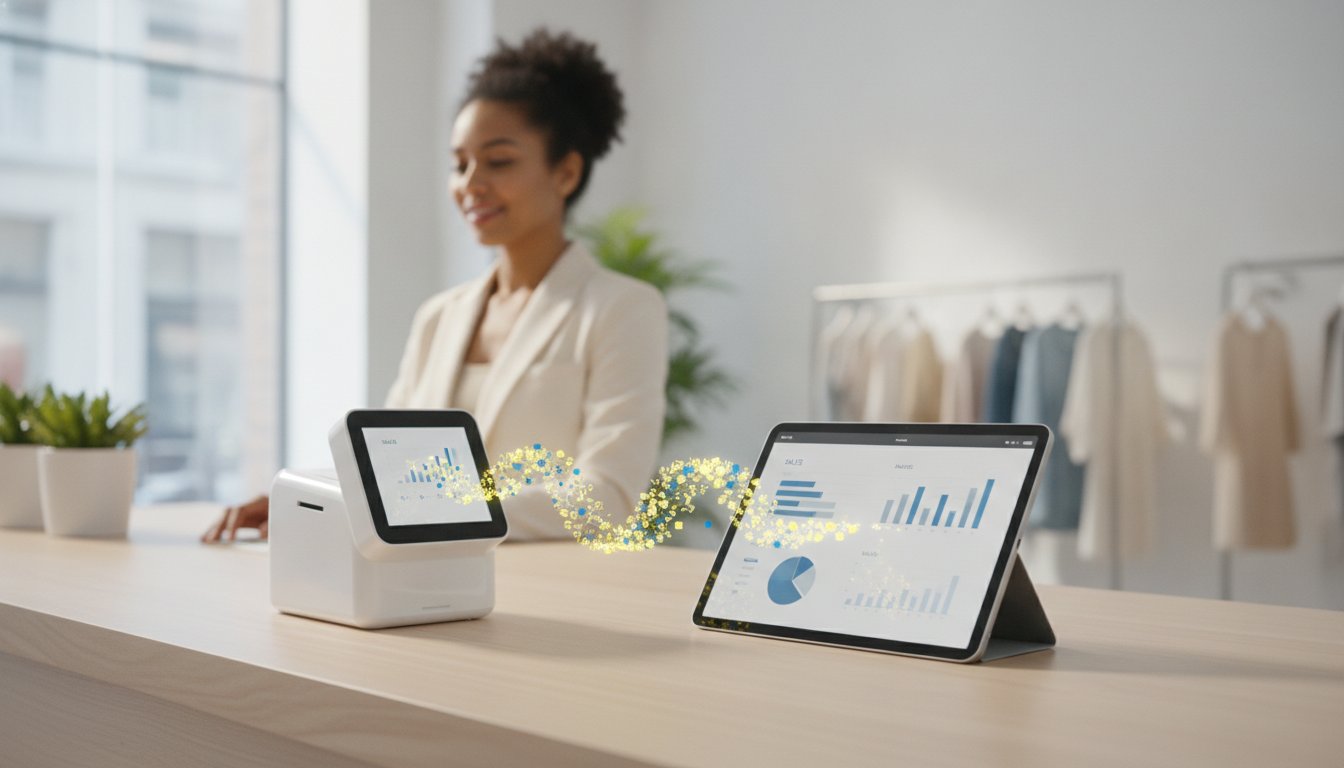
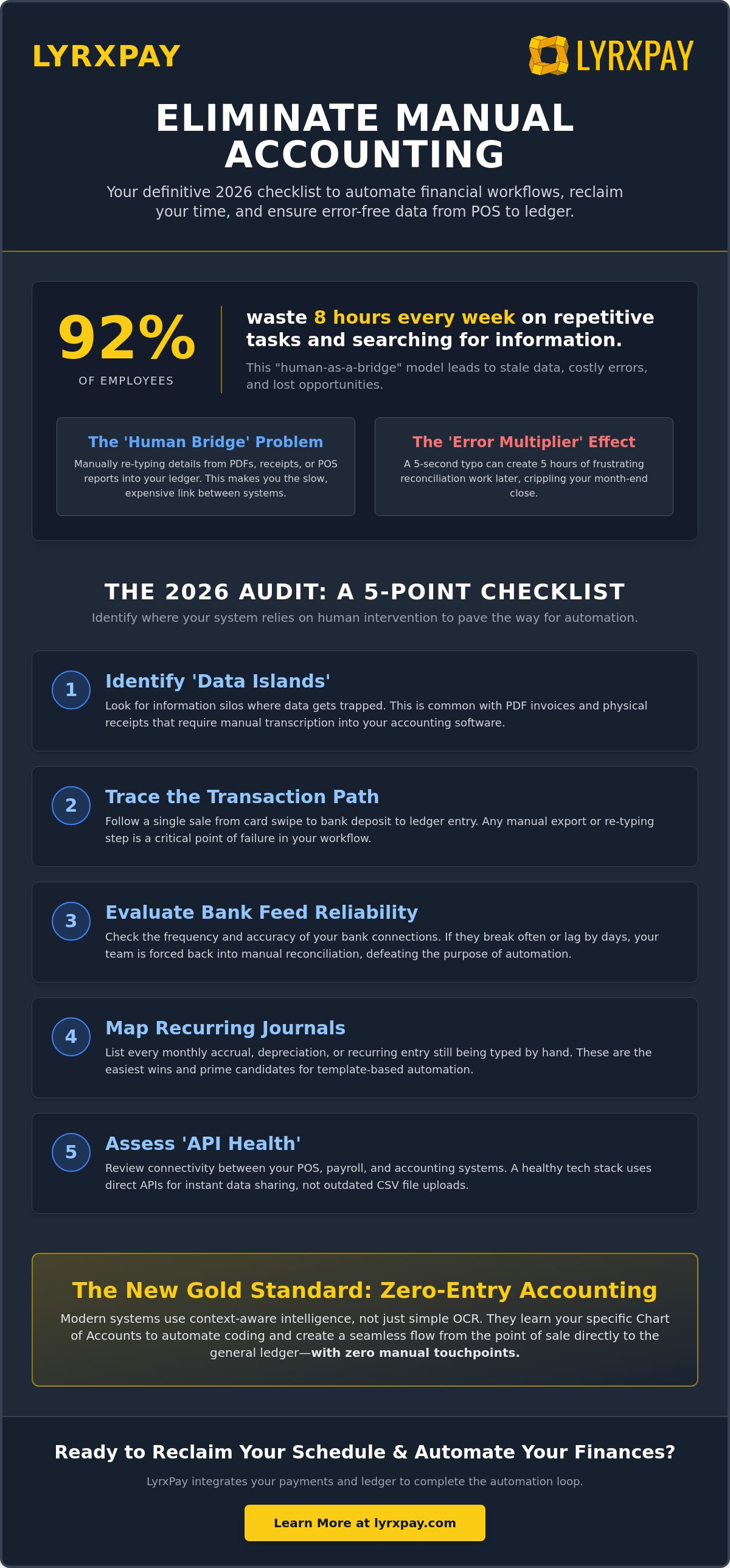
Did you know that 92% of employees report wasting eight hours every single week just searching for information or managing repetitive tasks? If you're still typing transaction details into a spreadsheet, you aren't just losing time; you're risking the accuracy of your entire financial foundation. It's exhausting to spend your weekends on bank reconciliation only to find that human errors have left your books mismatched and your visibility delayed. You deserve to be the architect of your business, not the manual bridge between your sales data and your ledger.
We believe your time is your most valuable resource, and we're committed to helping you protect it. This guide provides the definitive 2026 checklist to help you eliminate manual accounting data entry and automate your financial workflows from the ground up. We'll show you how to move toward hands-free reconciliation, seamless POS-to-ledger flows, and error-free payroll tracking. By the end of this article, you'll have a clear, actionable path to reclaiming your schedule and ensuring your financial data moves as fast as your business does.
Key Takeaways
- Identify and dismantle "data islands" by auditing how information flows from your paper receipts and PDFs into your central financial system.
- Understand why standard OCR often fails and how 2026 machine learning tools can finally learn your specific Chart of Accounts for higher accuracy.
- Learn to eliminate manual accounting data entry by bridging the "sync gap" between your merchant services and your ledger.
- Discover the critical role your credit card and ACH processor plays as the primary link in a fully automated financial workflow.
- Explore how combining integrated POS software with professional bookkeeping support creates a seamless, hands-free loop for your business operations.
The High Cost of 'Human-as-a-Bridge' Accounting
Manual accounting data entry isn't just a clerical task; it's any moment where a human acts as the bridge between two systems. If you find yourself re-typing numbers from a PDF invoice into your software, or manually copying totals from a point-of-sale report into a spreadsheet, you're functioning as an expensive piece of middleware. This "human-as-a-bridge" model is the primary reason financial data feels "stale" by the time it reaches your desk. When your team is even forty-eight hours behind on entry, your visibility into your accounting information system is effectively blind. You cannot make agile decisions based on numbers that are already several days old.
Small mistakes also carry a heavy price through the "Error Multiplier Effect." A single typo made during a late-night data entry session ripples through your entire ledger, creating hours of forensic reconciliation work weeks later. What takes five seconds to mistype often takes five hours to locate and fix during the month-end close. By the time you identify the mismatch, the trail has gone cold, and your staff is left frustrated by the hunt. Transitioning away from this reactive cycle allows you to move into proactive financial leadership. You stop looking at where your money was and start focusing on where it's going.
The Invisible Drain on Your Business Growth
Think about the true cost of these repetitive keystrokes. When you calculate the hourly rate of a skilled manager or bookkeeper and multiply it by the time they spend on data entry, the number is often staggering. However, the opportunity cost is even higher. What could your team achieve if they weren't buried in re-keying invoices? They could be analyzing profit margins, negotiating better vendor terms, or identifying new revenue streams. Beyond the financial cost, there is a psychological impact to consider. High-value employees rarely want to spend their careers on "busy work." Eliminating these chores is a direct investment in employee retention and overall company morale.
Why 2026 is the Year to Finalize Your Automation
The technology available in 2026 has evolved far beyond simple scanning. Modern systems now use context-aware intelligence to understand why a transaction happened, rather than just recording that it occurred. This allows for real-time liquidity management that was previously impossible for small businesses. To truly eliminate manual accounting data entry, you must adopt tools that learn your specific Chart of Accounts and automate the coding process from the source. Zero-Entry Accounting is the new gold standard for modern SMBs, where data flows autonomously from the point of sale to the general ledger without a single manual touchpoint.
The 2026 Audit: A 5-Point Checklist to Eliminate Manual Entry
To effectively eliminate manual accounting data entry, you must first identify where your current system relies on human intervention. Automation isn't about adding more software; it's about removing the friction between the tools you already use. We recommend starting with a high-level audit of your financial pipeline to spot the leaks that are currently draining your team's time. This 5-point checklist is designed to help you move from a fragmented workflow to a unified, autonomous system.
- Audit Point 1: Identify 'Data Islands'. Look for silos where information becomes trapped. This often happens with vendor invoices arriving as PDF attachments or physical receipts that require manual transcription into your ledger.
- Audit Point 2: Trace the Transaction Path. Follow a single sale from the customer's initial swipe to the bank deposit and finally to the ledger entry. If there is a manual export or a "re-typing" phase in the middle, that's a point of failure.
- Audit Point 3: Evaluate Bank Feed Reliability. Check the frequency and accuracy of your current feeds. If your bank connection breaks frequently or lags by several days, it forces your team back into manual reconciliation.
- Audit Point 4: Map Recurring Journals. List every monthly accrual, depreciation entry, or recurring journal you still type in by hand. These are prime candidates for template-based automation.
- Audit Point 5: Assess 'API Health'. Review the connectivity between your POS, payroll, and accounting core. A healthy tech stack uses direct APIs to share data instantly rather than relying on CSV file uploads.
Step 1: Mapping the Transaction Journey
Performing a touchpoint audit reveals exactly how many times a human interacts with your sales data. Every manual touch is an opportunity for a typo or a missed decimal point. If your payment processor doesn't automatically sync with your bookkeeping software, you're likely performing redundant work every single day. Finding all in one business financial solutions that bridge this gap is the fastest way to reclaim your schedule. While the technology handles the repetition, The Human Side Of Accounting Automation reminds us that your professional oversight is what ensures these automated systems stay aligned with your long-term goals.
Step 2: Identifying Your Most Repetitive Tasks
Most business owners find that the 80/20 rule applies to their administrative workload. Roughly 20% of your accounting tasks usually cause 80% of the manual labor. Common culprits include complex payroll journals, multi-state sales tax calculations, and vendor bill coding. By creating a "No-Entry" priority list, you can target these high-volume chores first. If you're tired of the constant cycle of data entry, exploring integrated merchant services can help you close those gaps and keep your data flowing without manual interference.
Intelligent Data Capture: Moving Beyond OCR
If you have ever used basic Optical Character Recognition (OCR), you know the frustration of fixing "S"s that were read as "5"s or manual corrections for blurry receipts. Standard OCR is essentially a digital magnifying glass that still requires a human to squint along with it. In 2026, we have moved past simple character reading into the era of Intelligent Document Processing (IDP). These systems don't just see text; they understand the context of your business. With the AI in accounting market projected to reach over $50 billion by 2030, according to Mordor Intelligence, the technology has reached a point where it can learn your specific Chart of Accounts and automate the coding process autonomously.
Modern intelligent capture handles complex multi-line invoices without you ever touching a keyboard. If a vendor sends a bill with ten different line items, the system can split those costs across various departments or projects automatically. This level of precision is supported by "Smart Matching" rules during bank reconciliation. Instead of a pile of "Uncategorized Expenses" at the end of the month, the software matches bank feed transactions to your captured invoices in real time. This proactive approach ensures your books are always ready for a spot check or a tax filing.
From Scanning to Understanding
The real magic happens when a tool understands intent. For example, an intelligent system recognizes that a charge from Amazon might be "Office Supplies" for one business but "Inventory" for another, based on your previous patterns. We aim for a 95% automated confidence score, which drastically reduces the "Review Time" your team spends on verification. When your coding is standardized and your systems are trained, the software does the heavy lifting while you simply provide high-level oversight. It's about moving from a role of "data typist" to "data strategist."
Eliminating Spreadsheet Dependency
Spreadsheets are often the "gateway drug" to manual data entry errors. While they feel flexible, every time you export data from one system to a CSV just to upload it into another, you're creating a window for version control issues and broken formulas. Transitioning to direct system-to-system integrations provides a single source of truth that spreadsheets simply cannot match. If you're ready to stop the manual shuffle, you can explore automated bookkeeping for merchants to see how hands-free strategies can replace your old Excel workbooks. By removing the middleman, you eliminate manual accounting data entry and ensure your financial health is always reflected in real time.
The Merchant Service Connection: Integrating Payments and Ledger
Your credit card and ACH processor shouldn't just be a utility; it's the engine that drives your financial data flow. Many business owners focus solely on their accounting software, but if your payment processor doesn't communicate with your ledger, you're stuck in what we call the "Sync Gap." This gap occurs when your point-of-sale (POS) data and your QuickBooks records are out of alignment, forcing your team to manually reconcile every transaction at the end of the day. By selecting a processor that integrates deeply with your stack, you can eliminate manual accounting data entry and ensure that every swipe is recorded accurately in real time.
Next-day deposits are another game-changer for your workflow. Instead of waiting days for funds to clear, having access to your capital within 24 hours simplifies the reconciliation of "In-Transit" funds. You no longer have to guess which batch of sales matches which bank deposit. For B2B companies, ACH processing removes the "manual check" bottleneck. You can say goodbye to tracking paper checks and wire confirmations by hand. If you're ready to upgrade your cash flow, explore our integrated payment solutions to see how we bridge the gap between your sales and your books.
QuickBooks Integration: The Gold Standard
A deep integration does more than just move numbers; it automatically maps transaction fees and records net deposits. This means you don't have to "batch" transactions manually at the end of the day or calculate merchant fees for every entry. If your system is set up correctly, the gross sale, the fee, and the net deposit are all recorded in one fluid motion. This removes the risk of human error during the most high-volume part of your bookkeeping. For more on this, check out our guide on QuickBooks integrated payment processing for specific setup tips to lower your overhead.
Payroll and ACH: The Final Frontier of Automation
Payroll is often the final hurdle in achieving a fully automated office. By automating the monthly payroll journal post, you avoid the tedious manual entry of tax liabilities and benefit allocations. ACH processing further streamlines this by handling vendor payments through a secure, automated workflow. This ensures compliance and data integrity without requiring your staff to manage individual wire transfers or physical signatures. It's the most efficient way to maintain a clean, audit-ready ledger with zero manual touchpoints. When your payroll and ACH workflows are integrated, your financial visibility becomes instantaneous rather than delayed.
Managed Care: How LyrxPay Completes the Automation Loop
Software alone is rarely a magic bullet. While many providers offer powerful tools, they often leave the heavy lifting of implementation and maintenance to you. The LyrxPay difference lies in our commitment to "managed care." We don't just hand over a dashboard; we provide the professional bookkeeping support and integrated systems necessary to eliminate manual accounting data entry for good. By positioning ourselves as a concierge for your back-office, we allow you to step away from the keyboard and focus on the craft that started your business in the first place.
Our integrated POS and merchant services ensure that clean, categorized data feeds into your accounting core from day one. This eliminates the "cleanup" projects that usually haunt business owners at the end of every quarter. When your sales data, transaction fees, and net deposits are synchronized automatically, the friction of administrative work simply vanishes. We also prioritize your liquidity through next-day deposits, ensuring your bank balance matches your ledger with minimal delay. If your cash flow moves faster, your business can grow faster.
Our Technology, Your Peace of Mind
We provide secure credit card and ACH processing with built-in accounting sync to keep your data protected and organized. Our team doesn't just set up the hardware; we audit your existing workflows to find and kill manual entry points before they cause errors. Whether it's customized POS hardware that talks directly to your ledger or specialized payroll solutions, we ensure every piece of your tech stack is working toward a single goal. This proactive oversight means you spend less time troubleshooting and more time leading.
Taking the Next Step Toward a Zero-Entry Future
Waiting to automate is often more expensive than the transition itself. Every hour your team spends on repetitive keystrokes is an hour stolen from high-value growth activities. We're here to help you bridge that gap with a transparent, results-oriented partnership. If you're ready to see exactly where your workflow is leaking time and money, we're ready to show you the way forward. You can start by getting a clear, honest look at your current setup. Schedule your free financial workflow audit with LyrxPay today and discover how a curated approach to merchant services can eliminate manual accounting data entry from your daily routine.
RECLAIM YOUR TIME AND FOCUS ON GROWTH
Managing a business in 2026 requires more than just hard work; it requires a commitment to operational efficiency. We have explored how moving beyond simple OCR and bridging the "sync gap" between your merchant services and ledger can transform your back office. By auditing your transaction journey and adopting intelligent data capture, you can finally eliminate manual accounting data entry and focus on the strategic health of your enterprise. You don't have to be the bridge between your systems when the right technology can do the heavy lifting for you.
We are here to support you in this transition with expert QuickBooks and Xero integration, next-day deposits for improved liquidity, and lower-fee ACH processing. If you're tired of the administrative drag, it's time to choose a partner who values your time as much as you do. Ready to kill the 'manual entry tax'? Let LyrxPay automate your financial workflow today. Your future self, and your bottom line, will thank you for making the shift toward a more streamlined, hands-free operation.
Frequently Asked Questions
How do I eliminate manual data entry in QuickBooks?
You can achieve this by connecting your bank feeds and merchant services directly to the platform. When you use a payment processor that offers native sync, you eliminate manual accounting data entry because sales, fees, and deposits are recorded automatically. This setup removes the need for tedious CSV imports or manual reconciliation at the end of every month.
Can I really trust AI to code my accounting transactions accurately?
Yes, provided you implement a system with high-confidence thresholds and initial human oversight. Modern AI tools in 2026 learn your specific Chart of Accounts and can reach a 95% automated confidence score. You simply review the rare exceptions rather than coding every single line item, which maintains total accuracy while saving your team hours of repetitive labor.
What is the best way to automate invoice processing for a small business?
The most efficient method is using Intelligent Document Processing (IDP) software that integrates with your accounting core. These tools automatically extract data from emailed PDFs or scanned receipts and map them to the correct vendor and account. This removes the "data island" problem where information stays trapped in documents and requires a human to re-type it.
How much time can I save by integrating my merchant services with my ledger?
Businesses using automated financial platforms have reported saving up to 250 hours per year. By linking your credit card and ACH processing directly to your books, you remove the daily task of matching sales reports to bank deposits. This often results in a 75% reduction in the time your staff spends on month-end closing activities.
Does automating my accounting increase the risk of an IRS audit?
No, automation typically decreases audit risk by improving data integrity and creating a clear digital trail. Because automated systems follow consistent rules, they reduce the human typos and classification errors that often trigger regulatory red flags. You gain a more transparent, audit-ready ledger that is much easier for any professional to verify and defend.
What is the difference between OCR and Intelligent Data Capture in 2026?
Traditional OCR only reads text characters, while Intelligent Data Capture (IDP) understands the context and meaning of the document. IDP can classify a bill, validate the mathematical totals, and assign it to a specific project without manual help. It is the difference between a simple digital image and a smart system that actually knows what it's looking at.
Can LyrxPay help if I already have a POS system I like?
Absolutely, as we work with various point-of-sale hardware and software configurations. We can often integrate our merchant services into your existing setup to eliminate manual accounting data entry between your sales floor and your ledger. Our goal is to bridge the "sync gap" and provide professional support without forcing you to change the tools you already love.
This is especially true for businesses with unique booking needs; for instance, you can visit Aria Software to learn more about how their specialized SaaS platform manages reservations for coworking spaces and clinics while keeping your data organized.
How do next-day deposits help with my automated reconciliation?
Next-day deposits align your actual cash flow with your digital ledger entries almost instantly. When funds hit your bank within 24 hours, the reconciliation software can match the deposit to the sales batch without dealing with "In-Transit" funds that span multiple days. This creates a tighter, more accurate loop for your liquidity management and real-time financial visibility.