
Financial Controls to Implement in a Small Business: The 2026 Checklist

Did you know the median loss from fraud for businesses with fewer than 100 employees is a staggering $141,000? According to the Association of Certified Fraud Examiners, small teams are often the most vulnerable. It's exhausting to stress over inaccurate reporting or the fear of embezzlement, yet many owners struggle to find the right financial controls to implement in a small business without slowing down their momentum. You didn't start your company to spend your weekends fixing manual data entry errors in QuickBooks or wondering if your cash flow is actually as secure as it looks on paper.
We believe you deserve total peace of mind regarding your resources. That's why we've compiled a prioritized 2026 checklist designed to secure your assets and streamline your operations. This isn't about adding more red tape; it's about using modern automation to protect your hard-earned growth. This guide will show you exactly how to transition from manual chaos to a structured system that delivers faster, more accurate month-end closes. By the end of this article, you'll have a clear path to a more resilient and professional financial foundation.
Key Takeaways
- Break the "Fraud Triangle" by identifying and closing the procedural gaps that lead to internal theft or mismanagement.
- Identify the core financial controls to implement in a small business, focusing on separation of duties and strict authorization protocols.
- Reduce manual entry errors by leveraging automated software integrations that sync your POS and payroll data directly with QuickBooks.
- Implement a structured 2026 checklist for daily POS batching and weekly payroll reviews to ensure constant financial accuracy.
- Improve your business liquidity and fraud detection speed by utilizing next-day deposits and integrated bookkeeping ecosystems.
Beyond the Ledger: Why Financial Controls are Your Business’s Best Defense
Financial controls are more than just line items on a spreadsheet or boring policy manuals. They are the specific procedures that keep your reporting accurate and your assets safe. When you look for financial controls to implement in a small business, you're essentially building a defense against the "Fraud Triangle." This psychological model explains that theft happens when there is pressure, rationalization, and opportunity. By removing the opportunity through smart workflows, you protect your company and your team simultaneously.
Business owners often worry that setting strict rules implies a lack of trust in their staff. In reality, strong systems protect your best employees from unfair suspicion if a discrepancy occurs. In 2026, these systems also impact your bottom line directly. With SBA 7(a) loan limits recently increased to $10 million, lenders are looking for rigorous oversight before approving capital. Clean, verified books aren't just a preference; they're a requirement for scaling your operations.
The High Cost of Inaction
The numbers are sobering. The Association of Certified Fraud Examiners reports that small businesses lose a median of $141,000 to fraud. Beyond theft, simple manual errors in QuickBooks can lead to missed tax deadlines, such as the September 15th cutoff for S-corporations. These mistakes trigger penalties that drain your liquidity when you need it most. Internal controls are the immune system of a business. Without them, even a minor procedural infection can become a fatal cash flow crisis.
Types of Controls: Preventive vs. Detective
Effective internal control systems generally fall into two categories. Preventive controls stop the leak before it starts. This includes restricting access to your payroll software or requiring specific authorization for large ACH transfers. Detective controls, on the other hand, identify issues after they occur. Monthly bank reconciliations and end-of-day POS report reviews are classic examples. A balanced strategy ensures you remain agile while keeping your data secure. It's about finding the right financial controls to implement in a small business that support your daily workflow rather than obstructing it.
The Four Pillars of Effective Internal Control Systems
Building a secure financial framework requires more than just good intentions. When you evaluate the specific financial controls to implement in a small business, focus on four structural pillars: separation of duties, authorization levels, digital audit trails, and physical safeguards. These pillars ensure your financial data remains accurate, verifiable, and protected from both external threats and internal errors. If these pillars are weak, your business becomes vulnerable to the very risks we identified in the previous section.
Separation of Duties in a Small Team
How do you divide tasks when your "team" is just you and a single office manager? The core principle is simple: no one person should control a transaction from start to finish. If one employee enters vendor invoices into the system, a different person should sign the checks or approve the digital ACH release. In many growing companies, the owner acts as the final digital gatekeeper for all outgoing funds. This simple check-and-balance system prevents the opportunity for mismanagement before it can even begin. For more oversight strategies, you can explore our guide on Business Liquidity Management Tools.
The Digital Audit Trail
Manual ledgers are a massive liability in 2026. They are prone to human error and lack the transparency needed for modern compliance or loan applications. A digital audit trail creates an automatic, unchangeable record of every action taken within your software. If your POS software and bookkeeping systems are synced, every transaction is timestamped and tracked without manual intervention. This removes the risk of "ghost" entries or deleted records that often hide financial leaks. Why leave your assets to chance when you can automate the oversight? Utilizing integrated bookkeeping services ensures that your financial history is written in ink, not pencil, providing total clarity for your year-end reviews.
Beyond these, you must define clear Authorization Levels. This involves deciding who has the "keys" to change payroll data, edit employee hours, or move funds between accounts. Finally, Physical and Digital Safeguards protect the hardware itself. Are your POS tablets password-protected? Is your QuickBooks access restricted by two-factor authentication? These pillars work together to create a managed care environment for your capital, allowing you to focus on your customers while the system handles the security.
Automated vs. Manual: Choosing Your Control Infrastructure
Manual data entry is the single largest point of failure for internal oversight. When you're deciding on the right financial controls to implement in a small business, you're choosing between a system that relies on human memory and one that relies on hard data. Manual processes are often opaque, leaving room for "creative" accounting or simple exhaustion-driven errors. Automating these workflows doesn't just save time; it creates a firewall around your cash flow. It's about moving from a reactive state of "fixing" to a proactive state of "managing."
The Death of the Manual Spreadsheet
Spreadsheets are where financial clarity goes to die. Because Excel files are static and easily edited without a trace, they represent a major red flag for auditors and lenders alike. Moving to cloud-based bookkeeping allows for remote oversight, meaning you can check your numbers from anywhere without waiting for a monthly report. Our bookkeeping services act as a professional layer of detective control, ensuring that your books always reflect the reality of your bank account. If your data flows automatically from your POS to your ledger, the opportunity for manual manipulation vanishes.
Payment Processing as a Control Point
Your merchant services provider is your first line of defense on the front end of your business. Modern payment systems come with built-in security like PCI compliance, which handles sensitive data so your staff doesn't have to. Using QuickBooks integrated payment processing is a game-changer for reducing reconciliation errors. Instead of manually matching credit card batches to invoices, the system does the heavy lifting for you. This integration ensures that every dollar processed is immediately accounted for in your ledger, leaving no room for "lost" transactions.
Strict authorization for ACH processing also prevents unauthorized withdrawals, keeping your operational capital where it belongs. Your POS hardware can also be configured to restrict employee access to specific functions, such as processing refunds or voiding transactions. This digital gatekeeping is one of the most effective financial controls to implement in a small business. When combined with next-day deposits, these tools allow you to spot missing funds in hours rather than weeks. Real-time monitoring turns your financial infrastructure into a proactive guardian of your growth.
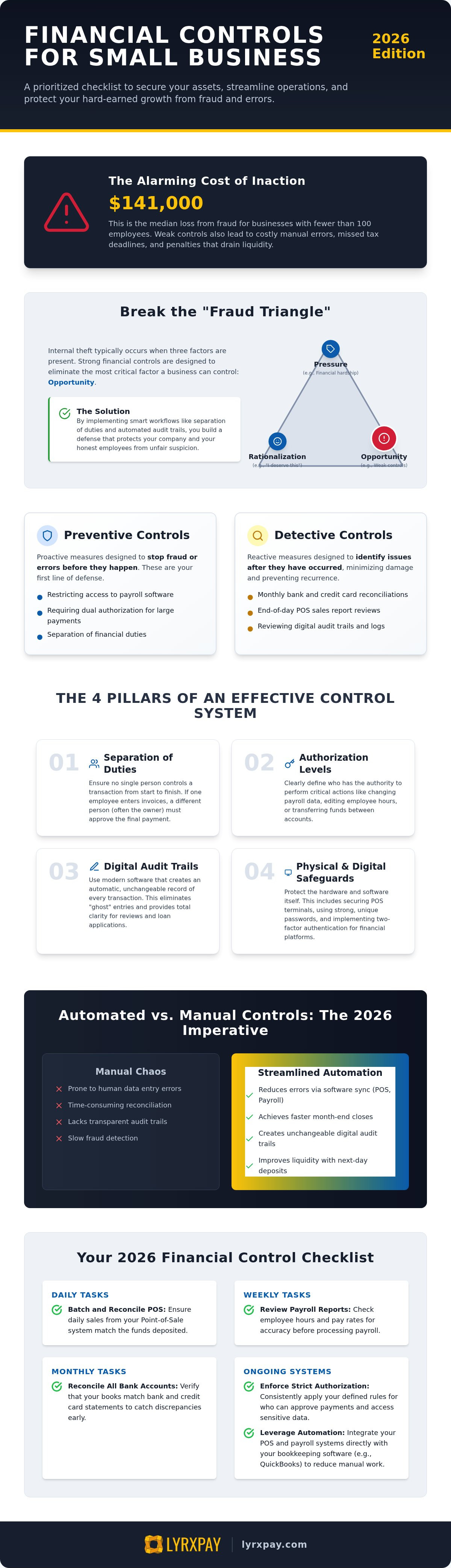
The Small Business Financial Control Checklist: 2026 Edition
Managing a growing company is a constant juggling act. You don't need a mountain of extra paperwork; you need a rhythm that fits into your existing schedule. By breaking down the essential financial controls to implement in a small business into daily, weekly, and monthly habits, you turn security into a background process rather than a crisis response. This structured approach ensures that no detail slips through the cracks while you focus on serving your customers and expanding your reach.
Daily and Weekly: The Pulse of the Business
Your day should ideally begin with a 5-minute morning review. Verify that the previous day’s credit card batches match your POS end-of-day reports exactly. If a discrepancy exists, it's much easier to resolve when the transaction is only 24 hours old. On a weekly basis, shift your focus to outgoing funds. Review your accounts payable and approve all payroll hours before they are processed. Utilizing secure ACH services for your B2B transactions allows you to maintain strict oversight of pending batches. Before you authorize a payment, confirm that any overtime was pre-approved. These short, consistent checks prevent small errors from snowballing into significant cash flow leaks.
Monthly and Annual: The Strategic Overview
Once a month, perform a comprehensive reconciliation of your bank and credit card statements against your general ledger in QuickBooks or Xero. This is your primary detective control. Look specifically for "ghost employees", which are fictitious entries in your payroll, or vendor name anomalies that look suspiciously similar to your regular suppliers. This is also the perfect time to perform a deep dive audit on your merchant statements. If you want to lower merchant fees, you must first identify the hidden surcharges or outdated rate structures that often creep into monthly billing.
As you move into quarterly and annual reviews, focus on the keys to the kingdom. Audit your software user permissions to ensure that former employees or those with changed roles no longer have access to sensitive financial functions. Annually, conduct a physical inventory count to verify that your digital records match your actual stock. These high-level financial controls to implement in a small business provide the integrity needed for accurate tax filing and future loan applications. Ready to take the stress out of your financial oversight? Our integrated bookkeeping and payroll solutions provide the managed care your business needs to thrive without the administrative headache.
Streamlining Security: How Integrated Solutions Protect Your Bottom Line
Streamlining your financial architecture is the final step in moving from vulnerability to total confidence. When your systems exist in silos, gaps appear. One of the most effective financial controls to implement in a small business is the adoption of an integrated ecosystem where your POS, payroll, and bookkeeping "talk" to each other in real time. This unified approach, often called the LyrxPay Ecosystem, ensures that every transaction is tracked from the moment a card is swiped until the final reconciliation in your ledger. By removing manual bridges between these functions, you eliminate the risk of human error or intentional manipulation that often occurs when data is moved by hand.
Speed is another critical factor in your defense strategy. While many providers hold your funds for three days or more, next-day deposits allow you to monitor your cash flow in near real-time. This isn't just about liquidity; it's a powerful detective control. If a deposit doesn't land when expected, you can investigate immediately rather than discovering a hole in your accounts a week later. Additionally, professional bookkeeping provides an essential unbiased eye. Having an expert partner review your accounts ensures that internal procedures are being followed, providing a level of oversight that is difficult to achieve with a small internal team alone.
The Concierge Approach to Financial Health
We believe that managing your money shouldn't feel like a second job. Our goal is to act as your partner, handling the heavy lifting of data flow so you can focus on growing your craft. This "concierge" style of service reduces the administrative tax on your time, ensuring that your financial controls are working for you, not against you. By integrating your Level 3 B2B rates directly into your workflow, we don't just help you save on processing; we implement the rigorous data controls required to qualify for those lower rates in the first place. It's a system that rewards accuracy with better margins and tighter security.
Next Steps: Strengthening Your Shield
Now that you have a prioritized checklist, the next step is to perform a quick self-audit. Look at your current authorization levels and digital audit trails. Are there gaps where a single person has too much control? If you're ready to move away from manual spreadsheets and siloed software, we're here to help you bridge those gaps. Scheduling a consultation can help you design a workflow that automates your security and simplifies your month-end closes. Don't leave your assets to chance. Take a proactive step today and secure your financial future with LyrxPay.
SECURE YOUR GROWTH: TURNING OVERSIGHT INTO OPPORTUNITY
You've seen how the right systems can transform your financial landscape from a source of stress into a foundation for scaling. By prioritizing the most impactful financial controls to implement in a small business, you aren't just checking boxes; you're building a shield around your hard-earned assets. Whether it's breaking the "Fraud Triangle" through separation of duties or replacing risky manual spreadsheets with unchangeable digital audit trails, these steps provide the clarity you need to lead with confidence.
You don't have to carry the burden of administrative oversight alone. We're here to act as your concierge partner, handling the technical flow of data so you can focus on your craft. You can streamline your financial controls with LyrxPay’s integrated solutions to eliminate manual entry via QuickBooks integration and improve your liquidity with next-day deposits. With professional bookkeeping and payroll support, you gain an expert ally dedicated to your operational health. Your business is too valuable to leave to chance. Take the first step toward a more secure, streamlined future today.
Frequently Asked Questions
What are the most important financial controls for a one-person business?
For a solo entrepreneur, the most effective financial controls to implement in a small business are automated software syncs and monthly external reviews. Since you can't separate duties with yourself, you should use integrated bookkeeping to create an unalterable audit trail. This prevents manual entry errors and ensures your QuickBooks data matches your bank statements. Setting up automated alerts for large transactions also acts as a digital safety net for your cash flow.
How can I prevent payroll fraud in a small business?
Preventing payroll fraud requires a strict two-step approval process for employee hours and bank account changes. You should regularly audit your staff list for "ghost employees" or duplicate addresses that might indicate fraudulent entries. Using an integrated payroll solution that syncs directly with your accounting software makes it much harder for unauthorized changes to go unnoticed. Always verify that overtime hours were pre-authorized before the final batch is processed each week.
Is it better to have manual or automated financial controls?
Automated controls are significantly superior to manual ones because they remove human error and provide real-time transparency. Manual ledgers and spreadsheets are static, easily manipulated, and lack the unchangeable timestamps required for modern compliance. Automation allows your POS and payment processing to update your books instantly. This shift reduces the administrative tax on your time and ensures your financial data is always ready for a loan application or tax filing.
How often should I reconcile my business bank accounts?
You should reconcile your full bank and credit card statements against your general ledger at least once a month. However, a daily review of your POS batch reports is a better habit for catching small discrepancies early. This consistent rhythm ensures that your records in QuickBooks or Xero remain accurate throughout the quarter. Frequent reconciliation makes the month-end close faster and provides you with a more accurate picture of your actual available liquidity.
What is the role of a POS system in financial internal controls?
Your POS system acts as the digital gatekeeper for your front-end revenue. It allows you to set specific authorization levels, restricting sensitive actions like refunds or voids to management only. By requiring unique login codes for every staff member, the system creates a clear audit trail for every transaction. Modern POS hardware is one of the essential financial controls to implement in a small business because it automates the batching process, ensuring sales figures reach your bank accurately.
Can my bookkeeper also be the person who signs the checks?
No, you should never allow the person who records transactions to also have the authority to sign checks or release ACH payments. This separation of duties is a fundamental pillar of internal control. If one person handles both, the opportunity for embezzlement increases because they can easily hide unauthorized payments within the ledger. As the owner, you should act as the final digital approver for all outgoing funds to maintain proper oversight of your capital.
How do next-day deposits help with financial control?
Next-day deposits act as a high-speed detective control by narrowing the window between a sale and the actual cash arrival. Standard three-day windows make it difficult to spot missing funds or batching errors until it's too late to easily investigate. When your processing deposits land the next business day, you can verify your POS reports against your bank balance in real-time. This speed improves your liquidity and makes your financial oversight much more proactive.
What should I look for when auditing my own merchant statements?
When auditing your merchant statements, you should look for hidden surcharges, inconsistent rate structures, and non-compliance fees. Verify that you are receiving the benefits of Level 3 B2B rates if you process significant business-to-business transactions. Many owners discover that their processing costs have crept up over time due to outdated contracts. Identifying these anomalies allows you to negotiate better terms and ensures that your payment processing remains a cost-effective part of your operations.