
What to Do When a Payment Processor Holds Your Funds: A Recovery Guide

You check your dashboard after a record-breaking sales weekend, expecting to see a healthy balance ready for deposit, but instead, you're met with a vague notice that your payouts are "under review." It's a gut-wrenching moment that creates immediate fear about payroll, inventory, and your company's survival. If you feel like your business is being held hostage by an automated algorithm, you aren't alone. Why should your hardest-earned revenue be locked away without a clear explanation? Many merchants face this exact liquidity crisis when their processing partners decide a spike in growth looks like a risk.
Knowing what to do when a payment processor holds your funds is the difference between a temporary hurdle and a total operational shutdown. You deserve a partner who views your success as a milestone, not a red flag. In this guide, we'll walk you through the immediate steps to satisfy risk departments and release your frozen cash. You'll also learn how to structure a dedicated merchant account with next-day deposits to ensure your cash flow remains uninterrupted. We're moving from the frustration of vague automated emails to the clarity of a professional, managed path forward.
Key Takeaways
- Identify whether you are facing a single transaction review or a total account freeze to determine the most efficient recovery path.
- Master exactly what to do when a payment processor holds your funds by presenting a transparent financial "paper trail" that satisfies risk departments.
- Understand why dedicated merchant accounts offer more stability than aggregators through proactive underwriting and personalized risk assessment.
- Leverage your QuickBooks or Xero data to negotiate the immediate release of frozen cash or establish a manageable rolling reserve.
- Prevent future cash flow gaps by transitioning to next-day deposits and structuring secondary accounts to handle seasonal or high-ticket spikes.
Immediate Action: What to Do When Your Funds Are Held
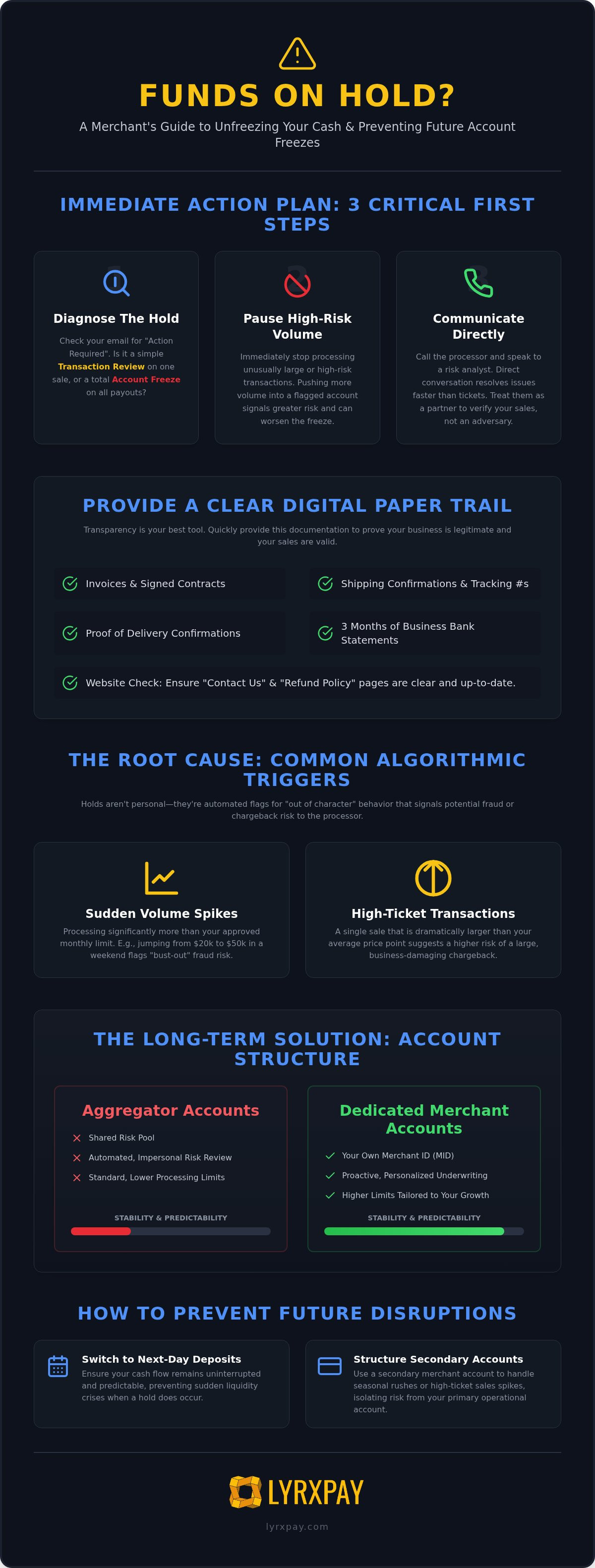
Don't let the initial shock paralyze your operations. If you’re staring at a frozen dashboard, knowing what to do when a payment processor holds your funds starts with a calm, tactical assessment of the damage. Your first task is to determine if you’re dealing with a single transaction review or a full account freeze. A transaction review is a minor speed bump where one large sale is paused for verification. An account level freeze is a total halt on all payouts. You’ll find the answer in your inbox. Search for a "Review" or "Action Required" notice, as this email contains the specific case ID and the list of documents the risk department needs to see.
Stop processing any high risk or unusually large transactions through the affected account immediately. Pushing more volume into a flagged account is like pouring gasoline on a fire; it signals to the algorithm that you’re trying to cash out before a total shutdown. Instead, pick up the phone. While support tickets are standard, speaking directly to a risk analyst can resolve misunderstandings that would take days to settle via email. As an intermediary, a Payment service provider is legally bound to monitor for fraud, so treat this as a collaborative audit rather than an interrogation.
Documenting Your Legitimacy
Transparency is your greatest asset. You need to prove that the sales are real and the customers are satisfied. Gather your digital paper trail immediately to show you have the infrastructure to support your volume. Knowing what to do when a payment processor holds your funds is about more than just sending an email; it’s about presenting a professional front that mirrors the stability of your business.
- Invoices and signed contracts: Provide the specific billing details for the flagged transactions.
- Shipping confirmations: Include tracking numbers that show the product is in transit.
- Proof of delivery: For completed sales, show that the customer has received their order.
- Bank statements: Prepare your last three months of statements to show consistent operating capital.
Also, check your website. Ensure your "Contact Us" page and "Refund Policy" are easy to find and match the details on your merchant application. Risk analysts often visit your site to verify you’re a legitimate operation before they release any cash.
The Communication Protocol
How you communicate determines how fast your cash is released. Keep a detailed log of every interaction. Write down ticket numbers, the date and time of calls, and the names of every representative you speak with. Ask for a specific timeline for the review completion. Most initial reviews should take 24 to 72 hours. If they can’t give you a date, ask what specific milestone triggers the release. Avoid aggressive language or threats. Treat the risk analyst as a partner. You're helping them verify a sale, not fighting for your life. This professional approach often leads to a faster resolution and a stronger reputation with the processor.
The Root Cause: Why Processors Pause Your Cash Flow
Risk management is the engine behind every fund hold. Every time you process a sale, your processor assumes a level of liability. If a customer disputes a charge, the processor is on the hook for those funds if your business cannot cover the reversal. This is why they monitor your account for "out of character" behavior. Learning what to do when a payment processor holds your funds starts with understanding that these triggers aren't personal; they're algorithmic. It isn't just about a single transaction; it's about the patterns that signal potential instability to a risk analyst's dashboard.
Sudden spikes in processing volume are the most common culprits. If your approved monthly limit is $20,000 and you suddenly process $50,000 during a holiday rush, the system flags the activity as a potential "bust-out" fraud. High-ticket transactions also cause friction. A single sale that is significantly larger than your average price point suggests a higher risk of a large chargeback. This cautious approach is reinforced by regulatory expectations, such as the Payment Processor Relationships Revised Guidance, which requires financial institutions to monitor for suspicious activity and maintain reserves. To avoid these automated traps, many businesses move to a dedicated merchant account that offers higher limits and more personalized underwriting.
New Account Probation Periods
If you've just opened your account, expect a "honeymoon" period that feels more like an interrogation. First-time deposits are often held for 7 to 10 days while the processor verifies your business legitimacy. You can shorten this window by providing "proof of business history," such as previous processing statements or tax returns from a previous provider. Incomplete "Know Your Customer" (KYC) documentation is another major hurdle. If your ID, business license, or address verification is missing or outdated, the risk department will pause payouts until the file is complete. Speeding up this process requires proactive transparency and a complete paper trail.
Chargeback Thresholds and Risk Signals
Processors live and die by the "1% Rule." Traditionally, if your chargeback-to-sales ratio exceeds 1%, your account is flagged for an automatic hold. While 2026 standards have shifted slightly, such as Visa’s "Excessive" threshold moving to 1.5% as of April 1, 2026, the principle remains the same. High ratios indicate poor customer service or potential fraud. Suspicious patterns, like "credit card testing" where dozens of small, rapid transactions occur, will also trigger an immediate freeze. If you operate in a high-risk industry, processors may even require a mandatory reserve to cover the $110 average cost of a chargeback, which includes lost merchandise and operational fees. Inconsistent patterns, such as a dormant account suddenly becoming active with high-volume sales, are also immediate red flags for risk teams.
Aggregators vs. Dedicated Merchant Accounts: The Hold Factor
Most business owners don't realize they've joined a giant financial "pool" when they sign up for popular apps like Square, Stripe, or PayPal. These companies are payment aggregators. They offer instant approval because they perform underwriting after you start processing sales. This business model is a primary reason why you might find yourself searching for what to do when a payment processor holds your funds. They let you in the door immediately, but the real security check happens while you're already operating. If your sales pattern doesn't perfectly match their automated risk profile, the algorithm pulls the emergency brake on your payouts.
Dedicated merchant accounts operate on the opposite philosophy. They perform thorough underwriting before you ever swipe a card. While this makes the initial setup take a few days longer, it provides a massive layer of protection for your liquidity. Because the processor already understands your business model, seasonal spikes and high-ticket sales are expected rather than flagged as suspicious. While aggregators prioritize their own speed, they often face significant pressure from regulators. For example, a recent Federal Trade Commission enforcement action highlights how the government monitors processors for unfair practices, making it even more important for you to have a transparent, stable relationship with a provider who knows your name.
Why Aggregators Freeze Accounts More Often
Aggregators use a "Batch Risk" model. They manage risk across their entire user base rather than evaluating you as an individual partner. If another merchant in a similar industry category commits fraud or sees a massive spike in chargebacks, the aggregator's AI might tighten the screws on every account in that "batch" to protect the processor's bottom line. You aren't being judged on your own merits; you're being judged by the company you keep. When a hold occurs, you're often left dealing with faceless support tickets and automated replies. There is no dedicated account manager to review your specific situation or advocate for your cash flow.
The Benefit of Pre-Underwritten Accounts
A dedicated account offers a concierge style of service that aggregators simply cannot match. By completing a thorough application process upfront, you set realistic processing expectations. This proactive transparency prevents "false positive" risk flags that lead to frozen funds. You can negotiate customized processing limits that grow with your business, ensuring that a record-breaking sales month is celebrated rather than punished. If you're tired of the uncertainty that comes with "instant" accounts, it's time to consider Choosing the Right Merchant Account for Your Business to secure your long-term operational health.
Strategies to Release Frozen Funds Faster
Speed is your only priority when your liquidity is on the line. While automated systems are designed to be cautious, they're often rigid. If you want to know what to do when a payment processor holds your funds, you must move beyond the standard support ticket. Start by requesting a "Manual Review." This forces a human risk analyst to look at your account rather than letting an algorithm make the final decision. When you get that analyst on the line, provide customer-signed sales receipts and delivery confirmations for every flagged transaction immediately. Showing that the product is already in the customer's hands significantly lowers the processor's perceived risk of a chargeback.
Using Integrated Bookkeeping as Leverage
Clean accounting records are your most powerful negotiation tool. If you use All-in-One Business Financial Solutions that integrate your processing with QuickBooks or Xero, you can provide instant transparency into your financial health. Sharing your Profit and Loss (P&L) statements demonstrates that your business is stable and has the operating capital to cover potential disputes. Risk departments are looking for "skin in the game." By showing a healthy balance sheet, you prove that you aren't a "fly-by-night" operation, which often leads to a much faster release of held cash. This paper trail turns a vague suspicion into a verified business partnership.
Negotiating Fund Release
If the processor refuses a full release, don't walk away empty-handed. Negotiate a compromise. Offer to established a "Rolling Reserve," where the processor keeps a small percentage (typically 5% to 10%) of your sales for a set period to cover potential risks while releasing the bulk of your funds immediately. This shows you're willing to share the risk. You can also propose a partial release specifically to cover essential operational costs like payroll or inventory. Providing proof of alternative funding, such as a business credit line, can further satisfy their concerns about your ability to handle reversals. If the stalemate continues, involving a merchant advocate can help bridge the gap between your needs and the risk department's requirements.
Ready to move to a partner that prioritizes your cash flow with personalized support? Switch to a dedicated merchant account and stop letting algorithms dictate your business success.
Optimizing Business Liquidity to Prevent Future Disruptions
Recovery is only the first half of the battle. Once you've successfully navigated a hold, your focus must shift toward building an operational fortress that prevents a repeat performance. True financial health means minimizing the "cash-in-transit" window. When your revenue sits in a processor's system for three to five days, you're essentially providing an interest-free loan while carrying all the risk. Transitioning to a partner that offers next-day deposits is the most effective way to protect your liquidity. By shortening the settlement cycle, you ensure that even if a hold occurs, it only affects a fraction of your weekly revenue rather than your entire operating budget.
Don't put all your eggs in one basket. Diversifying your processing is a sophisticated strategy that many growing businesses overlook. By maintaining a secondary merchant account specifically for high-ticket sales or seasonal spikes, you create a safety valve. If one account is flagged for a review, your primary cash flow continues through the other. It's also vital to implement Level 2 and Level 3 data processing for B2B transactions. Providing this extra layer of detail, such as tax IDs and commodity codes, gives the bank more confidence in the legitimacy of the sale, which naturally lowers the probability of an automated freeze.
The Power of Next-Day Deposits
Speed is a security feature. Faster settlement cycles improve your overall liquidity and drastically reduce the impact of any single hold. In the 2026 landscape, next-day deposits have become the gold standard for modern merchant services. When you have immediate access to your funds, you can reinvest in inventory or cover payroll without the anxiety of waiting on a faceless aggregator. To see how these speeds fit into your broader strategy, explore our guide on Business Liquidity Management Tools. Reducing the time your money spends in limbo is the best way to stop wondering what to do when a payment processor holds your funds.
Proactive Risk Management
Your processor shouldn't be a mystery. Proactive communication is the key to a "concierge" experience. If you're expecting a massive sales month or a one-time high-ticket invoice, tell your account manager first. Setting up "High-Ticket Alerts" allows the risk department to pre-approve the volume before the transactions even hit your dashboard. This human-centric approach turns potential red flags into green lights. Beyond stability, this level of detail often helps in How to Lower Merchant Fees by proving you're a low-risk, transparent partner. A dedicated support team that understands your seasonal cycles is your best defense against the rigid, automated algorithms that plague the industry.
Secure Your Cash Flow and Protect Your Growth
A fund hold doesn't have to be a death sentence for your business. By moving from reactive panic to tactical management, you can regain control over your hard-earned revenue. Remember that knowing what to do when a payment processor holds your funds is fundamentally about transparency. Start with a manual review, provide a clear paper trail through your integrated bookkeeping, and consider a dedicated merchant account to avoid the automated traps of faceless aggregators. You've worked too hard to let a rigid algorithm stall your momentum.
We provide the tools you need for maximum liquidity, including next-day deposits, lower merchant fees, and seamless QuickBooks or Xero integration. Stop worrying about frozen funds; switch to LyrxPay for dedicated support and next-day deposits. Your liquidity is the lifeblood of your operation; let's make sure it stays exactly where it belongs. You deserve a partner who advocates for your success every step of the way.
Frequently Asked Questions
How long can a payment processor legally hold my funds?
Payment processors can legally hold your funds for 90 to 180 days, which typically aligns with the window customers have to dispute a transaction. While this duration feels excessive, it's a standard risk mitigation tactic. If you're wondering what to do when a payment processor holds your funds for longer, review your merchant agreement for specific reserve clauses that outline their right to retain capital for potential liabilities.
Can I still process new sales while my current funds are on hold?
It depends on whether you have a specific transaction hold or a full account freeze. If it's a single transaction review, you can usually continue processing new sales. However, if your entire account is under review, your processing privileges are often suspended until you provide the requested documentation. We recommend stopping high volume activity immediately during any review to avoid triggering further risk alerts that could lead to a permanent termination.
What is the difference between a fund hold and a rolling reserve?
A fund hold is a temporary freeze on your entire balance while a risk analyst reviews specific activity. In contrast, a rolling reserve is a pre-negotiated percentage, often 5% to 10%, that the processor holds from every sale for a set period, like 60 days. Rolling reserves are common in high risk industries or for businesses with seasonal spikes, providing a predictable safety net rather than an unexpected total payout halt.
Will my payment processor notify me before they freeze my account?
Most processors don't provide advance notice before freezing an account because they want to prevent flight risk, where a merchant might try to withdraw all funds before a hold is placed. You'll typically receive an automated email the moment the hold is triggered. This lack of communication is a hallmark of faceless aggregators, which is why having a dedicated merchant account with a personal manager is vital for proactive risk management.
How can I avoid holds on high-ticket B2B transactions?
You can avoid holds on high-ticket B2B transactions by implementing Level 2 and Level 3 data processing. This requires providing additional transaction details, such as tax IDs and commodity codes, which validates the sale's legitimacy to the bank. Additionally, notifying your account manager before processing an unusually large invoice allows them to pre-verify the transaction, ensuring your liquidity remains intact and your deposit schedule stays on track for the next business day.
Can I switch processors while my funds are currently being held?
You can certainly switch to a new provider while your current funds are being held, but the new processor can't force the old one to release your money. Your frozen balance will remain with the original provider until the review period ends. Moving to a dedicated account with next-day deposits while your old funds are trapped can help you maintain operations and prevent further cash flow disruptions while you resolve the existing dispute.
Does QuickBooks integration help prevent payment holds?
Yes, QuickBooks integration is a powerful tool for preventing and resolving holds. By linking your accounting software directly to your merchant account, you provide an instant, transparent paper trail that risk departments use to verify your business health. When you can show real-time Profit and Loss statements and inventory records, risk analysts are much more likely to view your volume spikes as legitimate growth rather than suspicious activity or potential fraud.
What should I do if my processor refuses to release my funds after 90 days?
If your processor refuses to release your funds after 90 days without providing a clear reason or proof of pending chargebacks, you should escalate the matter. Start by filing a formal complaint with the Better Business Bureau and the Consumer Financial Protection Bureau. If the amount is significant, you may need to involve a merchant advocate or legal counsel to review the contract. Transparency remains your best defense when determining what to do when a payment processor holds your funds indefinitely.