
How to Negotiate Credit Card Processing Fees: The 2026 Business Strategy

What if the most profitable hour you spend this year isn't spent closing a new deal, but rather learning how to negotiate credit card processing fees for the one you already have? It's exhausting to open your monthly statements only to find a maze of opaque fees and charges that didn't exist when you first signed. With the average merchant discount rate sitting at 2.22%, every basis point matters for your liquidity. You might feel trapped by expensive hardware contracts or frustrated by hidden costs that appear months after you've locked in your rate. If you feel like your processor is a barrier instead of a partner, you aren't alone.
Protecting your revenue in 2026 requires more than just a passing glance at your overhead. We're here to help you move from confusion to total confidence. In this guide, you'll learn how to master negotiation to eliminate junk fees and optimize your pricing model for efficiency. We'll provide a clear script for your next call, explain how to leverage Level 3 data for lower B2B rates, and show you how a managed care approach to your payments finally lets you focus on your craft.
Key Takeaways
- Distinguish between non-negotiable interchange costs and the processor markups that are fully open to negotiation.
- Master how to negotiate credit card processing fees using a simple "Effective Rate" formula to spot hidden inconsistencies on your merchant statement.
- Leverage your processing volume and competitive offers as bargaining chips to eliminate junk fees and secure more favorable pricing models.
- Reduce expenses for B2B transactions by utilizing Level 2 and Level 3 data or switching high-value payments to lower-cost ACH processing.
- Partner with a dedicated merchant advocate to manage complex administrative tasks, ensuring next-day deposits and seamless software integration.
The Hidden Anatomy of Payment Processing Costs
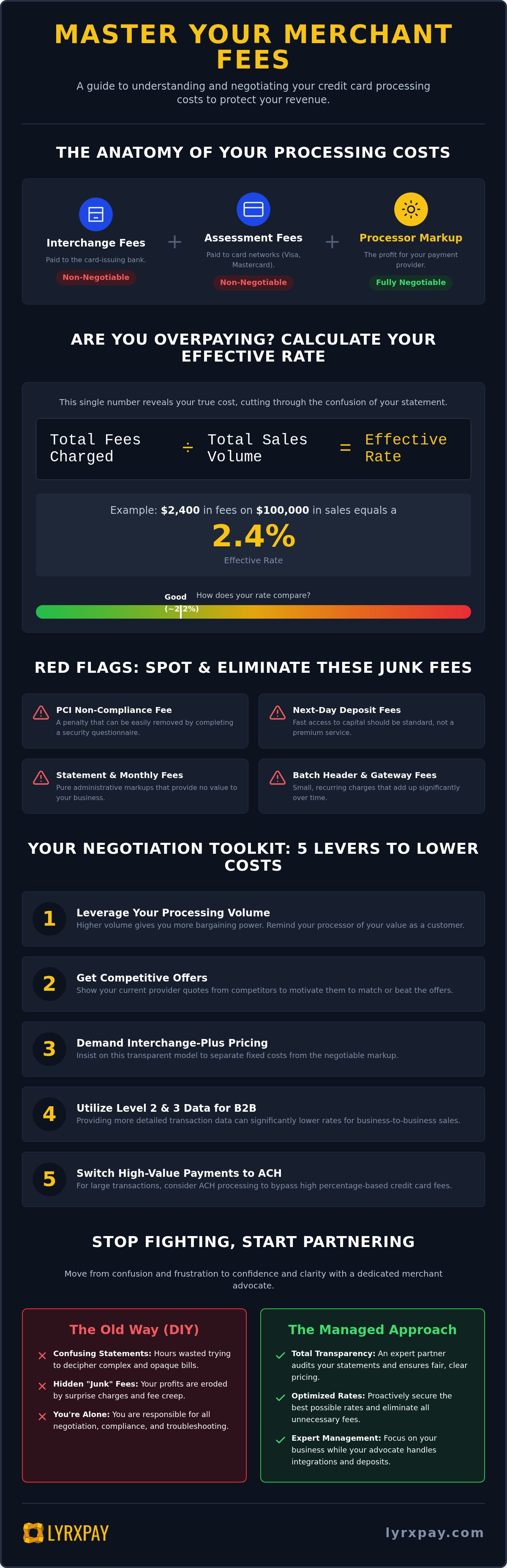
Understanding the layers of your merchant statement is the first step in learning how to negotiate credit card processing fees. Most providers present a single, confusing number, but your costs actually consist of a three-tier structure. First, there are Interchange fees, which are paid to the bank that issued the customer's card. Second, you have Assessment fees, which go directly to card networks like Visa or Mastercard. Finally, there is the Processor Markup. This is the only portion where your provider makes a profit, and it's the only part that is truly flexible.
Many business owners choose "Flat Rate" pricing because they want simplicity. It sounds great until you realize this model often hides the highest margins in the industry. Processors set these rates high enough to cover the most expensive rewards cards, meaning you pay a premium even when a customer uses a basic debit card. This "fee creep" creates a significant emotional toll. It's frustrating to watch your hard-earned liquidity vanish into opaque charges that don't seem to provide any real value to your operations.
Fixed vs. Negotiable: Know Your Battleground
The card networks set the base rates. You cannot change these wholesale costs. However, the Processor Markup is your primary area for negotiation. If you look at your statement and see "Junk Fees" like statement fees, monthly minimums, or PCI non-compliance charges, you're looking at pure profit for the provider. Identifying these line items gives you the leverage you need. When you know how to negotiate credit card processing fees, you start by demanding the removal of these unnecessary administrative costs that serve no functional purpose for your business.
The 2026 Transparency Standard
In 2026, modern merchants are moving away from traditional tiered "Qualified" and "Non-Qualified" models. These structures are often designed to be confusing, allowing processors to hide price hikes behind vague categories. The industry is shifting toward Interchange-Plus as the gold standard for honest pricing. This model separates the non-negotiable costs from the markup, giving you total clarity. While the base rate for a card is fixed, the "category" it falls into can often be optimized through better data submission. AI-driven auditing tools are now making it impossible for providers to hide these fees, giving you more power than ever to demand a fair deal.
How to Audit Your Merchant Statement for Leverage
Walking into a negotiation without data is like trying to find your way in the dark. You need a clear map of what you're currently paying before you can demand better terms. Learning how to negotiate credit card processing fees starts with a cold, hard look at your actual numbers. Most processors rely on the fact that these statements are intentionally difficult to read. By preparing an "Audit Packet" consisting of your last three months of statements, you move from a state of curiosity to a state of total confidence.
Start by comparing your initial quote to your actual bill. It's common to find that the "teaser rate" you signed up for has been buried under layers of new surcharges. If you're tired of doing the heavy lifting yourself, you can work with a merchant advocate who audits these statements for you. Identifying these discrepancies is your strongest leverage. It proves you're paying attention, which immediately changes the dynamic of the conversation with your provider.
Calculating Your True Effective Rate
Ignore the individual line items for a moment and focus on the big picture. To find your true cost, take the total fees charged and divide them by your total processing volume. For example, if you paid $2,400 in fees on $100,000 of sales, your effective rate is 2.4%. In 2026, a "good" rate for retail typically hovers around 2.2%, while professional services or e-commerce might see slightly higher averages due to card-not-present risks. The effective rate is the only metric that truly matters for your bottom line.
Red Flags in Modern Processing Statements
When you dig into the fine print, several red flags often emerge. Watch out for "Batch Header" fees or excessive "Gateway Fees" that seem to increase every few months. These are often small amounts, perhaps only 10 to 25 cents per batch, but they add up over a year of transactions. They're essentially administrative markups that provide no extra security or speed for your business.
- The PCI Non-Compliance Trap: If you see a monthly fee for PCI non-compliance, you're paying a penalty that can be eliminated immediately by completing a simple security questionnaire.
- Next Day Deposit Fees: In 2026, fast access to your capital shouldn't be an extra line item. If you're being charged for the privilege of seeing your own money, it's time to push back.
- Ancillary Service Charges: Look for "Club Fees" or "Support Packages" you never requested. These add zero value to your actual processing.
Once you've identified these "junk fees," add them to your audit packet. You now have a list of specific, non-essential costs that you can use as a starting point for your negotiation. This data-driven approach turns a stressful task into a structured business strategy.
Strategic Negotiation Tactics for Better Rates
Negotiation isn't just about asking for a lower number. It's about demonstrating your value as a merchant and proving you understand the mechanics of the industry. Your processing volume is your strongest bargaining chip, but it only carries weight when backed by a "Comparison Quote" strategy. By bringing a competing offer to the table, you force your current provider to match the terms or risk losing a stable revenue stream. Why settle for a generic discount when you can demand wholesale access? Learning how to negotiate credit card processing fees effectively means asking for the raw interchange cost plus a small, fixed markup, rather than a vague percentage that hides extra profit for the processor.
Demand a "No-Contract" agreement as a non-negotiable term. If a processor is confident in their service quality and pricing, they shouldn't need to trap you with a three-year commitment or expensive hardware leases. This ensures they continue to earn your business every single month. If they refuse to remove the term limits, it's a clear signal that they prioritize their own security over your operational health. This proactive stance positions you as an equal partner in a shared mission rather than a mere transaction.
Choosing the Right Pricing Model
Tiered pricing is almost always a losing game for the merchant. It allows the processor to categorize transactions as "Non-Qualified" at their own discretion, leading to unpredictable costs. Instead, request a transition to a more transparent model like Interchange-Plus or Subscription pricing. Interchange-Plus is the 2026 standard for honesty, showing you exactly what the card networks charge and what the processor earns. If your business handles high volumes, a subscription model might save you even more by replacing percentage markups with a flat monthly fee.
The "Concierge" Approach to Negotiation
You don't have to do this alone. Using a partner to negotiate on your behalf saves time and ensures you don't miss the fine print that leads to "fee creep" later. When you draft your "Request for Proposal," be specific about your integration needs, especially with software like QuickBooks. Ask how the provider handles the technical support gap during the transition phase. A true advocate manages these administrative burdens for you, allowing you to focus on your craft while they defend your resources. Knowing how to negotiate credit card processing fees is as much about choosing the right allies as it is about the numbers on the page.
5 Operational Levers to Lower Costs Today
Negotiation is often viewed as a one-time conversation with a sales representative. In reality, structural optimization of your daily workflow provides more sustainable relief than a simple discount. By pulling specific operational levers, you change the risk profile of your transactions, which encourages the networks to offer lower rates. This is the secret to how to negotiate credit card processing fees without even picking up the phone. When your business is optimized, you aren't just asking for a favor; you're proving that you deserve a better rate based on the quality of your data.
Mastering Level 2 and Level 3 Data
When you process a B2B transaction, the card networks look for specific data points to verify the legitimacy of the sale. If you provide extra information like purchase order numbers and tax data, you're seen as a lower-risk merchant. Standard interchange rates are significantly higher than Level 3 rates, which can slash your costs by a substantial margin. Many small businesses ignore this because they think it's only for large corporations, but automation makes it accessible for everyone. You can start by integrating Level 3 B2B rates into your QuickBooks invoices to ensure every qualified transaction automatically hits the lowest possible price point.
The ACH Advantage for Large Invoices
Percentage-based fees are a disaster for four and five-figure invoices. If you're paying a standard credit card rate on a $20,000 payment, you're losing hundreds of dollars just to move money. Transitioning these high-value clients to secure ACH processing replaces those steep percentages with a small, flat fee. This shift protects your cash flow without disrupting the client experience. For a step-by-step implementation plan, refer to The Ultimate Guide to B2B Payments.
Beyond data and ACH, you must address the "Card Not Present" risk. Using advanced verification tools like 3D Secure or enhanced address verification reduces the likelihood of chargebacks and costly downgrades. Additionally, you should batch your transactions daily. If you wait too long to settle, the networks may penalize you with higher settlement rates because the transaction data is considered "stale." Finally, integrating your payments directly with QuickBooks eliminates the manual reconciliation labor that quietly drains your administrative budget every month.
If you're ready to stop the fee creep and start building a more efficient payment ecosystem, partner with a merchant advocate who handles the heavy lifting for you. This managed care approach ensures you're always using the most efficient levers to protect your bottom line in 2026.
LyrxPay: Your Partner in Transparent Processing
LyrxPay acts as a dedicated merchant advocate, standing between you and the complex world of financial institutions. While learning how to negotiate credit card processing fees is a vital skill for any owner, we believe you shouldn't have to fight these battles alone. We position ourselves as a defender of your time and resources, ensuring that "fee creep" doesn't erode your margins while you're busy growing your brand. By providing a concierge level of support, we move the conversation away from a cold transaction and toward a dependable professional relationship.
Beyond Just a Transaction: A Financial Relationship
Our approach is rooted in "managed care" for your business operations. We don't just set up an account and disappear; we proactively anticipate your administrative needs. We handle the heavy lifting of merchant account optimization, ensuring your pricing model remains efficient as your volume grows. This partnership saves hours of back-office work through expert QuickBooks and Xero integration. When your payments and bookkeeping are seamlessly linked, you eliminate the hidden labor cost of manual reconciliation. You shouldn't have to spend your weekends researching how to negotiate credit card processing fees just to keep your margins; we do that work for you.
Modern Solutions for Modern Merchants
Liquidity is the lifeblood of any growing enterprise in 2026. We offer next-day deposits to ensure your capital is always where it belongs, which is in your bank account. This is a critical component of business liquidity management, allowing you to reinvest in your craft without waiting for the standard processing windows that slow down your momentum. Our commitment to lower fees and transparent pricing means you never have to guess what you're paying or why.
Ready to see the difference that a results-oriented partnership can make? We start by performing a thorough audit of your current merchant statements to find the inconsistencies and junk fees that are draining your bottom line. We provide the clarity you need to move forward with total confidence. Let us manage the complexity of your payment ecosystem so you can focus on the work you love. Reach out today to start your audit and secure a partner who is as invested in your operational health as you are.
Secure Your Bottom Line with Data-Driven Confidence
You now have the roadmap to move from a state of frustration to one of total control. By auditing your effective rate and leveraging operational tools like Level 3 data, you've mastered the mechanics of how to negotiate credit card processing fees like a seasoned strategist. Protecting your revenue in 2026 isn't just about a one-time conversation; it's about building a payment ecosystem that works for you, not against you. When you align your processing with your actual business workflow, you eliminate the fee creep that quietly drains your resources.
If you're ready to stop the administrative headache and return your focus to your craft, let us act as the defender of your time. Stop overpaying for credit card processing—get your free fee audit from LyrxPay today. Our team of QuickBooks and Xero experts provides a lower-fee guarantee and next-day deposits to keep your cash flow moving fast. You've already done the heavy lifting by learning the anatomy of your statements. Now, it's time to partner with an ally who treats your operational health as a shared mission.
Frequently Asked Questions
Can I really negotiate my credit card processing fees with a big bank?
Yes, you can absolutely negotiate with major financial institutions. Banks often rely on the assumption that business owners won't challenge their standard rates. If you present a clear audit of your processing volume and a lower competing offer, they'll frequently lower their markup to retain your business. It's helpful to remember that you're a valuable client; they'd rather keep a slightly lower margin than lose your account entirely to a more transparent competitor.
What is a "good" markup percentage over interchange in 2026?
A competitive markup typically ranges between 0.10% and 0.50% depending on your industry and monthly volume. For high-volume businesses, this number should be on the lower end of that scale. If your processor is charging a markup higher than 0.60%, you're likely paying for administrative bloat rather than actual service value. Understanding how to negotiate credit card processing fees effectively means focusing on this specific markup rather than the total rate.
How much can I save by switching to Level 3 processing for B2B?
Switching to Level 3 processing can reduce your interchange costs by approximately 0.50% to 1.00% per transaction on qualified corporate cards. This is possible because providing extra data points, such as tax IDs and invoice numbers, lowers the perceived risk for the card networks. For a B2B company doing significant volume, these savings translate into thousands of dollars in annual profit that would otherwise be lost to standard, high-risk interchange categories.
Are there any fees that are absolutely non-negotiable?
Interchange fees and card network assessment fees are non-negotiable because they're set directly by Visa, Mastercard, and the issuing banks. No processor has the power to change these wholesale costs. However, every other line item on your statement is a processor-controlled fee. This includes the markup, monthly service charges, and any "junk fees." Focus your energy on negotiating the parts of the bill where your provider actually has the authority to make changes.
How do I identify "junk fees" on my merchant statement?
Junk fees are often disguised under vague labels like "Statement Fee," "Monthly Minimum," or "Regulatory Product Fee." Another common trap is the "PCI Non-Compliance Fee," which is a penalty you shouldn't be paying if your security questionnaire is up to date. If a fee doesn't directly relate to a specific transaction or a necessary security service, it's likely a profit center for the processor. Identifying these items is a critical step in how to negotiate credit card processing fees.
Is it better to have a flat-rate or an interchange-plus pricing model?
Interchange-plus is almost always the superior choice for established businesses seeking transparency. While flat-rate models seem simple, they often hide high margins because the processor sets a single rate high enough to cover the most expensive rewards cards. Interchange-plus separates the actual cost from the processor's markup, ensuring you pay less when a customer uses a low-cost debit card. This model provides the clarity needed to manage your business liquidity more effectively.
How long does it typically take to see savings after renegotiating?
You should see the impact of a successful negotiation on your very next monthly statement. Most processors can update your fee schedule in their system within 24 to 48 hours. If you're switching to a new provider for better rates, the savings are immediate once you begin processing through the new account. It's a fast way to improve your bottom line without needing to increase your sales or change your core business operations.
What happens to my POS hardware if I switch processors for lower fees?
Many modern POS terminals are "unlocked" and can be easily reprogrammed to work with a different processor. If your hardware is proprietary or locked to a specific provider, a new partner will often provide updated equipment as part of the transition. A dedicated merchant advocate handles the technical heavy lifting for you, ensuring that your point-of-sale software and hardware remain operational so you don't experience any downtime during the switch.