
Outsourced Bookkeeping Costs: 2026 Small Business Guide

Every hour you spend wrestling with a complex spreadsheet is an hour you aren't closing a deal or growing your team. You likely started your business to build something great, not to become an accidental, unpaid bookkeeper. It's frustrating when messy records lead to audit anxiety; it's even worse when "surprise" bills from traditional firms make your monthly budgeting impossible. Because of these challenges, calculating the cost of outsourced bookkeeping for small business is the first step toward reclaiming your weekends and your peace of mind.
If you feel buried under a mountain of receipts, then it's time to look at the numbers. We agree that you need more than just a data entry clerk; you need a scalable system that offers predictable fees and total transparency. This guide provides the real-world costs of outsourcing your books and shows you how to choose a service that grows alongside your success. You'll discover how to move from chaotic records to clean, tax-ready financials every single month.
We'll break down current market rates for various service levels, compare the hidden expenses of in-house hiring, and explain how integrating your sales data creates the operational clarity you've been missing.
Key Takeaways
- Stop guessing your overhead by moving from unpredictable hourly billing to a transparent, flat-fee model that secures your monthly budget.
- Evaluate how the cost of outsourced bookkeeping for small business is shaped by your transaction volume and the number of accounts you need to reconcile.
- Avoid the "Founder Trap" by calculating the high price of DIY errors compared to the efficiency of professional, tax-ready financial management.
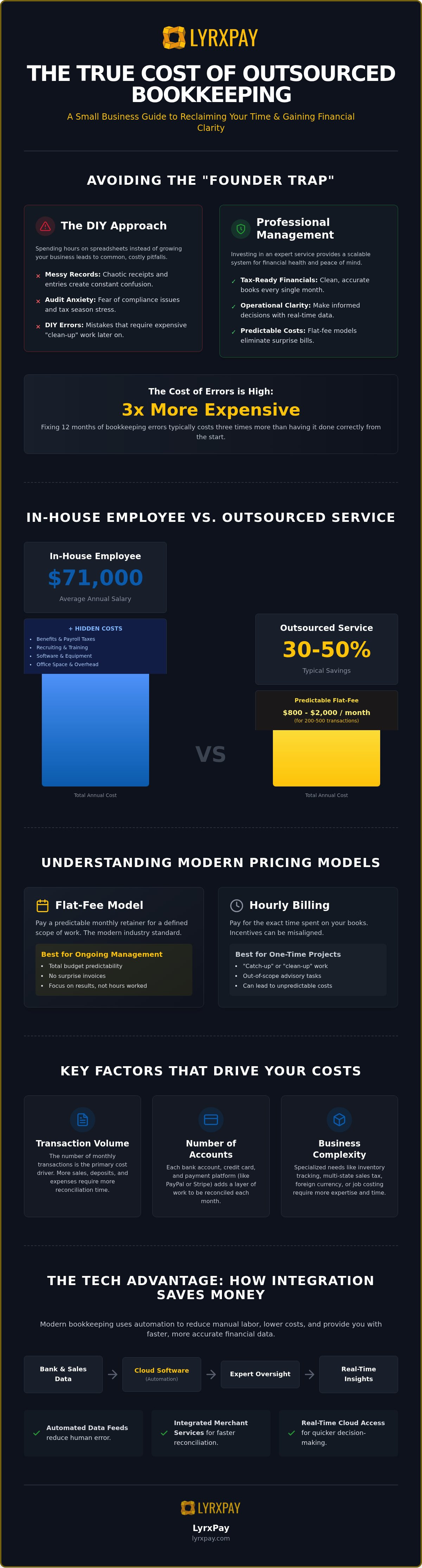
- Weigh the $71,000 average in-house salary against the 30% to 50% savings typically found through a remote, professional partnership.
- Streamline your operations by integrating merchant services and next-day deposits directly into your bookkeeping workflow for faster, more accurate reconciliation.
Understanding the Cost Structure of Outsourced Bookkeeping
Outsourced bookkeeping is a professional, remote service that manages your daily financial records, reconciliations, and reporting without the overhead of a full-time hire. In 2026, this model has evolved beyond simple data entry. It now functions as a strategic partnership where experts use cloud-based tools to keep your books "audit-ready" every day. The cost of outsourced bookkeeping for small business owners is no longer a mystery of billable hours; it's a transparent investment in your company's operational health.
Why has the industry shifted? Traditional hourly billing often created misaligned incentives where the slower a bookkeeper worked, the more they earned. Today, value-based pricing is the standard. This means you pay for results, such as accurate monthly statements and reconciled accounts, rather than just the time spent clicking buttons. If you choose a "cut-rate" service to save a few dollars now, you'll likely face a massive "cleanup" bill during tax season. Fixing twelve months of errors usually costs three times more than doing it right the first time.
Flat-Fee vs. Hourly Billing Models
Predictability is the greatest advantage of the modern flat-fee model. When you know exactly what your monthly retainer is, you can manage your cash flow with total confidence. You don't have to worry that a complex month of high transaction volume will result in a surprise invoice that drains your operating account. Hourly billing still has its place, however, specifically for one-time projects like "catch-up" work if your records have been neglected for several months. For most growing companies, a hybrid model combines a steady monthly fee for recurring tasks with clearly defined hourly rates for occasional, out-of-scope advisory projects.
The Impact of Software on Pricing
Technology is the primary driver of efficiency in 2026. Automation through leading cloud accounting platforms has significantly reduced the manual labor required for bank reconciliations. Modern services often bundle these software subscription costs directly into your monthly service agreement, providing a single, simplified invoice. This "all-in-one" approach ensures you aren't managing multiple tech bills while also paying for professional oversight.
- Automated Data Feeds: Direct links between your bank and accounting software reduce human error and lower the total labor hours required.
- Integrated Merchant Services: When your sales data flows directly into your ledger, the cost of outsourced bookkeeping for small business management decreases because there's less manual matching to do.
- Real-Time Access: Cloud-based tools allow you and your bookkeeper to view the same data simultaneously, speeding up decision-making and reducing back-and-forth emails.
By leveraging these tools, your bookkeeping partner spends less time on entry and more time ensuring your financial data is clean and actionable. This shift allows you to focus on your craft while they provide the managed care your business deserves.
Key Factors That Drive Bookkeeping Costs
Every business is unique, and so is its ledger. While revenue is a common metric for size, it doesn't always dictate the cost of outsourced bookkeeping for small business operations. Instead, the complexity of your daily activity determines the price. If you have high revenue but only three large invoices a month, your costs stay low. If you run a high-volume retail shop with hundreds of small daily swipes, the labor required to reconcile those entries increases.
Transaction volume is the primary driver. Research shows that for a typical business with 200 to 500 monthly transactions, you should expect to pay between $800 and $2,000 per month for high-quality service. The number of accounts also matters; reconciling one bank account is straightforward, but adding three credit cards, a digital payment platform, and a line of credit adds layers of verification that require more professional time. Finally, financial complexity like inventory tracking, foreign currency, or multi-state sales tax requires specialized knowledge and more frequent oversight to ensure accuracy.
Volume-Based Pricing Tiers
Most firms use tiered pricing to keep costs predictable for their clients. A common entry-level tier might cover up to 100 transactions per month. As your sales scale, your bookkeeping overhead naturally follows. However, if your merchant services are integrated directly with your accounting software, reconciliation time drops significantly. This efficiency can often keep you in a lower pricing tier even as your transaction count grows. You can explore how integrated processing simplifies your books to see this efficiency in action.
Service Depth: Basic vs. Full-Charge Bookkeeping
The scope of work you delegate also moves the needle on your monthly bill. Basic service focuses on bank reconciliation and generating monthly financial statements. This is a great starting point for owners who still want to handle their own billing and vendor payments. Full-charge bookkeeping, however, takes the entire back office off your plate. This includes managing accounts payable, accounts receivable, and complex tasks like payroll.
Integrating payroll solutions into your bookkeeping package often results in a higher monthly fee, but it eliminates the stress of tax compliance and manual data entry. If your bookkeeper is already working inside your financial platform, adding payroll is a logical step that ensures your labor costs are always accurately reflected in your profit and loss statements. Choosing the right depth of service ensures you aren't paying for bells and whistles you don't need while protecting the time you need to lead your company.
The True Cost of DIY Bookkeeping: A Reality Check
Many entrepreneurs view DIY bookkeeping as a way to "save" money during the early stages of growth. However, this is often a financial illusion known as the Founder Trap. When you handle your own ledger, the cost of outsourced bookkeeping for small business isn't just the monthly fee you're avoiding; it's the revenue you're losing by staying away from the front lines. Beyond the math, there's a heavy price for errors. Industry data shows that professional "clean-up" work to fix DIY mistakes typically costs three times more than maintaining accurate records from the start.
There's also the "eyes-on" advantage. A professional bookkeeper doesn't just record data; they spot missed tax deductions that an untrained eye might overlook. They also eliminate the "Sunday Night Stress" of staring at a pile of unorganized receipts. This allows you to walk into your Monday morning with total clarity instead of a mental fog of unreconciled transactions.
Calculating Your Opportunity Cost
To find the real price of your DIY efforts, use a simple framework: multiply the hours you spend on your books each month by your own hourly billing rate. If you spend 10 hours a month on data entry and your time is worth $200 per hour, your "free" bookkeeping is actually costing you $2,000 in lost productivity. Consider what you could achieve if you redirected those 10 hours toward high-value activities:
- Closing new sales contracts with high-value clients.
- Developing new product features or service offerings.
- Strategic networking to build long-term industry partnerships.
Effective business liquidity management suffers when owners are bogged down in paperwork instead of monitoring the cash flow trends that drive growth.
Risk and Compliance Expenses
DIY bookkeeping carries hidden risks that can result in expensive legal and financial penalties. Late filing fees and interest on underpaid taxes can quickly erase any perceived savings from doing it yourself. Beyond the penalties, organized books serve as your best defense during an IRS inquiry. If you're audited, having clean, professional records reduces the billable hours your CPA or attorney must charge to defend your position.
If you plan to apply for a business loan in 2026, lenders require GAAP-compliant financial statements. Professional oversight ensures your books meet these standards, making the cost of outsourced bookkeeping for small business a necessary investment for securing future capital. It's about moving from a state of "guessing" to a state of "knowing" your financial health.
Outsourced Service vs. In-House Employee
Hiring an employee feels like having total control, but it creates a massive financial footprint that many small businesses aren't ready to sustain. In 2026, the national midpoint salary for a full-charge bookkeeper is $71,000. For companies in regions with a higher cost of living, that figure often climbs between $80,000 and $110,000 annually. When you evaluate the cost of outsourced bookkeeping for small business, industry data shows that most companies save between 30% and 50% compared to a full-time in-house hire. This isn't just about the base pay; it's about eliminating the layers of overhead that come with an internal department.
Beyond the salary, you face the "Single Point of Failure" risk. If your solo in-house bookkeeper leaves for a new opportunity or takes an extended leave, your financial visibility vanishes overnight. An outsourced team provides built-in redundancy. If one professional is away, another expert who is already familiar with your account steps in to ensure your records stay current. This model also offers superior scalability; an outsourced partner can adapt to your seasonal peaks or rapid growth phases much faster than you can recruit and train new staff.
The Hidden Overhead of Hiring
A salary is just the starting point for an employee's true expense. To find the "fully burdened" cost, you must multiply that base salary by 1.25 to 1.4. This accounts for employer-paid taxes, health insurance, retirement contributions, and workers' compensation. You also provide office space, furniture, and high-end computer equipment. Perhaps the biggest hidden drain is your own time. You'll spend hours on management, performance reviews, and software troubleshooting. When you factor in individual software licensing costs for internal staff, the total expense often doubles your initial budget.
Quality Control and Expertise
An outsourced firm brings a "collective intelligence" that a single hire cannot match. You aren't just getting one person's perspective; you're getting a team that sees hundreds of different business scenarios every month. This model also builds in a natural separation of duties. By having an external team manage the books while you handle the final approvals, you create a critical internal control that reduces the risk of fraud. You gain access to 2026-level financial advisory and expert oversight without the executive-level price tag. If you want to move toward a leaner, more resilient back office, you can get a custom quote for bookkeeping services tailored to your specific growth goals.
Maximizing ROI: Integrated Bookkeeping and Merchant Services
Bookkeeping doesn't happen in a vacuum; it's the final destination for every dollar that enters your business. If your payment processing and your ledger aren't talking to each other, you're paying for manual labor to bridge the gap. By integrating these systems, you don't just see your numbers; you understand them in real-time. Next-day deposits are a game-changer here. When funds hit your account within 24 hours, reconciliation becomes a daily rhythm rather than a month-end marathon. This speed improves your liquidity and ensures your bookkeeping team is always working with the most current data.
When you evaluate the total cost of outsourced bookkeeping for small business, the "All-in-One" model offers the highest ROI. Bundling your merchant services with your bookkeeping doesn't just reduce the number of vendors you manage; it often reduces the total fees you pay across your entire back office. LyrxPay acts as a concierge for your financial health, ensuring that your POS data flows directly into your accounting software without human intervention. This managed care approach allows you to stop playing catch-up and start looking ahead.
Streamlining the Data Flow
Eliminating manual data entry is the fastest way to lower your administrative overhead. Through direct QuickBooks and Xero integration, every swipe at the register or ACH payment from a client is categorized automatically. If you're looking for ways to fund professional oversight, lowering merchant fees through a strategic review of your processing rates is the perfect place to start. Additionally, shifting more of your B2B transactions to ACH processing can significantly reduce the labor hours spent on accounts receivable, as these payments are easier to track and reconcile than physical checks.
Ready to Scale? Your Next Steps
Transitioning from a DIY "Founder Trap" to a professional outsourced model is a milestone in your business growth. In 2026, you shouldn't settle for a bookkeeper who only looks at your records once a month. Look for a partner who offers total transparency, a modern tech-stack, and proactive support. Your provider should be an advocate for your time, allowing you to step away from the spreadsheets and back into your role as a leader. If you're ready for clean, tax-ready financials and predictable monthly fees, you can get a custom quote for integrated bookkeeping and payment services from LyrxPay today. Moving to a managed care model for your back office is the most efficient path toward sustainable growth.
TAKE CONTROL OF YOUR FINANCIAL FUTURE
Deciding to move away from messy spreadsheets is a defining moment for any growing company. We've shown that the cost of outsourced bookkeeping for small business is far more than a monthly fee; it's a strategic move that eliminates the "Founder Trap" and protects you from expensive tax-season cleanups. By choosing a partner that integrates your merchant services directly with your ledger, you turn your financial data from a source of stress into a tool for rapid decision-making.
You deserve a back office that works as hard as you do. With next-day deposits to boost your cash flow and seamless QuickBooks or Xero integration, you can finally focus on your craft while we handle the heavy lifting. Our transparent pricing ensures you never face hidden merchant fees or unpredictable billing surprises. It's time to stop spending your weekends on data entry and start investing in your company's long-term health. Simplify your business finances with LyrxPay integrated solutions and gain the clarity you need to scale with confidence. Your business is ready for the next level; let's make sure your books are too.
Frequently Asked Questions
Is outsourced bookkeeping cheaper than a full-time employee?
Yes, outsourcing is almost always more affordable for small to mid-sized businesses. You avoid the "fully burdened" expense of a $71,000 median salary plus benefits, payroll taxes, and office equipment. Instead of paying for a full-time presence, you only pay for the professional results and expert oversight your business actually requires to stay compliant and organized.
How much does bookkeeping cost for a very small business with low transaction volume?
For a business with minimal activity, monthly costs typically fall at the lower end of the industry range. Pricing is generally determined by the number of bank accounts and credit cards you need reconciled rather than just your total revenue. This entry-level service provides clean, tax-ready financials without the high price tag of a full-charge accounting department.
Does the cost of bookkeeping include tax preparation and filing?
Usually, monthly bookkeeping and annual tax filing are separate services with distinct fee structures. While your bookkeeper ensures your records are accurate and "audit-ready," a CPA or tax professional typically handles the actual filing. Bundling these services can sometimes offer savings; however, it's important to verify if your specific contract covers only reconciliation or full tax compliance.
Can I reduce my bookkeeping costs by using specific accounting software?
Adopting modern tools like QuickBooks or Xero often leads to a lower cost of outsourced bookkeeping for small business because automation reduces manual labor. When your bank feeds and merchant services are integrated, your professional partner spends less time on data entry. This shift in focus ensures you pay for expert oversight rather than simple administrative tasks.
What is the difference between a bookkeeper and an accountant in terms of cost?
Bookkeepers generally have lower hourly or monthly rates because they focus on daily transaction recording and reconciliations. Accountants or CPAs charge higher fees for tax strategy, auditing, and high-level financial planning. By using a professional bookkeeper for routine tasks and an accountant for year-end strategy, you optimize your professional service budget while maintaining total accuracy.
How often will an outsourced bookkeeper update my financial records?
Most professional services update your records weekly or monthly, though some provide daily syncing for high-volume operations. Frequent updates are essential if you need to make quick decisions based on your current cash position. Choosing the right frequency ensures the cost of outsourced bookkeeping for small business management aligns with your need for real-time financial visibility.
Are there hidden fees I should look for in a bookkeeping service contract?
Watch for "out-of-scope" charges for tasks like historical cleanup, 1099 processing, or additional bank account reconciliations. Some firms also charge extra for software subscriptions or cloud storage that isn't included in the base retainer. Always request a clear definition of work in writing to ensure your monthly fee remains predictable and transparent throughout the year.