
PCI Compliance 2026: Small Business Security Guide

How much of your monthly merchant statement is actually paying for your transactions, and how much is just a penalty for "non-compliance" that you don't fully understand? If you're tired of seeing opaque fees eat into your margins while you're left staring at a confusing list of SAQ requirements, you aren't alone. Most business owners want a secure payment environment but simply don't have the time to become cybersecurity experts. It's a common struggle to balance the fear of a data breach with the reality of a packed schedule.
We believe PCI compliance for small business should be a tool for growth, not a source of administrative stress. This guide will show you exactly how to meet the mandatory PCI DSS 4.0 standards to protect your customer data and, more importantly, stop those unnecessary monthly fees from draining your bank account. We'll explore how to simplify your security scope and integrate these protections seamlessly with your existing operational workflows. By the end of this article, you'll have a clear, jargon-free roadmap to a more secure and profitable business.
- PCI compliance doesn't have to be a burden. Understand the new PCI DSS 4.0 requirements and how they apply to your small business.
- Stop unnecessary fees. Learn strategies to avoid non-compliance penalties and protect your bottom line.
- Simplify your security. Discover how to integrate robust data protection without disrupting your operations or relying on complex, external systems.
- Future-proof your business. Prepare for PCI Compliance 2026 and ensure long-term security and growth.
Key Takeaways
- Eliminate opaque non-compliance fees by identifying how payment processors use security standards as a hidden profit center on your merchant statements.
- Navigate the updated 2026 standards for pci compliance for small business by focusing on the core requirements that actually apply to your specific operations.
- Reduce your technical burden by utilizing integrated POS systems that handle encryption at the point of interaction, keeping sensitive data out of your network.
- Master the two critical steps of compliance: mapping your internal data flow and selecting the correct Self-Assessment Questionnaire (SAQ) for your processing method.
- Learn how a concierge-style support team can turn security from a confusing administrative headache into a seamless part of your daily financial workflow.
The Hidden Cost of Non-Compliance: Why PCI Standards Matter in 2026
Every time you swipe a customer's card, a complex web of security protocols activates to protect that transaction. This framework is governed by the Payment Card Industry Data Security Standard (PCI DSS), a global set of requirements designed to ensure all companies that process, store, or transmit credit card information maintain a secure environment. For many, pci compliance for small business feels like an optional administrative task, but in reality, it's the baseline for your business's survival. If you don't meet these standards, you aren't just risking a data breach; you're actively paying a penalty for your lack of certification.
The year 2026 marks a turning point in how payment processors handle merchant accounts. Many providers have turned non-compliance into a quiet profit center, often referred to as a "convenience tax." They charge monthly fees simply because a merchant hasn't completed their required paperwork or scans. These fees don't buy you extra security; they're essentially a fine for staying in the dark. As cyber-attacks on small businesses become more automated and sophisticated, staying compliant is no longer just about avoiding fees, it's about defending your reputation and your long-term liquidity.
The Financial Penalty of Inaction
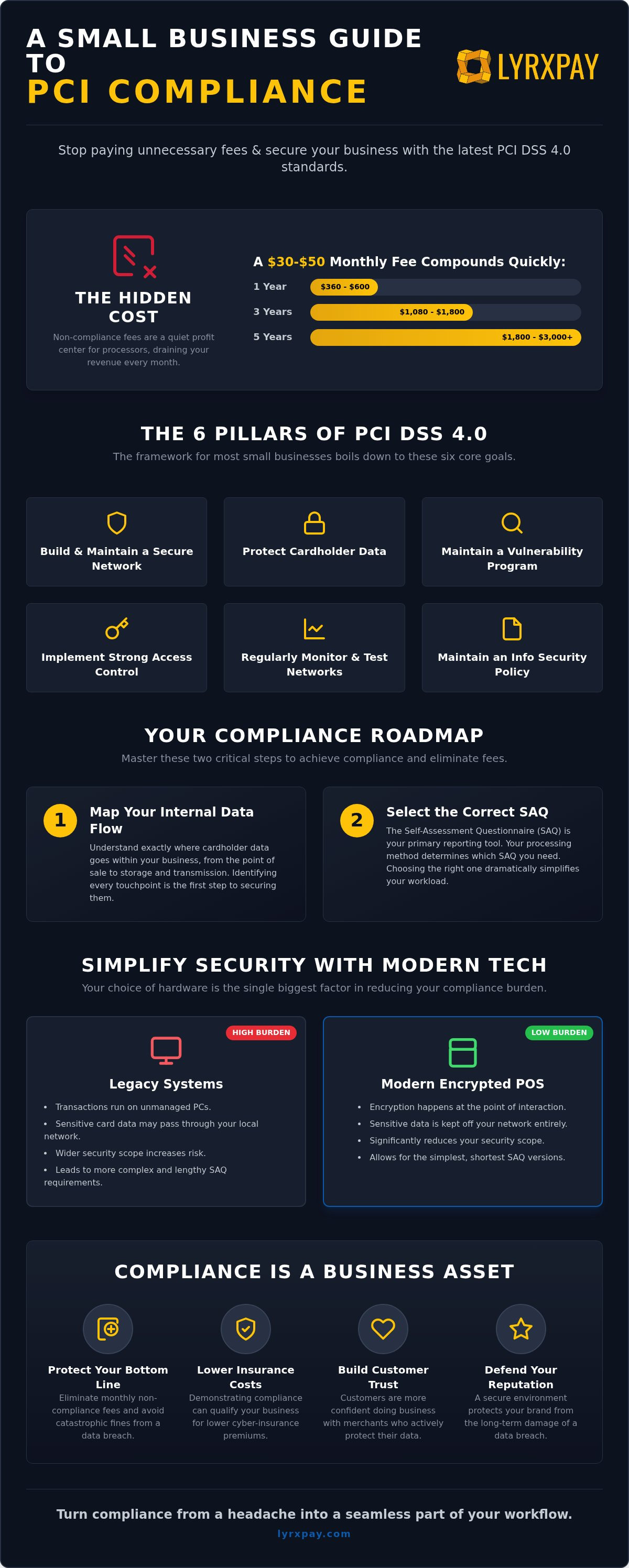
Look closely at your merchant statement. You'll likely find a line item labeled "PCI Non-Compliance Fee" or "PCI Monthly Penalty." While $30 or $50 a month might seem like a minor annoyance, these costs compound quickly. Over a few years, a small business can easily lose thousands of dollars in pure margin to these avoidable charges. Relying on a "set it and forget it" approach to security is a dangerous gamble in 2026. The financial drain of these fees, combined with the escalating cost of data recovery if a breach occurs, makes inaction the most expensive choice you can make. Compliance isn't a one-time event; it's a continuous process that keeps your hard-earned revenue where it belongs: in your business.
PCI Compliance as a Business Asset
Beyond just avoiding fines, pci compliance for small business acts as a powerful risk management tool. When you prove your systems are secure, you often qualify for lower cyber-insurance premiums and build deeper trust with your customer base. Secure processing is a fundamental pillar of all-in-one business financial solutions, ensuring that your growth isn't derailed by preventable fraud. The Self-Assessment Questionnaire (SAQ) serves as the primary reporting tool for small businesses to demonstrate they meet the specific security controls required for their processing environment. By mastering this tool, you move from being a target for predatory fees to being a protected, professional merchant.
Navigating the 2026 PCI Requirements: A Simplified Framework for SMBs
The transition to the latest standards has made 2026 a critical year for business owners to audit their current setups. While the official PCI DSS requirements span hundreds of pages, the framework for most small enterprises boils down to a few manageable pillars. Your hardware choice is the biggest lever you have. If you use a modern, encrypted POS system, your compliance workload is significantly lighter than someone running transactions through an unmanaged PC. Navigating pci compliance for small business doesn't have to be a solo mission through a technical desert.
The 12 core requirements focus on six goals: building secure networks, protecting cardholder data, maintaining vulnerability programs, implementing strong access controls, monitoring networks, and maintaining an information security policy. For e-commerce and merchants with IP-connected terminals, quarterly network scans by an Approved Scanning Vendor (ASV) are mandatory. These scans look for holes in your digital fence that hackers might exploit. It's about proactive defense, not just checking a box on a form.
Understanding Your Compliance Level
Most local shops and growing online stores fall into Level 4. This category is reserved for merchants processing fewer than 20,000 e-commerce transactions annually or up to 1 million total transactions. Your specific hurdles depend largely on whether you are "card-present," like a retail storefront, or "card-not-present," like an online shop. Retailers often have fewer technical requirements because the physical chip on the card provides a layer of security that online forms lack. If you are unsure where you sit, a transparent payment partner can help you identify your volume and required security tier without the usual industry fluff.
The SAQ Shortcut: Choosing the Right Questionnaire
The Self-Assessment Questionnaire (SAQ) is your way of telling the card brands that you are following the rules. Choosing the right one is the ultimate shortcut to saving time. For example, SAQ A is for merchants who fully outsource their payment processing to a third party. If your website redirects to a secure payment page, your burden is minimal. Conversely, SAQ C-VT is for those using a virtual terminal on a dedicated computer. Using the wrong form is a common mistake in pci compliance for small business that leads to unnecessary technical audits.
The goal is to keep card data off your local servers entirely. This is achieved through tokenization, which replaces actual card numbers with a "token" that is useless to hackers. By using modern payment tech that handles this heavy lifting, you effectively shrink your compliance scope. This makes the annual renewal a breeze rather than a month-long project that pulls you away from your actual work.
Security vs. Complexity: How Modern Payment Tech Reduces Your Burden
Modern technology has turned the tide against the manual, grueling checklists of the past. Instead of spending hours auditing your own network, integrated POS systems now handle encryption at the very moment a card touches the reader. This shift is vital for pci compliance for small business because it removes the merchant from the "chain of custody" for sensitive data. When you partner with a provider like LyrxPay, you gain a dedicated expert team that offers concierge-level support for your technical setup. We don't just send you a manual; we walk you through the integration to ensure your environment is locked down from day one.
Storing cardholder information on a local hard drive or an Excel sheet is a massive liability. In 2026, the industry has moved toward cloud-based vaulting, where data is stored in ultra-secure, off-site environments. This setup isn't just about safety; it's also about speed. Maintaining a compliant environment is often a prerequisite for features like next-day deposits. Because the risk of fraud is lower in a secure, audited system, processors can release funds to your bank account faster, improving your daily liquidity. It's a clear win for your cash flow.
Hardware-Level Security
Modern terminals are designed to keep your business Wi-Fi and your payment traffic completely separate. Through Point-to-Point Encryption (P2PE), data is encrypted within the hardware itself before it ever reaches your router. This means even if your store's Wi-Fi were compromised, the card data remains unreadable to anyone without the decryption key. This level of isolation is especially critical in high-stakes environments, as seen in our look at Merchant Services for Medical Offices: A Case Study in Financial Health. By using P2PE, you significantly reduce the number of questions you have to answer on your annual assessment.
The Role of Tokenization
Tokenization is the secret weapon for any business that relies on recurring billing or "card on file" transactions. It works by replacing a customer's primary account number with a unique, non-sensitive digital token. This process is a key strategy in how to lower merchant fees because it reduces the risk profile of every transaction you run. Since the actual card data is never stored on your system, you can offer seamless, one-click checkouts without the massive security overhead. The PCI Security Standards Council emphasizes that security should be continuous, not a point-in-time check. By leveraging hardware that automates these protections, pci compliance for small business becomes an invisible benefit of your tech stack rather than a manual chore.
Step-by-Step Guide to Achieving Compliance and Eliminating Fees
Reclaiming your hard-earned revenue starts with a clear plan of action. While the rules for pci compliance for small business can feel like a moving target, the path to eliminating those monthly penalties is actually a straightforward five-step process. By taking ownership of this workflow, you move from being a passive recipient of fees to an active defender of your business's bottom line.
- Step 1: Map your data flow. You must know exactly how card information enters and leaves your business. Whether it is through a physical terminal, an online checkout, or a virtual terminal on your laptop, documenting this path is the foundation of your security policy.
- Step 2: Select the correct SAQ. Based on your processing method, you'll need to fill out a specific Self-Assessment Questionnaire. Choosing the right one prevents you from answering hundreds of irrelevant technical questions.
- Step 3: Update your tech stack. Ensure your hardware and software meet 2026 encryption standards, specifically focusing on TLS 1.2 or higher. Outdated terminals are a primary trigger for non-compliance flags.
- Step 4: Conduct required scans. If you process payments over the internet, you'll need quarterly scans from an Approved Scanning Vendor to verify your digital perimeter is secure.
- Step 5: Submit your Attestation of Compliance (AOC). This is the final paperwork you send to your processor. It is the "magic button" that tells their system to stop charging you those monthly non-compliance fees.
Conducting a Merchant Statement Audit
Grab your most recent merchant statement and look for a line item labeled "PCI Non-Compliance" or "Monthly Security Fee." These charges often range from $25 to $100 per month. If you are paying $50 a month, that's $600 a year in pure profit lost to your processor. Identifying these leaks is the first step toward utilizing business liquidity management tools that actually help you grow. Once your AOC is submitted and accepted, these fees should vanish from your next statement.
QuickBooks and Xero Integration
A compliant payment gateway does more than just secure data; it ensures clean, automated syncing with your accounting software. Manual data entry of credit card info is a massive security risk and a total time-waster for your bookkeeping team. When pci compliance for small business is handled correctly through an integrated gateway, your transactions flow directly into QuickBooks or Xero without exposing sensitive numbers. Our team specializes in bridging the gap between secure processing and efficient bookkeeping, allowing you to focus on your craft rather than data entry errors. If you're ready to stop the fees and simplify your books, connect with our Texas-based support team today for a transparent statement review.
The LyrxPay Advantage: Managed Compliance and Transparent Processing
Most processors treat security standards as a hurdle for the merchant and a payday for themselves. At LyrxPay, we see pci compliance for small business differently. We view it as a partnership where our success is tied to your operational health. Our Texas-based team doesn't just point you toward a portal and wish you luck. We walk you through every line of the SAQ, ensuring you understand the "why" behind the security controls. This hands-on approach removes the stress of technical jargon and allows you to return to what you do best: growing your company.
Transparency is our baseline. When you have a secure, compliant environment, you unlock the ability to receive next-day deposits, which is essential for maintaining liquidity in a fast-paced market. We are committed to lowering your overall costs by identifying and stripping away the "junk fees" that many providers hide behind the banner of security. It is about advocacy. We act as a defender of your resources, ensuring that every dollar you spend on processing is working for you, not against you. By integrating your payments directly with QuickBooks or Xero, we also eliminate the manual errors that often lead to security vulnerabilities.
Concierge Support for Growing Businesses
You shouldn't have to be a cybersecurity expert to run a successful retail shop or medical office. Our concierge-style interaction moves away from the cold, clinical feel of traditional financial services. We help you spot the opaque fees on your current statements that others hope you'll ignore. When you switch to a processor that values your time, you'll find that compliance becomes a managed, background process rather than a monthly crisis. We treat your operational health with the same care you give your own customers, providing a reliable ally in an industry that is often intentionally confusing.
Ready to Secure Your Business?
The first step toward a cleaner, more profitable statement is a simple audit. We offer a free review to find hidden compliance fees and show you exactly where you can save. Whether you need a secure, integrated POS system or a streamlined ACH solution, we provide the tools to bridge the gap between your payment desk and your bookkeeping. Security shouldn't be a burden; it should be the foundation of your success. Let us handle the heavy lifting of pci compliance for small business so you can focus on your craft.
Get Your Free Statement Audit and Lower Your Fees Today
Take Command of Your Payment Security
Mastering pci compliance for small business is about more than just checking a security box; it's about defending your hard-earned margins against predatory non-compliance fees. You now have the roadmap to identify your specific compliance level, leverage modern encryption, and submit the correct paperwork to stop the cycle of unnecessary penalties. By shifting toward integrated technology and cloud-based vaulting, you protect your reputation while simplifying your daily administrative burden.
Why settle for opaque merchant statements when you can have a partner who advocates for your growth? At LyrxPay, we provide the Texas-based concierge support you need to navigate these requirements without the technical headache. You'll gain access to next-day deposits for improved cash flow and seamless QuickBooks or Xero integration to keep your books pristine and your data secure. It's time to stop paying for inaction and start investing in a more efficient financial future.
Switch to Secure, Low-Fee Processing with LyrxPay and start seeing the clarity your business deserves. You've built your craft with care; let us provide the managed care your payment environment needs to thrive.
Frequently Asked Questions
What is the most common reason small businesses fail PCI compliance?
Neglecting the annual Self-Assessment Questionnaire (SAQ) is the most frequent reason for failure. Many owners treat security as a one-time setup and forget that the standard requires a yearly update to account for changes in their hardware or software environment. This simple oversight is often the primary trigger for the recurring monthly penalties you see on your merchant statements.
How much are typical PCI non-compliance fees in 2026?
Fines for non-compliance from credit card companies can range from $5,000 to $100,000 per month depending on the severity and duration of the violation. These costs are levied by the card brands and passed down to you through your acquiring bank. Many processors also add a monthly "non-compliance fee" to your statement, which acts as a penalty for failing to submit your security documentation.
Do I need PCI compliance if I only use a mobile card reader?
Yes, you still need to maintain pci compliance for small business even if you only process payments through a mobile reader. While your requirements are generally simpler because the data is usually encrypted at the source, you must still complete a simplified SAQ. This confirms that you aren't storing sensitive cardholder data on your mobile device or using compromised hardware.
What is the difference between a network scan and an SAQ?
An SAQ is a digital document where you self-certify your security practices, while a network scan is an automated technical probe of your internet connection. The scan is performed by an Approved Scanning Vendor (ASV) to check your internet-facing systems for digital vulnerabilities. While almost every merchant needs to complete an annual SAQ, only those with IP-connected terminals or e-commerce sites typically require quarterly scans.
How does PCI compliance affect my QuickBooks integration?
Compliance ensures that your QuickBooks integration remains secure by using tokenized data instead of raw card numbers during the syncing process. This automation removes the need for manual data entry, which is both a massive security risk and a common source of accounting errors. A compliant environment allows your books to sync perfectly without exposing your customers to potential data breaches.
Is PCI compliance a legal requirement or just an industry standard?
PCI compliance is an industry standard mandated by your contractual agreement with credit card brands rather than a federal law. However, failing to meet these standards can lead to significant financial penalties and the permanent loss of your ability to accept credit card payments. Some states have also integrated these security standards into their own consumer protection and data privacy statutes.
How often do I need to renew my PCI compliance certification?
You must renew your PCI certification every 12 months to maintain a compliant status and avoid monthly penalties. If your business model requires technical network scans, these must be conducted by an approved vendor every quarter to ensure your digital defenses stay current. Staying on top of this schedule is the only way to permanently eliminate non-compliance fees from your merchant statements.
Can LyrxPay help me fill out my Self-Assessment Questionnaire (SAQ)?
LyrxPay offers personalized, concierge-style support to help you navigate the pci compliance for small business requirements with confidence. Our Texas-based team provides hands-on guidance to ensure you select the correct SAQ and understand the specific technical questions being asked. We believe security should be a partnership, and we work directly with you to eliminate opaque fees and protect your business reputation.