
How to Audit Credit Card Processing Statements: A 2026 Business Guide

Does your monthly merchant statement feel like it was written in a code designed to keep you from understanding where your money is going? You aren't alone in that frustration. Most business owners watch their sales volume stay steady while their processing costs mysteriously climb, leaving them buried under a mountain of opaque jargon and hidden surcharges. It feels like you're being penalized for simply doing business. This guide will show you exactly how to audit credit card processing statements to reclaim control over your bottom line.
You deserve a partner who acts as a defender of your resources. In the following sections, we strip away the complexity to provide you with total clarity. You'll learn to distinguish between non-negotiable interchange fees and the markups your processor adds on top. We provide a simple formula to calculate your true effective rate and a specific list of fees you can challenge right now. By the end of this guide, you'll have the confidence to oversee your financial health with the precision of an expert.
Key Takeaways
- Learn how to navigate the three core sections of your merchant statement, Summary, Detail, and Interchange, to find where costs are actually hiding.
- Discover the exact 5-step method for how to audit credit card processing statements, including how to reconcile your gross volume against POS data to catch errors early.
- Master the "Effective Rate" formula, the only metric that provides an apples-to-apples comparison of what you're truly paying across different processors.
- Understand the difference between non-negotiable interchange fees set by card brands and the processor markups that are often open for negotiation.
- Explore how moving to an Interchange-Plus pricing model and integrating your bookkeeping can automate your financial oversight and protect your margins.
Why Merchant Statements Are Designed to Confuse You
Does your monthly statement feel like a riddle? You aren't alone. Processors often use "Complexity by Design" to ensure you never quite grasp where your money goes. By using non-standardized terminology, one provider might label a cost as a "Daily Batch Header" while another calls it a "Terminal Access Fee," creating a fog that hides their true margins. This lack of consistency makes it nearly impossible to compare services without a map. Mastering how to audit credit card processing statements provides that map, allowing you to reclaim your revenue from hidden markups. Knowing how to audit credit card processing statements turns you from a passive payer into an active advocate for your own business.
To start, you must identify the three core sections: Summary, Detail, and Interchange. The Summary offers a birds-eye view of your volume, while the Detail section breaks down daily batches. The Interchange section is where the real work happens. This is where you'll find the three pillars of processing costs: the wholesale rates set by card brands, the mandatory assessments, and the processor markups. If you can't see these layers clearly, you're likely paying a "blind" rate that favors the processor over your bottom line.
Understanding the difference between interchange and markup is vital for your financial health. Interchange is the non-negotiable cost set by card brands like Visa and Mastercard. The markup, however, is the retail price your processor adds for their service. If your processor hides these in a tiered model, your costs will fluctuate without explanation. Auditing these figures is a core part of using business liquidity management tools to keep your cash flow healthy and predictable.
The Objective of a Professional Audit
A thorough audit does more than just catch errors. It ensures your business is classified correctly and that you aren't paying for services you don't use. If your Merchant Category Code is wrong, you might be paying high-risk rates for a low-risk business.
- Verify pricing: Confirm that your pricing model is applied correctly every single month.
- Expose junk fees: Uncover charges like PCI non-compliance fees that add zero value to your operations.
- Optimize classification: Ensure your Merchant Category Code (MCC) is optimized for the lowest possible rates.
Red Flags to Watch For Immediately
Have you noticed your costs rising while your sales stay the same? If you see new "administrative" fees appearing mid-contract, your processor is testing your vigilance. These quiet increases can drain your resources over time.
- Sudden surcharges: Watch for "statement fees" or "service charges" that weren't in your original agreement.
- Volume discrepancies: Look for significant gaps between your POS reports and the settled totals on your statement.
- Reconciliation friction: Inconsistent batch headers make daily reconciliation feel like a chore; they often hide settlement delays.
Deciphering the Three Pillars of Processing Costs
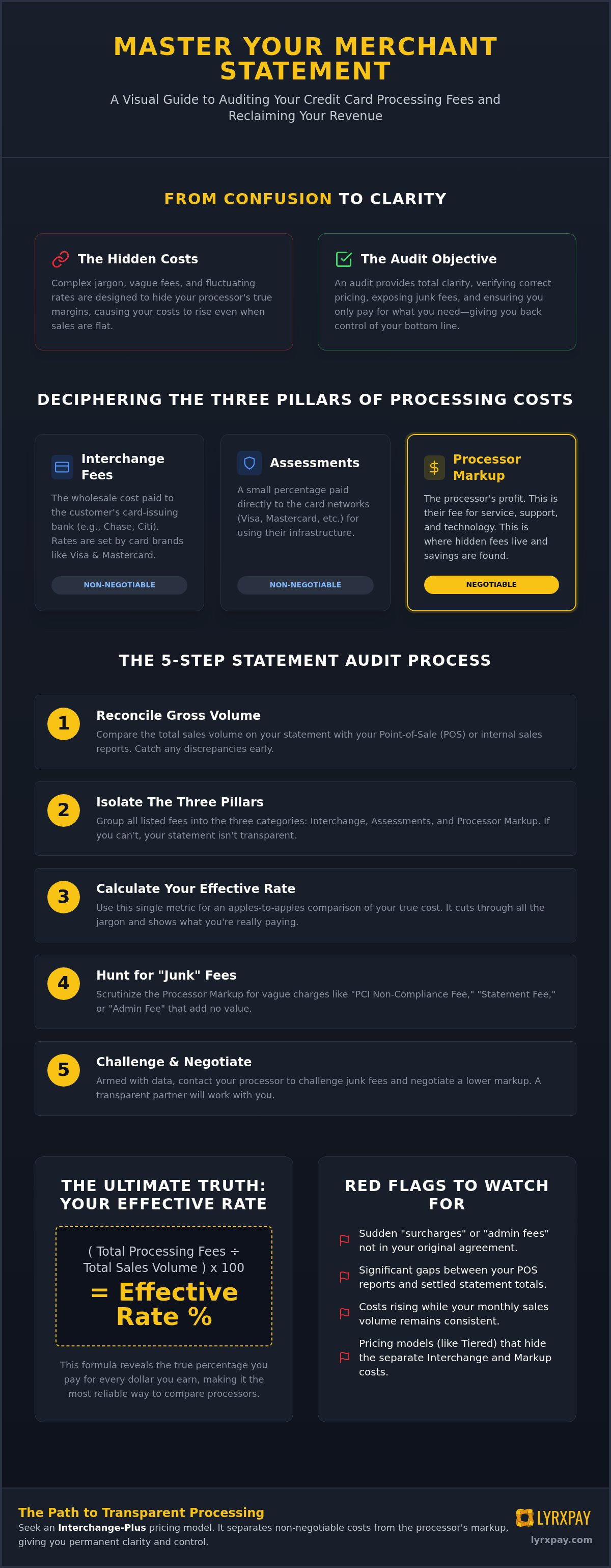
Why does the same transaction cost differently on two separate statements? To find the answer, you must look past the total amount and identify the three distinct layers of cost. Understanding these pillars is the foundation of learning how to audit credit card processing statements effectively. Every fee you see falls into one of three categories: interchange, assessments, or processor markups. If you can't distinguish between them, you can't tell if you're being overcharged.
Interchange fees represent the wholesale cost of doing business. These are non-negotiable rates set by card brands like Visa, Mastercard, and Discover. They're paid directly to the bank that issued your customer's card. Because these rates depend on the card type and how it was processed, they fluctuate constantly. Assessments are the second pillar. These are small, mandatory percentages paid directly to the card networks for the use of their infrastructure. Like interchange, these are non-negotiable and apply to every merchant across the board.
The third pillar is the processor markup. This is the only area where your merchant service provider makes a profit. It covers their operational costs, customer support, and technology. When you learn how to audit credit card processing statements, this is the primary area where you'll find savings. If your markup is buried in a complex pricing model, you're likely paying more than necessary for the same level of service. If you want a partner who prioritizes transparency, choosing a merchant service provider that clearly separates these costs is the smartest move for your bottom line.
Interchange-Plus vs. Tiered Pricing
Your pricing model dictates how clearly these pillars appear. Interchange-plus is the gold standard for transparency; it lists the exact wholesale cost followed by a fixed processor markup. Tiered pricing is the opposite. It groups transactions into "Qualified," "Mid-Qualified," and "Non-Qualified" buckets, which often allows processors to hide high margins behind vague labels. While flat-rate pricing offers simplicity, it often results in higher costs for high-volume merchants because the "one size fits all" rate is padded to protect the processor's margin.
Assessment Fees and Industry Standards
Assessments are the smallest slice of the pie, but they're often where confusion starts. You'll see line items like the Network Access and Brand Usage (NABU) fee or the Acquirer Processing Fee (APF). In 2026, these remain tiny fractions of a percent, often less than 0.15% of the transaction volume. These fees are rarely the reason for a high bill, but seeing them listed accurately is a sign of a transparent statement. Assessments are fixed percentages paid to the card brands for network usage, whereas interchange fees are wholesale rates paid to the card-issuing banks.
The 5-Step Credit Card Statement Audit Process
Ready to stop the quiet drain on your revenue? Executing a systematic review is the only way to ensure your processor stays honest. If you follow a structured path, you'll move from confusion to complete financial control. Here is exactly how to audit credit card processing statements in five clear steps.
- Step 1: Gather three months of data. Don't rely on a single month; seasonality or one-time adjustments can skew your perception. Trend analysis allows you to spot gradual fee increases that might otherwise go unnoticed.
- Step 2: Reconcile gross processing volume. Compare the total sales listed on your statement against your actual bank deposits and internal POS reports. If these numbers don't align, you may have settlement delays or hidden batching errors.
- Step 3: Categorize every fee. Use the three pillars we discussed earlier. Separate your interchange and assessments from the processor's markup. If a fee doesn't clearly fit into these categories, it's a candidate for further investigation.
- Step 4: Flag "Non-Revenue" fees. Look for charges that don't relate to transaction volume. This includes monthly minimums, statement fees, and compliance penalties. These are often the easiest costs to negotiate away.
- Step 5: Calculate your Effective Rate. Divide your total fees by your total gross sales volume and multiply by 100. This single percentage is your ultimate truth; it allows you to see past the jargon and compare your current costs against industry benchmarks.
By mastering how to audit credit card processing statements, you position yourself as a defender of your company's resources. You'll no longer guess if your rates are fair; you'll know exactly what you're paying and why.
Hunting for 'Junk Fees'
Junk fees are the "administrative" clutter that provides no value to your business. PCI non-compliance fees are the most common offenders. If you see this on your statement, you're paying a monthly penalty for not completing a simple security questionnaire. You should also watch for "Interchange Padding." This happens when a processor adds a few extra basis points to the wholesale cost and presents the total as the "official" rate. These small additions can cost high-volume businesses thousands over a year.
Cross-Referencing with Your POS
Your data is only as good as your source. Using integrated POS hardware and software allows you to verify transaction counts with surgical precision. Check for "double dipping" on batch fees, where you're charged both a gateway fee and a processing batch fee for the same group of transactions. Ensure your next-day deposits align perfectly with the settlement dates on your statement. If your deposits lag behind your sales volume, your processor might be holding onto your liquidity longer than necessary.
Calculating Your Effective Rate: The Ultimate Truth
The math doesn't lie. While your statement might be filled with hundreds of line items, there is one single number that cuts through the noise. This number is your Effective Rate. If you want to know how to audit credit card processing statements like a pro, you must master this calculation. It is the only metric that allows you to compare different processors fairly, regardless of their pricing model or fee structure. Without this number, you're just guessing at your actual costs.
The formula is straightforward: take your Total Fees, divide them by your Total Gross Sales Volume, and multiply the result by 100. For example, if you paid $1,500 in fees on $50,000 of sales, your effective rate is 3%. This percentage includes everything: interchange, assessments, markups, and those pesky monthly fees. By focusing on this "all-in" cost, you can see if your efforts to lower merchant fees are actually working or if your processor is just moving money from one bucket to another. It provides a baseline that jargon cannot hide.
Interpreting Your Results
What does a "good" rate look like in 2026? For a standard retail business where most cards are swiped or dipped, an effective rate between 2.2% and 2.8% is often considered competitive. If you're running an e-commerce shop, your rate will naturally be higher, typically ranging from 2.9% to 3.5%. This is because card-not-present (CNP) transactions carry a higher risk and higher interchange costs. If your effective rate is consistently above 3.5%, you're likely overpaying for basic processing services. A low "teaser" rate on a contract often leads to a high effective rate because the processor makes up the difference with hidden surcharges and junk fees. Understanding how to audit credit card processing statements ensures you don't fall for these initial low-cost traps.
Leveraging the Data for Negotiation
Once you have your data, you hold the power. Don't just call your processor to complain; present them with your Audit Summary. Show them your calculated effective rate and your specific interchange mix. Ask for a "Match or Beat" quote based on the transparent Interchange-Plus model we've discussed. If they value your partnership, they'll work to reduce their markups. However, if they refuse to budge or continue to hide fees behind jargon, it's time to stop negotiating and find a partner who values transparency. You've done the heavy lifting, and now you deserve a rate that reflects the health of your business. If you are ready for a simpler way to manage your margins, request a transparent merchant services review to see where you can save.
Beyond the Audit: Moving to a Transparent Model
Performing a manual audit is a vital first step, but you shouldn't have to spend hours every month playing detective. The ultimate goal is to move your business into a model where transparency is built into the foundation rather than hidden behind jargon. By switching to Interchange-Plus pricing, you secure long-term cost stability that tiered models simply cannot offer. You'll no longer have to worry about your processor arbitrarily moving transactions into "Non-Qualified" buckets to pad their own margins. This model ensures that as you learn how to audit credit card processing statements, you find fewer surprises and more consistency in your monthly reports.
True efficiency comes from a simplified financial workflow that respects your time. When you choose a provider that offers next-day deposits, you immediately improve your business liquidity. You aren't just saving money on fees; you're gaining faster access to your own capital to reinvest where it matters most. Transitioning to a partner who values clarity over confusing line items allows you to focus on your craft rather than your paperwork. It's about moving away from a mere transaction and toward a long-term professional relationship built on honesty and advocacy. If you have the right partner, then the stress of monthly reconciliation begins to disappear.
Automating Your Financial Oversight
Modern tools have changed the game for busy owners. By syncing your processing data directly with QuickBooks or Xero, you reduce the administrative burden of manual reconciliation. This deep integration allows for real-time fee tracking, which acts as a shield against "fee creep" between your scheduled audits. If you use LyrxPay’s reporting tools, you can monitor your effective rate monthly with a single click. This level of automation ensures that the lessons you've learned about how to audit credit card processing statements are applied automatically every day, keeping your margins protected without extra effort.
Choosing a Partner, Not Just a Processor
Your business deserves more than a cold, clinical financial service. Evaluating support levels is critical. Concierge-style service can be a game-changer for complex operations like medical offices where billing precision and HIPAA-compliant workflows are paramount. You should also consider the role of ACH processing as part of your total strategy. It often serves as a significantly lower-fee alternative to credit cards for recurring payments or B2B transactions. If you're tired of the jargon and the hidden surcharges, your next step is simple. Reach out to a provider that offers a free, no-obligation statement analysis. Let an expert do the heavy lifting and show you exactly where your money is going.
Take Control of Your Processing Future
You have moved from confusion to clarity. By mastering how to audit credit card processing statements, you've gained the tools to stop the quiet drain on your profit margins. You now know that the Effective Rate is your ultimate source of truth and that Interchange-Plus is the only pricing model that truly puts your interests first. It is time to stop playing defense and start demanding the transparency your business deserves to thrive in 2026. Why settle for jargon when you can have certainty?
We are ready to act as your advocate. If you want to eliminate the manual burden of monthly audits, then switching to a partner who prioritizes your operational health is the next logical step. Our platform offers next-day deposits to keep your cash flowing and direct QuickBooks integration to automate your bookkeeping, making financial oversight effortless and accurate. You've done the heavy lifting by learning the system; now, let us help you build a more profitable future. Stop overpaying—get a transparent statement analysis from LyrxPay today.
Frequently Asked Questions
What is a 'good' effective rate for credit card processing in 2026?
A competitive effective rate typically falls between 2.2% and 2.8% for retail businesses where cards are physically swiped. If you run an e-commerce store, your rate will likely range from 2.9% to 3.5% due to the higher risk of card-not-present transactions. These benchmarks serve as a helpful guide. If your current rate is consistently higher, you're likely paying for unnecessary markups or hidden fees.
Are PCI compliance fees mandatory on every merchant statement?
No, PCI compliance fees are not a mandatory network cost required by card brands. They're usually penalties that processors charge when you haven't completed your annual security self-assessment questionnaire. You can stop these charges immediately by completing your compliance requirements. A supportive processor will often help you through this process rather than simply collecting a monthly fee for your non-compliance.
How often should I audit my credit card processing statements?
You should perform a quick review every month to catch sudden surcharges or "fee creep" before they drain your revenue. A more comprehensive deep dive into how to audit credit card processing statements is best handled quarterly. This regular schedule ensures your pricing model stays aligned with your sales volume. It also helps you spot trends that a single month of data might miss.
What is the difference between interchange and a markup?
Interchange is the wholesale cost set by card networks like Visa and Mastercard, which goes to the bank that issued the customer's card. It's a non-negotiable base cost for everyone. The markup is the additional fee your processor charges for their services and technology. When you audit your statement, the markup is the primary area where you can negotiate lower costs and improve your margins.
Can I negotiate my processing fees without switching providers?
Yes, you can often negotiate your rates by presenting your current provider with a clear breakdown of your effective rate and interchange mix. Most processors would rather reduce their markup than lose a reliable merchant entirely. If you show them you've done the work to understand your costs, they're much more likely to offer a more transparent pricing model like Interchange-Plus to keep your business.
Why does my statement show 'non-qualified' fees?
"Non-qualified" fees are a hallmark of tiered pricing models, appearing when a transaction doesn't meet the processor's specific "qualified" criteria. This often happens with corporate cards, international cards, or rewards cards. These categories are often arbitrary and designed to hide higher markups. Switching to a transparent model eliminates these confusing labels and ensures you pay the true wholesale cost for every card type.
How do I find hidden fees on a tiered pricing statement?
The most effective method for how to audit credit card processing statements with tiered pricing is to calculate your total effective rate. Look for vague line items like "administrative surcharges" or "statement fees" that don't relate to specific transactions. Because tiered statements are designed to be opaque, calculating your "all-in" percentage is the only way to see the true cost of those hidden additions.
What should I do if I find an error on my merchant statement?
Contact your processor's support team immediately to dispute the discrepancy and request a formal credit. Have your POS reports and bank deposit records ready to serve as evidence for your claim. If your processor makes it difficult to resolve clear errors or hides behind complex jargon, it's a major red flag. You deserve a partner who values accuracy and responds quickly to your financial concerns.