
Preventing Employee Theft at POS: 2026 Business Guide
Did you know that 33% of all U.S. business bankruptcies are linked directly to employee theft? It is a sobering reality for any owner who has ever felt that sinking feeling when the cash drawer simply doesn't match the end-of-day reports. You want to trust the team you've built, but unexplained inventory shrinkage and recurring shortages make it difficult to focus on growth. If you're tired of feeling like you have to watch every transaction personally, it's time to master how to prevent employee theft at point of sale through smarter, more automated systems.
We understand that managing these operational leaks is stressful, and you deserve a partner who helps you protect your hard-earned resources. This guide provides a clear path to total financial visibility and peace of mind. You'll discover the most effective technical safeguards available in 2026, including AI-powered alerts for suspicious voids and biometric security measures. We'll also explore how integrated financial workflows and Point of Sale Software & Hardware can close the gaps in your reporting. This ensures that your bottom line remains protected while you focus on your craft.
Key Takeaways
- Identify the psychological "fraud triangle" that drives internal theft and learn why small businesses are prime targets for POS shrinkage.
- Discover how to prevent employee theft at point of sale by eliminating generic logins and integrating high-definition surveillance with real-time transaction timestamps.
- Master the art of "blind" cash counts and real-time inventory tracking to stop employees from matching their physical counts to system data.
- Establish a bulletproof culture of accountability by setting clear, written expectations that remove the ambiguity leading to asset misappropriation.
- Explore how modern Point of Sale Software & Hardware can automate your financial visibility, allowing you to reinvest fee savings into superior security tech.
Identifying the Red Flags: How Employee Theft Happens at the POS
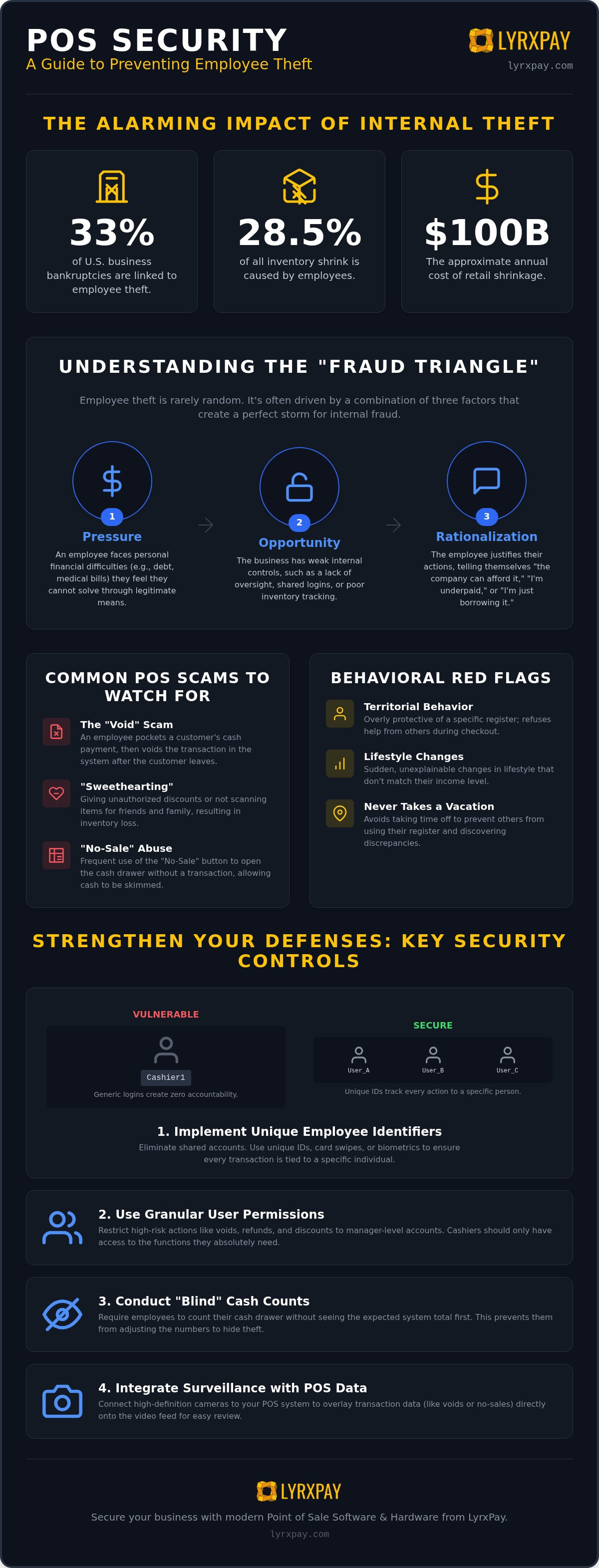
Understanding the "why" behind internal theft is the first step in protecting your business. Most workplace theft follows a psychological model known as the "fraud triangle." This consists of three elements: pressure, opportunity, and rationalization. An employee might feel financial pressure at home, notice a lack of oversight at the register (opportunity), and then convince themselves that the business can afford the loss (rationalization). Small businesses are statistically more vulnerable because they often lack the rigid Retail loss prevention strategies utilized by major corporations. With employee theft accounting for 28.5% of all inventory shrink, the impact on your annual revenue can be the difference between scaling your operations and facing a financial crisis.
It's vital to distinguish between honest mistakes and intentional misappropriation. A single misplaced decimal point is an error; a recurring pattern of "missing" cash or inventory is a theft strategy. When you know what to look for, you can implement the right Point of Sale Software & Hardware to close these gaps. Learning how to prevent employee theft at point of sale starts with recognizing the specific mechanics of how money disappears from the drawer.
Common POS Scams: Voids, No-Sales, and Under-Ringing
The "Void" scam is a common tactic where an employee accepts a cash payment, provides the customer their receipt, and then cancels the transaction after the customer leaves. This keeps the system's records balanced while the cash is pocketed. "Sweethearting" is another significant drain on resources. This occurs when staff give unauthorized discounts or simply don't scan items for friends and family. It's a subtle form of theft that is difficult to catch without integrated inventory tracking. Additionally, watch the "No-Sale" button. While it has administrative uses, frequent drawer openings without an associated transaction suggest that cash is being skimmed throughout the shift.
Behavioral Indicators in the Workplace
Security involves more than just monitoring data; it requires paying attention to human behavior. Be wary of staff members who are overly protective of a specific register or refuse to let others help them during busy periods. This territorialism often masks a desire to keep transaction histories private. Sudden changes in an employee's lifestyle or signs of significant financial stress are also notable red flags. Perhaps the most counterintuitive indicator is the "perfect" employee who never takes a vacation. If someone is running a complex theft scheme, they often cannot afford to be away from the register for a week, as a substitute might quickly uncover the discrepancies in the books.
Strengthening Your POS Security with Technical Controls
Retail shrinkage has become a nearly $100B problem, and a significant portion of that loss occurs directly at the register. While identifying behavioral red flags is essential, those observations only solve half the puzzle. You need technical roadblocks that make theft difficult to execute and easy to detect. Generic logins are a security nightmare for modern retailers. If every staff member uses a shared "Cashier1" account, you have zero accountability when the drawer comes up short. Implementing unique identifiers for every team member is the foundation of how to prevent employee theft at point of sale.
Implementing Granular User Permissions
Tiered access is a vital component of a secure retail environment. Your cashiers should have the tools to ring up sales efficiently, but they shouldn't have the unilateral power to delete them. By defining specific roles, you can ensure that high-risk actions like refunds and voids require a manager's override or approval. This simple technical control removes the "opportunity" leg of the fraud triangle we discussed earlier. Restricting back-office access also prevents the theft of sensitive business data and customer information, keeping your operations transparent and your liabilities low.
Leveraging Advanced Tracking and Biometrics
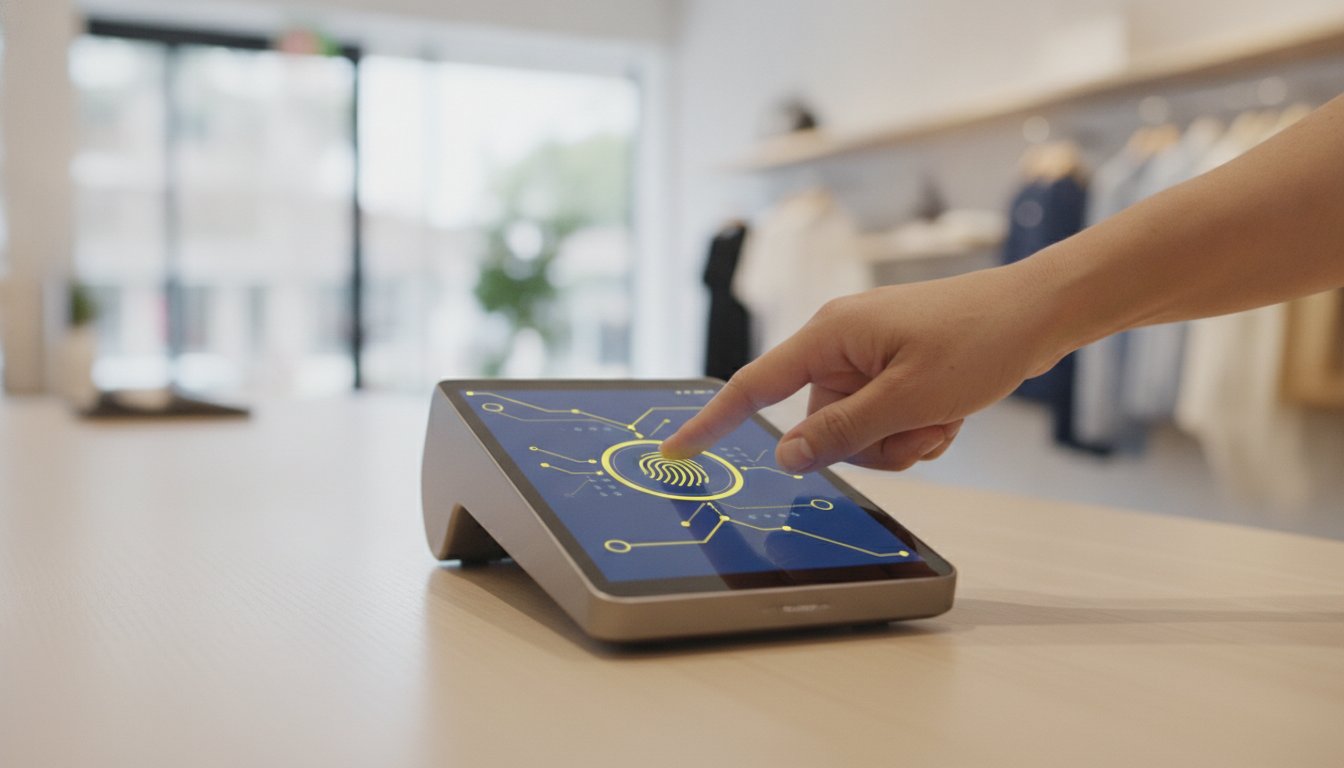
Modern Point of Sale Software & Hardware provides the precision tracking necessary for absolute accountability. Unique employee IDs or magnetic card swipes ensure you know exactly who was logged into a terminal at any given second. If you want to eliminate the risk of "buddy punching" or shared codes, biometric recognition like fingerprint scanning is the gold standard for 2026. It is impossible to "borrow" a fingerprint. Every action taken on the system is recorded in a detailed audit log, allowing you to review every keystroke if a discrepancy arises during your financial audits.
Hardware features like secure cash drawers prevent "skimming" by restricting when the drawer actually pops open. You should pair this with high-definition surveillance that is digitally synced to your transaction timestamps. If a drawer opens for a "No-Sale," you can instantly pull the video for that exact millisecond. This level of detail removes the guesswork from your investigations. Automated alerts for high-risk transactions, such as refunds over a certain dollar amount, give you real-time visibility without having to hover over your team's shoulders. Investing in these integrated systems acts as a proactive shield for your revenue, transforming security from a reactive chore into an automated, manageable workflow.
Automated Reconciliation: Using Data to Stop Shrinkage
Data is your most loyal employee. While technical controls act as a physical barrier, automated reconciliation provides the analytical proof you need to Stop Fraud at the Point of Sale. Real-time inventory tracking helps you master how to prevent employee theft at point of sale by flagging items that leave the shelf without an associated transaction. To take this a step further, you should implement "blind" cash counts. If your staff doesn't know the exact amount the system expects, they cannot "match" their physical count to hide small skims. Daily reconciliation isn't just a chore; it's your best defense against long-term skimming patterns that often go unnoticed during monthly reviews.
Integrating POS Data with QuickBooks and Xero
Manual data entry is where many security gaps hide. When you utilize all-in-one business financial solutions, your Point of Sale Software & Hardware communicates directly with your accounting platform. This automation eliminates human error and makes it nearly impossible for an employee to alter sales logs without leaving a digital footprint. Does your current system generate "exception reports"? These specific summaries highlight suspicious activity, such as an unusual volume of "short" drawers on specific shifts or multiple voids from a single user ID. If the sales logged in your POS don't match your bank deposits, the system flags the discrepancy automatically, giving you immediate clarity on where your money is going.
The Role of Next-Day Deposits in Auditing
Speed is a critical factor in identifying financial manipulation. When you use business liquidity management tools that offer next-day deposits, you reduce the "window of opportunity" for theft to go undetected. Seeing your processing funds in your account within 24 hours allows for faster auditing and better liquidity. If there is a shortfall, you'll know by Tuesday morning rather than waiting until the end of the week or month. This rapid feedback loop is a key strategy in how to prevent employee theft at point of sale, as it signals to your team that every transaction is being verified with precision and speed. By closing the loop between the register and the bank account, you remove the ambiguity that dishonest actors rely on.
Establishing a Culture of Accountability and Transparency
Even the most advanced technical controls can be undermined if your team doesn't value integrity. A culture of honesty starts with clear, written expectations that leave no room for interpretation. When you define exactly how money and inventory should move, you remove the gray areas that often lead to rationalization. Leading by example is equally critical. If an owner or manager bypasses the system to grab a drink without ringing it up, they signal to the staff that the rules are optional. True accountability is a top-down commitment.
Communicating your security measures doesn't have to destroy team morale. Instead of framing surveillance as a tool to catch "bad" employees, present it as a shield that protects honest staff from false accusations. When everyone knows that the system is watching, the temptation to stray is lowered, and the focus remains on customer service. Regular, unannounced audits are a powerful deterrent. They remind the team that oversight is a permanent part of the business rhythm, not just a response to a problem. This proactive approach is a cornerstone of how to prevent employee theft at point of sale.
Designing Robust Cash Handling Policies
Standardized procedures are the enemy of opportunity. You should implement a "Two-Person Rule" for counting large amounts of cash or preparing nightly deposits. This ensures that no single individual has total control over a significant sum of money. Additionally, you must enforce a mandatory receipt policy. When every customer is required to receive a printed record, it forces every transaction to be entered into the system. Standardizing shift changes is another vital step. Each employee should sign off on a drawer handover, ensuring that discrepancies are isolated to a specific window of time rather than a whole day.
Training and Whistleblower Protection
Education is a powerful preventive tool. Your staff should understand both the personal and professional consequences of theft, including the impact on the business's ability to provide raises or equipment upgrades. To support this, you must provide a secure, anonymous way for staff to report suspicious activity. Whistleblower protection ensures that honest employees feel safe coming forward. Finally, consider rewarding integrity. Incentivizing low-shrinkage performance through team bonuses can transform security from a burden into a shared goal. Secure your business operations today by choosing the right Point of Sale Software & Hardware that supports these transparent workflows.
Future-Proofing Your Business with LyrxPay’s Secure POS
Choosing the right technology partner is the final piece of the security puzzle. LyrxPay offers a comprehensive solution that combines secure credit card processing with advanced Point of Sale Software & Hardware. This integration is designed to do the heavy lifting for you, acting as a digital concierge that monitors your margins in real-time. By leveraging next-day deposits, we provide the visibility you need to audit your cash flow within 24 hours. This rapid turnaround is essential for anyone mastering how to prevent employee theft at point of sale, as it drastically shortens the time a dishonest actor has to manipulate the books before they're caught.
Why settle for a fragmented system that leaves gaps in your reporting? When your processing, hardware, and bookkeeping are unified, you gain a level of financial clarity that standalone systems simply can't match. Integrated payroll and bookkeeping solutions allow you to spot financial leaks by cross-referencing labor costs with sales performance automatically. This means you can identify red flags without spending hours manually digging through spreadsheets. It's about working smarter to protect what you've built.
Seamless Merchant Services for Maximum Security
Our focus on low fee credit card processing isn't just about saving money; it's about business health. When you reduce overhead, you can reinvest those savings into better surveillance or biometric hardware. Having a single partner for payments, POS, and accounting ensures your data remains consistent across all platforms. We provide expert support for QuickBooks integration, so you never have to worry about manual entry errors hiding a financial leak. It's a streamlined workflow that protects your time and your resources while providing absolute accountability for every dollar through the register.
Next Steps: Auditing Your Current POS
Ready to secure your register? Use this 5-minute checklist to identify your current Point of Sale Software & Hardware vulnerabilities:
- Do you have unique logins for every staff member instead of a shared code?
- Are high-risk actions like voids and refunds restricted to senior staff?
- Can you view your processing funds in your bank account within 24 hours?
- Does your system automatically flag inventory discrepancies against sales?
- Is your surveillance footage digitally synced to your transaction timestamps?
If you answered "no" to any of these, your business is exposed to unnecessary risk. Transitioning to a more secure system doesn't have to disrupt your daily operations. We handle the technical setup and migration, providing a "managed care" approach to your administrative needs. Contact LyrxPay today for a concierge-style consultation. We'll help you build a customized POS setup that matches your specific retail or service needs while closing the loop on internal theft forever.
SECURE YOUR FUTURE REVENUE
Protecting your revenue requires more than just high-definition cameras; it demands a unified approach to financial visibility. You've learned that combining granular user permissions with automated reconciliation is the most effective strategy for 2026. By mastering how to prevent employee theft at point of sale, you remove the hidden opportunities for shrinkage and regain your peace of mind. As a Texas-based provider of national merchant services, LyrxPay acts as your dedicated ally in this mission.
We provide the technical heavy lifting through next-day deposits for faster reconciliation and expert QuickBooks integration that keeps your books accurate without the manual effort. Don't let unexplained shortages dictate your business growth. You deserve a partner who defends your resources with the same passion you bring to your craft every day. Secure your business with LyrxPay’s integrated POS and merchant services today. We are ready to help you build a more transparent, profitable future.
Frequently Asked Questions
What is the most common way employees steal at the point of sale?
The most common methods involve asset misappropriation scams like voids, no-sales, and "sweethearting," where staff provide unauthorized discounts to friends. These tactics allow employees to pocket cash while keeping the system's records appearing balanced. Research indicates that asset misappropriation occurs in 89% of employee theft cases. Using modern Point of Sale Software & Hardware helps flag these patterns by tracking every time a drawer opens without a completed transaction.
Can a POS system really stop cash skimming?
A POS system cannot physically stop a person from taking cash, but it makes skimming nearly impossible to hide. By requiring unique logins and recording every keystroke, the software creates a digital paper trail for every cent. When you pair secure hardware with high-definition surveillance, you create a deterrent that removes the "opportunity" for theft. This is a central component of how to prevent employee theft at point of sale.
How do I confront an employee I suspect of stealing from the register?
You should always lead with data and remain professional during the conversation. Review your Point of Sale Software & Hardware audit logs and surveillance footage to gather concrete evidence before the meeting. It's best to have a witness present, such as another manager or a HR representative. Focus on the discrepancies in the reporting rather than making personal accusations. This approach maintains a culture of accountability while protecting the business from potential liability.
What are the legal requirements for using cameras near the POS?
Legal requirements vary, but you generally have the right to record video in areas where employees don't have a reasonable expectation of privacy. This includes the register and the sales floor. You should clearly state your surveillance policy in your employee handbook to ensure transparency. Be aware that recording audio often requires different consent levels depending on your jurisdiction. Always consult with a legal professional to ensure your specific setup remains compliant.
Does QuickBooks integration help detect employee fraud?
QuickBooks integration is a powerful tool for spotting financial leaks by automatically reconciling your sales logs with your actual bank deposits. If you're looking for how to prevent employee theft at point of sale, this automation is key. It eliminates the manual data entry errors that dishonest staff often use to mask their activities. LyrxPay provides expert QuickBooks support to ensure your data flows accurately from the register to your financial reports.
What are 'blind counts' and why are they important for retail security?
Blind counts are cash reconciliation processes where the employee counts the drawer without knowing the "expected" total from the system. This is a critical security measure because it prevents staff from simply reporting the system's number and pocketing the difference. If the physical count doesn't match the back-end report, the discrepancy is immediately obvious. It forces total honesty during shift changes and ensures your cash records remain untampered.
How often should I perform a loss prevention audit?
You should perform a formal loss prevention audit at least once a month, but unannounced "spot checks" are even more effective. Regular audits remind your team that oversight is a permanent part of your business operations. Monthly reviews of your inventory levels against your sales data help you identify long-term shrinkage trends. Combining these scheduled reviews with real-time alerts from your POS system ensures that you catch small issues before they become major losses.
Is it better to use a hider-door policy or an open-door policy for theft reporting?
An anonymous whistleblower policy is typically more effective for reporting theft than a standard open-door policy. While an open-door approach is great for general feedback, employees often fear social or professional retaliation if they report a colleague directly. Providing a secure, anonymous channel allows honest staff to protect the business without risking their personal relationships. This creates a stronger shield for your resources and encourages a culture of shared integrity.