
Is My Business PCI Compliant Checklist 2026: The Merchant’s Guide to DSS 4.0.1

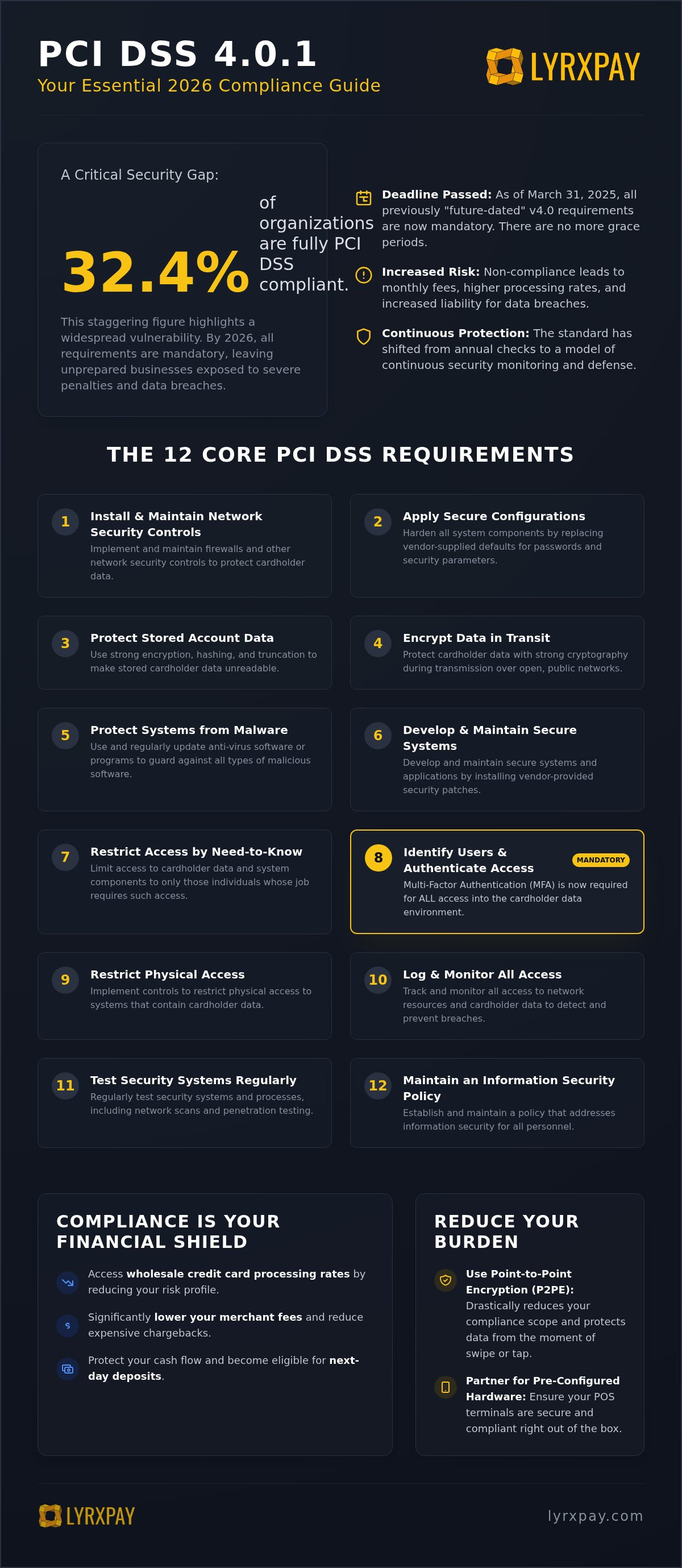
Did you know that only 32.4% of organizations are currently found to be fully PCI DSS compliant? It's a staggering figure that highlights just how overwhelming the transition to version 4.0.1 has become for most merchants. You probably feel like you're drowning in technical jargon and the constant fear of a data breach that could cost your business millions. If you're searching for an is my business PCI compliant checklist 2026 to clear the fog, you're looking for more than just security; you're looking for peace of mind.
We understand that your time is better spent growing your brand than decoding complex audit requirements. That's why we've built this guide to navigate the 2026 standards with a clear, actionable checklist designed to protect your data and lower your processing costs. You'll learn exactly how these new security mandates affect your merchant fees and how the right partnership can remove the administrative burden entirely. From mandatory multi-factor authentication to the shift toward continuous monitoring, we're here to ensure your business stays secure and profitable without the stress.
Key Takeaways
- Master the mandatory shift to PCI DSS 4.0.1 and understand why previously "future-dated" requirements are now essential for every merchant.
- Use our comprehensive is my business PCI compliant checklist 2026 to identify security gaps before they turn into expensive monthly non-compliance fees.
- Identify your specific compliance level and SAQ type so you can focus only on the audit requirements that actually apply to your business size.
- Learn how implementing Point-to-Point Encryption (P2PE) drastically reduces your compliance scope while naturally lowering your merchant processing costs.
- Discover how partnering with a concierge provider like LyrxPay ensures your POS hardware is pre-configured for the latest security standards out of the box.
Understanding the 2026 PCI DSS 4.0.1 Compliance Landscape
PCI DSS 4.0.1 represents the most significant update to payment security in over a decade. It's the latest evolution of the Payment Card Industry Data Security Standard, designed to address the sophisticated AI-driven fraud and insider threats that have become common in 2026. The shift is critical because all "future-dated" requirements from version 4.0 became mandatory as of March 31, 2025. This means that by 2026, there are no more grace periods; your business must meet every technical and operational standard to avoid severe penalties.
If you are currently hunting for an is my business PCI compliant checklist 2026, you aren't just looking for a piece of paper; you're looking for a strategy to keep your revenue safe. We view compliance as a shield for your business liquidity and reputation. Ignoring these standards leads to more than just a security risk. It results in monthly "PCI non-compliance fees" and increased liability that can drain your merchant account before you even realize there's a leak in your cash flow.
Who Must Comply in 2026?
Every business that processes, stores, or transmits credit card data must comply with these standards. It's a common myth that using a third-party processor absolves you of all responsibility. Even if you never touch a physical card, your network environment and how you handle digital tokens still fall under the 2026 requirements. Small businesses are often primary targets because hackers assume their defenses are weaker. With 95% of data breaches caused by human error, the 4.0.1 standard focuses heavily on continuous monitoring and staff authentication to close those gaps.
The Financial Impact of Compliance
Staying compliant is your ticket to accessing wholesale credit card processing rates. When you prove your environment is secure, you reduce the risk profile of your business in the eyes of banks. This lower risk translates directly into lower merchant fees and a significant reduction in expensive chargebacks. Furthermore, compliance is a prerequisite for next-day deposit eligibility. If your security isn't up to par, banks may hold your funds longer to mitigate potential fraud risks. By following a clear checklist, you protect your cash flow and ensure your hard-earned money hits your bank account as quickly as possible.
The Essential 2026 PCI Compliance Checklist: 12 Requirements
When you ask, is my business PCI compliant checklist 2026, you're looking at a framework of 12 core requirements established by the PCI Security Standards Council. These standards aren't just suggestions; they're the technical backbone of secure commerce. In 2026, the focus has shifted from static, annual checks to a model of continuous protection. This involves protecting stored account data through strong encryption (Requirement 3) and ensuring that cardholder data is shielded by robust cryptography during every transmission across open, public networks (Requirement 4). Additionally, your systems must be defended by up to date antivirus and anti-malware solutions that can detect the latest AI-generated threats (Requirement 5).
Building a Secure Digital Perimeter
Requirements 1 and 2 focus on your network's front door. It's no longer enough to just have a basic firewall. You must install and maintain advanced network security controls that specifically manage traffic between your payment environment and the outside world. Many businesses fall into the trap of using "out-of-the-box" settings for their POS hardware, which often include factory-set credentials. In 2026, default vendor passwords are the primary vulnerability for merchants because they provide a universal key for automated hacking tools to bypass your security. Applying secure, unique configurations to every system component is a non-negotiable step in your compliance journey.
MFA Everywhere: The 2026 Mandatory Standard
Requirement 8 has become a major focal point this year. Multi-Factor Authentication (MFA) is now mandatory for all access to the cardholder data environment, not just for remote workers. Whether your staff is accessing a terminal on-site or an admin is logging in from home, they must provide at least two forms of identification. While this sounds like a hurdle for speed, it's a vital defense against credential theft. Our integrated POS systems at LyrxPay are designed to simplify this process, ensuring your team can authenticate quickly without slowing down the checkout line. If you're feeling overwhelmed by these technical shifts, you might consider how modern merchant services can handle the heavy lifting for you.
Vulnerability Management and Monitoring
The era of the "point-in-time" scan is over. Requirements 10 and 11 now emphasize automated log reviews and continuous monitoring of your network. You need to know the moment a suspicious login attempt occurs, not months later during an audit. Regular security testing and penetration testing have become more rigorous to keep pace with modern hackers. Ensuring your secure credit card processing solutions include real-time threat detection is the most effective way to satisfy these requirements while protecting your business liquidity and reputation.
Determining Your Compliance Level and SAQ Type
Identifying where your business stands starts with your annual transaction volume. The payment industry divides merchants into four distinct levels to determine the level of scrutiny required. Level 1 merchants handle over 6 million transactions per year and must undergo an intensive external audit. Most small to medium businesses fall into Level 4, processing anywhere from a few dozen to 1 million transactions. When reviewing your is my business PCI compliant checklist 2026, it is vital to remember that even as a Level 4 merchant, you are still required to validate your security through an annual Self-Assessment Questionnaire (SAQ) and an Attestation of Compliance (AOC).
The specific SAQ you must complete depends entirely on your processing method. An e-commerce shop has a different risk profile than a physical retail store. If your setup is complex or involves custom software, you might be required to complete SAQ D, which covers the full breadth of the 4.0.1 standards. For a deep dive into the specific requirements for each business model, you can access the Official PCI DSS Document Library. This resource provides the primary source documents needed to ensure your reporting is accurate and defensible.
The 2026 SAQ Cheat Sheet
To simplify the process, most merchants will fall into one of these three primary categories:
- SAQ A: Designed for e-commerce merchants who outsource all cardholder data functions to compliant third parties. If you don't store or process data on your own servers, this is your path.
- SAQ B-IP: This applies to brick and mortar merchants using standalone, IP-connected terminals. These devices are isolated from your main network to reduce risk.
- SAQ D: The comprehensive "catch-all" for any merchant who does not fit the criteria for other types. It requires evidence for all 12 core PCI requirements.
Level 1 vs. Level 4: What Changes?
The main difference between compliance levels is how you prove your security. Level 1 businesses must hire a Qualified Security Assessor (QSA) for an on-site audit. Level 4 merchants typically self-report. However, don't let the "self-assessment" label lead to a false sense of security. The 4.0.1 standards are just as rigorous for a small shop as they are for a global corporation. If a breach occurs, a Level 4 merchant without a valid AOC faces the same massive fines and potential loss of processing privileges. At LyrxPay, we act as your concierge partner. We provide the pre-configured hardware and bookkeeping support needed to keep Level 4 merchants compliance-ready year-round, so you never have to scramble when the annual deadline hits.
Strategies to Reduce Your 2026 Compliance Burden
Reducing the "scope" of your environment is the single most effective way to lower the pressure of your 2026 compliance audit. If you don't store sensitive account data, there's simply less for a hacker to steal. By moving data out of your network and into the hands of a PCI-validated service provider, you shift the technical liability away from your back office. This proactive approach turns your is my business PCI compliant checklist 2026 from a massive technical hurdle into a manageable administrative task. It's about working smarter, not harder, to protect your business liquidity.
Tokenization and P2PE: The Security Power Couple
These two technologies work together to create a fortress around your transactions. Tokenization replaces primary account numbers with non-sensitive identifiers, allowing for seamless ACH payment processing and recurring billing without the risk of storing raw card data. Meanwhile, Point-to-Point Encryption (P2PE) ensures that card data is encrypted at the exact moment of swipe or dip, remaining unreadable until it reaches the secure decryption environment. Implementing a validated P2PE solution can reduce your annual SAQ from over 300 questions to just 30. This hardware-level security is far superior to software-only fixes because it effectively removes your POS system from the scope of most PCI requirements.
Integrating Security with Financial Workflows
Your security strategy shouldn't stop at the terminal. Many businesses accidentally create security holes when they connect their payment data to accounting software. It's vital that your QuickBooks integration is PCI-compliant to ensure that data remains protected as it moves into your ledgers. By using all-in-one business financial solutions, you centralize your security management and reduce the "audit footprint" of your bookkeeping and payroll departments. This consolidation makes it much easier to provide evidence of compliance during your annual review. If you're ready to simplify your operations and protect your margins, it's time to explore secure merchant services that handle these complexities for you.
Securing Your Cash Flow with LyrxPay’s Compliant Solutions
PCI compliance is often viewed as a burden, but it's actually a strategic financial asset that unlocks lower processing rates and faster cash flow. At LyrxPay, we take a concierge approach, transforming that overwhelming is my business PCI compliant checklist 2026 into a streamlined operational advantage. Our integrated POS hardware and software solutions arrive pre-configured for the latest DSS 4.0.1 standards, removing the guesswork from your security setup. By ensuring your environment is inherently secure, we advocate for your business with transparent pricing that rewards your commitment to data integrity. Secure processing isn't just about avoiding fines; it's about building a foundation for sustainable growth.
Next-Day Deposits and Liquidity
Effective business liquidity management tools require more than just a tracking spreadsheet. They require a merchant account that banks trust implicitly. When you maintain a high level of security compliance, you unlock the ability to receive next-day deposits, keeping your cash flow fluid and your business agile. LyrxPay doesn't just provide processing; we act as a partner who audits your processing costs to ensure you aren't paying "risk premiums" for outdated security. The peace of mind that comes from knowing your funds are safe and accessible is what allows you to focus on your craft. We believe that liquidity management starts with a secure merchant account, and we're here to defend your resources against unnecessary fees.
Seamless Integration, Maximum Security
Security shouldn't come at the cost of efficiency. We provide expert QuickBooks and Xero integration that keeps your financial data isolated and secure, preventing the bookkeeping department from becoming a compliance liability. This level of managed care is why we are a preferred partner for specialized industries like medical offices, where data sensitivity is paramount and the stakes for a breach are high. Our goal is to make the complicated feel manageable by handling the heavy lifting of security for you. We don't just sell software; we provide a professional partnership that prioritizes your operational health. If you're tired of navigating technical jargon alone, take the next step toward a more secure future and get a free PCI compliance and fee audit today.
Take Command of Your 2026 Compliance Strategy
Navigating the shift to PCI DSS 4.0.1 doesn't have to be a solo mission that drains your time and resources. You now have the tools to move from uncertainty to action. By implementing strong encryption and reducing your audit scope, you aren't just checking boxes; you're actively protecting your business liquidity and reputation. This is my business PCI compliant checklist 2026 is designed to help you identify gaps before they become costly liabilities. It's about turning a technical requirement into a strategic advantage for your bottom line.
Remember that a secure merchant environment is your ticket to the lowest transaction fees in the industry and the speed of next-day deposits for all compliant merchants. We specialize in expert QuickBooks integration and accounting support to ensure your financial data remains isolated and your workflows stay efficient. Stop overpaying and start securing; get your free LyrxPay merchant audit today. You've done the hard work of building your business. Let us handle the heavy lifting of security so you can focus on your next big growth milestone with total confidence.
Frequently Asked Questions
Is my small business really a target for hackers in 2026?
Yes, small businesses are primary targets because they often lack the sophisticated defense systems of larger corporations. In 2026, the average cost of a data breach in the United States reached $10.22 million, a record high. Since 95% of cybersecurity breaches stem from human error, hackers focus on smaller merchants with less rigorous training. Protecting your revenue starts with a clear strategy, and using an is my business PCI compliant checklist 2026 helps close these dangerous vulnerabilities.
What is the difference between PCI DSS 4.0 and 4.0.1?
PCI DSS 4.0.1 is an editorial update to version 4.0 that provides minor clarifications without adding new technical requirements. It replaced version 4.0 to ensure the standard is easier to interpret for merchants and assessors. All future-dated requirements from the original 4.0 release became mandatory on March 31, 2025. This means by 2026, your business must be fully aligned with 4.0.1 standards to remain in good standing with your processing bank.
Do I need to be PCI compliant if I only accept ACH payments?
If you only accept ACH payments and never handle credit or debit card data, you don't need to be PCI compliant. However, ACH transactions are governed by NACHA rules, which have their own rigorous security and encryption standards. Most modern businesses find they eventually need to accept cards to stay competitive. When you expand, having an is my business PCI compliant checklist 2026 ready ensures you can scale your payment options without exposing your business to massive non-compliance fees.
How much are the fines for PCI non-compliance in 2026?
Non-compliance fees in 2026 can range from $5,000 to $100,000 per month depending on your transaction volume and the duration of the violation. Beyond these monthly penalties, a data breach can lead to legal liabilities and the permanent loss of your ability to process payments. These financial hits often drain business liquidity faster than any other operational expense. Staying compliant is the most effective way to protect your cash flow and maintain your eligibility for next-day deposits.
Can I store credit card numbers if I encrypt them myself?
You should never store raw credit card numbers on your own servers, even if you attempt to encrypt them yourself. PCI Requirement 3 has extremely strict rules for key management and storage that are difficult for most merchants to meet. Instead, you should use tokenization to replace sensitive data with non-sensitive tokens. This method removes the data from your system entirely, shifting the security burden to your provider and significantly reducing the scope of your annual compliance audit.
How often do I need to complete the PCI self-assessment?
You must complete your PCI Self-Assessment Questionnaire (SAQ) at least once every 12 months to maintain your compliant status. If you make significant changes to your network or payment hardware, you may need to re-evaluate your status sooner. Compliance is no longer a one-time annual event but an ongoing process of monitoring and evidence gathering. Keeping your documentation organized year-round prevents the stress of a last-minute scramble when your processing bank requests your annual Attestation of Compliance.
What is an ASV scan and does my business need one?
An ASV scan is a quarterly security test performed by an Approved Scanning Vendor to check your internet-facing systems for vulnerabilities. If your business stores cardholder data or has a website that connects to a payment gateway, you likely need these scans every 90 days. These scans cost roughly $100 to $200 per IP address and are a mandatory part of many SAQ types. They provide an essential external check to ensure your digital perimeter remains secure.
How does LyrxPay help me stay compliant with QuickBooks?
LyrxPay provides a concierge approach by ensuring your QuickBooks and Xero integrations are built with security in mind. We help you isolate your payment data so it never creates a vulnerability within your accounting software. Our team offers professional bookkeeping and accounting support to manage the administrative side of compliance for you. By centralizing your financial workflows through our secure merchant services, you can focus on your craft while we handle the technical heavy lifting of data protection.