
QuickBooks Bookkeeping Services for Small Business: The 2026 Integration Guide

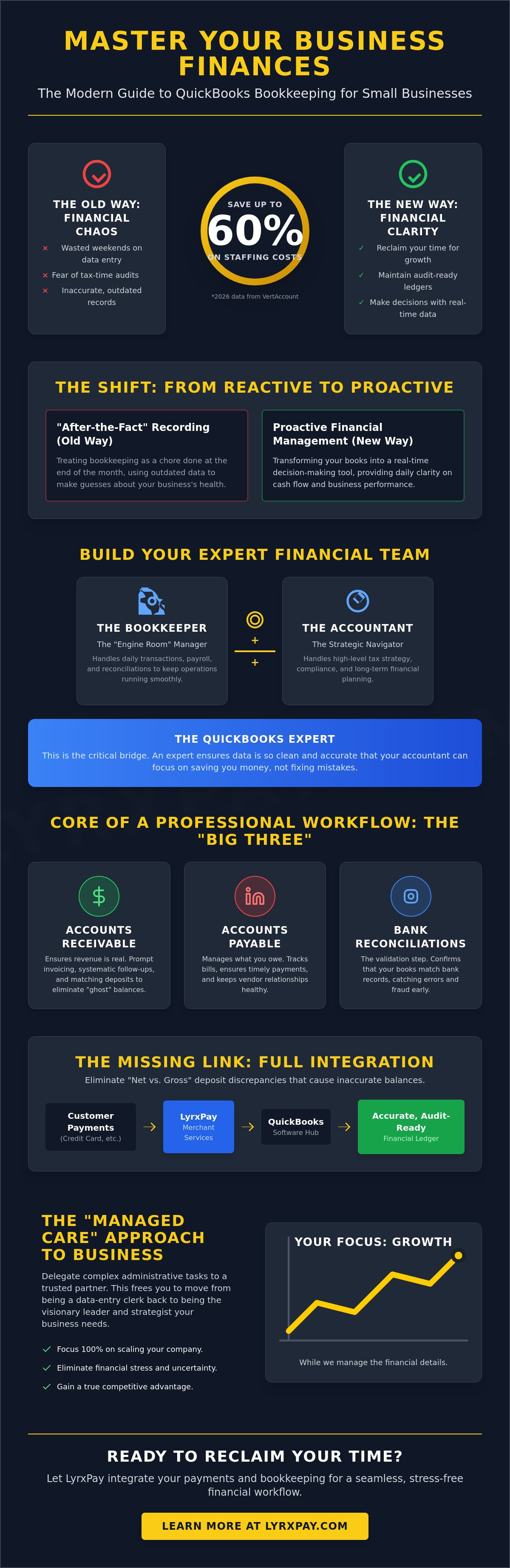
Did you know that outsourcing your financial oversight can lead to up to 60% savings on in-house staffing costs, according to 2026 data from VertAccount? Most owners still spend their Sundays untangling bank reconciliations and hunting for hidden merchant fees, but the right quickbooks bookkeeping services for small business can turn that frustration into a competitive advantage. You didn't start your company to become a part-time data entry clerk; you started it to lead.
It's understandable to feel a sense of dread when looking at messy records or worrying about the 2026 tax-time audits. We agree that your time is too valuable to be wasted on manual data entry. This guide promises to help you master the transition to a seamless, integrated financial workflow that combines professional bookkeeping with expert QuickBooks management.
We'll walk through the exact steps to automate your data flow from payments directly to your ledger. You'll discover how to achieve real-time financial clarity while ensuring your records stay accurate and audit-ready. By the end, you'll have a clear roadmap to reclaim your time and focus entirely on your core business growth.
Key Takeaways
- Understand the shift from "after-the-fact" recording to proactive financial management, turning your books into a real-time decision-making tool.
- Master the "Big Three" of professional workflows—Accounts Payable, Accounts Receivable, and Bank Reconciliations—to maintain an audit-ready ledger.
- Discover how integrating merchant services with quickbooks bookkeeping services for small business eliminates the "net vs. gross" deposit discrepancies that often cause inaccurate balances.
- Apply a 5-step evaluation framework to choose between virtual and on-site partners while ensuring your chart of accounts is tailored to your specific industry.
- Leverage a "managed care" approach to business operations, allowing you to delegate complex administrative tasks and focus entirely on scaling your company.
What are QuickBooks Bookkeeping Services for Small Business?
Professional quickbooks bookkeeping services for small business represent a powerful hybrid of software mastery and deep accounting expertise. Are you still treating your books as a chore to be finished at the end of the month? In 2026, the industry has shifted away from "after-the-fact" recording toward a proactive style of financial management. While adhering to standard methods of bookkeeping, these modern services focus on turning raw transaction data into actionable business intelligence. If your books are always current, then you can make decisions based on today's cash flow rather than last month's guesses. This transformation is the core goal of a professional partnership.
Many owners attempt the DIY route to save on costs, but the hidden price of errors is often much higher. Messy records lead to missed deductions and the constant fear of a tax-time audit. Professional services provide a clear return on investment by eliminating these risks and reclaiming your weekends. By delegating the administrative heavy lifting to an expert, you move from being a data entry clerk to a true business strategist. It's about moving away from a mere transaction and toward a long-term professional relationship built on clarity and relief.
The Difference Between a Bookkeeper and an Accountant
Think of your bookkeeper as the person managing the engine room of your business. They handle the daily transactions, payroll, and reconciliations that keep the machine running smoothly. Your accountant, conversely, is the navigator who handles high-level tax strategy and long-term planning. Small businesses in 2026 need both roles to function efficiently. A QuickBooks expert bridges this gap. They ensure the data is so clean that your accountant can focus on saving you money instead of fixing basic entry mistakes. This synergy creates a managed care environment for your financial health.
Why QuickBooks Remains the SMB Standard
QuickBooks is more than just a ledger; it's a vast ecosystem with over 800 integrations that connect everything from your bank to your inventory. This flexibility allows your financial system to scale effortlessly from a simple setup to an Enterprise-level solution as your revenue grows. If you need a platform that communicates with your CRM, your payroll, and your merchant processor, this is the industry standard. QuickBooks is the central nervous system of modern business finance.
Core Components of a Professional Bookkeeping Workflow
How do you actually build a financial engine that doesn't stall? It starts with mastering the "Big Three" of daily operations: Accounts Payable, Accounts Receivable, and Bank Reconciliations. While these tasks might seem basic, they are the pillars of financial integrity. If any one of these areas is neglected, your records will quickly descend into a mess of "ghost" balances and missing entries. Professional quickbooks bookkeeping services for small business focus on creating a rhythmic, repeatable process so that your data is always ready for a deep dive. To maintain proper bookkeeping, you must ensure that every dollar moving in or out of your company has a clearly defined home.
A clean Chart of Accounts (COA) is the foundation of this structure. Many owners make the mistake of using a generic template, but a COA should be tailored to your specific industry. If you own a retail shop, your categories shouldn't look like those of a software consultant. This level of customization allows for a meaningful month-end close. This process isn't just a formality; it's a validation step that ensures your financial reports are reliable enough for a bank loan or a surprise audit. In 2026, staying compliant also means keeping a close eye on the 1099-NEC reporting threshold, which has increased to $2,000 for payments made this year. Professional services handle this tracking alongside payroll synchronization to ensure your tax liabilities are never a mystery.
Accounts Receivable and Revenue Tracking
Revenue isn't real until the cash is in your bank account. Professional services ensure that invoices are sent promptly and followed up on systematically. A common nightmare for small businesses is the "ghost" balance, which happens when a deposit is recorded without being matched to a specific invoice. This makes it look like you're owed money that you've already collected. Expert bookkeepers also manage the complexity of sales tax across different jurisdictions within QuickBooks, ensuring you don't overpay or underpay the state. If you find these technicalities overwhelming, a tailored financial proposal can help streamline your revenue pipeline.
Bank and Credit Card Reconciliations
Reconciliation is the process of proving that your QuickBooks ledger matches the reality of your bank statement. It's the ultimate truth-teller. Many owners struggle with "uncategorized expenses," which act like a junk drawer for transactions they don't recognize. A successful monthly reconciliation process includes:
- Verifying every transaction against bank and credit card statements.
- Identifying and resolving duplicate entries immediately.
- Clearing out the "uncategorized" folder to ensure accurate tax deductions.
- Matching merchant service fees to the correct expense accounts.
The Missing Link: Integrating Merchant Services with QuickBooks
Why are my QuickBooks balances always slightly off? This is the number one question business owners ask when they look at their monthly reports. The culprit is rarely a simple math error. Instead, it is almost always the disconnect between your merchant services provider and your ledger. Small business bookkeeping becomes incredibly complex when your processor deposits "net" amounts into your bank account. If you sell a product for $1,000 but only see $970 hit your bank, your records will never match your invoices unless those fees are accounted for immediately.
This "net vs. gross" discrepancy creates a bookkeeping nightmare that consumes hours of manual adjustment. If your payment processing isn't integrated, your bookkeeper has to hunt through monthly statements to find where that missing $30 went. Beyond the time drain, there is the risk of "hidden fees." Many merchant statements are intentionally dense, making it difficult for traditional bookkeepers to spot junk fees or rate hikes. An integrated Point of Sale (POS) system solves this by feeding every transaction detail directly into the ledger. This ensures that your revenue is recorded at the gross level while processing fees are automatically categorized as expenses.
Solving the Reconciliation Gap
Modern quickbooks bookkeeping services for small business rely on a seamless data pipeline. Your ACH and credit card processing data should flow into the software without any manual entry. This automation is vital for maintaining accuracy. By leveraging next-day deposits, you can keep your books in "real-time," matching your bank balance to your ledger every 24 hours. Automated payment integration eliminates 90% of manual entry errors. This level of synchronization provides the financial clarity you need to make fast, confident decisions about your cash flow.
For businesses operating in specialized sectors, utilizing a high-risk payment gateway ensures that even the most complex transaction data is funneled into this pipeline without losing detail or accuracy.
Auditing Your Processing Costs Through Your Books
Your QuickBooks expense reports should act as a diagnostic tool for your business health. If you are reviewing your reports, you should be able to spot exactly how much you are losing to processing costs each month. Many companies stay with flat-rate aggregators because they seem simple, but they often pay significantly more than they would with wholesale processing rates. LyrxPay specializes in lowering these specific "leakage" costs by offering custom proposals based on your actual volume. By auditing these expenses through your quickbooks bookkeeping services for small business, you can protect your margins and ensure your service providers are working for you, not against you.
How to Choose and Implement a QuickBooks Bookkeeping Service
Selecting the right quickbooks bookkeeping services for small business is a decision that directly impacts your operational health. You aren't just hiring someone to check boxes; you're looking for a partner who understands the 2026 digital landscape. Start by looking for the QuickBooks ProAdvisor certification. This credential ensures your partner has passed rigorous testing on the software's latest features and automation capabilities. While on-site services still exist, most businesses now favor virtual models for their speed and lower overhead. The key is finding a "concierge" who acts as a proactive guide rather than a passive observer.
A 5-step framework for evaluating a new partner includes:
- Verify Certification: Ensure they are active QuickBooks ProAdvisors.
- Assess Industry Fit: Do they understand the specific Chart of Accounts for your niche?
- Review Security: Confirm they use "View-Only" bank access to protect your funds.
- Test Integration Knowledge: Ask how they handle the merchant service gaps discussed earlier.
- Evaluate Communication: Define how often you'll meet to review financial health.
Vetting Your Bookkeeping Partner
During your initial consultation, don't be afraid to ask direct questions. You need to know exactly how they handle complex scenarios. Ask these five critical questions:
- "How do you handle ACH reversals or credit card chargebacks in the ledger?"
- "Can you manage multi-state sales tax compliance within QuickBooks?"
- "What is your specific process for a month-end close?"
- "How do you ensure my POS data matches my bank deposits?"
- "What internal controls do you have to prevent data entry errors?"
The Onboarding Roadmap
The transition to professional management follows a logical progression designed to build confidence. It begins with Step 1: Historical Data Cleanup. You can't build a future on messy past records; your partner will fix previous errors to create a clean slate. Step 2: Integration Setup involves connecting your bank feeds and secure credit card processing solutions to ensure data flows automatically. Finally, Step 3: Defining the Communication Cadence sets the rhythm for your relationship. This includes scheduled monthly reports and CFO-level reviews to ensure you always have real-time financial clarity. This methodical approach moves you from curiosity to complete confidence in your records.
Scaling with LyrxPay: Beyond Basic Bookkeeping
Choosing a partner shouldn't feel like adding another task to your to-do list. LyrxPay functions as a concierge for your financial health, providing a curated service that goes far beyond simple data entry. We advocate for your time and resources by implementing a "Managed Care" approach to your business operations. This means we don't just record transactions; we anticipate your needs and offer a proactive path forward. If you've ever felt the stress of managing multiple vendors who don't talk to each other, you'll appreciate the relief that comes from total transparency. By having one partner manage your payments, payroll, and quickbooks bookkeeping services for small business, you eliminate the friction that usually slows down growth.
The synergy of an all-in-one financial pipeline is undeniable. When your credit card processing, payroll, and ledger are synchronized, the "reconciliation gap" we discussed earlier disappears by default. You won't have to play telephone between different companies to figure out why a deposit doesn't match an invoice. This integrated workflow ensures that your data is always audit-ready and your records are beyond reproach. We pride ourselves on making the complicated feel manageable, allowing you to focus on the craft that made you start your business in the first place. It's about moving away from a mere transaction and toward a long-term professional relationship built on honesty and results.
The Power of Next-Day Deposits
Liquidity is the lifeblood of any company, and in 2026, waiting several days for your own money to clear is an unnecessary obstacle. Faster access to cash makes your quickbooks bookkeeping services for small business significantly more accurate because your ledger reflects your actual bank position almost instantly. There's a profound psychological relief in waking up and seeing a "true" cash balance every morning. This speed isn't just about peace of mind; it's about practical leverage. If you have the cash on hand, you can negotiate better terms with vendors or handle payroll without the stress of "pending" deposits. Improved liquidity simplifies your growth by removing the waiting game from your daily routine.
Your Ally in Financial Growth
We believe in being more than a service provider; we're a reliable ally invested in your operational health. LyrxPay takes on the heavy lifting of administrative tasks so you can lead your company with confidence. Our personality is that of an authoritative yet friendly guide who has already done the work of building these integrated systems. We don't hide behind jargon or complex, hidden fees. Instead, we offer a straightforward partnership built on integrity. Don't let messy records or slow processing hold you back from your potential. Schedule a consultation to see how LyrxPay integrates your financial workflow.
RECLAIM YOUR TIME AND FINANCIAL CLARITY
Mastering your financial workflow isn't just about balancing a checkbook; it's about building a foundation for sustainable growth. We've explored how a proactive approach to your ledger can eliminate the reconciliation gap and provide real-time insights into your cash flow. By choosing the right quickbooks bookkeeping services for small business, you transition from being overwhelmed by data to being empowered by it. You don't have to navigate these complexities alone.
LyrxPay is here to act as your authoritative yet friendly guide in this journey. We provide expert QuickBooks integration support to ensure your payments and payroll flow seamlessly into your records without manual intervention. With next-day deposits for improved liquidity and a national service model rooted in a Texas-based support ethos, we handle the heavy lifting of administrative tasks. It's time to stop spending your weekends on bank reconciliations and start focusing on your long-term vision.
Get a Free Consultation for Your QuickBooks & Merchant Needs
Your business deserves the clarity and relief that comes with managed financial care. Let's build a more efficient and profitable future together.
Frequently Asked Questions
How much do QuickBooks bookkeeping services typically cost for a small business?
Costs for quickbooks bookkeeping services for small business generally depend on your monthly expenses and transaction volume. While automated software subscriptions start at lower price points, professional managed services typically begin around $500 per month for full-service support. This investment is often offset by the 60% savings found when comparing outsourced help to the cost of a full-time in-house employee.
Can a bookkeeping service help me lower my credit card processing fees?
Yes, a specialized service can identify "leakage" in your financial reports caused by excessive merchant fees. By integrating your payment processing directly with your ledger, your bookkeeper can audit statements for hidden junk fees or rate hikes. Choosing a partner that offers wholesale processing rates instead of flat-rate aggregators can significantly protect your margins and improve your overall liquidity.
Is it safe to give a bookkeeping service access to my QuickBooks account?
It is completely safe when you follow standard security protocols. You shouldn't ever share your primary login credentials; instead, you can invite your bookkeeper as a "Standard User" or "Company Administrator" with specific permissions. Most professionals also use "View-Only" access for bank accounts, which allows them to download statements and reconcile transactions without the ability to move or withdraw funds.
What is the difference between QuickBooks Online and QuickBooks Desktop for bookkeeping services?
QuickBooks Online is the recommended choice for most businesses in 2026 because it offers real-time cloud accessibility and superior third-party integrations. While the Desktop version was once the gold standard for complex inventory, it lacks the automatic updates and seamless payment synchronization that modern services require. Most professional bookkeepers now favor the Online version to ensure your data is always current and accessible from anywhere.
How often should I meet with my QuickBooks bookkeeper?
Most small businesses benefit from a monthly communication cadence. This allows you to review the month-end close, analyze financial reports, and ensure all reconciliations are accurate before moving into the next period. For businesses in high-growth phases, a quarterly review is also helpful to discuss long-term strategy and operational health. Regular check-ins prevent minor errors from becoming major year-end headaches.
Can a bookkeeping service handle my payroll and 1099 filings too?
Yes, comprehensive quickbooks bookkeeping services for small business usually include payroll management and 1099 filings as core offerings. This ensures that your employee payments and contractor records are synchronized with your general ledger. In 2026, it's particularly important to have a professional track the $2,000 reporting threshold for 1099-NEC forms to ensure your business stays compliant with updated federal regulations.
What happens if my books are currently a mess; can a service fix them?
Professional services specialize in "historical data cleanup" to fix past mistakes and untangle messy records. Whether you have months of unrecorded bank reconciliations or a cluttered Chart of Accounts, an expert can perform a deep audit to restore accuracy. Starting with a clean slate is essential because you can't make reliable strategic decisions if your foundational data is flawed or incomplete.
Does QuickBooks bookkeeping include tax preparation?
Bookkeeping and tax preparation are distinct functions. While a bookkeeper ensures your daily records are accurate and audit-ready, a CPA or tax strategist typically handles the actual filing of your returns. However, having professional bookkeeping makes the tax preparation process much faster and less expensive. Your records will be so clean that your accountant can focus on finding deductions rather than fixing basic entry errors.