
Clover Alternatives for Small Business: The 2026 Guide to Better Fees and Cash Flow

Is your current point of sale system actually working for you, or is it just a high-priced gateway to hidden costs and slow deposits? If you are searching for Clover alternatives for small business, you've likely felt the sting of seeing your weekly revenue tied up in processing delays while navigating a maze of opaque pricing. It's frustrating to realize that your expensive hardware might become a useless paperweight the moment you try to find a better deal with another processor. You deserve a partner that protects your margins, not one that locks them away.
It doesn't have to be this way. In this 2026 guide, we explore the best merchant service options that deliver lower transaction fees and the next-day deposits your cash flow demands. You'll discover how to transition to flexible hardware that works with multiple providers, giving you the freedom to shop for the best rates as your volume grows. We want to help you move away from proprietary restrictions toward a system that actually supports your daily operations.
We will compare the latest flexible POS systems and merchant service partnerships that integrate seamlessly with your bookkeeping and payroll. This breakdown provides a clear path to reclaiming your weekly liquidity and simplifying your back-office operations without the hidden overhead.
Key Takeaways
- Escape the "walled garden" of proprietary hardware to regain control over your processing costs and contract terms.
- Identify whether a payment aggregator or a dedicated merchant account offers the best balance of simplicity and long-term savings for your volume.
- Compare leading Clover alternatives for small business to find a solution that offers more than just a card reader, like integrated payroll and bookkeeping.
- Optimize your weekly liquidity by switching to providers that prioritize next-day deposits and transparent fee structures.
- Transition to a high-touch merchant partnership that replaces generic support lines with personalized care and direct advocacy for your bottom line.
Why Small Businesses Are Moving Beyond Clover in 2026
Running a business is hard enough without your technology working against you. In 2026, the shift away from closed ecosystems is accelerating because owners realize that convenience often comes with a hidden price tag. If you feel like your current setup is a "walled garden" where you have no say in your processing rates, you aren't alone. Many are actively seeking Clover alternatives for small business to regain the leverage they've lost to proprietary systems. It's about more than just swiping cards; it's about who actually controls your cash flow.
A modern Point of Sale (POS) system should be a tool for growth, not a contract trap. When your hardware is locked to a specific processor, you lose the ability to negotiate. If rates go up, you're stuck. If deposit speeds slow down, you're stuck. This lack of movement is exactly why 2026 businesses are prioritizing hardware that is processor-agnostic. They want the brain of their business to integrate with payroll, bookkeeping, and inventory without being held hostage by a single vendor's fee structure.
The Hidden Costs of Proprietary POS Hardware
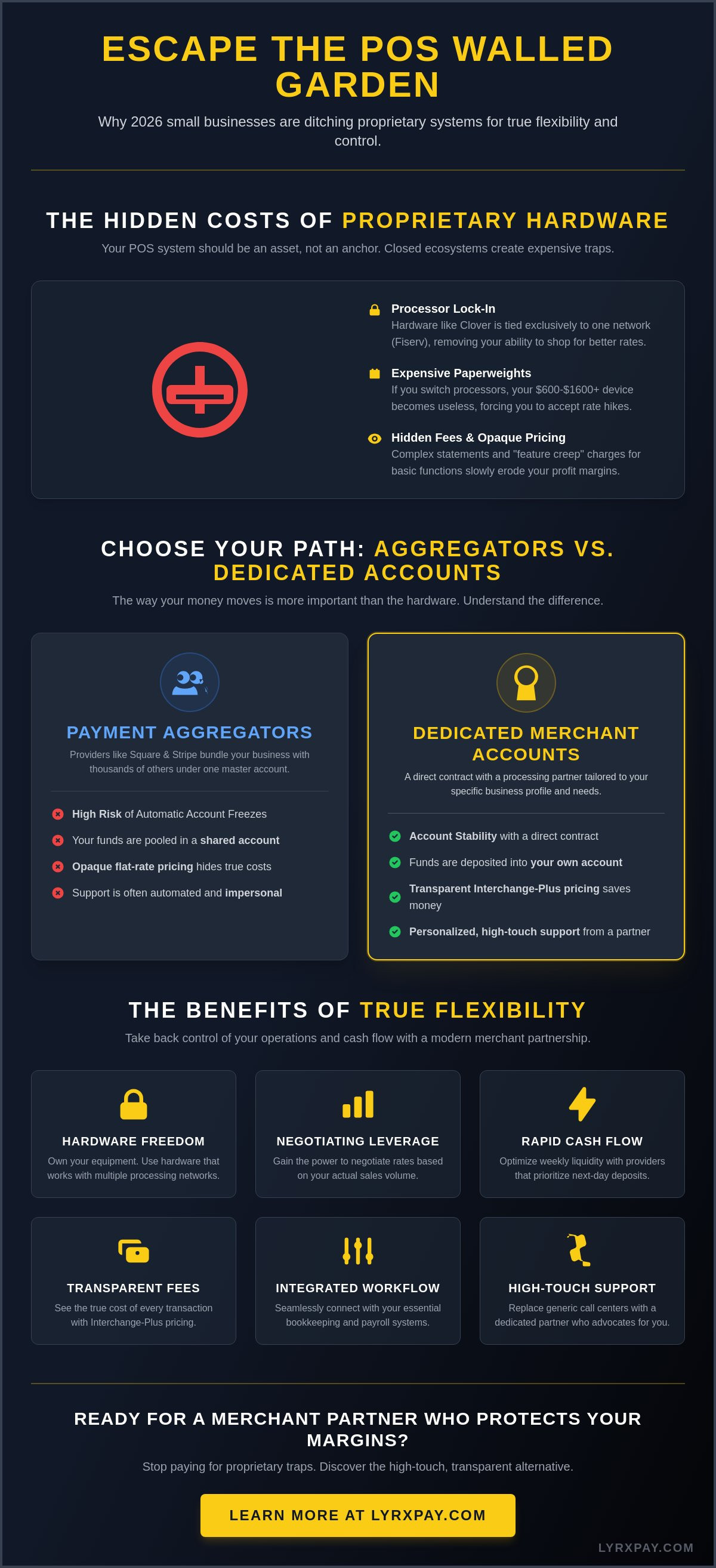
Buying proprietary hardware feels like a solid investment until you want to change your merchant service provider. Because Clover devices are built to work specifically with the Fiserv network, they often become expensive paperweights the moment you try to switch. You might have paid $599 for a handheld Flex or over $1,600 for a Station Solo, only to find that those devices won't "re-program" for a different processor. This creates a cycle of fee fatigue. You're forced to accept whatever rate increases come your way because the cost of replacing your entire hardware stack feels too high. Over time, those software fees and "feature creep" charges for basic functions like online ordering can quietly erode your monthly margins.
Merchant Service Flexibility: The New Priority
What does true flexibility look like for a scaling business? It means owning your data and your equipment. If a provider isn't meeting your needs, you should be able to move your processing to a partner that offers better rates or faster deposits without buying new terminals. Open ecosystems allow you to shop for the best value. This is the core reason businesses are looking for Clover alternatives for small business that prioritize transparency over lock-in. When you choose a flexible partner, you gain:
- Ownership: Hardware that works with multiple processing networks.
- Leverage: The ability to negotiate rates based on your actual volume.
- Agility: Faster access to your funds through next-day deposits.
If your current POS feels like a barrier to your liquidity, it's time to look at a partnership that values your operational health. You shouldn't have to choose between sleek hardware and fair fees. You can have both when you break free from the proprietary trap.
The Hidden Trap: Aggregators vs. Dedicated Merchant Accounts
While many Clover alternatives for small business focus on the touchscreen or the sleek design, the real difference lies in how your money moves. Most popular POS systems use an "aggregator" model. Providers like Square or Stripe bundle your business with thousands of others under a single master account. This makes setup fast, but it creates a fragile environment for your cash flow. You aren't a client to them; you're just a data point in a massive pool of sub-merchants.
Aggregators rely on automated algorithms to manage risk. If you have an unusually busy Saturday or process a larger-than-normal transaction, these systems often trigger an automatic freeze without a human ever looking at your file. You're left fighting a chatbot to get your own money. A dedicated merchant account eliminates this volatility by providing a direct contract tailored to your specific business profile. This stability is the foundation of a healthy operation.
Understanding Interchange-Plus Pricing
Interchange-plus is the most transparent merchant billing method. This model separates the non-negotiable fees charged by card brands from the processor's markup. Big-box providers often push flat-rate pricing because it sounds simple, but it actually hides the fact that you're overpaying for every debit card transaction. When you can see the true cost of every swipe, you gain the power to keep more of your revenue. If you're tired of flat rates that eat your profits, it might be time to explore a dedicated processing partnership that puts your growth first.
Account Stability and Funding Speed
Being an aggregated sub-merchant means you're at the mercy of the group's collective risk. If the aggregator faces issues, your funding could be delayed. Dedicated accounts prioritize your individual liquidity. This structure facilitates consistent next-day deposits, ensuring your weekly payroll and inventory needs are always met. High-volume businesses require this level of concierge support to avoid the stress of unexpected fund holds and automated account closures.
Scaling your business requires a partner that understands your unique patterns. Flat-rate pricing might work for a side hustle, but once your volume hits a certain threshold, the lack of transparency becomes a major expense. You deserve a system that grows with you, offering the stability of a direct account and the clarity of interchange-plus billing. It's the only way to ensure your hard-earned cash stays where it belongs: in your business bank account.
Top Clover Alternatives Compared: Square, Shopify, and Toast
Are you paying for a premium "all-in-one" experience while only using a fraction of the features? When evaluating Clover alternatives for small business, the search usually begins with the big names that dominate the market. Square remains a popular entry point for micro-merchants because of its low barrier to entry, but the long-term costs have shifted. Following the 2025 fee adjustments that increased in-person transaction costs to 15 cents per swipe, many scaling businesses are finding that the "free" software comes at a significant price once volume increases.
If your revenue comes from both a physical storefront and a digital shop, Shopify POS offers unparalleled synergy. It synchronizes inventory in real-time, making these systems popular Clover alternatives for small business owners who prioritize digital sales. However, pure brick-and-mortar retailers often find the interface restrictive unless they pay for the "Pro" add-on. For those in the culinary world, Toast is the undisputed leader for kitchen operations, though its March 2026 "Volume Subscription Fee" has introduced a new layer of cost for high-traffic restaurants.
Finding the right fit requires a clear understanding of the logistics behind accepting credit and debit card payments. You need a system that matches your specific workflow, whether that involves scanning barcodes or managing a complex seating chart. Here is how the top contenders stack up for different industries.
Retail-Focused Alternatives
Inventory-heavy businesses often choose between Shopify and Lightspeed. Shopify excels at ease of use and aesthetics, making it perfect for boutiques. Lightspeed, conversely, offers deeper reporting and more granular inventory controls for businesses with thousands of SKUs. Both platforms offer seamless integration with accounting tools like QuickBooks and Xero. This connection ensures your bookkeeping stays current without manual data entry, allowing you to focus on moving products rather than reconciling spreadsheets.
Restaurant and Service Industry Options
Service-based businesses have different needs than retail shops. While Toast dominates the kitchen with tableside ordering and integrated tip management, it might be overkill for a salon or a consulting firm. Service providers are increasingly moving toward mobile-first ACH processing solutions to lower their overhead. If you don't need a bulky kitchen display system, a leaner setup that prioritizes deposit speed and low-cost bank transfers can significantly improve your monthly liquidity. Choose the tool that solves your specific pain points, not just the one with the most aggressive marketing.
Beyond Hardware: Evaluating Cash Flow and Integrated Workflows
Is your payment terminal a tool for growth or just a digital cash drawer? Many owners looking for Clover alternatives for small business realize that the real value of a system isn't the hardware on the counter; it's how that system connects to the rest of the business. Your point of sale should function as the central brain of your operation. When your processing, payroll, and bookkeeping live in separate silos, you're forced to spend hours on manual data entry that could be spent on strategy. A truly integrated workflow removes these obstacles, allowing you to manage your entire business from a single source of truth.
Cash flow is the lifeblood of any small operation. If your funds are tied up in a 48 or 72-hour settlement cycle, you're essentially giving your processor an interest-free loan while you struggle to pay your own bills. Moving beyond big-box providers often means gaining access to faster funding cycles that mirror the speed of your sales. When you can count on your money being available the next business day, you gain the confidence to make real-time decisions about inventory, staffing, and expansion.
The Power of Next-Day Deposits
Standard 2-3 day settlement timelines are a relic of an older banking era. In 2026, waiting for your money is a hidden fee on your business growth that limits your ability to negotiate with your own suppliers. If you have cash in hand, you can often secure early-payment discounts or better terms from vendors. Improved liquidity changes the math of your daily operations, turning a stressful waiting game into a strategic advantage. You deserve a partner that prioritizes your access to capital as much as you do.
Seamless QuickBooks and Xero Integration
Manual accounting data entry is more than just a chore; it's a liability. Every time you manually transfer sales data from your POS to your accounting software, you risk human errors that can lead to costly audit flags or missed tax deductions. An automated sync between your processing and your books ensures your financial health is visible in real-time. Expert QuickBooks integration simplifies tax season for merchants by ensuring every transaction is categorized and reconciled automatically. This level of precision allows you to streamline your integrated financial workflows and reclaim your time for the work that matters most.
Choosing the right Clover alternatives for small business means looking at the total cost of ownership, including the time you spend on administration. If your current system doesn't talk to your payroll or your bookkeeping software, it's not a complete solution. By unifying these tasks, you eliminate the friction that holds back scaling businesses. You gain clarity, speed, and the peace of mind that comes from knowing your back-office is as efficient as your front-of-house.
The LyrxPay Difference: A High-Touch Alternative to Big-Box POS
Why settle for a generic support ticket when you can have a dedicated partner? When researching Clover alternatives for small business, it's easy to get lost in a sea of hardware specs and software tiers. At LyrxPay, we believe the hardware is just the beginning. We move you away from the frustration of endless call center loops and toward a relationship built on advocacy. You aren't just another merchant ID to us; you're a partner whose time and resources we are committed to defending.
We provide a holistic ecosystem that brings your Point of Sale, Payroll Solutions, and Bookkeeping together under one roof. This isn't about selling you a one-size-fits-all terminal that might not suit your counter space or your workflow. It's about crafting a solution that fits your specific needs. If you want to lower your overhead, transparent credit card and ACH processing are the place to start. We strip away the opaque fee structures that big-box providers rely on, giving you the clarity you need to scale with confidence.
Managed Care for Your Administrative Tasks
LyrxPay acts as a proactive guide for your business's operational health. We offer a concierge style of service that larger competitors simply cannot replicate. From the initial hardware setup to long-term financial scaling, we anticipate your needs before they become obstacles. Think of us as your managed care team for the administrative side of your craft. This partnership allows you to focus on your customers while we handle the technical and financial heavy lifting. If your business grows, your systems should move with you, not hold you back.
Take Control of Your Processing Costs Today
Are you certain you're getting the best rate? Many businesses are surprised by the hidden costs buried in their current merchant statements, especially within locked ecosystems. Performing a fee audit is the first step toward reclaiming your margins and improving your weekly liquidity. We make the transition to a lower-fee solution simple and stress-free, ensuring your data remains secure throughout the move. If you're ready to see the real numbers behind your processing, you can audit your merchant statement and discover lower fees with LyrxPay. We'll help you identify exactly where your revenue is leaking and show you a more efficient path forward.
Choosing the right Clover alternatives for small business is about more than just finding a new screen. It's about finding a team that values your success as much as you do. By combining high-touch service with integrated financial tools, we help you build a more resilient business. Stop fighting your technology and start using it to your advantage.
RECLAIM YOUR MARGINS AND YOUR TIME
Choosing the right path forward means looking beyond the hardware on your counter and focusing on the financial health of your entire operation. By exploring Clover alternatives for small business, you've already taken the first step toward breaking free from restrictive contracts and opaque pricing. You now know that the combination of a dedicated merchant account and seamless back-office integration is the key to sustainable growth. It's time to stop letting slow deposits and hidden fees dictate how you run your daily operations.
You can secure next-day deposits to improve your liquidity and use expert QuickBooks and Xero integration to eliminate manual errors. Lower fees are finally within reach when you move away from the rigid big-box model toward a partnership that values your unique workflow. We are ready to help you navigate this transition with the personal attention and concierge support your business requires to thrive. Your hard work deserves a system that protects your margins and respects your time.
Stop overpaying for your POS and processing; get a custom LyrxPay quote today
Let's build a more efficient future for your business together. You've done the heavy lifting; now it's time to let your technology work for you.
Frequently Asked Questions
What are the main reasons to look for a Clover alternative?
The primary drivers for switching are proprietary hardware lock-in and high processing costs. Many owners seek Clover alternatives for small business to gain the freedom to negotiate rates without replacing their entire terminal setup. If your current system limits your choice of processor, you're essentially stuck with whatever fee increases they implement. Moving to an open system allows you to own your equipment and shop for the best possible merchant service rates.
Can I keep my Clover hardware if I switch to another merchant service provider?
It's rarely possible to use Clover hardware with a different processor. Because these devices are encrypted specifically for the Fiserv network, they won't work with outside merchant accounts. If you decide to switch, you'll likely need to invest in new, processor-agnostic hardware. This is why many businesses now prioritize open-market equipment that provides long-term flexibility and prevents future hardware waste.
Which POS system has the lowest transaction fees for small businesses?
Interchange-plus pricing models typically offer the lowest overall transaction costs for growing businesses. While flat-rate aggregators provide simplicity, they often hide the fact that you're overpaying for debit transactions. A dedicated merchant account reveals the true cost of every swipe. This transparency allows you to keep more of your revenue, especially as your monthly processing volume increases beyond the startup phase.
How long does it take to switch from Clover to a new POS system?
Most businesses can complete the transition to Clover alternatives for small business within 3 to 10 business days. This timeframe covers the application process, account underwriting, and the delivery of your new hardware. A dedicated partner can help you export your inventory and customer data to ensure a seamless move. Planning the switch during a slower period helps minimize any disruption to your daily operations.
What is the difference between a POS aggregator and a dedicated merchant account?
Aggregators pool your business with thousands of others, while a dedicated account gives you a direct contract with a processor. Being part of an aggregate pool increases the risk of automated fund holds or account freezes. A dedicated merchant account offers greater stability, personalized support, and faster funding speeds. It's the difference between being a number in a massive database and having a professional ally for your business.
Do all Clover alternatives offer next-day deposits?
Next-day deposits are not a universal standard, so you must verify this with each provider. Many aggregators default to a 2 or 3-day settlement cycle unless you pay an additional fee for instant transfers. Dedicated merchant service providers often include next-day funding as a standard feature to support your liquidity. Having fast access to your cash allows you to manage payroll and inventory without the stress of waiting for settlements.
How does POS integration with QuickBooks save my business money?
Integration saves money by automating the reconciliation process and reducing human error. When your POS talks directly to QuickBooks, you don't have to pay someone to manually enter daily sales totals. This real-time synchronization ensures your financial reports are accurate for tax season and provides a clear picture of your profit margins. It's a simple way to reclaim hours of administrative time every single week.
Is ACH processing cheaper than credit card processing for my business?
ACH processing is significantly more cost-effective than credit card processing for most businesses. Instead of paying a percentage of the total sale, ACH often involves a low flat fee per transaction. This makes it a superior option for large invoices or recurring service payments. If you can move even a portion of your volume to ACH, you'll see an immediate and positive impact on your bottom line.