
Wholesale Credit Card Processing Rates: The Merchant’s Guide to True Costs

What if your "simple" payment provider is actually your most expensive vendor? If you're currently paying a flat rate for every transaction, you're likely paying a massive premium for convenience while leaving thousands of dollars on the table. It's time to pull back the curtain on wholesale credit card processing rates to see what you're actually paying for. Most business owners find their merchant statements intentionally confusing, but understanding the industry floor is the first step toward reclaiming your revenue.
We understand the frustration of seeing rising costs without a clear explanation. This guide will show you exactly how to secure the lowest possible fees by moving away from opaque pricing models. You'll gain a clear understanding of Interchange-Plus pricing, learn how to audit your own statement for hidden markups, and discover tools to lower your monthly overhead. We've done the heavy lifting so you can stop overpaying and focus on growing your business with confidence.
Key Takeaways
- Identify the non-negotiable "base cost" set by card networks so you can recognize the absolute floor of your processing expenses.
- Secure wholesale credit card processing rates by adopting an Interchange-Plus model, effectively bypassing the high markups found in standard flat-rate pricing.
- Use our five-minute statement audit framework to spot hidden junk fees and reclaim control over your monthly overhead.
- Simplify your workflow by pairing transparent processing fees with integrated bookkeeping and Quickbooks for a more efficient, cost-effective back office.
Decoding Wholesale Credit Card Processing Rates
Think of wholesale rates as the raw material cost of your business transactions. Just as a baker pays a base price for flour before selling a loaf of bread, every merchant pays a base price to accept a card payment. These wholesale credit card processing rates are the absolute floor. They're set directly by card brands like Visa and Mastercard, and they represent the non-negotiable cost of doing business in a digital economy. No processor, regardless of their size or marketing budget, can bypass these rates or buy them for less.
It's vital to distinguish between a "wholesale business" and "wholesale pricing." While you might run a distribution company that sells in bulk, wholesale pricing in this context refers to the transparent pass-through of costs. When you understand this base cost, you gain a clear view of your business liquidity. You stop guessing where your money goes and start seeing exactly how much of every dollar stays in your pocket. This level of clarity is the foundation of a healthy, scalable operation.
Interchange: The Real Wholesale Cost
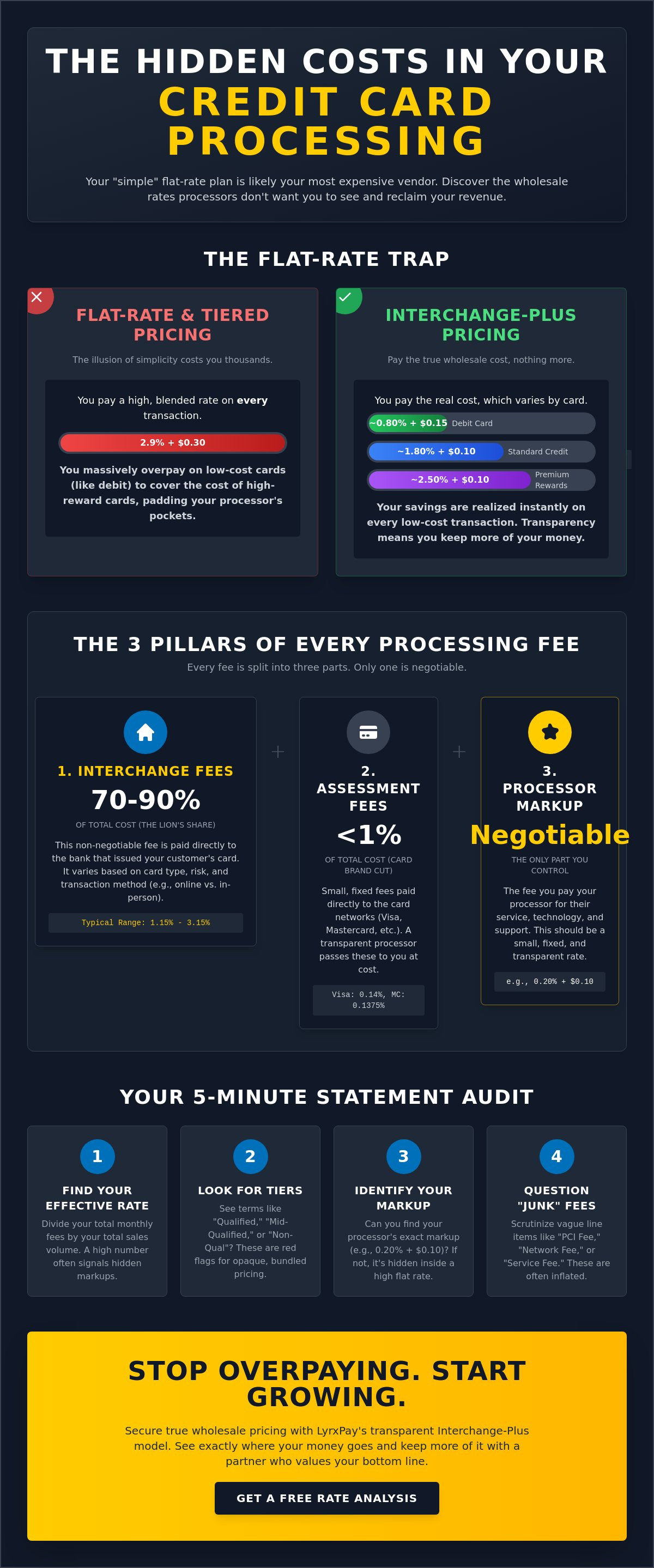
The engine behind these rates is known as interchange. At its core, Interchange fees are paid directly to the bank that issued the customer's card. As of November 2025, these fees generally range from 1.15% to 3.15% of the transaction value. The specific rate depends heavily on the type of card your customer uses. For instance, a basic debit card might cost only 0.80% plus $0.15, while a premium Visa Signature Preferred card carries a higher rate of 2.10% plus $0.10. These rates aren't static. Card brands update them twice a year to reflect the current financial landscape, including the 2025 antitrust settlement that will reduce average rates by 0.10% for the next five years.
Why Processors Hide the Wholesale Floor
Many providers prefer to keep you in the dark using the "Tiered Pricing" trap. They bundle various wholesale credit card processing rates into arbitrary buckets labeled "Qualified," "Mid-Qualified," or "Non-Qualified." This lack of transparency allows them to hide high markups. If you're using a flat-rate provider, you're likely paying a massive premium for simplicity. You might pay 2.9% for every transaction, even when the true cost for a debit card is less than 1%. We believe knowing your base cost is a right, not a privilege. By moving to an unbundled model, you remove the obstacles between you and your profit, ensuring your merchant statement finally makes sense.
The Three Pillars of Every Processing Fee
Every time a customer swipes, dips, or taps a card, the resulting fee is split into three distinct pieces. If your current provider gives you a single "blended" rate, they're likely blending away your profit by hiding the true wholesale credit card processing rates underneath. Understanding the math of a transaction is the only way to reclaim your margin. By moving to an unbundled pricing model, you can see exactly where every cent goes, ensuring your daily cash flow remains predictable and your deposits stay high.
Think of your payment processor as the defender of your business health. Their job is to route your money efficiently while charging a fair fee for the service. When these costs are transparent, you can audit your statement with confidence. If you're ready to see the real numbers, it's time to look at the three pillars that hold up every processing fee.
Component 1: Interchange Fees (The Lion's Share)
This is the non-negotiable fee paid directly to the bank that issued your customer’s card. It typically accounts for 70% to 90% of your total processing costs. While the card brands set these rates, the specific "floor" changes based on how you accept the payment. For example, "card-not-present" transactions, such as online orders or keyed-in payments, carry higher risk and therefore higher interchange rates than a physical swipe. Interchange is the fundamental building block of all processing costs.
Component 2: Assessment Fees (The Card Brand Cut)
These small, fixed fees go directly to the card networks like Visa, Mastercard, or Discover. As of late 2025, Visa charges 0.14% for credit transactions, while Mastercard sits at 0.1375%. Because these fees are identical for every processor in the country, they're often the smallest part of your statement. However, they can be the most confusing because they appear as a long list of tiny line items. A transparent provider will pass these through to you at cost without adding a hidden margin.
Component 3: Processor Markup (The Only Negotiable Part)
The markup is the fee you pay your processor for the technology, security, and support they provide. This is the only part of the equation where you have room to negotiate. Processors typically charge this in "basis points," where one basis point equals 1/100th of a percentage point. For example, a markup of 20 basis points is 0.20%. When you partner with a transparent processor, you ensure this markup stays low and fixed, prioritizing your business growth over their bottom line. Keeping this pillar lean is the key to securing true wholesale credit card processing rates and maintaining long-term liquidity.
Interchange-Plus vs. Flat-Rate Pricing
Choosing a pricing model is often a trade-off between the perceived ease of a flat rate and the actual savings of a transparent model. Many business owners start with flat-rate providers because the math feels simple. You pay one percentage regardless of the card type. However, as your business grows, that simplicity becomes a significant financial drain. Once you scale, the goal shifts from "easy to understand" to "lowest possible cost." This is where accessing true wholesale credit card processing rates becomes a competitive necessity rather than just a financial preference.
Beyond the raw percentages, the structure of your account affects your daily operations. Dedicated merchant accounts often provide the advantage of next-day deposits, a stark contrast to the holding periods sometimes seen with massive payment aggregators. This immediate access to capital improves your cash flow and allows you to reinvest in your business faster. While some worry that an unbundled statement is too complex for a small team, it's actually just a detailed receipt that proves you aren't being overcharged.
The True Cost of 'Simple' Flat Rates
A typical flat rate of 2.9% plus $0.30 per transaction might look clean on paper, but it effectively hides the wholesale floor. If the actual interchange cost for a regulated debit card is only 0.05% plus $0.22, the processor pockets the entire difference as profit. For high-volume businesses, this "convenience fee" can add up to thousands of dollars in lost revenue every year. This is especially true for B2B companies. High-ticket transactions can often qualify for lower rates through Level 2 and Level 3 data processing, but flat-rate models rarely pass those savings back to the merchant. In the world of processing, simple usually means expensive.
Why Interchange-Plus is the Gold Standard
Interchange-Plus is the most transparent pricing model available because it separates the base costs from the processor's margin. You see exactly what the card-issuing bank took and exactly what your processor earned for their service. This model offers automatic savings. If wholesale credit card processing rates drop due to new regulations or network adjustments, your monthly bill decreases immediately without you having to ask. You aren't stuck in a high-priced bucket; you're riding the actual market floor. Interchange-Plus is the only model that passes wholesale savings directly to the merchant. By choosing this path, you transition from a passive payer to an informed partner in your business's financial health.
How to Spot 'Hidden' Markups in Your Statement
Have you ever looked at your merchant statement and felt like you needed a decoder ring? You aren't alone. Many sales reps will tell you that you're already on a "wholesale plan" just to end the conversation. But "wholesale" is a marketing term unless the actual math backs it up. To find the truth, you need to look past the sales pitch and into the fine print. Auditing your statement shouldn't take all day. In fact, you can usually spot the most common offenders in under five minutes if you know where to look.
The goal is to move from confusion to confidence. When you understand the true wholesale credit card processing rates, you can ask your provider direct questions. If they can't give you a straight answer about a specific fee, it's a sign that they're prioritizing their margin over your growth. You deserve a partner who acts as a concierge for your financial health, not a gatekeeper of your own data. Empowering yourself with this knowledge is the first step toward lowering your monthly overhead.
Red Flags: The 'Junk Fees' Checklist
Processors often layer on small charges that feel insignificant individually but create massive annual leakage. Keep a sharp eye out for these common "junk fees":
- PCI Non-Compliance Fees: You shouldn't pay a monthly penalty for compliance. A supportive processor helps you meet standards rather than profiting from your confusion.
- Statement and Administrative Fees: These are often "legacy" charges for paper mailings or account maintenance that provide zero actual value to your business.
- Batch Header Fees: These are small charges applied every time you close out your terminal. While they seem like pennies, they can add up to hundreds of dollars in unnecessary costs every year.
The 'Qualified' vs. 'Non-Qualified' Shell Game
If your statement groups transactions into "Qualified," "Mid-Qualified," or "Non-Qualified" tiers, you're likely overpaying. This tiered model is a shell game designed to hide the real wholesale credit card processing rates. The processor decides which transactions "qualify" for the low rate, and unsurprisingly, most of your sales end up in the more expensive tiers. This is why a transaction that should be cheap often costs you a premium. Demand an "unbundled" or Interchange-Plus statement from your provider. If they refuse to show you the raw interchange costs, it's time to find a partner who values transparency. Switch to a transparent processing plan today and stop the hidden leakage in your merchant account.
Securing True Wholesale Pricing with LyrxPay
Understanding the math behind your merchant statement is the first step toward financial freedom. However, actually managing those wholesale credit card processing rates shouldn't become your new full-time job. We position ourselves as your dedicated concierge, handling the technical complexities of merchant accounts so you can return your focus to your customers. Our goal is to act as a defender of your resources, ensuring you never pay a penny more than necessary to accept a payment.
Operational health is about more than just a low rate. It's about how that rate interacts with your entire business ecosystem. Many providers focus solely on the transaction, leaving you to figure out the accounting on your own. We take a different approach by linking your processing directly to your financial back office. This holistic view allows us to support your growth from the first swipe to the final tax filing.
Seamless QuickBooks and Xero Integration
Manual data entry is a silent killer of business productivity. If your team spends hours every week reconciling merchant statements with your ledger, you're losing money on labor even if your rates are low. Our systems integrate directly with QuickBooks and Xero to ensure your data flows automatically. We provide expert QuickBooks setup and ongoing bookkeeping support to make sure your payments and accounting stay perfectly aligned. This integration doesn't just save time; it provides a level of clarity that allows for better, faster decision-making.
Beyond the Rate: A Partnership for Growth
Cash flow is the lifeblood of any growing company. Waiting days for your funds to clear is an outdated obstacle that we've removed. By offering next-day deposits, we ensure your liquidity remains high, giving you the freedom to pay vendors or reinvest in inventory without delay. Our integrated POS software and hardware solutions are built to grow alongside you, whether you're opening a second location or expanding your service offerings. We're here to provide managed care for your administrative tasks, letting you focus on the craft that started it all.
Ready to see how much you could be saving? We offer a no-obligation review of your current merchant statement to find hidden markups and junk fees. Stop overpaying and get your free statement audit from LyrxPay today!
Take Control of Your Processing Costs
You've pulled back the curtain on the industry's most guarded secrets. You now know that the "base floor" of every transaction is set by card networks, and anything above that is where your profit can slip away. By identifying the three pillars of every fee and choosing a transparent Interchange-Plus model, you position your business for long-term health. Don't let your hard-earned revenue get lost in a sea of "non-qualified" tiers or opaque flat rates. True wholesale credit card processing rates are reachable when you have a partner who prioritizes your liquidity through next-day deposits and ensures your accounting stays lean with expert QuickBooks and Xero integration.
Ready to see exactly where your money is going? Audit Your Merchant Statement for Free with LyrxPay to uncover hidden markups and reclaim your margin. You've done the hard work of building your business; now it's time to ensure your processing partner works just as hard for you. We're ready to help you thrive.
Frequently Asked Questions
What are actual wholesale credit card processing rates for 2026?
Wholesale rates, primarily composed of interchange fees, currently range from 1.15% to 3.15% for credit transactions. For example, a basic debit card often carries a rate of 0.80% plus $0.15, while a premium Visa Signature Preferred card is 2.10% plus $0.10. These wholesale credit card processing rates are set by the card brands and issued to the banks, meaning they're the non-negotiable base cost for every merchant in the country.
Is Interchange-Plus pricing better than flat-rate pricing for small businesses?
Interchange-Plus is almost always the superior choice for businesses looking to lower their overhead. While flat-rate models offer a single, simple percentage for every sale, they often hide a significant profit margin on low-cost transactions like debit cards. If you want to pay the true cost of each card type rather than a padded average, the transparency of an unbundled model ensures you aren't overpaying for simplicity.
Can I negotiate my wholesale processing rates with my current provider?
You cannot negotiate the base interchange or assessment fees because these are fixed by the card networks and banks. However, you can and should negotiate the processor's markup, which is the only part of the fee that stays with your provider. If your current rep claims your wholesale credit card processing rates are already as low as possible, ask for a detailed audit to see exactly how much of their own margin is layered on top.
What is the difference between a basis point and a percentage in processing?
A basis point is a unit of measure equal to one-hundredth of one percent, or 0.01%. In the processing world, markups are often quoted in basis points to provide a more granular view of the cost. For instance, a markup of 20 basis points means you're paying 0.20% above the wholesale floor. Understanding this distinction helps you compare different provider offers with much higher precision.
How do next-day deposits improve my business liquidity?
Next-day deposits improve your liquidity by giving you faster access to the cash generated from your daily sales. Instead of waiting several days for a payment aggregator to release your funds, you receive your money the next business day. This speed allows you to pay vendors, cover payroll, and reinvest in inventory without the stress of a cash flow gap, keeping your operations moving at full speed.
Why does my merchant statement have so many different fee categories?
Your statement is complex because it reflects the various entities involved in a single transaction, including the issuing bank, the card network, and the processor. A transparent statement will break these down into separate line items so you can see the raw interchange costs and assessment fees. If your statement is a confusing mess of "qualified" tiers, it's likely a sign that your provider is hiding high markups behind vague terminology.
Do wholesale rates change based on whether I swipe or key-in a card?
Yes, the method of acceptance significantly changes the wholesale cost because it affects the risk level of the transaction. Swiping or tapping a card in person is considered a lower risk, which qualifies for the lowest possible interchange rates. Keying in a card manually or taking a payment through an online portal increases the risk of fraud, which leads the card networks to charge a higher wholesale fee to offset that liability.
How does QuickBooks integration reduce my overall business costs?
QuickBooks integration reduces costs by automating the reconciliation process and eliminating hours of manual data entry. If your processing and bookkeeping systems speak the same language, your financial records stay accurate without the need for a staff member to match deposits to sales records. This synergy doesn't just save on labor costs; it also reduces the likelihood of expensive accounting errors and provides a real-time view of your business health.