
21 Critical Questions to Ask a Merchant Services Provider in 2026

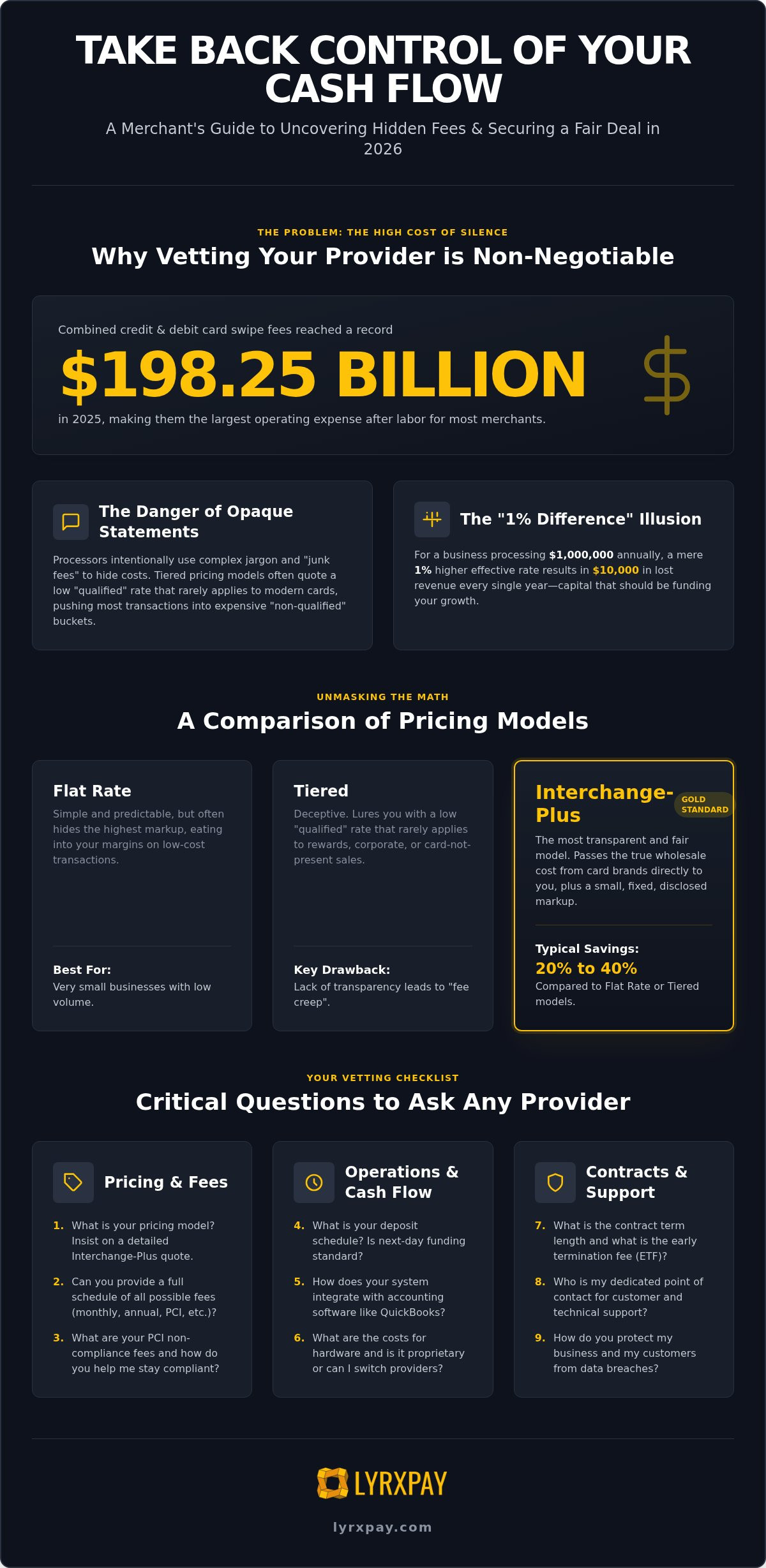
Did you know that combined credit and debit card swipe fees reached a record $198.25 billion in 2025? For most modern merchants, these costs are now the largest operating expense after labor. It's exhausting to watch your hard-earned revenue disappear into a black hole of opaque fee structures and "incidental" charges that change without notice. You want to focus on your craft; you shouldn't have to spend hours decoding a processing statement that feels like it was written in another language.
This guide will empower you to take back control of your cash flow. By knowing the exact questions to ask a merchant services provider, you'll expose hidden costs, secure next-day liquidity, and ensure your POS system finally plays nice with QuickBooks. We've compiled 21 critical inquiries designed to separate the true partners from the predatory processors. We'll cover everything from the mandatory PCI DSS 4.0 compliance standards to the latest 2026 interchange adjustments, giving you the clarity you need to protect your margins.
Key Takeaways
- Identify "fee creep" and protect your bottom line by implementing a rigorous vetting process for any new merchant partner.
- Compare pricing models to see why Interchange-Plus remains the gold standard for transparency and cost savings in 2026.
- Secure your liquidity by knowing the right questions to ask a merchant services provider regarding settlement speed and next-day deposits.
- Streamline your operations with seamless QuickBooks integration that eliminates manual data entry and reduces accounting errors.
- Navigate the latest security standards and contract terms to protect your business from both data breaches and predatory termination fees.
The High Cost of Silence: Why Your Merchant Services Provider Needs a Vetting Process
Most business owners treat their payment processor like a "set it and forget it" utility. This silence is exactly what traditional banks count on. When you stop looking at the fine print, fee creep begins. A fraction of a percent here and a monthly service fee there might seem small in isolation, but they compound quickly. If you aren't actively monitoring your statements, you're likely paying for the processor's growth instead of your own.
Consider the math of your bottom line. A 1% difference in effective rates might not sound like much during a high-pressure sales pitch. However, for a business processing $1 million annually, that is $10,000 lost every single year. That is capital that should be funding your next hire or a new marketing campaign. Moving beyond the sales pitch requires a structured approach. You need an operational partner who values transparency as much as you do. This guide provides the specific questions to ask a merchant services provider so you can audit your current setup or vet a new one with total confidence.
The Danger of Opaque Merchant Statements
Processors often hide "junk fees" behind complex jargon that is intentionally difficult to decode. You might see charges for "PCI non-compliance" even if you are compliant, or "statement fees" that serve no purpose other than increasing the provider's margin. Tiered pricing is a common psychological trick; they quote a low "qualified" rate that almost no modern transaction actually hits. Most of your sales end up in "non-qualified" buckets with much higher costs. A fee audit is a necessary quarterly business health check to ensure your rates haven't drifted from your original agreement.
Defining Your Business Requirements for 2026
Before you start the interview process, you must define what your operations actually look like in 2026. The landscape has shifted. Are you moving toward more online ACH payments to reduce costs, or is your in-person retail volume still the primary driver? Do you need a simple standalone terminal, or is it time for a full POS system that manages inventory and payroll? Knowing these details helps you how to lower merchant fees by choosing the right hardware and software from the start. Taking the time to assess your needs ensures you don't pay for "premium" features you'll never use while missing out on the integrations that actually save you time.
- Assess your current split between card-present and card-not-present transactions.
- Review your need for recurring billing or subscription management tools.
- Evaluate how well your current hardware integrates with your accounting software.
By approaching the selection process with these requirements in hand, you transform the conversation. You're no longer just a lead in a salesperson's funnel; you're a partner looking for a specific solution. This shift in dynamic is the first step toward securing a fair deal.
Unmasking the Math: Questions to Ask About Pricing Models and Hidden Fees
Pricing is where transparency often goes to die in the merchant services industry. Most providers rely on three primary models: Flat Rate, Tiered, and Interchange-Plus. While Flat Rate pricing feels simple, it usually hides a significant markup that eats into your margins. Tiered pricing is even more deceptive; it lures you in with a "qualified" rate that rarely applies to modern rewards cards or business cards. In 2026, Interchange-Plus remains the gold standard for transparency. This model passes the actual cost from the card brands directly to you with a small, fixed margin on top. Businesses that switch to Interchange-Plus typically see savings between 20% and 40% compared to traditional flat-rate models.
You must also look beyond the base rate to understand the total cost of acceptance. This includes ancillary fees that processors often bury in the fine print. For instance, with the mandatory enforcement of PCI DSS 4.0 in 2026, many providers now charge automatic monthly increases of 0.10% to 0.50% for accounts that aren't fully compliant. If you don't ask the right questions to ask a merchant services provider upfront, these "incidental" costs can easily double your effective rate without you noticing until the statement arrives.
Specific Fee-Related Questions to Pose
When you sit down with a potential partner, don't let them gloss over the specifics. Demand clear answers to these inquiries:
- "Is your pricing interchange-plus or tiered?" If they say tiered, ask for a breakdown of what percentage of your specific industry's transactions actually qualify for the lowest rate.
- "What are your exact batch-out and gateway fees?" These small per-transaction or per-day fees can add up to hundreds of dollars a year.
- "Do you offer a rate-lock guarantee for the duration of the contract?" With Visa and Mastercard making biannual adjustments, such as the 5-8 basis point increase for B2B categories in April 2026, you need to know if your provider's markup will remain steady.
Spotting the Red Flags in the Fine Print
Be wary of "liquidated damages" clauses. These are predatory terms that require you to pay the processor's projected future profits if you cancel your contract early. While a standard early termination fee of around $495 is common in 2026, liquidated damages can cost you thousands. Additionally, watch out for hidden annual membership or maintenance fees that provide no actual service value. Reducing these unnecessary expenses is a primary step in business liquidity management tools, as every dollar saved in processing is a dollar of immediate cash flow. If a provider is hesitant to give you a full "total cost of acceptance" breakdown, it's a sign they are hiding something. At LyrxPay, we believe in radical transparency, ensuring you see exactly where every penny of your processing fee is going.
Beyond the Swipe: Evaluating Integration, Hardware, and Cash Flow Speed
If pricing is the skeleton of your processing agreement, then cash flow speed and technical integration are the muscles that keep your business moving. You can have the lowest rates in the world, but if your money is stuck in "processing" for three days, you can't pay your vendors or cover payroll on time. Cash flow is the lifeblood of your operation. When your processor holds onto your funds for several business days, they are essentially leveraging your hard-earned capital to bolster their own liquidity while you struggle to meet deadlines. In 2026, next-day settlement has moved from a premium perk to an industry expectation for healthy businesses.
Your hardware and software must also act as a cohesive unit rather than a collection of disconnected tools. A modern POS system should do more than just open a cash drawer; it should provide a real-time window into your inventory, sales trends, and staff performance. If your terminal doesn't talk to your accounting software, you're stuck in a cycle of manual data entry that invites human error. These are the operational frictions that eat away at your time. Knowing the right questions to ask a merchant services provider regarding their tech stack will save you from expensive hardware "upgrades" six months down the road.
Cash Flow and Deposit Questions
Liquidity management starts with knowing exactly when your money will hit your bank account. Don't settle for vague promises of "fast" deposits. Instead, pin potential providers down with these specifics:
- "What is the daily cutoff time for next-day deposits?" For restaurants and late-night retail, a 5:00 PM cutoff is useless. You need a provider that supports late-night batching.
- "Are there additional fees for accelerated settlement?" Some processors quote a low rate but then charge a premium for the "privilege" of accessing your money the next day.
- "How do you handle weekend and holiday transaction processing?" Your business doesn't stop on Saturdays; your funding shouldn't either.
Software and POS Integration Check
Manual data entry is a significant hidden cost. If your manager spends four hours a week reconciling credit card statements with your general ledger, that is time stolen from customer service or growth strategies. You should prioritize all-in-one business financial solutions that bridge the gap between the swipe and the spreadsheet. Ask potential partners, "Does your system offer a direct, native integration with QuickBooks or Xero?" A "yes" here means your deposits, fees, and sales data sync automatically, providing you with a clean, audit-ready set of books every morning without lifting a finger. This level of automation isn't just a luxury; it's a requirement for scaling a professional business in today's fast-paced market.
The Reliability Audit: Questions Concerning Security, Support, and Contract Terms
Trust is the primary currency of 2026. While low rates might get a provider in the door, their reliability is what keeps your business operational during a crisis. A data breach or a multi-day terminal outage can cost you more than a decade of processing fees in lost revenue and tarnished reputation. You need a partner who views security as a shared mission rather than a compliance checkbox. Moving away from the cold, clinical feel of big-bank processors means finding a team that actually picks up the phone when you need them most.
The industry is notorious for "overseas call centers" where support staff read from scripts and lack any real technical depth. When your POS system crashes during a busy Saturday rush, you don't have time for a forty-minute hold. You need an advocate who understands your specific hardware and software configuration. Evaluating these intangibles requires a specific set of questions to ask a merchant services provider before you sign any service agreement. This audit ensures you aren't just buying a service, but securing a long-term professional relationship.
Security and Compliance Questions
PCI DSS 4.0 enforcement became mandatory in early 2025; by 2026, the penalties for non-compliance are steeper than ever. Most processors now levy automatic monthly rate increases of 0.10% to 0.50% if your filing isn't current. You must be proactive in your defense. Ask these specific questions to gauge their commitment to your protection:
- "Who handles my PCI DSS compliance filing and are there fees involved?" Some providers offer a concierge-style service to manage this for you, while others leave you to navigate complex portals alone.
- "What fraud detection tools are built into the gateway at no extra cost?" In an era of sophisticated digital theft, basic encryption is the bare minimum. You want advanced monitoring that anticipates threats.
- "How do you assist in the event of a customer chargeback dispute?" You want a partner who provides a clear, structured rebuttal process, not one that simply deducts the funds and moves on.
Support and Longevity Questions
Contracts are where many merchants feel trapped. While three-year terms with early termination fees of around $495 are still common in 2026, you should push for more flexible, month-to-month arrangements that favor your business health. Use these questions to ask a merchant services provider to expose their true support culture:
- "Will I have a dedicated account manager or just a generic support line?" A dedicated contact ensures you aren't explaining your business history to a new stranger every time you call.
- "What is your average hold time for technical POS issues?" Demand concrete data, as "we're fast" is not a measurable metric.
- "What is the specific process and cost for terminating the contract?" Transparency at the exit is just as vital as transparency at the start.
Don't settle for being treated like a number in a database. If you're tired of navigating automated phone trees and want a partner who actually cares about your operational health, it's time to partner with a provider that prioritizes your peace of mind.
The LyrxPay Standard: How We Answer the Toughest Questions in the Industry
After reviewing the essential questions to ask a merchant services provider, it's clear that the gap between a utility and a partner is transparency. At LyrxPay, we don't just provide a terminal; we provide a bridge to better liquidity. While larger processors often hold funds for several business days to pad their own accounts, we've made next-day deposits our standard feature. This commitment ensures your cash flow remains fluid, allowing you to reinvest in your growth without waiting on a bank's bureaucracy.
Our approach is designed to remove the administrative friction that slows you down. We offer lower-fee credit card and ACH processing that scales with your volume. By prioritizing Interchange-Plus models and eliminating the "junk fees" mentioned earlier, we ensure your effective rate remains competitive. Our Texas-based team operates as a concierge service, moving away from the cold, clinical interaction of traditional financial services. When you call us, you're speaking to a professional who knows your name and your business goals, not a script-reader in a distant call center.
A Partnership That Goes Beyond Payments
A healthy business requires a holistic view of its finances. We go beyond the swipe by integrating payroll solutions and bookkeeping directly into your workflow. This synergy eliminates the manual data entry that often leads to costly accounting errors. For specialized fields, such as our merchant services for medical offices, we tailor the hardware and software to meet specific regulatory and operational needs. Whether you're managing a clinic or a retail storefront, our goal is to streamline your back-office so you can focus on your patients or customers.
Ready for a Transparent Merchant Statement?
The first step toward a more efficient operation is knowing where you stand. Our team provides a comprehensive, free fee audit to expose exactly where your current provider is hiding their margins. We take the guesswork out of the transition, managing the technical setup to ensure your business flow remains uninterrupted. LyrxPay exists to defend the merchant's time and resources by providing a managed care approach to business operations. If you're ready to move from a transaction to a relationship, we're here to do the heavy lifting for you.
- Request your free statement analysis to identify hidden markups.
- Experience the relief of automated QuickBooks and Xero syncing.
- Access your funds faster with standard next-day deposits.
Secure Your Business Growth for 2026
You've done the heavy lifting by learning how to spot hidden fees and prioritize your business liquidity. Choosing a payment partner isn't just about finding the lowest rate; it's about securing a reliable ally who understands that every second of delay in funding affects your bottom line. By arming yourself with the right questions to ask a merchant services provider, you have shifted the power dynamic back in your favor. You are no longer just a merchant; you're an informed advocate for your own revenue.
Transparency is the only metric that truly matters in today's market. Whether it's ensuring your terminal is ready for the latest security standards or automating your bookkeeping with seamless QuickBooks and Xero integration, your operational health depends on the quality of your partnership. You deserve next-day deposits as a standard feature, not a premium luxury. We are here to help you navigate these complexities with clarity and confidence, moving away from clinical banking toward a true concierge experience.
Ready to stop overpaying? Get your free merchant statement audit from LyrxPay today. Our team provides a no-obligation fee analysis to show you exactly where you can save. You've built a great business; let's make sure you keep more of what you earn.
Frequently Asked Questions
What is a good credit card processing rate for a small business in 2026?
A good rate is one that uses an interchange-plus model, which typically saves businesses 20% to 40% compared to flat-rate or tiered options. In 2026, you should look for a provider that passes through the actual interchange costs set by the card brands with a minimal, transparent markup. Since Visa and Mastercard adjusted rates in April 2026, a transparent provider will show you exactly how those changes affect your specific industry instead of hiding them in a bundled fee.
How long are typical merchant service contracts?
Three-year contracts remain the industry standard in 2026, though month-to-month options are becoming more common for established businesses. These longer agreements often include early termination fees that average around $495. Knowing the term length is one of the most important questions to ask a merchant services provider before signing, as you need to know if you have the flexibility to move if your business needs change.
What happens if I want to switch providers before my contract ends?
Switching early usually triggers an early termination fee, and in some cases, "liquidated damages" clauses that are much more expensive. Some providers require you to pay the projected profit they would have made over the remaining months of your term. Always check if your new provider offers a signing bonus or a buyout to cover these costs. It's vital to review the specific termination process to avoid surprise legal hurdles that can affect your cash flow.
Is there a difference between a merchant account and a payment gateway?
Yes, a merchant account is the specialized bank account where your funds are held, while a gateway is the software that securely transmits transaction data. Think of the gateway as the digital version of a physical terminal and the merchant account as the holding tank for your revenue. In 2026, most modern providers bundle these together. This integration ensures that your online and in-person sales flow into a single reporting dashboard for easier daily management.
How do next-day deposits actually work for my bank account?
Next-day deposits work by batching your transactions at a specific cutoff time and initiating an ACH transfer to your bank immediately. While traditional big-bank processors might take 48 to 72 hours, a high-quality provider uses accelerated settlement to ensure your funds are available the following business day. This improves your liquidity and allows you to cover expenses like payroll or inventory without waiting on the standard banking lag that often hurts small businesses.
Can I use my existing POS hardware with a new merchant services provider?
It depends on whether your hardware is "unlocked" and compatible with the new provider's software and gateway. Many proprietary systems are designed to lock you into a specific processor, which can make switching difficult or require a hardware replacement. Before you make a move, ask for a technical audit of your current terminals. A transparent partner will tell you exactly which pieces of equipment can be reprogrammed and which might need a modern update.
What are the most common hidden fees to look for on a statement?
Look for PCI non-compliance fees, which have significantly increased in 2026 following the mandatory enforcement of PCI DSS 4.0. You should also watch for "statement fees," "regulatory product fees," or "batch header fees" that weren't clearly disclosed during the sales process. These "junk fees" are often used to inflate the processor's margin. Reviewing these details is part of the essential questions to ask a merchant services provider to ensure you aren't being overcharged for standard services.
Why is QuickBooks integration so important for my bookkeeping?
Direct QuickBooks integration eliminates manual data entry, which is the primary source of accounting errors and staff frustration. When your payment data syncs automatically, your deposits, processing fees, and sales taxes are recorded in real-time without extra work. This saves your manager hours of reconciliation every week. It also ensures that your financial reports are always accurate, giving you a clear view of your business health whenever you need to make a strategic decision.