
Credit Card Fraud Prevention: 2026 Merchant Guide

For every dollar a fraudster steals, your business actually loses three. Between the cost of lost inventory and those draining chargeback fees, the "true cost" of a single bad transaction is enough to keep any owner up at night. You've worked too hard to build your revenue only to see it leaked through sophisticated scams or "friendly fraud." It's exhausting to feel like you're constantly playing catch-up with shifting EMV liability rules, which is why mastering credit card fraud prevention for small business is no longer optional.
This guide will show you how to protect your revenue without creating a headache for your customers. You'll learn to shield your bottom line using integrated technology and merchant-first policies that stop threats before they hit your bank account. We'll explore the latest 2026 NACHA requirements, the reality of PCI DSS 4.0 compliance, and how a secure, automated workflow between your POS and your financial management platform can turn your defense into a source of financial clarity. Let's move from reactive fear to a proactive strategy that keeps your cash where it belongs.
Key Takeaways
- Understand how the true cost of fraud can reach $3.75 for every dollar stolen when you account for lost inventory, shipping, and chargeback fees.
- Master credit card fraud prevention for small business by utilizing EMV-compliant hardware that shifts the burden of liability away from your storefront.
- Discover how to use integrated POS and accounting software to automatically flag suspicious patterns before they impact your bottom line.
- Develop a proactive internal fraud policy that empowers your team to verify identities legally and spot red flags with confidence.
- Strengthen your business liquidity with next-day deposits, allowing you to maintain operational health even when fighting disputed transactions.
The Hidden Impact: Understanding the Real Cost of Credit Card Fraud
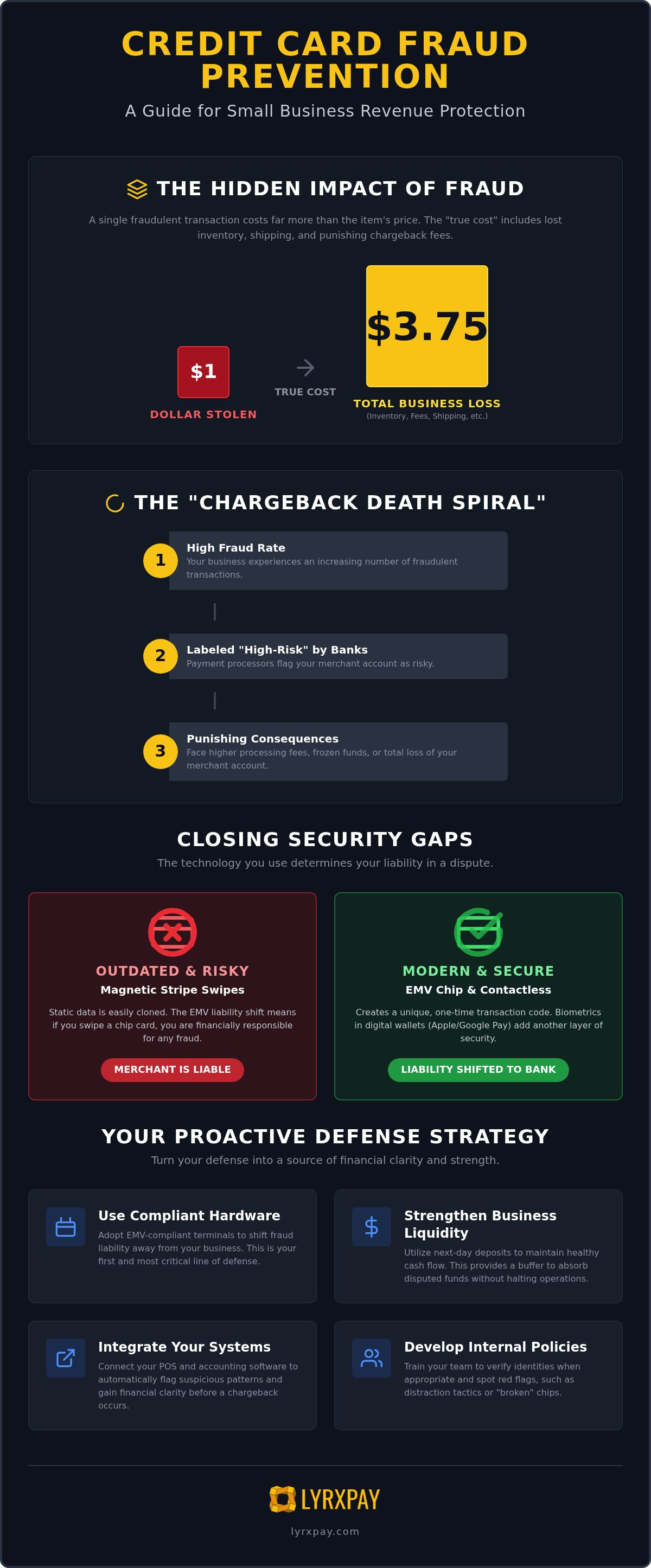
What does a single fraudulent transaction actually cost you? Most owners look at the sticker price of the stolen item and stop there. In reality, Understanding Credit Card Fraud reveals a much darker picture for your ledger. Industry data for 2026 suggests that for every $1 lost to a scammer, U.S. merchants actually lose $3.75 once you factor in shipping, restocking, and those punishing bank fees. This multiplier makes credit card fraud prevention for small business a matter of survival rather than just a technical checkbox.
If your fraud rate climbs too high, you risk entering the "Chargeback Death Spiral." Banks don't just charge you fees; they label you a high-risk merchant. This leads to higher processing rates, held funds, or the total loss of your merchant account privileges. Protecting your revenue isn't just about stopping one bad actor. It's about defending your ability to do business at all. When you view fraud through this lens, it becomes clear that security is actually a form of profit protection.
Direct vs. Indirect Fraud Costs
The damage hits your ledger in two distinct waves. First, you deal with the direct loss: the physical inventory is gone and the original transaction amount is reversed. Then, the indirect costs settle in. You're hit with chargeback fees that often exceed the original sale price, plus the cost of the labor your team spends fighting the dispute. Friendly fraud, where a customer makes a legitimate purchase but disputes the charge with their bank to avoid paying, is a particularly sharp drain on modern retail margins.
The Liquidity Risk of Unresolved Fraud
Fraud is a direct threat to your daily cash flow. When a transaction is disputed, the bank often freezes those funds immediately, sometimes pulling additional "reserve" amounts from your account to cover potential future losses. If you're operating on thin margins, these frozen assets can paralyze your daily operations. You can't pay vendors or cover payroll with money that is locked in a bank's dispute queue.
This is why we view security as a core part of your business liquidity management tools. By using next-day deposits, you create a vital buffer for your business. Getting your legitimate funds into your account faster means you have the capital to absorb the temporary hit of a dispute without stalling your growth. Effective credit card fraud prevention for small business ensures your hard-earned money stays fluid, accessible, and exactly where it belongs.
Closing the Gaps: Card-Present vs. Card-Not-Present Security
The rules of the game changed with the EMV liability shift, yet many owners still don't realize where the buck stops when a transaction goes sideways. If a customer presents a chip-enabled card and you choose to swipe the magnetic stripe instead of "dipping" it, you are legally responsible for any resulting fraud. Banks moved the liability to whichever party uses the least secure technology. For anyone prioritizing credit card fraud prevention for small business, upgrading to modern terminals isn't just a convenience; it's a vital shield for your bank account.
Swiping is a relic of the past because magnetic stripes hold static data that is easily cloned. When a customer taps their phone or dips their card, the terminal generates a unique, one-time transaction code that cannot be reused by a thief. This technology is roughly 10 times more secure than a traditional swipe. As of 2026, staying compliant with PCI DSS 4.0 standards is mandatory, requiring merchants to maintain a higher level of continuous security monitoring than ever before. You can find more detailed guidance on maintaining these standards by reviewing Visa's merchant security tips.
In-Person Security: Beyond the EMV Chip
Contactless payments and digital wallets like Apple Pay or Google Pay add an extra layer of defense through biometrics. Since a thief can't easily replicate a thumbprint or facial ID, these methods are incredibly resilient. Be wary if a customer claims their chip "isn't working" and asks you to manually enter the card number. This is a common tactic used to bypass security features. Train your team to recognize distraction tactics, such as a second person trying to engage the cashier in a complex conversation while a "customer" fumbles with a suspicious card at the terminal.
E-commerce and Phone Orders: The Card-Absent Challenge
Card-not-present (CNP) transactions carry the highest risk because you cannot physically verify the card or the person holding it. You must make CVV and CVC codes a mandatory field for every remote sale. Additionally, implementing an Address Verification Service (AVS) allows you to match the billing zip code provided by the customer with the one on file at the issuing bank. If they don't match, it's a major red flag. Never accept credit card details through unencrypted channels like email or text. If you're looking for a more robust way to handle these remote risks, exploring secure processing hardware can help automate these checks during the checkout process.
Integrated Defense: Using POS and Accounting to Spot Red Flags
Data silos are where fraudsters thrive. If your payment terminal doesn't talk to your accounting software, you're essentially flying blind, relying on luck to catch anomalies before they drain your accounts. Effective credit card fraud prevention for small business relies on a unified front where every transaction is tracked, reconciled, and audited in real time. When your systems are integrated, a red flag in your sales data becomes an immediate alert in your back office, allowing you to stop a "death spiral" of chargebacks before it starts.
Your terminal is more than a piece of hardware; it's a digital gatekeeper. Modern POS systems use end-to-end encryption to ensure that sensitive data is never "in the clear" as it moves from the customer's chip to your bank. The true power of all in one business financial solutions lies in their ability to cross-reference transactions across your entire ecosystem. By monitoring high-risk purchasing patterns, such as multiple rapid-fire transactions on the same card or unusual "split transactions," these systems act as a proactive shield for your margins.
QuickBooks and Xero: Your Fraud Early Warning System
How do you spot fraud that has already bypassed your initial filters? Reconciling your books daily isn't just a best practice for taxes; it's your best "post-game" audit tool. By syncing your processor with QuickBooks or Xero, you can instantly identify duplicate charges or "micro-fraud," where scammers test a card with tiny, unnoticeable amounts before making a large purchase. Expert bookkeeping ensures your merchant statements are audited for errors or unauthorized fees, giving you a level of managed care that protects your liquidity.
POS Software Features That Stop Fraud
Accountability starts at the counter. Your POS software should allow you to set specific transaction limits that require a manager's override for high-value sales. This simple step prevents "internal fraud" or unauthorized employee activity. Using unique login codes for every staff member creates a clear paper trail for every tap, dip, and manual entry. If every transaction is tied to a specific user and encrypted from the moment of contact, you significantly reduce the surface area for digital theft. This integrated approach turns your daily workflow into a self-healing security system.
The Merchant’s Policy: Proactive Internal Controls
Technology is your first line of defense, but a solid internal policy is the glue that holds your security strategy together. Without clear, written guidelines, your team is left to make gut decisions during high-pressure sales moments. A formal policy for credit card fraud prevention for small business ensures that every employee knows exactly how to handle a suspicious transaction without feeling like they're being "difficult" with a customer. It moves the responsibility from the individual staff member to a standardized business process.
One of the biggest areas of confusion involves asking for customer identification. While card network rules generally state you shouldn't refuse a sale solely because a customer won't show ID for a signed card, you have every right to request it for high-value orders or when a terminal flags a mismatch. If a customer is hesitant to provide a government-issued ID that matches the name on the card for a $2,000 purchase, that's a signal to pause. Explicitly outlining these "stop-and-verify" thresholds in your policy manual protects your staff and your bottom line.
Identifying High-Risk Orders
Your team should be trained to spot red flags before the transaction is finalized. High-risk orders often follow specific patterns that are easy to identify once you know what to look for. Keep a "Red Flag" checklist near your POS terminals that includes:
- Mismatched Addresses: Orders where the shipping destination is a high-risk region or significantly different from the billing address.
- First-Time "Whales": Unusually large orders from a new customer who has no previous purchase history with your business.
- Authorization Failures: A single customer attempting to use multiple different cards or failing the CVV check several times in one session.
Employee Training and Access Control
Internal security is just as vital as external defense. You should limit access to sensitive customer data on a strict "need-to-know" basis, ensuring that only senior management can view full transaction histories or export customer lists. Accountability requires that you immediately deactivate POS and software accounts for former employees the moment they leave your company. It's a simple administrative step that prevents unauthorized access to your processing environment.
Training must also evolve with modern threats. Scammers in 2026 are increasingly leveraging AI-driven voice cloning to impersonate owners or technicians, tricking employees into sharing one-time passwords or bypassing terminal security protocols. By educating your team on these social engineering tactics, you turn them into an active part of your security infrastructure. If you're ready to upgrade your defense, partner with a provider that prioritizes merchant security.
Building a Fraud-Resilient Workflow with LyrxPay
Securing your business shouldn't feel like a solo mission. While the technical tools and internal policies we've discussed are essential, the strength of your defense often depends on who is standing behind your merchant account. LyrxPay acts as a dedicated advocate for your time and resources, providing more than just a terminal. We focus on credit card fraud prevention for small business by building a secure ecosystem where your processing, accounting, and cash flow work in perfect harmony.
Defending your margins starts with low fee credit card processing that keeps more capital in your hands. When a fraudulent hit does occur, your biggest need is liquidity. Our next-day deposits ensure you aren't left waiting for weeks to access your legitimate funds while a dispute is being processed. This speed allows you to recover faster and maintain your operational health without the stress of frozen assets stalling your growth.
Integration is the final piece of the fortress. We provide expert support to ensure your QuickBooks or Xero setup is seamlessly connected to your payment flow. This creates a transparent audit trail that makes spotting anomalies effortless. If a chargeback does arrive, you don't have to navigate the complex dispute process alone. LyrxPay stands with you, helping you gather the compelling evidence required under 2026 rules to protect your revenue.
Why a Dedicated Merchant Partner Matters
Generic aggregators often treat small businesses as numbers in a spreadsheet, frequently freezing accounts at the first sign of unusual activity without a second thought. We take a different path. As a dedicated partner, we provide personalized support and proactive account monitoring. We get to know your typical transaction patterns. This allows us to flag truly suspicious activity before it hits your bank account, rather than penalizing you for a successful, high-volume day.
Next Steps for Your Business Defense
Ready to turn your payment workflow into a secure asset? Start with these three steps:
- Audit your hardware: Ensure your current terminal is fully EMV and NFC compliant to avoid unnecessary liability.
- Bridge the gap: Schedule a consultation to integrate your payments, payroll, and bookkeeping for a unified defense.
- Get a second opinion: Contact LyrxPay today for a comprehensive fee and security audit to identify hidden vulnerabilities in your current setup.
Secure Your Future: Turning Defense Into Growth
Protecting your revenue in 2026 requires more than just reactive fixes. By understanding the true $3.75 multiplier of every stolen dollar and closing technical gaps with EMV hardware, you've already taken the first steps toward financial stability. True credit card fraud prevention for small business happens when you bridge the gap between your payment terminal and your accounting software, turning your daily reconciliation into a proactive audit tool. When your team follows a clear internal policy, you remove the guesswork from high-pressure transactions and keep your focus on your craft.
You don't have to navigate these complex security shifts alone. With LyrxPay, you gain a partner dedicated to your operational health through transparent, lower-fee processing and next-day deposits that keep your cash flow fluid. Our seamless QuickBooks and Xero integrations ensure that your data is always accurate and your margins are defended. Take the next step to harden your storefront and streamline your back office. Protect your business and lower your fees with a LyrxPay security audit today. Your hard work deserves a defense that is as tireless as you are.
Frequently Asked Questions
Can a small business be held liable for credit card fraud?
Yes, you can be held liable, particularly if you're using outdated swipe-only terminals. Since the EMV liability shift, the party with the least secure technology pays for the fraud. If you use modern chip-dipping or tapping hardware, the liability usually moves to the bank. Upgrading your equipment is a primary step in credit card fraud prevention for small business.
What is the most common type of credit card fraud for small businesses?
Card-not-present (CNP) fraud is currently the most frequent threat to modern merchants. This occurs when stolen data is used for online or phone orders where the physical card isn't present. Friendly fraud is also a major concern, where a legitimate customer disputes a charge they actually made to get a free product. Both require proactive monitoring to protect your revenue.
How do I legally ask a customer for ID during a credit card transaction?
You can ask for ID to verify a transaction, but you generally cannot refuse a sale solely because a customer declines if the card is signed. Frame your request as a supportive step for the customer's own security. If the terminal flags a high-risk order or the signature is missing, you have much stronger grounds to insist on a government-issued ID to proceed.
Does PCI compliance actually prevent fraud or just protect the bank?
PCI compliance is a dual shield that protects both your business and the banking network. By following these standards, you ensure that sensitive data is encrypted and handled securely, which drastically lowers your risk of a breach. While it helps banks maintain a secure ecosystem, it also saves you from the catastrophic fines and lost processing privileges that follow a data leak.
What should I do if I suspect a transaction is fraudulent before I ship the product?
Pause the order immediately and reach out to the customer via a verified phone number or email. If you see red flags like mismatched addresses or multiple failed attempts, it is better to cancel the transaction and issue a refund. Issuing a voluntary refund is significantly cheaper than losing your inventory and paying a chargeback fee after the product has shipped.
How does QuickBooks integration help with fraud prevention?
Integration turns your accounting software into a powerful audit tool by syncing every sale in real time. When your processor talks to QuickBooks, you can instantly spot duplicate charges or unusual refund patterns that might signal internal theft or external scams. This automated oversight is a key component of credit card fraud prevention for small business because it eliminates manual errors.
What is the difference between a chargeback and a refund?
A refund is a voluntary return of funds you control, while a chargeback is a forced reversal by the customer's bank. Refunds are a standard part of customer service and carry minimal cost. Chargebacks are far more damaging because they come with high penalty fees and can result in your merchant account being flagged as high-risk or even terminated.
Are virtual credit cards safer for my employees to use?
Virtual cards are much safer for employee use because they offer granular control over spending. You can set specific transaction limits or create single-use numbers for specific vendors, which prevents uncontained losses if a number is stolen. If an employee leaves or a card is compromised, you can deactivate that specific virtual number instantly without disrupting your entire business workflow.