
ACH vs. Wire Transfer for Business Payments: The 2026 Guide to Cost and Speed

The $35 domestic wire transfer is quickly becoming a relic of a slower era, yet many businesses still pay it because they fear the three day "black hole" of traditional bank processing. In 2026, the debate of ach vs wire transfer for business payments has shifted from a simple race for speed to a strategic battle for better cash flow and cleaner data. If you're still choosing between losing a chunk of your margin to bank fees or waiting half a week for a vendor payment to clear, you're likely working harder than you need to.
We know that managing liquidity shouldn't feel like a guessing game or a manual data entry nightmare. You want your funds to move fast without the premium price tag, and you need those transactions to sync perfectly with your accounting system without a second thought. This guide will help you master the critical differences between ACH and wire transfers so you can slash your per-transaction costs and accelerate your settlement cycles. We'll break down the latest 2026 NACHA rules, the rise of Next-Day functionality, and how to automate your financial workflows so you can focus on your craft.
Key Takeaways
- Discover how to slash transaction costs by switching from high-fee domestic wires to efficient ACH processing without sacrificing reliability.
- Learn why the choice of ach vs wire transfer for business payments now centers on liquidity, with Next-Day ACH offering near-instant speeds at a fraction of the cost.
- Stop manual reconciliation errors by leveraging automated QuickBooks integrations that sync your payments and bookkeeping in real time.
- Identify the exact scenarios where a wire's immediate settlement is worth the premium, such as high-value real estate or equipment acquisitions.
- Master the 2026 settlement rules to reclaim your working capital and eliminate the anxiety of multi-day waiting periods.
Navigating Digital Payments: Why the ACH vs. Wire Choice Matters for Your Bottom Line
Business in 2026 doesn't wait for the mail. The era of the paper check is finally ending, replaced by a digital landscape where speed is the baseline expectation. Most modern transactions now fall under the broad umbrella of Electronic Funds Transfer (EFT). However, simply "going digital" isn't enough to protect your margins. Choosing between ach vs wire transfer for business payments is a strategic decision that directly impacts your daily working capital and operational stress levels.
When your funds are stuck in a processing "black hole," you can't pivot. You can't snag a limited-time inventory discount or settle a vendor dispute with an immediate payment. This uncertainty creates a liquidity trap that forces many owners into expensive, short-term borrowing just to cover the gaps. Predictable settlement cycles offer more than just financial stability; they provide the psychological relief of knowing exactly when your cash is yours to use.
The High Cost of Transaction Friction
Transaction friction is a silent profit killer. While a single $25 or $50 wire fee might seem like the cost of doing business, these expenses compound rapidly. If you're wiring twenty vendors a month, you're handing over nearly $1,000 monthly just to move your own money. Beyond the direct fees, settlement delays can stall inventory procurement and sour relationships with key suppliers who expect prompt payment. Smart owners are moving toward business liquidity management tools to regain control over these hidden costs. If your current system doesn't offer a clear path to fast, low-cost transfers, you're likely leaving significant money on the table.
Defining the Contenders
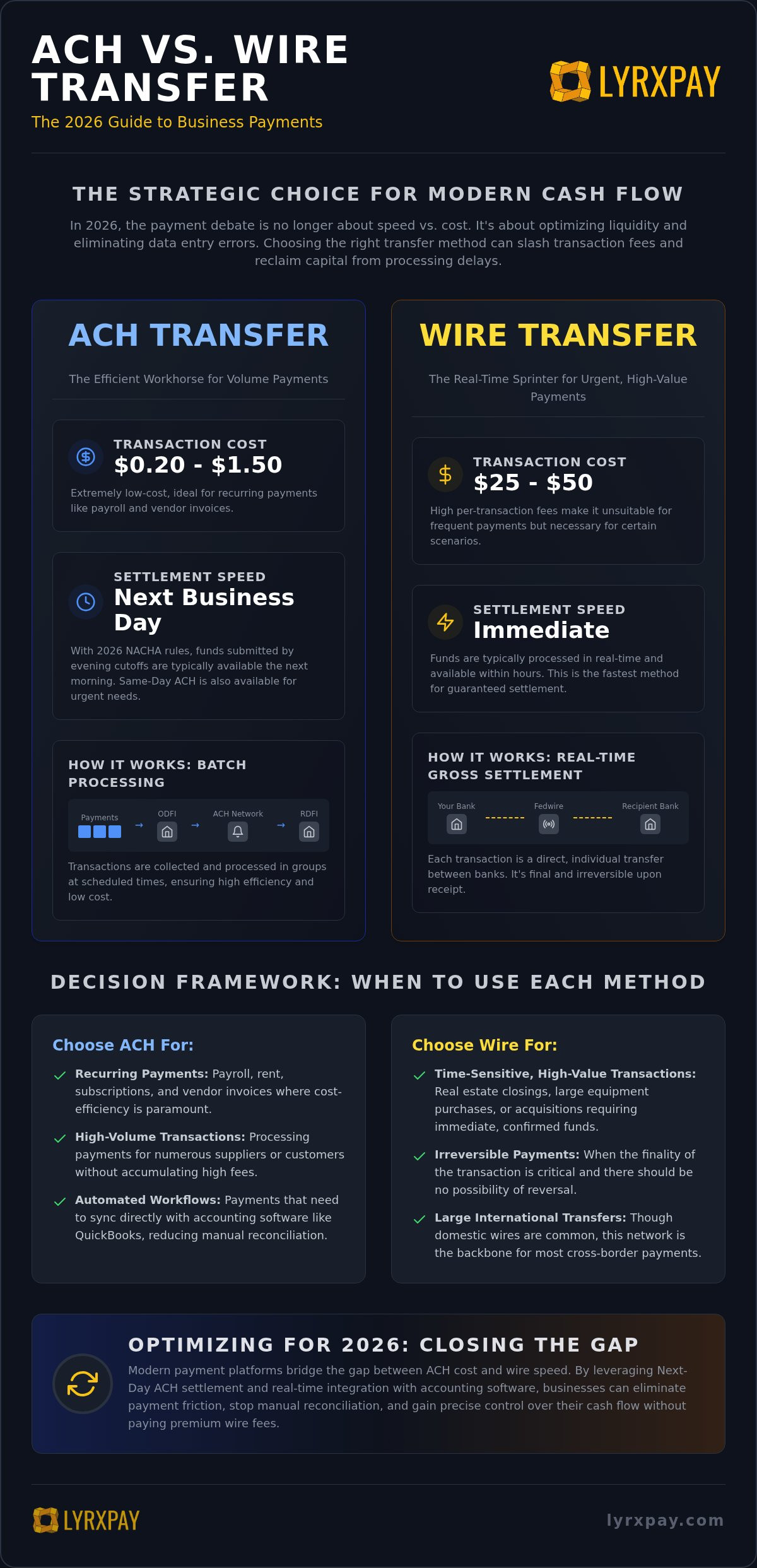
To choose the right tool, you have to understand the mechanics. ACH is the cost-effective, batch-processed workhorse of the American economy. It's designed for volume and efficiency, making it the standard for payroll and recurring bills. Wire transfers are the real-time sprinters. They offer immediate, individual settlement via networks like Fedwire. In 2026, the traditional "speed" argument for wires is weakening. With Same-Day ACH limits at $1 million and a massive increase in transaction volume, ACH is becoming a viable alternative for high-value operations that once required a wire. The choice today is less about who is fastest and more about which method integrates with your workflow without draining your bank account.
The Technical Breakdown: How ACH and Wire Transfers Move Money in 2026
Money doesn't simply travel through a wire; it follows a highly regulated infrastructure of digital checkpoints. When you evaluate ach vs wire transfer for business payments, you're really choosing between two different philosophies of movement: the efficiency of the crowd versus the speed of the individual. Understanding the mechanics behind these paths is the first step toward reclaiming your time and your capital.
ACH Mechanics and Batch Processing
The ACH Network functions like a high-speed commuter train. It doesn't leave the station for every single passenger; instead, it waits for a scheduled time to move everyone at once. Your payment starts at your bank, known as the Originating Depository Financial Institution (ODFI). It's then sent to a central clearing house where it's sorted and routed to the vendor’s bank, or the Receiving Depository Financial Institution (RDFI).
The secret to modern liquidity lies in the "Magic Hour." In 2026, the Federal Reserve's expanded operating windows have drastically shortened the wait. If you submit your files by the 9:00 PM EST batch window, NACHA standards now ensure that funds are often settled and available by the next morning. This evolution has made Next-Day ACH the new industry benchmark, offering a "wire-like" experience without the premium price tag. If you want to see how this looks in practice, you can explore streamlined ACH processing that prioritizes these faster windows.
Wire Transfer Finality
Wire transfers operate on a Real-Time Gross Settlement (RTGS) basis. Think of this as a private courier rather than a commuter train. Each transaction is processed individually and immediately through networks like Fedwire or CHIPS. Because the settlement happens in real-time, the transaction is irrevocable the moment it's completed. Once those funds hit the recipient's account, they cannot be clawed back by the sender.
This "instant" nature is often a requirement for high-stakes scenarios, such as real estate closings or million-dollar equipment purchases, where the recipient needs guaranteed funds before releasing an asset. However, for most day-to-day operations, this level of speed is a luxury that comes with a steep per-transaction cost. By understanding these technical paths, you can decide if a specific payment truly requires the "sprinter" speed of a wire or if the "workhorse" efficiency of a modern ACH batch will get the job done just as effectively.
The Critical Comparison: Speed, Security, and Cost Analysis
How much is a few hours of extra time truly worth to your business? When you weigh ach vs wire transfer for business payments, the decision often comes down to a simple calculation of value versus cost. While wires were once the only way to move significant capital quickly, 2026 regulations have fundamentally changed the math for the modern merchant. You no longer have to choose between "fast and expensive" or "slow and cheap."
- Transaction Fees: ACH costs typically range from $0.25 to $1.00 per transfer. Wires frequently cost between $25.00 and $50.00.
- Settlement Speed: Next-Day ACH settles in roughly 24 hours. Wires settle in 1 to 4 hours during business windows.
- Transfer Capacity: Same-Day ACH limits now sit at $1 million per payment, removing the traditional barrier for most B2B operations.
The gap is closing. For a business processing fifty payments a month, choosing ACH over wires could save over $1,200 monthly in bank fees alone. Unless your transaction requires the immediate, minute-by-minute finality of a wire, the modern ACH network provides the liquidity you need without the unnecessary overhead.
Risk Management and Fraud Prevention
Finality is a double-edged sword. With a wire transfer, the settlement is irrevocable. If you fall victim to the sophisticated wire fraud schemes prevalent in 2026, those funds are likely gone forever. ACH offers a different safety profile. While it includes "chargeback" risks for some, it also provides clear return codes for payment failures, such as insufficient funds or closed accounts. By using integrated merchant services, you add a layer of automated verification that monitors these codes, protecting your revenue before a failure even occurs. It's about having a partner who acts as a defender of your resources.
Calculating the Real Cost of Speed
Is a $35 wire fee cheaper than a one-day delay? If you're a high-volume retailer, that 24-hour gap in liquidity might prevent you from restocking a top-selling item, costing you hundreds in lost sales. In that specific scenario, the wire is the logical choice. However, if you're managing standard vendor payouts, that $35 is simply a drain on your margin. Mastering your cash flow means knowing exactly when to pay for speed and when to leverage the efficiency of ACH. If you want to dive deeper into protecting your profit, you can read our guide on how to lower merchant fees to optimize every dollar that leaves your account.
Decision Framework: When to Wire and When to Use ACH for Business Operations
Choosing between ach vs wire transfer for business payments shouldn't be a coin flip. It's a strategic choice based on the specific operational need at hand. If you're running a standard business cycle, your default should almost always be ACH. This method serves as the undisputed king of payroll and employee reimbursements. It's predictable, recurring, and handles high volumes without scaling your costs. For recurring vendor payments, ACH is even better. It allows you to automate your outflows, which often helps you secure early-payment discounts from suppliers who value their own cash flow consistency.
Wires still have their place in the modern office, but they're specialized tools. If you're closing on a new warehouse or purchasing a $500,000 piece of specialized machinery, the recipient will likely demand a wire. They want that irrevocable status that guarantees the funds are theirs the moment they arrive. Similarly, international trade often requires the SWIFT network for speed. While Global ACH is gaining ground for smaller overseas transfers, a domestic wire remains the standard for high-value, time-sensitive settlements that can't wait until the next business day.
The Accounting Sync Advantage
Manual data entry is a hidden tax on your time and your bookkeeper's patience. When you send a wire through a standard bank portal, the transaction often exists in a vacuum. Your accounting team then has to manually record that payment in your ledger, a process that invites human error and reconciliation headaches. By moving toward all-in-one business financial solutions, you can eliminate this friction. If your payment system syncs directly with QuickBooks, the reconciliation happens automatically. This ensures your books are always accurate without a single minute of manual data entry.
The 2026 B2B Checklist
Before you commit to a payment method, run through these three critical questions to protect your margins:
- Is the payment over $1 million? While NACHA has increased limits, extremely high-value transfers may still require the individual settlement path of a wire.
- Does the recipient need funds in under 4 hours? If you're facing a hard deadline like a real estate closing or a late-day auction, the wire's speed is worth the premium.
- Is this a one-time payment to an unverified vendor? ACH offers a more structured path for verification and potential returns if the banking details are incorrect.
Ready to stop overpaying for speed? Partner with an advocate who understands your cash flow needs and start optimizing your payments today.
Optimizing Cash Flow: How LyrxPay Closes the Gap Between ACH and Wire Speeds
LyrxPay exists to bridge the gap between traditional banking limitations and the high-velocity needs of your business. If you've been stuck in the middle of the ach vs wire transfer for business payments debate, you know the frustration of choosing between excessive fees and agonizing wait times. We've redesigned this experience. By focusing on Next-Day deposits, we provide you with "wire-like" liquidity without the per-transaction premium that drains your margins. It's about giving you the best of both worlds: the cost-efficiency of the ACH network and the rapid access to funds your operations demand.
Our approach isn't just about moving numbers; it's about advocacy. We provide concierge-style onboarding where we handle the technical setup and configuration, allowing you to stay focused on your craft. You shouldn't have to be a payments expert to get the best rates or the fastest clearing times. We offer lower fees than traditional big-bank processors because we believe in a results-oriented relationship. This commitment extends across our entire ecosystem, including integrated POS systems, payroll solutions, and bookkeeping tools designed to fuel your growth.
The LyrxPay QuickBooks Integration
Efficiency is the ultimate defender of your time. When your payment processor talks to your accounting software, the results are transformative. Our seamless integration provides real-time visibility into your cash position, so you never have to guess about your available balance. This isn't just about convenience; it's about automated reconciliation. If your payments and books sync instantly, you eliminate the manual errors that plague standard financial workflows. To further maximize your savings, you can learn about integrating level 3 B2B rates into your Quickbooks Invoices to capture the lowest possible interchange costs.
Secure Your 2026 Liquidity
The first step to true financial health is moving away from legacy systems that profit from your delays. Switching to a modern processor removes the "pending" anxiety that comes with traditional bank batches. We provide transparent reporting that shows you exactly where your money is at every stage of the cycle. In a world where ach vs wire transfer for business payments is a daily tactical decision, having a partner who manages the administrative burden allows you to lead with confidence. Don't let outdated infrastructure hold back your 2026 growth. Optimize your business payments with LyrxPay today and experience the relief of a curated, professional partnership.
RECLAIM YOUR TIME AND YOUR MARGINS
The choice of ach vs wire transfer for business payments no longer requires you to trade speed for savings. By understanding the 2026 shift toward faster settlement windows and higher transaction limits, you can move your capital with the precision your business deserves. Wires remain the correct tool for high-value real estate or equipment purchases where finality is non-negotiable. For everything else, the modern ACH network provides the efficiency needed to keep your operations lean and your vendors satisfied.
You shouldn't have to navigate these technical waters alone. Our mission is to act as your advocate, removing the friction of manual reconciliation and the anxiety of multi-day clearing cycles. With next-day deposits included as standard and direct sync for QuickBooks and Xero, we ensure your data and your dollars are always where they need to be. We don't believe in hidden "speed fees" for qualified merchants. We believe in providing the tools you need to grow.
Ready to see the difference a partnership makes? Get Started with a LyrxPay Next-Day Merchant Account and experience the relief of a curated financial workflow. Your business is built on your craft; let us handle the heavy lifting of your payments.
Frequently Asked Questions
How long does an ACH transfer typically take for a business in 2026?
Standard ACH transfers typically settle in one to three business days, though Same-Day ACH is now a standard expectation for many B2B operations. In 2026, the ACH network has evolved to support much faster liquidity than in previous decades. Most modern processors prioritize these faster windows to help you avoid the "black hole" of traditional bank processing. Choosing a provider that offers next-day deposits ensures you have access to your funds without the typical multi-day wait.
Are wire transfers safer than ACH payments for large B2B transactions?
Wire transfers provide immediate finality, which is why they are preferred for high-stakes transactions like real estate closings. However, this finality is a double-edged sword because wire transfers are irrevocable. If you fall victim to fraud, the funds are likely gone forever. ACH payments offer a different security profile with clear return codes for failures. The choice of ach vs wire transfer for business payments often depends on whether you need the safety net of reversibility or absolute finality.
What are the typical fees for ACH vs. wire transfers?
Domestic wire transfers generally cost between $15 and $35, with some traditional banks charging up to $40 for outgoing requests. In contrast, ACH transfer fees typically range from $0.20 to $1.50 per transaction. While some banks may charge slightly more, the cost difference remains significant. For high-volume businesses, switching from wires to ACH can save thousands in annual bank fees while still maintaining the speed required for modern cash flow management.
Can an ACH payment be reversed or cancelled after it is sent?
Yes, ACH payments can be reversed or cancelled under specific circumstances, such as duplicate entries or unauthorized transactions. This flexibility is a key differentiator when comparing ach vs wire transfer for business payments. Unlike wires, which are irrevocable once processed, the ACH network allows for corrections if an error is caught within the permitted NACHA windows. This provides a level of administrative protection that can save your team from the stress of a simple data entry mistake.
Is there a limit on how much money I can send via ACH?
As of 2026, the per-payment limit for Same-Day ACH is $1 million. This cap allows the vast majority of B2B transactions to move through the ACH network instead of requiring a more expensive wire transfer. While Nacha has approved an increase to $10 million, that change is not effective until September 17, 2027. For now, if your transaction exceeds the $1 million threshold, you will likely need to utilize a wire transfer for immediate settlement and finality.
Do I need a special merchant account to get next-day ACH deposits?
You don't necessarily need a special account, but you do need a processor that prioritizes liquidity and modern settlement windows. LyrxPay includes next-day deposits as a standard feature for our merchant accounts to help you optimize your cash flow. Traditional banks often default to a three-day schedule, which can stall your operations. By partnering with a provider focused on advocacy, you can access your funds faster without paying the hidden "speed fees" often found elsewhere.
What is the daily cut-off time for a next-day deposit to be processed?
Most modern processors utilize the 9:00 PM EST batch window to ensure your funds are cleared for next-day availability. If you submit your payment files before this "magic hour," the Federal Reserve's updated windows allow for settlement by the following morning. Meeting these cut-off times is essential for maintaining a predictable financial rhythm. We handle the technical heavy lifting of these schedules so you can focus on running your business instead of watching the clock for every transaction.
Does LyrxPay support international wire transfers and ACH?
LyrxPay focuses exclusively on providing the highest level of service for businesses operating within the United States. We specialize in domestic credit card and ACH processing with a concierge-style approach that prioritizes US-based liquidity and QuickBooks integration. While our national coverage ensures you can move money across all fifty states, we do not currently offer support for international wire transfers or Global ACH. This allows us to remain a dedicated advocate for the specific needs of the American merchant.