
Exposing Hidden Fees in Credit Card Processing: A 2026 Merchant Guide

What if the "low rate" your processor promised is actually a Trojan horse for a dozen surcharges you never signed up for? You aren't alone if you've spent your Sunday evening squinting at a fifteen page merchant statement, trying to figure out why your bank balance doesn't match your sales reports. It's frustrating to feel like a passenger in your own business finances, especially when unexpected debits appear without warning or explanation. You've worked too hard to build your business to let it be drained by complex, predatory contracts that feel impossible to escape.
We believe you deserve total clarity regarding your money. This guide is your toolkit for exposing hidden fees in credit card processing in 2026, moving you away from deceptive pricing and toward a model that actually respects your bottom line. With the average swipe fee hitting 2.36% last year, every basis point you reclaim is direct liquidity back into your operations. It's time to shift from confusion to confidence.
You'll learn how to identify common "liquidity leaks" like digital enablement fees and undefined authorization surcharges that often hide in plain sight. We'll provide a step by step roadmap to audit your current contract, negotiate better terms, and simplify your back office. It's time to stop overpaying and start growing.
Key Takeaways
- Learn to distinguish between fixed interchange costs and the "junk fees" processors add to your monthly bill.
- Identify the most common hidden fees in credit card processing, including PCI penalties and monthly minimums, to reclaim your business liquidity.
- See why interchange-plus pricing is the only way to ensure you're paying a fair markup instead of falling into the tiered pricing trap.
- Follow a five-step DIY audit to calculate your true effective rate and spot the "miscellaneous" charges that don't belong on your statement.
- Move toward a transparent model for Credit Card & ACH Processing that includes next-day deposits to stabilize your cash flow and simplify your operational tasks.
What Are Hidden Fees in Credit Card Processing?
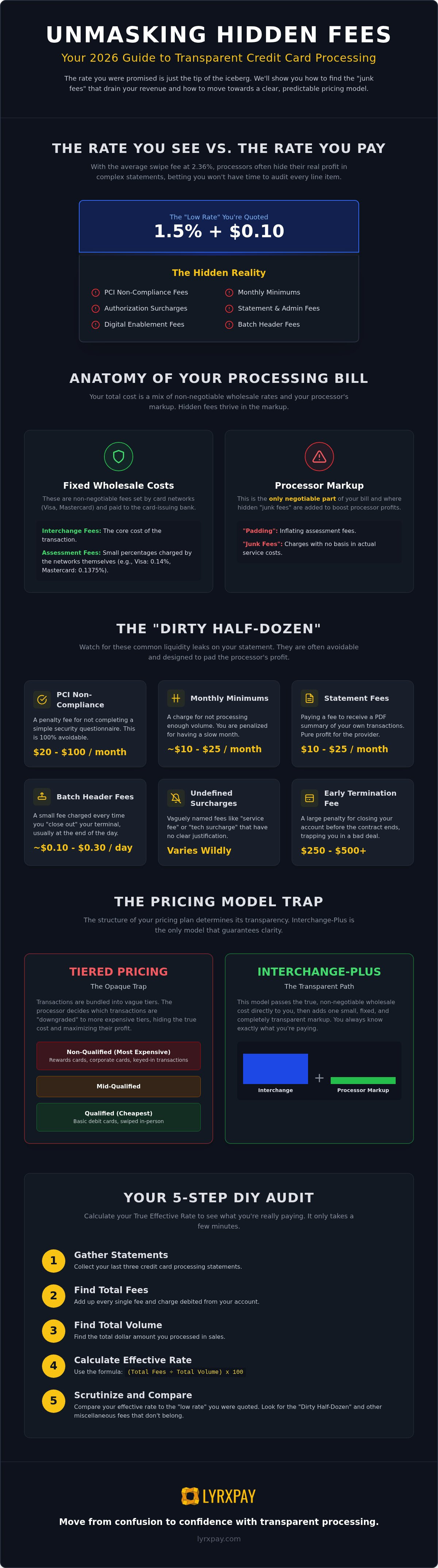
Hidden fees in credit card processing are costs that don't appear in the flashy "headline rate" you were promised during a sales call. Instead, they're buried deep within multi-page statements, often disguised with vague labels like "service fees" or "technology surcharges." These costs represent the gap between the rate you think you're paying and the actual amount that leaves your bank account every month. In 2026, processors are increasingly using complexity as a tactical tool. By making statements intentionally difficult to read, they hide their profit margins behind a fog of technical jargon, betting that busy business owners won't have the time to audit every line item.
While a landmark $5.54 billion settlement recently reduced average interchange rates by 10 basis points, many merchants haven't seen those savings. Instead, processors have introduced new "ancillary" fees to offset their own losses. It's a shell game where the names change, but the impact on your bottom line remains the same. Understanding the anatomy of your bill is the first step toward reclaiming your lost revenue.
The Distinction Between Interchange and Markups
To spot a hidden fee, you first need to know what you can't change. Interchange fees are the non-negotiable wholesale costs set by card networks like Visa and Mastercard. These are paid directly to the bank that issued your customer's card. Alongside these are assessment fees, which are small, fixed costs charged by the networks themselves. For example, in 2026, Visa charges 0.14% for credit transactions, while Mastercard sits at 0.1375%.
The processor markup is where hidden fees in credit card processing actually live and thrive. This is the only negotiable part of your bill. Predatory processors often "pad" the assessment fees or add "junk fees" that have no basis in actual service costs. Common examples include:
- PCI Non-Compliance fees (often $20 to $100 per month)
- Statement fees for digital-only accounts
- Undefined authorization fees (which Mastercard increased to 0.30% in 2025)
- Location data validation fees
How Hidden Fees Drain Your Business Liquidity
These fees act as "liquidity leaks" that create a death by a thousand cuts effect on your monthly cash flow. Because many of these charges are debited separately or at different times than your standard processing fees, they make bookkeeping a nightmare. This fragmentation makes it nearly impossible to predict exactly how much cash you'll have on hand at the end of the week.
Transparent pricing does more than just save you money; it provides the predictability you need for effective growth. Integrating your processing with business liquidity management tools is only possible when your costs are fixed and visible. When you eliminate the "speed fees" and unexpected debits, you gain a clearer roadmap for your effective rate, allowing you to reinvest that capital back into your inventory, staff, or expansion plans.
The "Dirty Half-Dozen": 6 Common Fees to Watch For
Finding hidden fees in credit card processing often feels like a game of whack-a-mole where every move costs you money. While some costs are legitimate, many are simply "junk fees" designed to pad the processor's profit. According to the Federal Reserve report on interchange fees, while the base costs of moving money have seen increased scrutiny, processors continue to find creative ways to layer on additional charges. Here are the most frequent offenders you'll find on a typical statement.
- PCI Non-Compliance Fees: Many processors charge between $20 and $100 every month if you haven't completed a self-assessment questionnaire. This fee is often 100% avoidable; it's a penalty for a task that takes minutes to complete.
- Monthly Minimums: This is a fee for NOT processing enough. If your contract requires a $25 monthly minimum and you only generate $15 in fees, the processor debits the $10 difference. You shouldn't be penalized for a slow month.
- Statement & Administrative Fees: In a digital world, paying $10 to $25 just to receive a PDF summary is a relic of the past. These are pure profit for the provider.
- Batch Header Fees: Every time you "close out" your terminal at the end of the night, you might be charged a small fee. While it looks like cents, it adds up to hundreds of dollars over the life of a contract.
Predatory Contractual Fees
The most dangerous fees aren't just monthly line items; they're the ones that trap you in a bad relationship. Early Termination Fees (ETF) act as "financial handcuffs," often costing $500 or more to cancel your service. Even worse are "Liquidated Damages" clauses, which allow the processor to charge you the estimated profit they would have made for the remainder of your three year term. This can result in a bill for thousands of dollars just to walk away. You should also be wary of equipment lease scams. Signing a 48 month lease for a $300 terminal can end up costing you $2,000 over time. It's almost always better to buy your hardware upfront.
Technical and Operational Markups
Operational fees often hide behind technical jargon. Gateway fees are common for e-commerce, but they're frequently marked up far beyond the actual cost of the software. You might also see "Voice Authorization Fees," which are obsolete charges from the days of calling in a transaction over the phone. Perhaps the most frustrating is the next-day deposit surcharge. You shouldn't have to pay extra for your own money; a transparent partner includes fast access to funds as a standard service. If you're tired of these markups, switching to a more transparent processing partner can immediately improve your liquidity.
Mastercard's 2025 increase of the Undefined Authorization fee to 0.30% is a prime example of how network changes become profit centers for processors who don't pass the savings of other settlements down to you. By staying vigilant, you can ensure your hard-earned revenue stays in your bank account where it belongs.
Analyzing Your Statement: Tiered vs. Interchange-Plus
Your merchant statement shouldn't require a decoder ring to understand. If you're struggling to find the true cost of your Credit Card & ACH Processing, the problem usually isn't your math skills; it's the pricing model your provider chose for you. Most business owners look at the teaser rate on the first page, but the only number that dictates your operational health is your effective rate. You calculate this by dividing your total fees by your total processing volume. If that number is significantly higher than 2.36%, which was the average effective swipe fee in 2025, you've likely fallen victim to hidden fees in credit card processing camouflaged within a tiered structure.
Flat-rate pricing often feels like the easy choice, but for a growing business, it's frequently the most expensive path. While paying a single percentage for every transaction sounds convenient, you're essentially paying a premium for that simplicity. You're giving up the chance to benefit from lower cost debit transactions or the 2025 interchange reductions. A transparent, curated service doesn't just give you a rate; it gives you a roadmap to lower your effective costs over time.
The Tiered Pricing Trap
Tiered pricing is the primary tool used to obfuscate costs. Processors bucket your transactions into three arbitrary categories: Qualified, Mid-Qualified, and Non-Qualified. They'll quote you a low "Qualified" rate to get you to sign the contract, but in 2026, very few transactions actually meet those strict criteria. Most modern cards, including rewards, corporate, and international cards, automatically "downgrade" to the expensive Non-Qualified tier. This allows the processor to keep the massive spread between the actual interchange cost and the inflated tier price. It's a profit-maximizing machine that works directly against your business liquidity.
Interchange-Plus: The Transparent Alternative
Interchange-plus is widely considered the gold standard for transparency. Unlike tiered or flat-rate models, this structure separates the actual cost of the transaction from the processor's markup. When you look at an interchange-plus statement, you see the exact interchange fee set by the card brands, followed by a small, fixed fee for the processor. It's clear. It's honest. There's no place for hidden fees in credit card processing to hide when every cost is a distinct line item.
We advocate for this model because it protects your resources and simplifies your bookkeeping. By moving away from opaque tiers, you reclaim the liquidity needed to scale your operations. If you're processing high volumes, even a few basis points saved through a transparent model can result in thousands of dollars back in your pocket. It's the difference between being a passive payer and an active manager of your company's cash flow.
A 5-Step DIY Audit for Your Merchant Statement
Performing a monthly audit is the only way to ensure your processing partner stays honest. You don't need a background in forensic accounting to spot hidden fees in credit card processing; you just need a methodical approach and a few minutes of focus. By following these steps, you can move from a state of uncertainty to a state of total control over your business liquidity.
- Step 1: Calculate your Effective Rate. Divide your total monthly fees by your total sales volume. If the result is significantly higher than the 2025 industry average of 2.36%, you're likely overpaying.
- Step 2: Scan for "Non-Compliance" or "Miscellaneous" line items. These are almost always junk fees. Look for PCI non-compliance charges or "admin" fees that weren't in your original quote.
- Step 3: Compare your "Headline Rate" to the actual debit. If you were promised 1.9% but your effective rate is 3.5%, the gap is being filled by hidden markups and tier downgrades.
- Step 4: Use technology to your advantage. Implementing all-in-one business financial solutions allows you to track these fees automatically rather than relying on manual statement reviews.
- Step 5: Demand a formal review. Present your findings to your processor and ask for a written explanation of every "miscellaneous" charge. If they can't justify them, it's time to switch.
Leveraging QuickBooks for Real-Time Auditing
Most business owners only use QuickBooks for tax preparation, but it's actually a powerful tool for auditing your processor in real time. When you integrate your Credit Card & ACH Processing directly with your accounting software, you eliminate the manual entry that often masks fee spikes. You can see the exact net deposit for every transaction, making it easy to spot when a processor takes more than their fair share. This automation reduces back office labor and ensures your books always reflect your true liquidity. It's a proactive way to manage your operational health without spending hours on spreadsheets.
Negotiating with Your Current Processor
If you find discrepancies, don't be afraid to use your leverage. Start by asking for a move to "Interchange-Plus" pricing. Mentioning this specific model tells the processor you understand how the industry works and that you're no longer a candidate for tiered pricing traps. Use a simple script: "I've calculated my effective rate at 3.4%, which is well above the current market average. I'd like to move to a transparent interchange-plus model with no non-compliance or batch fees." If they refuse to budge or try to "explain away" the junk fees, stop negotiating. At that point, the relationship is no longer a partnership. You can get a transparent fee audit here to see exactly how much you could be saving with a provider that prioritizes your growth.
LyrxPay: The Transparent Partner for Your Growth
Choosing a merchant partner shouldn't feel like signing a peace treaty with an adversary. At LyrxPay, we've built our entire business around a "No-Hiding" philosophy that prioritizes your operational health. We provide Credit Card & ACH Processing that replaces the industry's usual smoke and mirrors with absolute clarity. If you're tired of the "liquidity leaks" we've explored in this guide, we're here to plug them. Our model ensures you know exactly what you're paying for, allowing you to focus on your craft rather than your processing statements.
Liquidity is the lifeblood of your operations. That's why we offer next-day deposits as a standard feature, not an expensive add-on. We don't believe in "speed fees" for your own money. By integrating directly with QuickBooks and Xero, we simplify your life and eliminate the stress of manual reconciliation. Our role is to act as your advocate, auditing your costs proactively to ensure hidden fees in credit card processing never find their way back onto your bill. We're not just a vendor; we're a defender of your time and resources.
Modern POS and Hardware Solutions
Hardware shouldn't be a financial trap. We provide modern POS and hardware solutions with fair, transparent pricing that avoids the predatory 48 month leases common in the industry. Whether you're in retail or professional services, our software grows with your business. We also offer integrated payroll and bookkeeping solutions to streamline your entire operation. This unified approach creates a financial ecosystem where every tool works together to save you time and money, moving you away from the cold, clinical feel of traditional banking toward a curated, concierge style of service.
Get a Free Statement Audit
Are you ready to stop being a passenger in your own financial story? Our "concierge" review process is designed to give you immediate clarity without the headache. Simply send us your current merchant statement, and our experts will perform a deep dive audit to expose every hidden markup and junk fee you're currently paying. We'll show you exactly how much you can reclaim. During the transition, we handle the heavy lifting to ensure your move to a lower fee model is seamless and stress free. If you want to learn more about how to lower merchant fees, let us audit your statement today. It's time to reclaim your liquidity and partner with a reliable ally who is invested in your growth.
Take Control of Your Merchant Revenue
You now have the practical tools to identify the "dirty half-dozen" and calculate your own effective rate with confidence. By moving away from tiered traps and toward a transparent interchange-plus model, you ensure every dollar of your hard-earned revenue is accounted for. Identifying hidden fees in credit card processing is no longer a mystery; it's a standard, manageable part of your monthly operational health. You've done the heavy lifting by learning how to spot these liquidity leaks, and now you can take the final step toward total financial clarity.
You don't have to navigate this transition alone. We're here to act as your reliable ally, providing the expert QuickBooks integration support and next-day deposits you need to maintain peak liquidity. Our mission is to eliminate the predatory "junk" fees that drain your bank account without adding value to your service. It's time to shift your focus from squinting at complex statements back to the craft you love. Stop overpaying and start growing with a LyrxPay transparent merchant account. Your business deserves a partnership built on honesty and results. Let's build a more profitable future together.
Common Questions About Merchant Fees
What is a typical PCI compliance fee in 2026?
Typical PCI non-compliance fees in 2026 range from $20 to $100 per month, though they are entirely avoidable. These charges are penalties for not completing an annual self-assessment questionnaire. A transparent merchant partner will help you navigate the compliance process rather than using it as a profit center. It's one of the most frequent ways legacy providers pad their margins without offering any actual value to your business.
Can I negotiate my credit card processing fees with my current bank?
You can absolutely negotiate the processor markup portion of your fees with your current provider. While the interchange rates set by card brands are non-negotiable, the added percentage and per-transaction fees charged by your bank are flexible. If your current provider refuses to move you to a transparent interchange-plus model, it's a strong indicator that they aren't looking out for your long-term operational health.
Why do my processing fees change every month even if my sales are the same?
Fees often fluctuate because the "card mix" of your transactions changes from month to month. Different cards, such as high-rewards credit or corporate cards, carry higher wholesale costs than basic debit cards. If you're on a tiered pricing plan, these differences trigger "downgrades" that increase your costs. This is often where hidden fees in credit card processing are camouflaged, as processors rarely explain these variations in a clear way.
Is flat-rate pricing better than interchange-plus for small businesses?
Flat-rate pricing is simple but often more expensive for businesses that process more than a few thousand dollars monthly. While the predictability is nice, you're usually paying a significant premium to cover the processor's risk on high-cost cards. Interchange-plus is generally better because it passes the actual wholesale cost to you with a transparent, fixed markup. This allows you to benefit from lower-cost transactions and keep more of your hard-earned revenue.
What is an "effective rate" and how do I calculate it?
Your effective rate is the total percentage of your sales volume that goes toward processing fees. To calculate it, take the total fees debited from your account and divide them by your total gross sales for the month. For example, paying $300 in fees on $10,000 in sales equals a 3.0% effective rate. This number is the only metric that truly reveals the impact of processing on your business liquidity.
How does QuickBooks integration help me see hidden fees?
QuickBooks integration allows you to automate your reconciliation and see the exact net deposit for every sale. Instead of waiting for a confusing monthly statement, you can monitor your costs in real time. This visibility makes it nearly impossible for a processor to slip in hidden fees in credit card processing without your knowledge. It also significantly reduces back-office labor by eliminating the need for manual data entry of complicated processing costs.
What should I do if I find a "junk fee" on my merchant statement?
If you find a "junk fee" on your statement, you should immediately request a written explanation and a refund from your processor. Many providers will waive these fees if they're challenged by a merchant who understands their statement. If the provider refuses to justify the charge or continues to add miscellaneous fees, it's time to transition to a partner that prioritizes transparency. You shouldn't have to fight your bank to keep your money.
Are next-day deposits standard, or do they always cost extra?
Next-day deposits are not standard across the industry, but they should be for any business focused on growth. Many legacy processors still treat fast funding as a premium service and charge extra "speed fees" to access your money. A transparent partner includes next-day deposits as a standard feature to help you maintain healthy liquidity. Fast access to your own revenue is essential for managing daily expenses and scaling your operations effectively.