
How ACH Payments Streamline Business Transactions

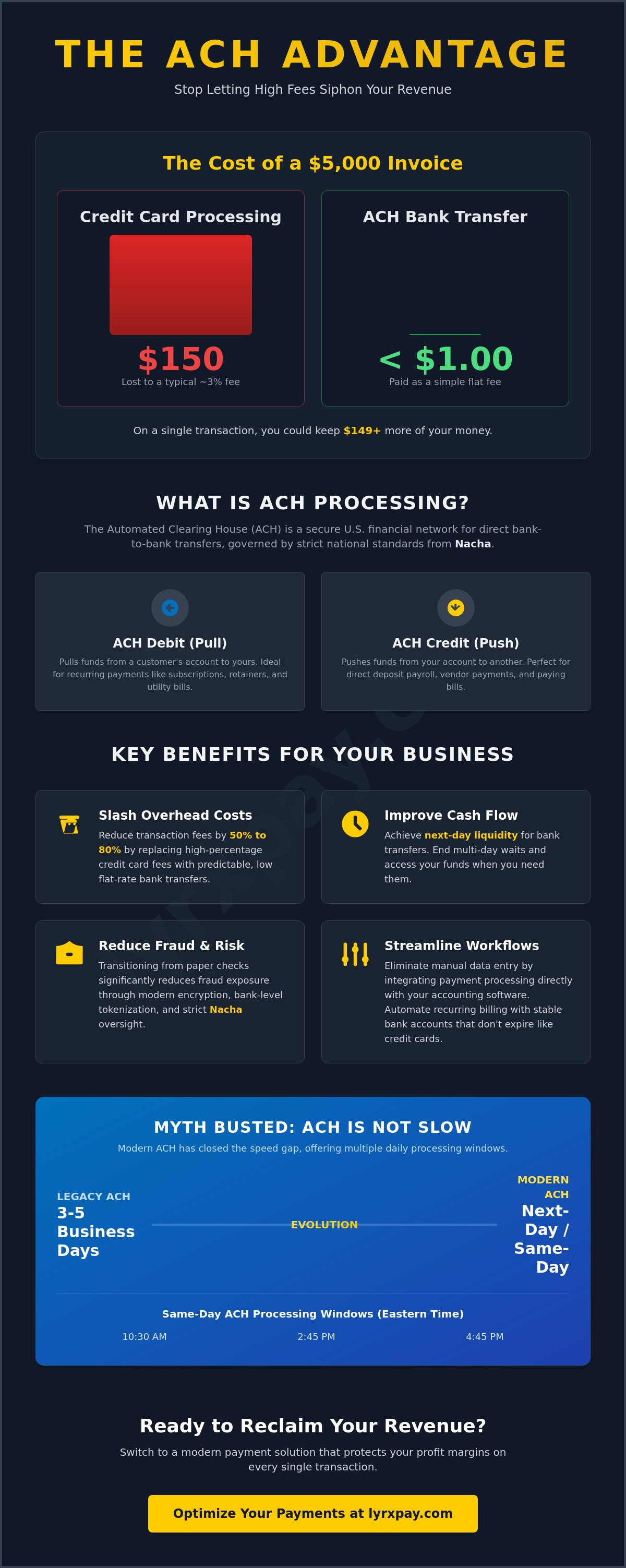
Why pay $150 to process a single $5,000 invoice when you could pay less than a dollar? If you feel like credit card processing fees are quietly siphoning away your hard-earned margins, you aren't alone. Many business owners accept high percentage-based fees as an unavoidable cost of doing business, but there's a more efficient path forward. Understanding the latest ach payment processing benefits is the first step toward reclaiming your revenue and simplifying your back-office operations.
It's frustrating to deal with manual data entry errors or slow settlement times that hinder your liquidity. We're here to help you move past those obstacles. In this guide, you'll discover how modern ACH processing slashes transaction fees by 50 to 80 percent, improves cash flow with next-day deposits, and integrates seamlessly with your accounting software. We will walk through the 2026 Nacha fraud monitoring rules and show you how to automate your recurring billing so you can focus on your craft instead of chasing payments.
Key Takeaways
- Learn how to slash overhead costs by replacing high-percentage credit card fees with flat-rate bank transfers, a core pillar of ach payment processing benefits.
- Discover why transitioning away from paper checks significantly reduces your exposure to fraud through modern encryption and bank-level tokenization.
- See how you can achieve next-day liquidity for bank transfers, ending the multi-day wait times traditionally associated with clearing funds.
- Find out how to eliminate manual data entry and "clean" your books in real-time by integrating payment processing directly with your accounting software.
- Understand the strategic shift digital-first businesses are making to protect profit margins on large-scale B2B invoices and wholesale orders.
What is ACH Payment Processing and Why is it Essential in 2026?
Digital-first businesses are rapidly abandoning the mailbox. By 2026, the administrative weight and security risks of paper checks have become a liability that few growing companies can afford to carry. Instead, savvy owners are turning to the Automated Clearing House (ACH), a centralized electronic network that enables direct bank-to-bank transfers. This shift isn't just about going paperless; it's about taking total control of your financial infrastructure and protecting your bottom line from unnecessary friction.
The network is governed by Nacha, the organization that establishes the strict national standards every transfer must follow. This oversight ensures that whether you are "pushing" or "pulling" money, the transaction remains secure and predictable. You will generally use two primary methods to move funds:
- ACH Debit: This allows you to "pull" funds from a customer's account. It is the gold standard for managing recurring subscriptions, monthly retainers, or utility payments without chasing invoices.
- ACH Credit: This is used to "push" funds from your account to another. It is the most common way to handle employee payroll or pay large vendor bills with precision.
ACH vs. Credit Cards: The Fundamental Difference
Why are B2B leaders prioritizing bank transfers over plastic? The answer is found in the fee structure. Credit cards rely on complex card networks that charge "interchange" fees, which often take a 3% bite out of every transaction. This percentage-based model punishes you for growing your sales. ACH utilizes the existing banking system, shifting the focus to predictable flat-rate processing. When you look at ach payment processing benefits, the math is simple. If you process a $10,000 wholesale order via credit card, you might lose $300 to fees. That same transaction via ACH typically costs less than a dollar. For high-ticket B2B transactions, this difference alone can save a business thousands of dollars every month.
The Evolution of ACH Speeds
The most common misconception about bank transfers is that they're too slow for modern commerce. While legacy systems once took nearly a week to clear, the network has undergone a massive transformation. With Same-Day ACH processing windows now occurring at 10:30 a.m., 2:45 p.m., and 4:45 p.m. Eastern Time, the "speed gap" between bank transfers and credit cards has effectively closed. Modern merchant service providers have streamlined these workflows to offer next-day liquidity, ensuring your cash isn't trapped in transit while you're trying to pay your own bills. ACH is a high-speed, bank-level transfer system that acts as a primary cost-control mechanism for businesses navigating the competitive landscape of 2026.
Core Financial Benefits: Maximizing Your Business Margins
Stop letting percentage-based fees act as a tax on your growth. Every percentage point you surrender to card networks is a point taken directly from your net income. While credit cards are convenient for small consumer purchases, they quickly become a liability for high-ticket B2B invoices and wholesale orders. This is where the true power of ach payment processing benefits becomes undeniable. By shifting to a bank-to-bank model, you replace unpredictable, escalating costs with a stable financial foundation.
The financial relief extends beyond the transaction itself. Consider the "invisible" costs of paper checks. Between the price of postage and envelopes and the hourly cost of staff manually reconciling payments, a single check can cost a business significantly more than its face value. Digital transfers eliminate this administrative friction. This shift also offers superior stability for recurring billing. Credit cards expire, get lost, or are replaced, leading to failed payments and involuntary churn. Bank accounts, however, rarely change. This continuity ensures your revenue remains predictable and your customer relationships stay intact.
Analyzing the Cost-Per-Transaction Savings
Let's look at the hard numbers. If you process a $5,000 invoice via a standard credit card network at a 3% rate, you lose $150 in fees. If you process that same payment through the Federal Reserve's ACH services, you typically pay a flat fee between $0.25 and $0.75. You keep nearly $149 more on just one transaction. For high-volume merchants, these savings aren't just incremental; they represent tens of thousands of dollars in annual overhead that can be reinvested into your team or product development. To explore broader ways to protect your revenue, read our guide on how to lower merchant fees.
Operational Efficiency and Scalability
REDUCE YOUR ADMINISTRATIVE BURDEN. Manual payment collection is a bottleneck that prevents you from scaling. ACH allows you to automate the "pull" of funds, which is why it's the gold standard for subscription-based models and professional service retainers. You no longer have to wait for a client to log in and pay or hear the classic excuse that "the check is in the mail." By scheduling these transfers, you gain total control over your liquidity. If you're ready to modernize your cash flow, exploring a tailored ACH solution can give you the relief you need to focus on your craft.
Security and Risk Management: Why Bank Transfers are Safer
Fraud is expensive. It isn't just about the lost revenue; it's about the hours of administrative labor spent investigating breaches and the damage to your professional reputation. While many business owners view paper checks as a "traditional" and safe method, they remain the most targeted payment type for fraud in the United States. A physical check contains every piece of information a criminal needs to drain an account. By contrast, the ach payment processing benefits extend far beyond cost savings, offering a sophisticated security framework that paper checks simply cannot match.
The network operates on a foundation of multi-layered encryption and tokenization. This means sensitive banking data is converted into a unique digital identifier during transit, ensuring that even if data were intercepted, it would be useless to unauthorized parties. The safety of the network is not static. As of March 2026, new Nacha rules require all non-consumer originators to implement risk-based processes to monitor for fraudulent transactions. This proactive shift toward documented fraud monitoring provides an extra layer of defense for your business, moving the industry beyond basic "commercially reasonable" standards to a more robust, verified level of protection.
The Downfall of Paper Check Vulnerabilities
ACH eliminates the primary risks associated with physical mail, such as mail theft and "check-washing" fraud. Because these transfers occur in a closed-loop system between financial institutions, there is no physical document to lose or alter. This direct connection also allows for real-time bank verification. By verifying account status and balance before a transaction is initiated, you significantly reduce the risk of Non-Sufficient Funds (NSF) returns. Tokenized bank data prevents identity theft in B2B transactions by replacing actual account numbers with random digital strings that are useless to hackers even if intercepted.
Chargeback and Dispute Mitigation
Are you tired of "friendly fraud" in the credit card industry? One of the most significant ach payment processing benefits is the strictness of the dispute process. Unlike credit cards, where a consumer can often trigger a chargeback with a single click, ACH disputes are governed by rigid Nacha guidelines. For B2B transactions, the window to contest a payment is extremely narrow, and the burden of proof is high. This protects you from arbitrary reversals and ensures your revenue stays in your account where it belongs. To learn more about securing your cash flow, explore our latest insights on B2B payment processing solutions. We are here to help you build a defense that lets you focus on growth rather than risk.
Seamless Financial Workflows: Accounting and Integration
Manual reconciliation is a drain on your time. You didn't start a business to spend your evenings matching bank statements to invoices, yet many owners find themselves trapped in this administrative loop. Automated reconciliation changes that. It's one of the most practical ach payment processing benefits because it removes the human error factor from your bookkeeping. When a payment is initiated, the system handles the heavy lifting of updating your ledger, ensuring your records are accurate without you lifting a finger.
Beyond incoming revenue, a single ACH portal simplifies how you send money out. Instead of jumping between different banking apps or writing physical checks for payroll and vendor payouts, you can centralize everything. This unified approach keeps your books "clean" in real-time, which is a massive relief when tax season arrives. By reducing the number of manual touchpoints in your financial cycle, you effectively eliminate the accounting errors that lead to expensive tax-time headaches and audits.
QuickBooks Integrated Payment Processing
If you use QuickBooks or Xero, you know how messy third-party "bridge" apps can get. They often create duplicate entries or fail to sync correctly, leaving you with a digital mess to untangle. Integrating ACH directly into your accounting software means that when a client pays an invoice, it's automatically marked as "Paid." This immediate synchronization provides a clear picture of your cash flow at any moment. For those looking to maximize their operational efficiency, exploring all in one business financial solutions can help you consolidate your tech stack and streamline your growth.
Managing Multi-User Access and Permissions
Security doesn't have to come at the expense of speed. You can easily set up "view-only" or "approval-only" roles for your bookkeeping team. This allows them to reconcile transactions and prepare reports without having the authority to move funds or change core settings. It's a proactive way to maintain internal controls while allowing your team to work effectively. Having a centralized reporting system for all bank and card transactions gives you a "single source of truth" for your business health. If you're ready to stop the manual data entry and reclaim your time, connect with us for integrated processing today.
The LyrxPay Advantage: Optimizing Cash Flow with Next-Day Deposits
Waiting for your money is a choice you no longer have to make. In the past, the primary drawback of bank transfers was the agonizing three to five day settlement window. While you were busy fulfilling orders and managing staff, your funds were often stuck in digital limbo. We've solved this liquidity puzzle. By offering next-day deposits for both credit card and ACH processing, we ensure that your hard-earned revenue is available when you need it most. This rapid settlement is one of the most impactful ach payment processing benefits for businesses that operate on tight margins or high-volume cycles.
Your working capital is the lifeblood of your operations. When funds clear in 24 hours rather than a week, you gain the flexibility to respond to market opportunities in real-time. This isn't just about speed; it's about advocacy. Most financial institutions treat you like a number in a clinical, automated system. We take a different approach, acting as a defender of your resources and providing a concierge-level experience that prioritizes your operational health. We've done the heavy lifting so you can focus on your craft.
REINVEST IN YOUR SUCCESS IMMEDIATELY
When you have immediate access to your capital, you can fund payroll or restock inventory without dipping into high-interest lines of credit. Faster settlement reduces your reliance on short-term business loans, saving you even more in interest costs over time. Our team brings Texas-based expertise to a national audience, combining deep industry knowledge with a personal touch that you won't find at a traditional bank. If you have a question about a transaction or a workflow, you speak to an expert who is invested in your success, not a generic call center.
GET STARTED WITH LOWER-FEE PROCESSING
IDENTIFY THE HIDDEN COSTS. Most merchant statements are intentionally confusing, buried under layers of jargon and "junk" fees that eat into your profit. We offer a simple audit process to help you see exactly where your money is going and where it's being wasted. Transitioning to a transparent, flat-fee ACH model is straightforward, and we handle the technical side of the setup to ensure a seamless transition. If you're tired of the cold, clinical bank experience and ready to keep more of your revenue, we're here to guide you through the process.
Ready to slash your fees? Get a LyrxPay quote today.
RECLAIM YOUR REVENUE AND YOUR TIME
Moving your business toward bank-to-bank transfers is more than a cost-cutting measure; it's a strategic upgrade to your entire financial workflow. By embracing ach payment processing benefits, you protect your margins from escalating card fees and secure your cash flow with next-day deposits. You've seen how automated reconciliation through QuickBooks and Xero integration removes the burden of manual data entry, allowing you to focus on the craft that actually grows your business.
You deserve a partner who acts as an advocate for your resources. Our Texas-based team provides the national support and personal attention you need to thrive in a digital-first economy. We pride ourselves on making the complicated feel manageable, ensuring your transition to a more efficient system is seamless and transparent. It's time to move beyond the clinical, impersonal bank experience and toward a partnership that actually prioritizes your growth.
Stop overpaying for merchant services; switch to LyrxPay today!
Your path to a more profitable and streamlined business starts with a single, smart choice. We look forward to being your ally in every transaction.
Frequently Asked Questions
What is the difference between an ACH payment and a wire transfer?
ACH payments are processed in batches through a central clearing house, making them the most cost-effective choice for recurring B2B transactions. Wire transfers move individually and in real-time, but they carry much higher fees for both the sender and the receiver. While wires are useful for immediate, one-off settlements, the ach payment processing benefits for regular operations include massive cost savings and superior automation.
How long do ACH payments take to process in 2026?
Most ACH payments now settle within one business day, with Same-Day ACH options available for urgent transfers across three daily processing windows. As of September 18, 2026, new Nacha rules require receiving banks to make funds available by 9:00 a.m. local time on the settlement date. This shift effectively eliminates the legacy multi-day wait, providing your business with the reliable liquidity needed to manage daily expenses.
Are ACH payments safer than credit card payments for my business?
Bank transfers are exceptionally secure because they move through a closed-loop system rather than vulnerable card networks. In 2026, expanded Nacha fraud monitoring rules require all originators to implement documented, risk-based processes to detect and prevent fraudulent transactions. This proactive defense, combined with strict dispute rules that prevent "friendly fraud," makes ACH a safer choice for protecting your business margins.
Can I integrate ACH processing with my existing QuickBooks account?
Yes, you can integrate ACH processing directly with your QuickBooks or Xero account to automate your entire bookkeeping cycle. This integration allows the system to match incoming payments to open invoices in real-time, marking them as "Paid" without any manual intervention. It's a straightforward way to keep your ledger clean and significantly reduce the administrative labor that usually peaks during tax season.
What are the typical fees associated with ACH payment processing?
ACH fees are generally structured as either a low flat rate per transaction or a small percentage that is often capped at a maximum dollar amount. This pricing model is a primary driver of ach payment processing benefits, as it allows you to process large wholesale invoices for a fraction of the cost of credit card interchange. By avoiding percentage-based "taxes" on your growth, you retain more working capital.
What happens if an ACH payment is returned for non-sufficient funds (NSF)?
If a payment is returned for non-sufficient funds, you'll receive an automated return code, typically "R01," within one to two business days. To avoid the stress of failed payments, our system utilizes real-time bank verification to check account status and balances before the transfer begins. This proactive step ensures you only initiate transactions that are likely to clear, protecting your cash flow from unnecessary disruptions.
Is there a limit on the dollar amount I can send via ACH?
The current per-transaction limit for Same-Day ACH is $1 million, which covers the vast majority of B2B and wholesale needs. For businesses handling even larger settlements, the network limit is scheduled to increase to $10 million in late 2027. If your transaction volume regularly exceeds these limits, we can help you structure your processing to maintain speed and security without resorting to expensive wire transfers.
Do I need a special merchant account to accept ACH payments?
You need a merchant service provider that is authorized to originate ACH transactions and can provide the necessary bank-level security. While some traditional banks offer basic services, a specialized provider can integrate ACH and credit card processing into a single, user-friendly portal. This unified approach gives you a clearer view of your total liquidity and simplifies your daily reconciliation tasks through a single source of truth.