
Level 3 B2B Rates: 2026 Guide to Lowering Interchange Fees

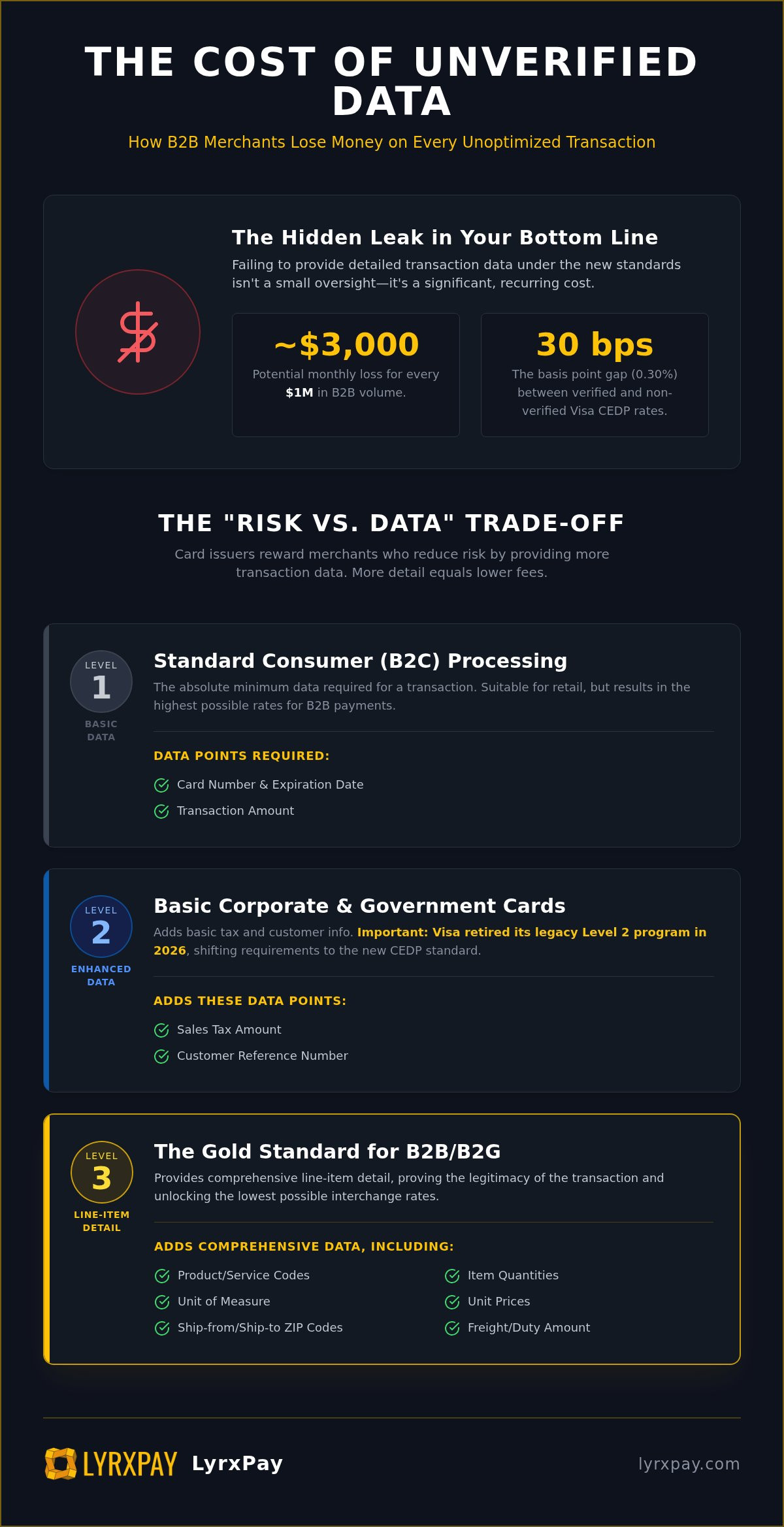
Did you know that failing to verify your transaction data under the new 2026 standards could be costing you $3,000 every single month for every million dollars in volume? That 30 basis point gap between verified and non-verified Visa CEDP rates isn't just a rounding error; it's a direct leak in your company's bottom line. If you're tired of seeing your margins eroded by high interchange fees on corporate and government cards, you're not alone.
We understand the frustration of deciphering opaque merchant statements while your team wastes hours on manual data entry for line-item details. It feels like a tax on your growth. You deserve a partner who acts as an advocate for your resources, turning complex financial requirements into a streamlined advantage. By mastering Level 3 business-to-business rates, you can stop the overpayment and start optimizing your business liquidity today.
In this guide, we'll show you how to adapt to the retirement of Visa's Level 2 program and leverage the new Commercial Enhanced Data Program (CEDP) to your benefit. You'll learn how to automate fee optimization and improve your cash flow through next-day deposits. We've done the heavy lifting to simplify the 2026 landscape, allowing you to focus on your craft while we secure your profit margins.
Key Takeaways
- Learn how detailed line-item data acts as a strategic lever to unlock the lowest possible interchange fees for corporate and government cards.
- Master the specific processing requirements for Level 3 business-to-business rates to stop overpaying on every high-value transaction.
- Discover the "Math of Margin" and how reducing your processing costs can lead to a double-digit increase in your bottom-line profit.
- Follow a practical implementation roadmap to audit your current merchant statement and automate your data mapping for total efficiency.
- Optimize your business liquidity by pairing automated fee reductions with the operational speed of next-day deposits.
Understanding Level 3 Business-to-Business Rates in 2026
Think of Level 3 processing as a transparency discount. When you accept a payment from another business or a government agency, card brands like Visa and Mastercard view these transactions as higher stakes than a typical retail purchase. To mitigate risk, they require more information. If you provide that data, they reward you with significantly lower interchange fees. These specialized Level 3 business-to-business rates are designed specifically for the B2B and B2G sectors where transaction sizes are larger and invoice details are more complex.
The core of this system is a "Risk vs. Data" trade-off. By submitting line-item details, you're giving the issuing bank proof that the transaction is legitimate and authorized. This transparency reduces the likelihood of fraud or disputes. In 2026, this is no longer just a technical perk; it's a competitive necessity. With the recent shift toward Visa's Commercial Enhanced Data Program (CEDP), merchants who fail to provide deep data are essentially volunteering to pay higher rates. If your current processor treats a $10,000 corporate invoice the same as a $10 consumer purchase, you're likely losing thousands of dollars to unnecessary downgrades.
The Three Tiers of Payment Data
Understanding where your transactions fall is the first step toward optimization. The industry categorizes data into three distinct levels, each with its own Level 2 and Level 3 processing requirements that dictate your final cost. Providing more detail moves you up the tiers and brings your costs down.
- Level 1: The standard for consumer (B2C) sales. It only requires basic info like the card number, expiration date, and transaction amount.
- Level 2: The middle ground for corporate cards. It adds requirements for sales tax amounts and customer reference numbers.
- Level 3: The "Gold Standard" for B2B. This tier requires exhaustive line-item detail, including product codes, quantities, unit prices, and ship-to zip codes.
Why B2B Merchants Are Often Overcharged
Many businesses fall into the "Standard Rate" trap without realizing it. If you use a consumer-grade or "flat-rate" processor, they often lack the technical fields needed to pass detailed data to the banks. When this data is missing, the transaction "downgrades" to the most expensive interchange category possible. This is particularly painful for industries like manufacturing, wholesale distribution, and professional services where margins are closely guarded. If you're processing large B2B invoices through a platform that doesn't support automated data mapping, you aren't just paying for a service; you're paying an "ignorance tax" to the card networks. We believe in acting as your advocate to identify this "interchange fat" and trim it from your monthly statement.
Level 1 vs. Level 2 vs. Level 3 Processing Requirements
Think of your transaction data as a digital passport. Level 1 is a basic ID; Level 2 is a travel visa; and Level 3 is a comprehensive background check. If your payment processor isn't sending every required "page" of that passport to the issuing bank, the transaction gets flagged as higher risk. When risk goes up, so do your costs. Visualizing this data gap is the first step toward reclaiming your profit margins. Level 3 data is the specific line-item detail required to verify a commercial purchase.
Most standard processors only send Level 1 data, which includes the card number, expiration date, and transaction amount. This is fine for a coffee shop, but it's a disaster for B2B merchants. To qualify for Level 3 business-to-business rates, your system must be capable of transmitting dozens of additional data points. If you're processing high-value invoices without these details, you're essentially paying a premium for the bank's lack of information. We believe in providing the clarity you need to bridge this gap and stop the overpayment.
Level 2 Data Requirements
Level 2 used to be the comfortable middle ground for corporate cards. It required sales tax indicators, tax amounts, and customer reference numbers. However, the landscape changed significantly in January 2026. Visa retired its legacy Level 2 program in favor of the Commercial Enhanced Data Program (CEDP). While Mastercard still supports Level 2 processing, relying on it for Visa transactions will now lead to expensive downgrades. For Mastercard, you still need to ensure your gateway captures merchant postal codes and tax ID requirements to maintain compliance.
Level 3 Data Requirements: The Deep Dive
To reach the lowest interchange tiers, you must provide a "Deep Dive" of information. This isn't just about the total price; it's about the "what" and "how" of the sale. The requirements include:
- Line-item detail: Specific item descriptions, product codes, and unit prices for every part of the order.
- Quantity and Unit of Measure: Are you selling by the "each," the "hour," or the "case"? The bank needs to know.
- Shipping Information: Freight, shipping, and duty amounts must be broken out from the subtotal.
- Transaction Summaries: Discount indicators and ship-to zip codes to verify the destination of the goods.
The card brands enforce an "All or Nothing" rule. If you're missing just one field, like a product code or a unit of measure, the entire transaction is disqualified from the lower rate. This is why many businesses see their fees spike even when they think they're doing everything right. You can verify the specific requirements for different card types in Visa's official interchange fee schedule. If you aren't sure if your current software is capturing these fields, we can audit your merchant account to identify exactly where your data is falling short and help you secure the savings you've earned.
Calculating the Real ROI: How Level 3 Rates Impact Your Bottom Line
Every dollar you claw back from the card networks is a dollar that goes directly to your bottom line. While a 1% reduction in fees might sound modest, its impact on your net profit is often magnified by a factor of ten. If your business operates on a 10% net profit margin, saving 1% on your total processing volume is functionally equivalent to increasing your sales by 10% without any of the overhead. Mastering Level 3 business-to-business rates isn't just about technical compliance; it's a high-leverage financial strategy that protects your hard-earned revenue.
Identifying "interchange fat" requires a keen eye for how your monthly merchant statement is structured. We often see statements littered with terms like "EIRF" or "Standard," which are red flags indicating your transactions have been downgraded to the most expensive tiers. These hidden costs act as a silent tax on your growth. By auditing these statements, we can help you pinpoint exactly where your data is failing to meet the requirements and how much liquidity you're leaving on the table. Learn more about how to lower merchant fees through a strategic audit of your current processing setup.
Consider a typical $10,000 B2B transaction. Under standard Level 1 rates (often 2.70% + $0.10 for small business cards in 2026), you would pay $270.10 in fees. By providing the line-item detail required for Level 3 "Product 3" status, that rate can drop to 1.75% + $0.10, costing you only $175.10. That is a $95 difference on a single invoice. If you process twenty of these invoices a month, you're looking at nearly $23,000 in annual savings just by optimizing your data transmission.
The Cost of Downgrades
A "downgrade" occurs when a transaction fails to meet the criteria for its lowest possible rate, causing it to "fall" into a more expensive category. On your statement, this often looks like a separate line item with a higher percentage. Common triggers include missing purchase order (PO) numbers or incorrectly formatted tax fields. While a single downgrade is frustrating, the cumulative impact over a fiscal year can strip away a significant portion of your annual revenue, often totaling thousands of dollars for mid-sized firms.
Level 3 as a Competitive Advantage
Lowering your overhead gives you more room to maneuver in a crowded market. You can choose to pass these savings to your customers to win large, price-sensitive contracts, or reinvest that capital into marketing and product development. Furthermore, reducing these fixed costs is a core component of modern business liquidity management tools. When you stop the leak of interchange fees, you improve your daily cash position and give your business the fuel it needs to scale with confidence.
Implementing Level 3 Processing: A Technical and Operational Roadmap
Moving from awareness to action requires a structured approach. You've seen the potential for savings, but the technical execution is where many businesses stumble. To capture Level 3 business-to-business rates consistently, you need a system that removes human error from the equation. It starts with a thorough audit of your current merchant account to ensure it's even capable of handling enhanced data. Not all accounts are created equal. Some legacy setups are hard-coded for Level 1 and will never allow you to access discounted tiers, no matter how much data you try to send.
Once compatibility is confirmed, your next move is selecting a payment gateway that supports automated data mapping. This is the brain of your processing. It should automatically take the information from your invoices and map it to the specific fields required by Visa's Commercial Enhanced Data Program to secure Level 3 business-to-business rates. From there, you'll integrate your POS or ERP system to ensure line-item data flows seamlessly without manual intervention. Don't forget the human element; training your billing team to capture Purchase Order (PO) numbers is a small step that prevents massive downgrades. Finally, you must monitor your monthly statements to verify that your optimization efforts are actually working.
Solving the Manual Entry Problem
Manual data entry is a silent profit killer. If your staff has to spend five minutes typing in product codes and unit measures for every transaction, the labor cost quickly eclipses the interchange savings. Modern gateways solve this through automated data "ghosting," where the system intelligently fills in missing fields based on your typical transaction patterns. By utilizing an expert QuickBooks integration, you can sync your existing invoices directly to Level 3 processing. This eliminates double-entry and ensures that every commercial card you accept is optimized for the lowest possible rate.
Choosing the Right Gateway Partner
The right partner acts as a concierge for your financial health. Look for essential features like robust virtual terminals, flexible API support for your custom software, and automated recurring billing. Security is non-negotiable. Your gateway must maintain the highest PCI DSS standards to protect sensitive data during transmission. Exploring all-in-one business financial solutions can provide the integrated growth path you need to stay ahead of 2026's shifting regulations. If you're ready to stop the manual struggle and start saving, we can optimize your B2B processing today and help you reclaim your margins.
Beyond the Rates: How LyrxPay Optimizes B2B Payment Workflows
Technical compliance is only the beginning of a truly optimized financial strategy. While many merchant services providers treat your transaction volume as a commodity, we view it as the lifeblood of your operation. Most processors set up your account and then disappear until a problem arises. We take a different approach. At LyrxPay, we operate as your dedicated advocate, ensuring that your Level 3 business-to-business rates aren't just a one-time setting but a permanent part of your margin protection. We don't just process your payments; we audit your statements and optimize your entire workflow so you can stop worrying about the technical side of finance and focus on your craft.
Our concierge-level service means you have real people to talk to when you need help navigating the complexities of the 2026 interchange landscape. We do the heavy lifting of managing your administrative health, providing clarity where other financial services offer only confusion. By combining our advocacy-based approach with expert support for QuickBooks and Xero, we eliminate the friction of manual accounting data entry. It's a partnership designed to protect your time and your resources equally.
The Power of Next-Day Deposits
In the world of wholesale and professional services, liquidity is king. Why should you have to wait three to five business days to access the funds from a sale you've already completed? This outdated practice is a significant obstacle to growth. We prioritize your cash flow by offering next-day deposits, ensuring that the savings you earn from Level 3 business-to-business rates are available when you need them. This synergy between lower fees and fast funding allows you to pay vendors, manage payroll, and reinvest in your business without the stress of a waiting period.
Streamlined Back-Office Operations
Efficiency happens when your processing, payroll, and bookkeeping work in a single, unified workflow. By integrating these essential tasks, you reduce the administrative burden that keeps many small business owners working late into the night. We provide the tools to sync your invoices directly with your processing gateway, ensuring that every line-item detail is captured automatically for the banks. This proactive approach anticipates your needs and offers a sense of managed care for your business health. If you're ready to see the difference a dedicated ally can make, it's time to stop overpaying for B2B processing and get a LyrxPay fee audit today.
SECURE YOUR MARGINS AND OPTIMIZE FOR 2026 GROWTH
Reclaiming your profit from complex card network fees is one of the most effective ways to strengthen your business's financial foundation. You've seen how the 2026 landscape demands greater transparency through enhanced data. By mastering Level 3 business-to-business rates, you aren't just following a technical requirement; you're actively defending your company's resources. It's about turning every transaction's metadata into an immediate boost for your bottom line.
We're here to act as your advocate and do the heavy lifting for you. Whether it's through expert QuickBooks integration that wipes out manual entry or the improved liquidity of next-day deposits, our goal is to simplify your administrative life. We pride ourselves on making the complicated feel manageable, allowing you to focus on your craft while we secure your savings. Ready to see exactly where your "interchange fat" is hiding? Get a Free Merchant Statement Audit and Lower Your B2B Rates with LyrxPay. Let's work as equal partners to ensure your business health is always a priority.
Frequently Asked Questions
What is the difference between Level 2 and Level 3 processing?
Level 2 processing requires basic tax amounts and customer reference numbers, while Level 3 demands deep line-item detail like product codes, quantities, and unit prices. Providing this extra data reduces risk for the bank, which results in the lowest possible interchange fees. If you're processing high-value corporate invoices, shifting to the higher tier is essential for protecting your margins.
How much can Level 3 business-to-business rates save my company?
You can typically save between 0.5% and 1.1% on every eligible transaction. By utilizing Level 3 business-to-business rates, a merchant with $100,000 in monthly commercial volume could reclaim over $1,000 in fees that would otherwise go to the banks. These savings scale directly with your volume, making it a high-leverage tool for wholesalers and manufacturers who want to improve their liquidity.
Do I need to manually enter data for every Level 3 transaction?
You don't need to manually type in data if you have the right integration. Modern payment gateways use automated data mapping to pull line-item details directly from your invoices or ERP system. This technology fills in the required fields for you, saving your billing team hours of tedious work and preventing the human error that leads to expensive downgrades.
Which credit cards are eligible for Level 3 interchange rates?
Eligibility is limited to commercial cards, including corporate, purchasing (P-cards), and government-issued cards. Standard consumer credit cards, such as basic personal rewards cards, are only eligible for Level 1 rates. To maximize your savings, you should focus on optimizing transactions from your larger business and government clients who use these specialized commercial accounts.
Can I qualify for Level 3 rates using a standard retail POS system?
Most standard retail POS systems aren't equipped to handle the complex requirements of Level 3 business-to-business rates. They lack the necessary fields for transmitting line-item data like unit prices and commodity codes. To qualify, you'll generally need a B2B-optimized gateway or a virtual terminal that's specifically designed to communicate this enhanced data to the card networks.
What happens if I don’t provide Level 3 data for a corporate card?
Your transaction will "downgrade," meaning you'll be charged the highest possible interchange fee. Card networks view transactions with missing data as higher risk and penalize you accordingly. On your monthly statement, these downgrades often appear under labels like "Standard" or "EIRF," signaling that you've missed out on the significant discounts available for verified commercial data.
Is Level 3 processing available for international B2B transactions?
Yes, Level 3 processing is available for many international transactions, though the rules vary by region and card brand. While the most substantial savings are often found within domestic US B2B commerce, providing enhanced data on international corporate cards can still help reduce cross-border fees. We can help you audit your international volume to see where these optimizations apply.
How do I know if my current merchant statement includes Level 3 rates?
You need to look at the interchange detail section of your merchant statement for specific descriptors. Look for terms such as "Commercial Level 3," "Product 3," or "PPS Level 3." If your statement only shows "Level 1" or "Standard" for your business-to-business sales, you are likely overpaying. We can provide a transparent audit to help you decode these opaque terms and find your savings.