
Clover vs Square for Retail Shops: The 2026 Comparison Guide
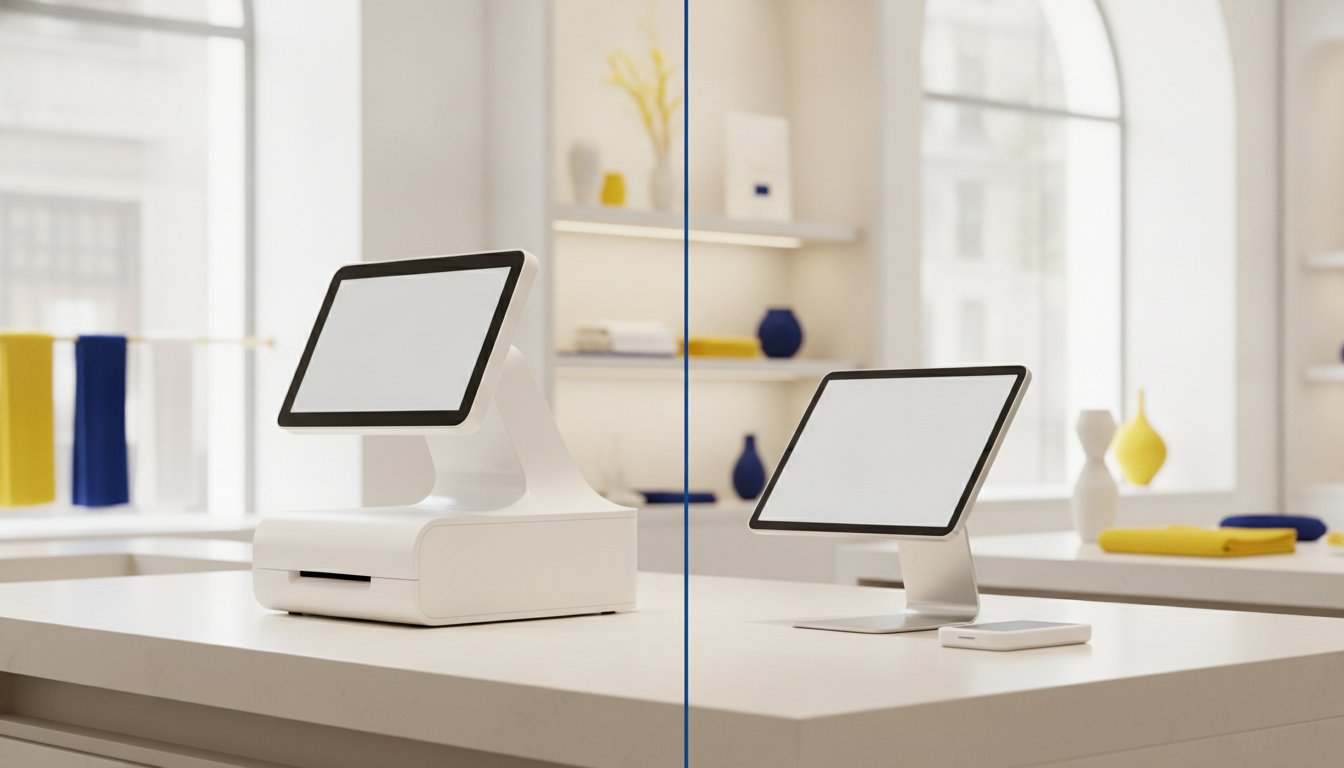
That sleek Square reader on your counter might look like the simplest way to run your boutique, but it could be the most expensive piece of hardware you'll ever own. You've likely felt the sting of flat-rate fees that aren't actually flat once your volume grows. It's frustrating to watch your hard-earned margins disappear into a black hole of processing costs while waiting days for your funds to hit your bank account. You deserve a partner who acts as a defender of your resources, not just another vendor taking a cut.
This 2026 comparison of Clover vs Square for retail shops reveals which powerhouse actually saves you money and time when paired with modern merchant services. we'll explore how to achieve lower effective processing rates, move to next-day deposits, and finally get your inventory to talk to your QuickBooks software without the manual headaches. By the end of this guide, you'll know exactly which platform offers the stability and speed your business needs to thrive. We've done the heavy lifting so you can get back to your craft with total clarity and confidence.
Key Takeaways
- Understand the fundamental difference between payment aggregators and dedicated merchant accounts to better protect your long-term business health.
- Compare Clover vs Square for retail shops to see how moving beyond flat-rate "convenience taxes" to transparent wholesale pricing saves your shop money.
- Identify the specific hardware and software combinations that automate inventory management and sync directly with your bookkeeping.
- Gain the advantage of next-day deposits and a dedicated support team to ensure your liquidity and operations never stall.
- Learn how a simple audit of your current processing statements can reveal immediate opportunities to reclaim lost revenue.
The Core Difference: Aggregators vs. Merchant Accounts
Most business owners don't realize that the software sitting on their counter is just the tip of the financial iceberg. Behind the sleek screens, the way your money actually moves from a customer's card to your bank account determines your shop's long-term health. When evaluating Clover vs Square for retail shops, the most critical distinction isn't the hardware design. It's the difference between being a "sub-merchant" in a giant pool or having a dedicated account built specifically for your needs.
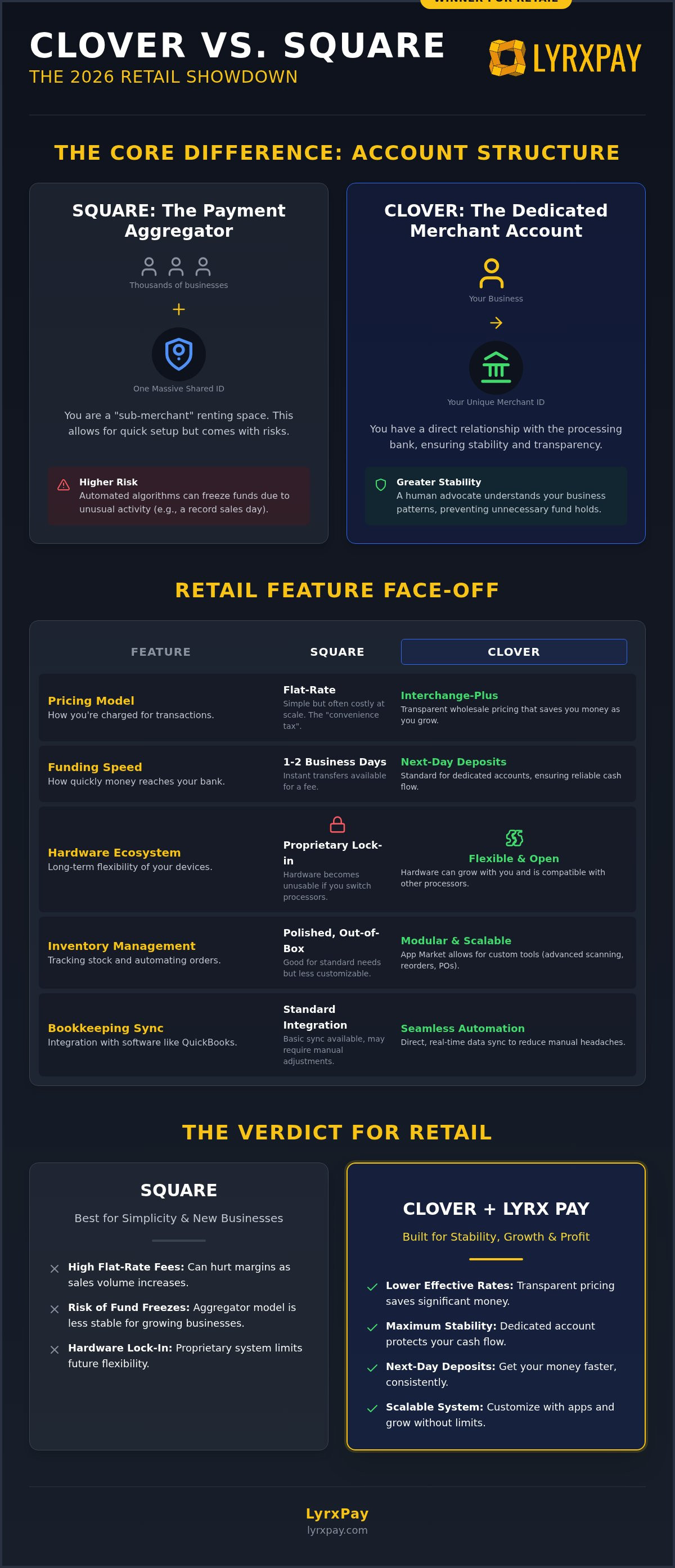
Square operates as a payment aggregator, also known as a Merchant of Record. They bundle thousands of businesses together under one massive processing ID. This allows for nearly instant setup, but it means you're essentially renting space on their platform. Clover, by contrast, is a versatile hardware platform designed to work with dedicated merchant accounts. This setup gives you a unique relationship with the processing bank, providing a level of stability and transparency that aggregators simply can't match.
Why Your Retail Setup Choice Matters in 2026
Operational stability is your greatest asset. Aggregators rely heavily on automated risk algorithms. If your shop has a record-breaking sales day or processes a few large transactions, an automated bot might flag your account and freeze your funds for weeks. This "shoot first, ask questions later" approach can be devastating for your liquidity. A dedicated merchant account offers a concierge level of service. You have a human advocate who understands your business patterns, helping you handle chargebacks and security alerts without disrupting your cash flow. Modern retail requires a Point of Sale (POS) that doesn't just swipe cards; it should integrate your sales data directly into your bookkeeping for a seamless financial workflow.
Ownership vs. Subscription: The Hardware Reality
Square's proprietary ecosystem is designed to keep you locked in. If you ever decide to switch to a different processor, your Square hardware often becomes unusable. It's a "lock-in" effect that limits your future options. Clover hardware is built for flexibility and longevity. For high-volume retail locations, the long-term cost of ownership is often lower when you aren't tied to a single, rigid ecosystem. Future-proofing your shop means choosing hardware that can grow with you. When you pair Clover's robust devices with a transparent processing contract, you gain the freedom to scale without the fear of sudden fee hikes or platform-wide policy shifts that could eat into your margins.
Retail Feature Face-Off: Inventory and Efficiency
Daily operations in a busy shop demand more than just a way to take money. In the comparison of Clover vs Square for retail shops, the real battle happens in the stockroom and the checkout line. Square for Retail offers a highly polished, "out-of-the-box" experience that works well for boutiques with standard needs. Clover takes a different path through its App Market. This modular approach allows you to build a custom toolkit, adding specific barcode scanning or label printing apps only when you need them. For brands expanding into multiple locations, Clover's ability to sync data across separate merchant IDs provides a level of granular control that Square's unified model often lacks. You can manage employee permissions and sales reports for five different stores from a single dashboard without losing site-specific data.
Mastering Inventory Management
Inventory shouldn't be a manual chore. In 2026, the standard for retail is real-time syncing across every channel. If a customer buys your last pair of boots in-store, your online shop should reflect that change instantly. Clover hardware excels here by supporting high-speed barcode scanners and automated reorder triggers that alert you when stock hits a critical level. You can handle bulk uploads for diverse catalogs with thousands of SKUs without the system lagging. This level of automation is why many growing retailers find relief in a customized POS solution that scales alongside their inventory. Vendor management is also simpler on Clover, as you can link specific items to their suppliers and generate purchase orders with a single tap.
Customer Experience at the Counter
The checkout experience is your final chance to impress. The Clover Station Duo offers a professional, customer-facing screen that feels substantial and permanent. In contrast, the Square Register provides a sleek, minimalist aesthetic. Both systems handle chip, tap, and mobile wallet payments with impressive speed. While you're setting up these systems, it's wise to follow advice from the FTC regarding transparency in your service agreements to ensure your "fast" system doesn't come with slow, hidden costs. Beyond the swipe, modern CRM integrations now allow you to capture customer feedback and manage loyalty points directly on the screen. Digital receipts are now the baseline, but the ability to print high-quality paper receipts for traditional shoppers remains a key strength of the Clover ecosystem.
The Cost Trap: Flat-Rate vs. Interchange Plus
Simplicity often comes with a hidden price tag. Square has built its reputation on a single, easy-to-understand flat rate. While 2.6% plus 10 cents per transaction sounds straightforward, it's essentially a convenience tax on your growth. When you're just starting out, this model is helpful. However, as your volume increases, that flat rate becomes a heavy anchor. You end up paying the same high margin on a basic debit card as you do on a high-reward corporate credit card. This is where the debate of Clover vs Square for retail shops takes a turn toward your bottom line. You deserve to keep more of what you earn.
Interchange Plus pricing is the transparent alternative. It separates the actual cost of the transaction, set by the card brands, from the processor's small markup. This "wholesale" approach ensures you benefit from lower costs on debit and standard cards. Most top retail POS systems can be configured with this pricing model if you work with the right partner. The break-even point typically arrives sooner than you think. If your retail shop processes more than $5,000 monthly, the savings from a dedicated merchant account often pay for the hardware in a matter of months.
Unmasking Hidden Processing Costs
The sticker price isn't the only thing eating your margins. Many retailers overlook the impact of card-not-present (CNP) rates. If you take a phone order or a customer pays through an emailed invoice, Square's rate jumps to 3.5% plus 15 cents. These spikes can quietly erode your profits on big-ticket items. You should also watch out for separate PCI compliance fees that some providers tack on as "junk fees." Interchange Plus is the gold standard for retail transparency because it reveals exactly what you're paying for without the fluff. We believe in acting as a defender of your resources, ensuring you never pay more than necessary for account stability.
Liquidity: The Value of Next-Day Deposits
Cash flow is the lifeblood of any storefront. While aggregators often hold funds for one to two business days, next-day deposits provide an immediate boost to your inventory purchasing power. When your money hits your account faster, you can restock popular items or pay vendors without tapping into expensive short-term credit. This improved liquidity creates a safety net for your operations. For a deeper strategy on optimizing your cash flow, explore these Business Liquidity Management Tools. Faster access to your funds doesn't just feel better; it makes your business more resilient against unexpected expenses.
Implementation: Setting Up Your Retail Workflow
Switching systems shouldn't feel like a second job. When you evaluate Clover vs Square for retail shops, the actual setup process determines how quickly you'll see a return on your investment. We believe in a structured approach that removes the guesswork from your transition. It's about moving from a generic, "one-size-fits-all" configuration to a tailored workflow that mirrors how you actually do business.
The process begins with a clear audit of your current processing statements to find the "true" rate you've been paying. Many owners are surprised by the gap between an advertised flat rate and their actual monthly costs. Once the numbers are clear, you can select Clover hardware based on your physical space. If you need mobility for line-busting, the Clover Flex is ideal; for a primary checkout, the Station Duo provides the dual-screen experience customers expect in 2026. After hardware selection, we map your QuickBooks or Xero integration to ensure automated reconciliation from day one. A quick 30-minute training session for your staff prevents opening-day friction. Finally, you launch with next-day deposits active to keep your liquidity high.
QuickBooks Integration: Ending Manual Data Entry
Manual data entry is a relic of the past. By syncing daily sales batches directly to your general ledger, you eliminate the "Friday night bookkeeping" marathon. This reduces accounting errors and saves hours every week. If you handle wholesale or large business orders, consider integrating level 3 B2B rates into your Quickbooks Invoices to capture even deeper savings. It's about making your software work as hard as you do so you can focus on your craft.
Payroll and Back-Office Synergy
Your POS should be the hub of your business. Connecting the built-in time-clocks to your payroll solution ensures that hours worked are accurate and instantly ready for processing. You can manage employee permissions and track sales performance without leaving the dashboard. This creates a cohesive environment where your back-office works for you. For a complete look at these integrations, explore our All-in-One Business Financial Solutions. It's the most efficient way to manage growth without increasing your administrative burden. Ready to reclaim your time? Speak with a dedicated advocate to start your transition today.
The Verdict: Why LyrxPay + Clover Wins for Retail
Choosing between Clover vs Square for retail shops eventually comes down to a simple question: do you want a vendor or a partner? Square is a great tool for the first day of business, but as your sales volume grows, its flat-rate model starts to feel like a penalty for your success. By combining Clover's professional, durable hardware with a dedicated merchant account, you gain a system that actually works to protect your margins. The fiscal year savings from lower transaction fees alone can often fund your next big inventory restock or a shop renovation.
Beyond the numbers, the human factor is where the LyrxPay and Clover combination truly pulls ahead. While Square relies heavily on automated help bots and standardized responses, you get the peace of mind that comes with a dedicated, Texas-based support team. We act as your concierge for all things merchant services. If a transaction looks odd or a deposit is delayed, you aren't shouting into a void; you're talking to a reliable ally who has already done the heavy lifting for you. This advocacy ensures your account stays stable and your doors stay open.
Lowering Your Fees Without Sacrificing Quality
Many business owners accept high fees because they don't have the time to decipher complex processing statements. We change that. Our team performs a thorough audit of your current rates to ensure you never overpay for the privilege of taking a card. This isn't just about a one-time transaction; it's about a long-term professional relationship built on transparency. To learn more about our methodology, check out our How to Lower Merchant Fees guide. We believe that every dollar saved in processing is a dollar you can reinvest into your own craft.
Ready to Upgrade Your Retail Shop?
The transition to a modern merchant services provider is faster and simpler than most retailers imagine. 2026 is the year to stop settling for "good enough" and start reclaiming your retail margins. You've worked too hard to let hidden fees and slow deposit times dictate your liquidity. From next-day deposits to seamless QuickBooks integration, the infrastructure for your growth is ready. Contact us today for a custom hardware and processing quote and see the difference a dedicated advocate makes for your bottom line.
RECLAIM YOUR MARGINS AND YOUR TIME
Your retail shop is more than just a place of business; it's a craft you've spent years perfecting. When deciding between Clover vs Square for retail shops, remember that hardware is just the entry point. The real victory lies in the processing contract and the support system standing behind it. By moving away from flat-rate convenience taxes and toward wholesale Interchange Plus pricing, you protect your long-term liquidity and ensure every sale contributes more to your bottom line.
You don't have to navigate these complex financial waters alone. With next-day deposits included, expert QuickBooks integration, and a team of Texas-based advocates in your corner, you can finally focus on growth instead of administrative hurdles. It's time to trade automated help bots for a concierge partnership that treats your resources as its own. We're ready to help you build a more resilient and profitable future.
Get a Custom Clover Quote and Lower Your Retail Fees Today
Retail POS Frequently Asked Questions
Is Clover or Square cheaper for a small retail shop?
Square typically wins on upfront costs for micro-businesses because they offer a free software tier and low-cost card readers. However, the calculation for Clover vs Square for retail shops changes once you process over $5,000 monthly. At that level, the savings from wholesale processing rates on Clover often outweigh Square's flat-rate convenience tax. You'll keep more of your margins as your sales volume increases, making Clover the more scalable choice for growth.
Can I use my own merchant account with Square hardware?
No, Square hardware is locked into their proprietary ecosystem. You cannot use a third-party merchant account with Square registers or terminals. This creates a "lock-in" effect that prevents you from shopping around for better rates. Clover hardware is much more flexible, allowing you to choose a dedicated provider who acts as an advocate for your business. This flexibility ensures you aren't stuck with a single processor if their service or pricing changes.
How do next-day deposits work with LyrxPay and Clover?
Next-day deposits ensure that your sales from today are available in your bank account by the next business day. This process improves your liquidity and allows you to restock inventory or pay staff without waiting for the typical two-day lag seen with many aggregators. By settling your batches daily, we prioritize your cash flow. It's a standard feature designed to give you the operational speed necessary to run a modern storefront with total confidence.
Does Clover integrate with QuickBooks Online for retail sales?
Yes, Clover offers seamless integration with QuickBooks Online through specialized apps in the Clover App Market. This connection allows your daily sales totals, tax collected, and tips to sync directly to your general ledger without manual entry. It eliminates the risk of human error and saves your bookkeeping team hours of work every week. By automating this data flow, you gain a real-time view of your financial health, making tax season far less stressful.
What happens if my internet goes down during a retail sale?
Both systems offer an offline processing mode that allows you to continue taking payments during a network outage. The transaction data is stored securely on the device and processed once your connection is restored. It's important to remember that you assume the risk for any declined cards once you go back online. Having this fallback ensures you never have to turn away a customer during a peak sales period just because of a technical glitch.
Are there long-term contracts when using Clover through LyrxPay?
We believe in earning your business every month rather than trapping you in rigid, multi-year agreements. Our approach is built on transparency and a results-oriented partnership. While some resellers might try to lock you in, our goal is to provide such high value through lower fees and concierge support that you'll never want to leave. This flexibility gives you the power to make the best decisions for your retail shop's operational health at any time.
Can I switch from Square to Clover without losing my data?
You can migrate your inventory lists and customer databases by exporting your data into a CSV file from Square and uploading it into Clover. While your transaction history doesn't usually transfer between different processors, your essential catalog and loyalty information stay intact. We help guide you through this transition to ensure your barcode structures and item variations are mapped correctly. This ensures a smooth move that doesn't disrupt your daily retail workflow.
What is the difference between flat-rate and Interchange Plus pricing?
Flat-rate pricing charges one fixed percentage for every card type, which often includes a hidden markup. Interchange Plus is the transparent alternative where you pay the "wholesale" cost set by Visa and Mastercard plus a small, fixed fee. When comparing Clover vs Square for retail shops, Interchange Plus is almost always more cost-effective for established businesses. It ensures you benefit from lower costs on debit cards rather than paying a high rate for every swipe.