
Understanding Credit Card Processing Assessment Fees: The 2026 Merchant Guide

Last Tuesday, a merchant named Sarah discovered that despite a "low-cost" promise from her processor, her actual fees were climbing while her revenue stayed flat. It's an exhausting scenario that makes understanding credit card processing assessment fees feel like a full-time job. You likely know the frustration of trying to reconcile your merchant statement with QuickBooks or Xero, only to find a maze of confusing terms that leave you feeling nickel-and-dimed by the card networks.
We're here to act as your advocate and provide the clarity you've been looking for. You'll soon be able to distinguish between non-negotiable brand costs and the sneaky markups that processors often hide in the fine print. We'll walk you through the 2026 rate updates, including Visa's 0.14% credit assessment [verify] and the impact of the 0.10% interchange settlement reduction. You'll gain a transparent view of your processing partnership and the tools to audit your statements to ensure you're never overpaying again.
Key Takeaways
- Identify the three distinct pillars of processing costs so you can separate non-negotiable brand fees from your processor's profit margin.
- Mastering the art of understanding credit card processing assessment fees allows you to verify the newest 2026 network rates and avoid overpaying.
- Learn why Interchange-Plus pricing acts as a defender of your resources by passing network savings directly through to your business.
- Uncover the specific "padded" fees to watch for on your merchant statement and how to calculate your true effective rate with confidence.
- Discover how transparent processing paired with next-day deposits and QuickBooks integration can simplify your bookkeeping and boost liquidity.
The Three Pillars of Credit Card Processing Costs
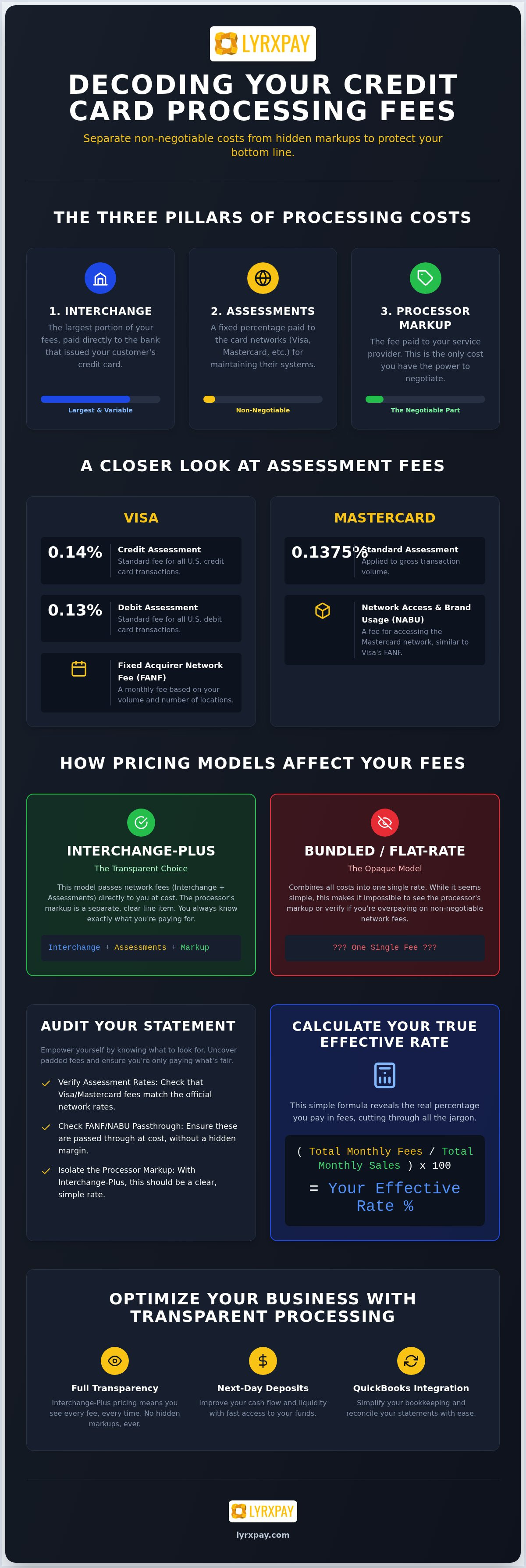
Every time a customer swipes, dips, or taps their card, a complex financial engine springs to life. For many business owners, the resulting statement looks like a wall of jargon designed to obscure the truth. However, the first step toward reclaiming your bottom line is understanding credit card processing assessment fees and where they fit into the bigger picture. These costs aren't arbitrary; they're one of the three foundational "pillars" that make up your total processing expense.
Think of your processing costs as a pie divided into three unequal slices:
- Interchange: The largest slice, paid to the bank that issued the customer's card.
- Assessments: A fixed slice paid directly to the card networks like Visa and Mastercard.
- Processor Markup: The final slice, which is the fee paid to your service provider for managing the transaction.
While interchange and markups often dominate the conversation, assessment fees are the non-negotiable costs that fund the global infrastructure of the card brands. These networks, including Visa, Mastercard, Discover, and American Express, charge these fees to maintain high-speed data centers, fraud prevention systems, and security protocols. Gaining a clear view of these pillars is the essential first step in a merchant statement fee audit.
Interchange Fees vs. Assessment Fees
It's easy to confuse these two, but they serve different masters. Interchange is volume-based and flows to the issuing bank to cover their risk and administrative costs. On the other hand, assessments are network-based and fund the brand's global operations. You can view the assessment fee as the "toll" paid to use the card brand's high-speed network. To better understand the relationship between these costs, you can explore the historical context of Interchange and Assessment Fees. While interchange rates fluctuate based on hundreds of variables, assessments are generally more stable and apply to every transaction on that specific network.
Identifying the Processor Markup
This is where your advocacy begins. The processor markup is the only area where you have real negotiating power. Some providers use a "bundled" or flat-rate model to simplify things, but this often serves as a smoke screen to hide their own margins. By mixing assessments and interchange together, they make it nearly impossible for you to see if they're padding the bills. Transparency in the markup is the hallmark of a modern merchant services provider. When you have a partner who breaks down every cent, you can see exactly what goes to the networks and what goes to the processor. This level of detail is vital for understanding credit card processing assessment fees and protecting your business from unnecessary costs.
Deep Dive: Common Card Brand Assessment Fees Explained
Most business owners see a single line item for "assessments" on their monthly statement, but that's rarely the full story. In 2026, these fees are a mosaic of network-specific costs that vary based on card type and risk level. For instance, Visa's current assessment rate for credit transactions is 0.14% [verify], while debit transactions sit at 0.13% [verify]. Mastercard follows closely with a standard rate of 0.1375% [verify]. While these percentages seem small, they apply to every dollar of your gross sales. If you process international cards or operate in a high-risk category, these rates can climb as the networks account for increased cross-border security and currency conversion.
Visa and Mastercard Specific Assessments
One of the most misunderstood charges is Visa's Fixed Academics Network Fee (FANF). This is not a simple percentage; it's a monthly fee based on your number of locations and processing volume. If you have multiple storefronts, this fee scales accordingly. Mastercard has its own version called the Network Access and Brand Usage (NABU) fee. These are non-negotiable costs set by the networks themselves. Ethical processors pass these through exactly at cost without adding a hidden margin. If you notice these numbers don't align with standard network tables, it's time to ask for a transparent fee review to protect your revenue.
Transaction-Based vs. Volume-Based Charges
A complete strategy for understanding credit card processing assessment fees requires looking at both volume and transaction counts. Some fees, like the standard assessment, are a percentage of the total sale. Others are "per-event" charges that trigger regardless of the transaction size. For example, the Mastercard Undefined Authorization fee increased to 0.30% in April 2025. Then there are "kilobyte" fees. These are tiny charges for the actual data transmission across the network. While a single kilobyte fee is negligible, a high-volume merchant with thousands of transactions will see them add up quickly. B2B merchants face unique challenges too. With Visa sunsetting its Level 2 data program in April 2026, submitting detailed Level 3 data is now the only way to keep network costs in check for commercial transactions.
How Assessment Fees Impact Your Pricing Model
Your choice of pricing model is the lens through which you view your monthly expenses. If that lens is cloudy, you're likely losing money to hidden markups. Understanding credit card processing assessment fees requires a merchant agreement that doesn't hide the truth. A transparent model doesn't just save you money. It provides the data needed for accurate financial forecasting and helps you spot when a provider is inflating their own margins at your expense.
Many processors still push tiered pricing models, which remain the least transparent options on the market. In a tiered system, your transactions are lumped into buckets like "qualified" or "non-qualified." Because assessments are bundled into these broad categories, it's impossible to see the actual card brand charges. This lack of clarity directly hinders your ability to use business liquidity management tools effectively. If you can't see the specific costs leaving your account, you can't optimize your cash flow or predict your next-day deposit amounts with certainty.
THE TRANSPARENCY OF INTERCHANGE-PLUS PRICING
This model is widely considered the gold standard for high-volume entities and medical offices. It separates the three pillars of cost into distinct line items on your statement. You see the interchange, you see the assessment, and you see the processor's markup. This structure allows you to audit every penny of network cost with total precision. It's the most honest way to do business. If the card brands lower a fee, that saving flows directly to your bank account rather than staying in the processor's pocket. Interchange-Plus pricing allows you to audit every penny of network cost to ensure your business stays lean and profitable.
THE "CONVENIENCE TAX" OF FLAT-RATE MODELS
Flat-rate pricing is often marketed as "simple" and "predictable." While it's easy to understand, it functions as a convenience tax for the merchant. When card brands reduce their assessment fees, a flat-rate processor usually keeps those savings as extra profit. They don't pass the reduction on to you because your rate is locked. For high-volume merchants, this simplicity costs far more than it's worth. You lose all visibility into what the card brands are earning versus what your processor is taking home. If your business is growing, that lack of transparency becomes a significant drain on your resources. Choosing a partner who advocates for your bottom line means moving away from these "black box" models and toward true cost transparency.
Auditing Your Merchant Statement for Assessment Accuracy
Knowledge is your best defense against predatory pricing. While we've spent time understanding credit card processing assessment fees in theory, the real work happens when your monthly statement arrives. To start your audit, calculate your "effective rate" by dividing your total processing fees by your total sales volume. If that number is creeping above 3% without a massive influx of international or high-rewards cards, you likely have a fee problem. This simple calculation is the fastest way to stop overpaying for credit card processing and regain control of your margins.
Reconciling your processing fees with your general ledger isn't just about accounting; it's about operational health. When you treat your merchant statement as a static bill, you miss the opportunity to catch "fee creep." By reviewing these costs monthly, you can ensure that the 0.10% interchange reduction from the recent Visa/Mastercard settlement is actually reaching your bottom line rather than being absorbed by your processor.
Spotting Inconsistencies in Monthly Statements
Statements are often intentionally dense. When you scan yours, look for "miscellaneous" or "service" fees grouped suspiciously close to the card brand assessments. Ethical providers pass network costs through at the exact rates set by the brands. If you see a Visa assessment higher than 0.14% [verify] or a Mastercard rate exceeding 0.1375% [verify], your processor is likely applying a surcharge on top of the network's own fee. These tiny "rounding errors" are actually hidden profits that belong in your bank account. You should also watch for duplicated charges, like being billed for both a "batch fee" and a "network access" fee for the same set of transactions.
Leveraging QuickBooks for Fee Transparency
Manual reconciliation is a recipe for burnout. Modern businesses use integrated accounting and payment solutions to automate the heavy lifting. By syncing your processing data directly with QuickBooks or Xero, you can generate reports that track fee trends over time. If a specific network fee suddenly spikes while your sales remain steady, your software will highlight the discrepancy immediately. This proactive approach ensures you aren't just understanding credit card processing assessment fees but actively managing them. Automated bookkeeping acts as a permanent audit trail for every cent that leaves your business. If you suspect your current provider is padding your bill, get a professional statement review to see the truth.
Optimizing Your Bottom Line with LyrxPay
LyrxPay isn't just another processor; we act as a dedicated defender of your business resources. While understanding credit card processing assessment fees is the first step toward financial health, the second is choosing a partner who refuses to hide behind technical jargon. We provide a concierge style of support that turns your merchant statement from a source of stress into a clear tool for growth. For B2B companies, this advocacy includes integrating Level 3 B2B rates directly into your invoicing workflows. By automating the collection of detailed transaction data, you qualify for lower network rates that most processors simply ignore.
Our approach is grounded in the belief that you should keep more of what you earn. We don't just provide software; we offer a long-term professional relationship built on honesty and straightforwardness. By removing the obstacles of complex fee structures, we allow you to focus on the craft that made your business successful in the first place. Whether you are auditing a single statement or overhaulng your entire financial workflow, we are here to ensure every cent is accounted for.
Transparent Reporting and Next-Day Deposits
Waiting for your money to clear is a thing of the past. Our next-day deposits ensure that your liquidity remains high. You can reinvest your revenue almost as soon as you earn it, which is vital for maintaining healthy operational cash flow. This speed is paired with reporting that is refreshingly clear. We break down every transaction into its core parts: interchange, assessments, and our own modest markup. You will never have to guess if a network fee was padded or if a "service" charge is actually a hidden profit margin. This level of detail provides the peace of mind that only comes from a partner who acts as your financial ally.
Integrated Bookkeeping and Payroll Support
True efficiency comes from a unified financial strategy. LyrxPay moves beyond simple processing to offer an all-in-one financial solution. By handling your payments, payroll, and bookkeeping under one roof, we eliminate the friction of managing multiple disconnected vendors. Our experts ensure that your fees are recorded correctly in QuickBooks or Xero, preventing the reconciliation headaches that often lead to expensive accounting errors. Understanding credit card processing assessment fees is much simpler when your reporting is integrated directly into your general ledger. We take the heavy lifting off your plate, allowing you to manage your business with confidence and clarity.
RECLAIM YOUR REVENUE WITH TOTAL TRANSPARENCY
Mastering the art of understanding credit card processing assessment fees is more than just a technical exercise; it's a vital step in defending your business's resources. You've learned that while these network costs are non-negotiable, they shouldn't serve as a mask for hidden processor markups. By moving to a transparent Interchange-Plus model, you ensure that every cent is accounted for and that network savings flow directly back to your bank account. Managing your operational health becomes much simpler when your payments, bookkeeping, and payroll work in perfect harmony.
LyrxPay is here to act as your financial ally. We provide next-day deposits for all credit card and ACH processing to keep your liquidity high, backed by expert QuickBooks and Xero integration support to streamline your workflow. You deserve a processing partnership that prioritizes your bottom line over their own margins. Don't let confusing statements drain your hard-earned revenue any longer. Stop overpaying and get a transparent fee audit from LyrxPay today. We're ready to help you navigate the complexities of 2026 and beyond with confidence.
Frequently Asked Questions
What is the average credit card assessment fee in 2026?
Assessment fees for the major networks currently hover between 0.13% and 0.15% of the transaction volume. In 2026, Visa's credit assessment is 0.14% [verify], while Mastercard charges 0.1375% [verify]. These are non-negotiable costs set by the card brands to fund their global infrastructure. While they represent a small percentage of your total processing expense, they apply to every dollar processed across their networks. These rates are fixed for all merchants regardless of size.
Can I negotiate assessment fees with my merchant service provider?
You cannot negotiate these fees because they are set by the card brands, not your processor. Unlike the processor markup, which is the only negotiable part of your statement, assessments are fixed "tolls" for using the network. If a provider claims they can lower your assessment rates, they are likely misrepresenting the facts. Your best strategy is finding a partner who passes these costs through without adding a hidden surcharge or margin.
Why do Visa and Mastercard charge different assessment fees?
Each card network operates as an independent entity with its own overhead, fraud prevention systems, and data center requirements. Visa and Mastercard use different fee structures to fund these operations and manage their specific reward programs. These variances reflect their unique business models and the different levels of risk they assume. Understanding credit card processing assessment fees involves recognizing that these networks compete with each other, leading to slight differences in their published rates.
What happens to assessment fees if I use a flat-rate processor?
On a flat-rate plan, assessment fees are bundled into your single "all-in" percentage. This means you lose all visibility into what the card brands are actually charging. If Visa or Mastercard reduces a fee, your flat-rate processor usually keeps that extra margin rather than passing the savings to you. While this model offers simplicity, it lacks the transparency needed to audit your costs or benefit from network-wide rate reductions that occur throughout the year.
Are assessment fees the same as interchange fees?
No, they serve two different purposes in the transaction cycle. Interchange fees are paid to the bank that issued the customer's card to cover credit risk and administrative costs. Assessment fees are paid directly to the card networks, like Visa or Mastercard, for the use of their transmission infrastructure. While both are non-negotiable for the merchant, they appear as separate line items on a transparent Interchange-Plus statement. Separating them is the only way to see your true costs.
How do I find assessment fees on my merchant statement?
You can find these charges by looking for the "Network Fees" or "Brand Fees" section of your statement. Look for specific abbreviations such as NABU for Mastercard or FANF for Visa. On a transparent statement, these will be listed separately from your interchange costs and processor markups. If your statement only shows a single "qualified" or "non-qualified" rate, you are likely on a tiered plan that hides these specific assessments from your view.
Do assessment fees apply to ACH and B2B payments?
Assessment fees apply to all credit and debit card transactions, including those in the B2B sector. However, standard ACH payments do not use the card brand networks and therefore do not trigger these specific assessments. For B2B payments, you can often lower your overall costs by providing Level 3 data. This doesn't change the assessment itself but significantly reduces the interchange portion of the transaction, protecting your bottom line from unnecessary network expenses.
Can assessment fees change throughout the year?
Yes, card networks typically update their fee schedules twice a year, usually in April and October. These adjustments reflect changes in network technology, security requirements, or legal settlements. For example, the Mastercard Undefined Authorization fee increased to 0.30% in April 2025. Staying proactive with understanding credit card processing assessment fees ensures you aren't caught off guard by these semi-annual updates to the network's non-negotiable costs. A transparent processor will notify you of these changes immediately.