
How Credit Card Processing Fees Affect Profit Margins: A 2026 Strategic Guide

If you look at your net income today, do you see your payment processor standing there like an uninvited silent partner taking their cut before you've even paid the rent? It's a heavy realization for any business owner to see exactly how credit card processing fees affect profit margins, particularly as U.S. swipe fees reached a staggering $198.25 billion in 2025. You aren't alone if you find your monthly statements impossible to decipher or feel like your hard-earned revenue is leaking through a dozen different hidden gaps.
We understand that frustration, and we believe you shouldn't need a degree in finance just to protect your bottom line. This 2026 strategic guide promises to demystify those complex costs and provide you with a proven roadmap to defend your resources. You'll discover a clear framework to calculate your true effective rate, learn actionable ways to lower fees without risking customer satisfaction, and find out how to create a seamless bridge between your transactions and your bookkeeping. By the end of this article, you'll have the tools to stop the bleeding and turn your payment setup into a streamlined engine for growth.
Key Takeaways
- Identify how "silent partner" fees can drain up to 20% of your net income; learn to spot the hidden anatomy of every transaction.
- Move beyond confusing teaser rates by learning the step-by-step process to calculate your true effective rate from any monthly statement.
- Gain a strategic perspective on how credit card processing fees affect profit margins and see how your specific industry benchmarks compare to the national average.
- Unlock significant savings by optimizing your payment mix with ACH options and utilizing Level 3 processing data for corporate card transactions.
- Eliminate administrative stress by integrating your payments directly with QuickBooks and securing next-day deposits to bolster your daily liquidity.
The Mechanics of Margin Erosion: How Fees Drain Net Income
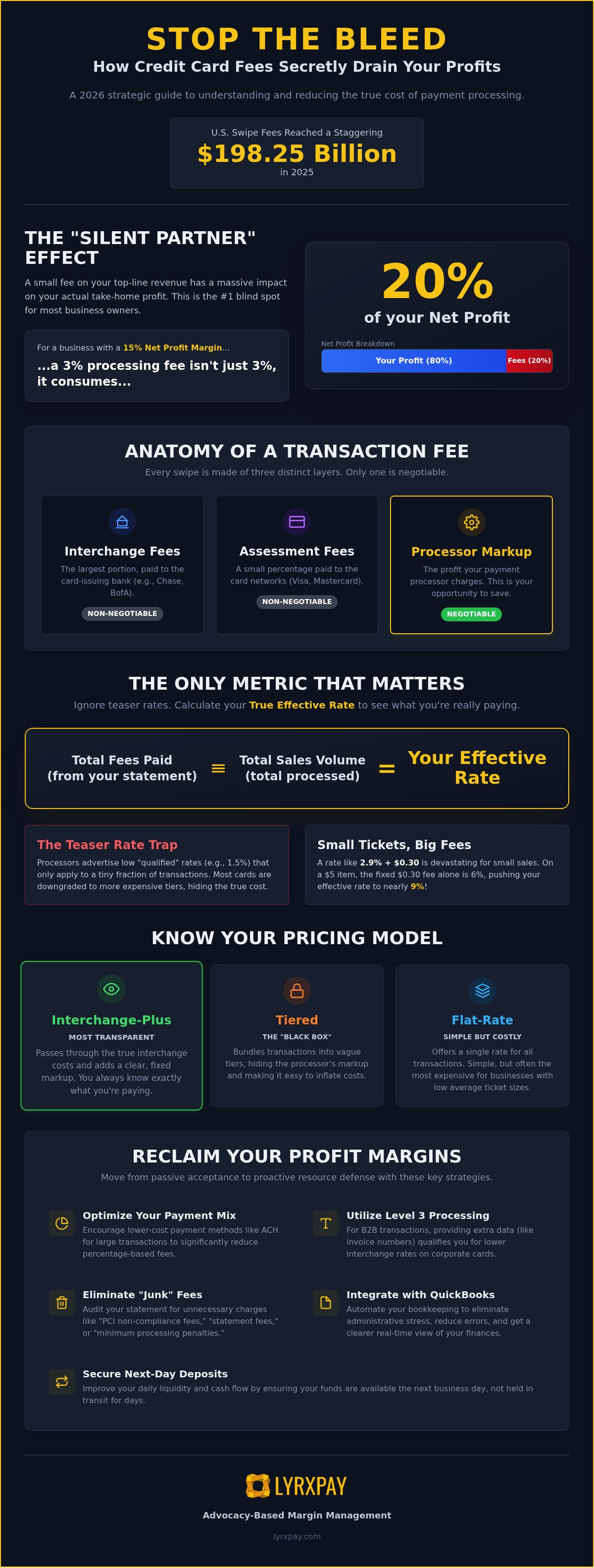
It’s easy to look at a 3% transaction fee and dismiss it as a minor inconvenience. However, top-line percentages are deceptive. When you examine how credit card processing fees affect profit margins, the math reveals a more painful reality. If your business operates on a 15% net profit margin, a 3% processing fee isn't just 3% of your profit; it's 20% of your take-home pay. This "silent partner" takes a significant chunk of your earnings without ever contributing to your operations or overhead.
Focusing on gross revenue is a vanity metric if you aren't guarding the exit points where your cash escapes. Many owners fall into the psychological trap of believing these costs are simply the "price of doing business." While you can't eliminate fees entirely, accepting them without scrutiny is a choice that directly reduces your business valuation. Every swipe or dip involves three distinct cost layers that you must understand to stay in control:
- Interchange Fees: These are paid directly to the card-issuing bank. As this Interchange Fees Explained resource notes, these are the largest component of your costs and are set by the networks.
- Assessment Fees: These small, fixed percentages go to card networks like Visa or Mastercard for the use of their infrastructure.
- Processor Markup: This is the only part of the fee that is actually negotiable. It’s what your merchant services provider charges for handling the transaction.
The Ripple Effect on Operating Cash Flow
The damage isn't limited to the dollar amount on your statement. Settlement delays of two or three days act as a hidden liquidity tax. When your funds are locked in transit, you lose the ability to reinvest that capital immediately. This friction makes accurate forecasting difficult and starves your business of the cash needed to capitalize on sudden growth opportunities. Transparent fee structures aren't just about saving pennies; they’re about ensuring you have the liquidity to stay agile and responsive.
Variable vs. Fixed Cost Analysis
Merchant fees are a variable cost that scale alongside your success. If your volume has increased but your pricing model remains the same, your growth is actually becoming more expensive. Identifying the moment your business outgrows a flat-rate model is crucial for protecting your bottom line. Professional advocacy ensures you aren't stuck paying retail rates when your volume qualifies you for wholesale pricing. By treating these fees as a manageable variable rather than a fixed burden, you move from passive acceptance to proactive resource defense.
Calculating Your Effective Rate: The Only Metric That Matters
Don't get distracted by the 1.5% "Qualified" rate printed on your merchant contract. That number is a teaser. It's a marketing tool designed to get you in the door, but it rarely reflects the actual amount leaving your bank account at the end of the month. To truly understand how credit card processing fees affect profit margins, you must ignore the sales pitch and look at the cold, hard math of your monthly statement.
The pricing model you choose dictates how much of your revenue stays in your pocket. Flat-rate pricing offers simplicity but often carries a premium that eats into your earnings. Tiered pricing is frequently a "black box" where processors hide high markups by categorizing transactions as "non-qualified." Interchange-plus remains the most transparent option, passing through the actual costs from the card networks with a clearly defined markup. If you aren't sure which one you have, it's time to dig into the data.
The Effective Rate Formula
There's only one calculation that tells the truth: Total Fees divided by Total Sales Volume. This simple formula reveals your real cost of acceptance. For example, a flat rate of 2.9% plus 30 cents might sound reasonable until you apply it to a small-ticket business. If you sell a $5 cup of coffee, that 30-cent fixed fee alone is 6% of the transaction. When you add the percentage, your real cost is nearly 9%. This is why auditing your current provider is essential; you need to know if your pricing model actually fits your transaction size and volume.
Spotting Hidden Markup and Fee Bloat
Unoptimized statements are often riddled with "junk fees" that serve no purpose other than increasing the processor's profit. Look for red flags like PCI non-compliance fees, monthly statement fees, or minimum processing penalties. These are often masked within tiered structures where the complexity makes it difficult to see where the network costs end and the processor's bloat begins. Identifying these leaks is the first step toward reclaiming your resources. If you find your statement impossible to read, a merchant services advocate can help you strip away the jargon to see what you're actually paying. The Effective Rate is the ultimate benchmark for processing efficiency, representing the true percentage of revenue lost to the cost of acceptance.
Industry Benchmarks: Is Your Business Losing More Than Average?
Every business starts with a baseline cost dictated by its Merchant Category Code (MCC). This four-digit number tells card networks what kind of risk your industry represents, and it sets the floor for your interchange rates. If your MCC is misclassified, you might be paying a higher baseline than your competitors without even knowing it. Understanding these benchmarks is the first step in seeing exactly how credit card processing fees affect profit margins within your specific sector.
Retail and restaurant environments face unique pressures because they operate in high-volume, low-margin spaces. In these businesses, a 30-cent fixed fee on a small transaction can be devastating. Conversely, professional and medical services often deal with high-ticket transactions where the percentage fee becomes the primary concern. To see a real-world example of these dynamics, you can explore this medical services case study which highlights how strategic processing protects financial health in high-ticket environments.
High-Volume vs. High-Ticket Pressures
Why do those extra cents matter so much? If you're a coffee shop owner, a $0.10 increase in your per-transaction fee can represent a massive percentage of your total profit. For a law firm billing $5,000, that dime is irrelevant, but a 0.5% markup on the total volume is a significant loss. Another hidden drain is the "downgrade." This happens when card-not-present data is missing or incomplete, causing the transaction to be processed at a higher, more expensive rate. Strategic payment routing and ensuring data quality are essential to keep your costs at the lowest possible tier.
For B2B and wholesale companies, the stakes are even higher. These businesses frequently process corporate and government cards that qualify for significantly lower wholesale rates if you provide Level 2 and Level 3 data. Without this extra information, you're essentially leaving money on the table. By submitting line-item details like tax amounts and freight codes, you can lower your interchange costs by up to 1% on those specific transactions.
The Compounding Effect on Business Valuation
Fee optimization is a long-term asset, not just a monthly saving. Consider the impact on your business valuation. If you reduce your processing fees by just 0.5%, that saved capital flows directly to your EBITDA. Because businesses are often valued as a multiplier of their earnings, a $10,000 annual saving could potentially increase your final sale price by $50,000 or more. Investors look closely at merchant processing efficiency during due diligence; they want to see a lean, optimized operation where the owner is a proactive defender of their resources. If you treat your processing setup as a manageable variable, you aren't just saving money today; you're building a more valuable company for tomorrow.
Strategic Solutions: How to Reclaim Your Profit Margins
Reclaiming your profit isn't just about asking for a lower rate; it's about re-engineering how you accept money. If you understand how credit card processing fees affect profit margins, you know that card payments aren't always the best tool for every job. While consumer-facing businesses rely on swipes, B2B and professional services have strategic alternatives that can drastically reduce the cost of acceptance.
The Power of ACH for High-Value Invoices
Credit cards charge you a percentage of the total, which means your costs scale infinitely with your invoice size. For a $10,000 professional service fee, a 3% charge costs you $300. In contrast, ACH processing typically operates on a small flat fee. By encouraging clients to pay via bank transfer, you keep nearly all of that $300 in your own pocket. Transitioning clients doesn't have to be difficult; if you offer a secure, integrated portal, the convenience remains while the cost disappears. You can explore the technical details in this ACH guide to see if it’s the right fit for your billing cycle.
Level 3 Data: The Secret Weapon for B2B
When you process corporate or government cards without providing extra data, you're paying a "lazy tax." Card networks reward transparency. By submitting Level 3 data points such as tax amounts, freight costs, and commodity codes, you prove the transaction is low-risk. Level 3 data can reduce interchange rates by up to 1% for B2B transactions.
Manually entering this data is a chore, but modern QuickBooks integration can automate the submission of Level 3 data for every invoice. This removes the administrative friction and ensures you always get the lowest possible wholesale rate without extra effort from your staff. By automating this process, you turn a complex regulatory requirement into a passive profit protector.
Fraud Prevention and Hardware Optimization
Chargebacks are a "double loss" that many businesses fail to account for in their margin analysis. You lose the physical product or the time spent on the service, and you lose the cash from the sale. Modern POS hardware does more than just read cards; it ensures data-rich, low-risk transactions that are much harder for customers to dispute. If your hardware is outdated, you’re essentially leaving your front door unlocked. Upgrading to EMV-compliant, integrated systems is a proactive defense that protects your net profit from avoidable leaks.
If you're ready to stop the bleeding and optimize your payment setup, it’s time to partner with a merchant services advocate who prioritizes your profit over their markup.
The LyrxPay Advantage: Advocacy-Based Margin Management
Most processors view your business as a mere volume count. We see you as a partner whose resources deserve protection. Understanding how credit card processing fees affect profit margins is only the first step; the second is having an ally who proactively defends those margins through transparency and technical expertise. We've moved away from the clinical, cold feel of traditional financial services to provide a concierge style of support that treats your operational health as our primary mission.
Liquidity is the lifeblood of any growing company. When your funds are tied up in multi-day settlement cycles, you're essentially giving the processor an interest-free loan. We provide next-day deposits to ensure your cash is available when you need it most. This focus on speed is a core component of our liquidity guide, helping you capitalize on inventory discounts or unexpected growth opportunities without the stress of a cash crunch.
We believe your time is better spent on your craft than on manual data entry. Our expert QuickBooks and Xero integration creates a seamless bridge between your payments and your bookkeeping. This doesn't just save time; it eliminates "reconciliation leaks" where small errors and hidden fees often go unnoticed. By automating the flow of data, we remove the administrative friction that keeps many business owners stuck in the weeds of their own back office.
Real-Time Margin Visibility
When your payments and accounting systems are fully integrated, you gain a level of clarity that most owners never experience. You can see the true cost of every sale instantly. This real-time visibility is a central theme in our all-in-one guide to business growth. By housing your processing, bookkeeping, and payroll within a single, managed ecosystem, you create a foundation for accurate forecasting and confident decision-making. We act as the defender of your resources so you can stay focused on the big picture.
Ready to Stop the Profit Leak?
Switching to a lower-fee, higher-service model shouldn't be a headache. We've streamlined the transition process to be as smooth and painless as possible. Our dedicated team provides proactive, national support, ensuring you have a direct line to an expert whenever you need it. We don't hide behind complex terminology or automated phone trees; we pride ourselves on making the complicated feel manageable.
Don't let your processor be a silent partner in your profits any longer. It's time to take control of your cost of acceptance with a team that values your bottom line as much as you do. Reach out today for a transparent audit of your current fees and discover the LyrxPay difference.
Take Control of Your Financial Future
Understanding how credit card processing fees affect profit margins is the first step toward reclaiming your hard-earned revenue. You've seen how hidden markups and unoptimized data can drain your resources, but you've also discovered the tools to fight back. By calculating your true effective rate and leveraging strategic alternatives like ACH or Level 3 processing, you move from a passive participant to a proactive defender of your business valuation.
You don't have to navigate these complexities alone. With next-day deposits for improved liquidity and seamless QuickBooks or Xero integration to stop reconciliation leaks, we provide the technical foundation you need to thrive. Our team offers national support with a concierge touch, ensuring you always have an expert in your corner. It's time to stop the bleeding and focus on what you do best.
Stop overpaying and start protecting your margins with LyrxPay today. Your business deserves a partner that is just as invested in your success as you are.
Frequently Asked Questions
How do credit card processing fees affect the prices I charge customers?
Business owners often use cost-plus pricing to account for merchant costs. If your effective rate is 3%, you must raise prices by at least that much to maintain the same net income. This is a direct example of how credit card processing fees affect profit margins. Many retailers build a 2.5% to 4% buffer into their MSRP to ensure transaction costs don't erode their planned earnings.
Can I pass credit card processing fees to my customers legally in 2026?
Surcharging is legal in most of the U.S., though it remains prohibited in Connecticut, Maine, and Massachusetts as of 2026. You must follow specific network rules, such as displaying clear signage and ensuring the surcharge doesn't exceed your actual cost of acceptance. Additionally, the Illinois Interchange Fee Prohibition Act, effective July 1, 2026, bans interchange fees on tax and gratuity portions, which may change how you calculate these costs.
What is a "good" effective rate for a small business?
A "good" rate depends on your industry and card mix, but a common benchmark for in-person retail is between 2.3% and 2.7%. For online or card-not-present businesses, the average often climbs to 2.9% or higher. If your effective rate exceeds 3.5% as a standard retailer, it's a clear sign of fee bloat or an unoptimized pricing model. Auditing this number monthly is the only way to protect your resources.
How does Level 3 processing lower my B2B transaction costs?
Level 3 processing lowers costs by providing card networks with more detailed transaction data, which reduces the perceived risk of the payment. By including line items like freight codes and tax amounts, B2B merchants can access wholesale interchange rates that are significantly lower than standard commercial rates. This data-rich approach is one of the most effective ways to mitigate how credit card processing fees affect profit margins on high-value corporate invoices.
Why does my merchant statement show different rates for different cards?
Different cards carry different interchange costs set by the networks. A basic debit card has a capped interchange fee of $0.21 + 0.05% for large banks, while a high-end rewards credit card can cost 2.5% or more. Your statement reflects these underlying costs. If you're on a tiered pricing model, the processor may also group these into qualified or non-qualified buckets, often hiding their own additional markups within the complexity.
How can QuickBooks integration help me track my profit margins better?
Integration allows for real-time tracking of net income by automatically deducting processing fees from your gross sales data. Instead of waiting for a monthly statement to see your losses, you can view the impact on your margin for every individual invoice. This automation eliminates manual entry errors and ensures your bookkeeping reflects your actual bank balance, allowing for more accurate financial forecasting and immediate operational adjustments.
What is the difference between ACH and credit card processing fees for my margin?
Credit card fees are typically percentage-based, meaning they take a bigger bite as your sales grow. ACH processing usually involves a small flat fee per transaction regardless of the dollar amount. For a $5,000 invoice, a 3% credit card fee costs you $150, while an ACH transfer might only cost a few dollars. Switching high-value payments to ACH is a powerful strategy to keep more profit in your pocket.
Will switching to a lower-fee processor affect my settlement time?
Not necessarily, and in many cases, it can improve it. While some legacy processors still take 48 to 72 hours to deposit funds, modern advocacy-based providers offer next-day deposits as a standard feature. Lowering your fees doesn't mean sacrificing service or liquidity. In fact, an optimized setup should provide both a lower effective rate and faster access to your capital, helping you maintain a healthy cash flow.