
Common Bookkeeping Mistakes: 2026 Survival Guide

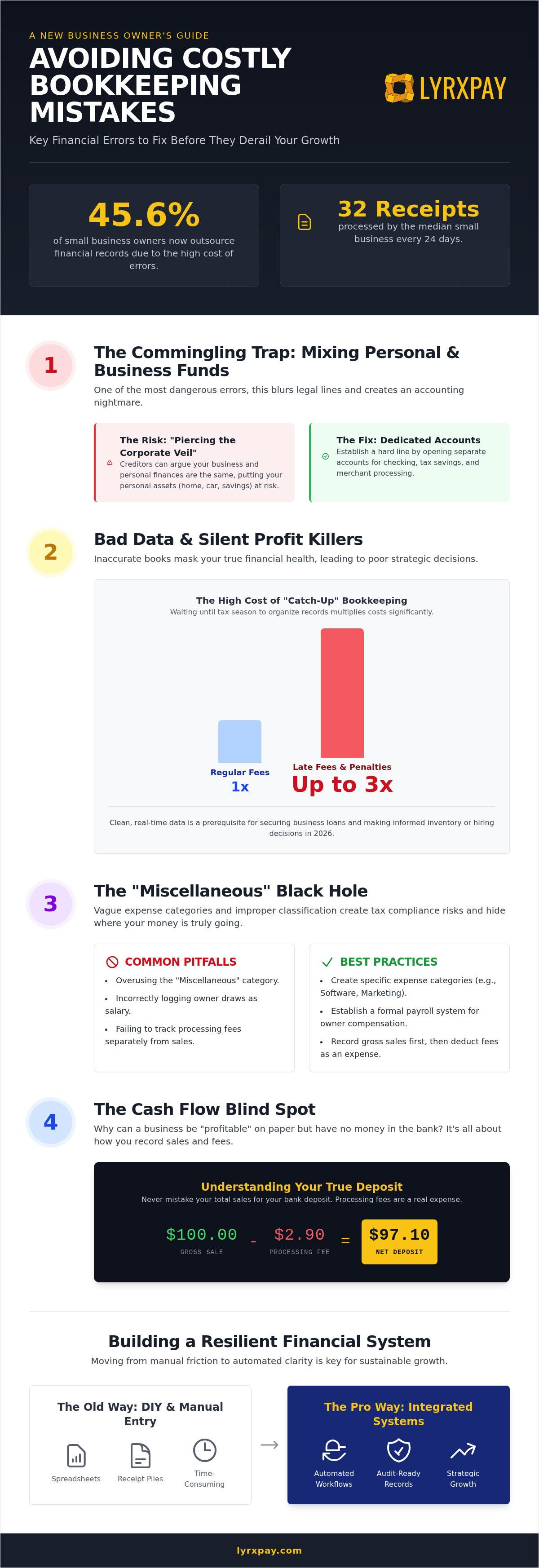
Did you know that 45.6% of small business owners now outsource their financial records because the cost of a single error can outweigh a year of professional help? It’s a staggering figure, but it makes sense when you consider that the median small business processes 32 receipts every 24 days. When you’re dealing with that volume, it’s easy to fall into the common bookkeeping mistakes for new business owners that lead to IRS audits or messy records. You started your company to innovate and serve your customers, not to spend your nights staring at spreadsheets or worrying about the latest digital record-keeping standards.
We understand that stress, and we’re here to help you clear the fog. This survival guide identifies the most expensive financial errors of 2026, providing a clear path to fix them before they derail your growth or compliance. You’ll learn how to move from time-consuming manual data entry to automated workflows that protect your resources. We’ll preview the essential steps to ensure your records are audit-ready, giving you a transparent view of your business’s true profitability and the confidence to focus on your craft.
Key Takeaways
- Identify hidden opportunity costs and learn why accurate data is your most important tool for making smart inventory and growth decisions.
- Safeguard your personal assets by avoiding the common bookkeeping mistakes for new business owners that lead to the "commingling" trap and threaten your legal protections.
- Understand why "Miscellaneous" categories are dangerous for your budget and how to correctly classify owner draws versus salary to stay compliant with 2026 tax standards.
- Learn why you can be profitable on paper but have a zero bank balance, and how to record gross sales to account for processing fees correctly.
- Determine when your time is worth more than the cost of professional help, and how a concierge approach to integrated payroll removes the friction of manual data entry.
The Silent Profit Killers: Why Bookkeeping Mistakes Cost More Than You Think
Bookkeeping is far more than just balancing a checkbook. It is the systematic recording, analyzing, and interpreting of every financial transaction your business touches. When you treat it as a secondary task, you invite a massive opportunity cost into your operations. Bad data masks your true growth signals. You might feel ready to hire a new team member when, in reality, your cash flow is too brittle to support the overhead. Poor inventory decisions often follow, leading you to sink capital into slow-moving stock while your bestsellers remain unreplenished. These common bookkeeping mistakes for new business owners do more than just complicate your life; they actively drain your resources. If you fall into the trap of catch-up bookkeeping and wait until April 14th to organize your records, expect to pay up to three times more in professional fees and late penalties. In the competitive landscape of 2026, having clean, audit-ready books is the absolute prerequisite for securing business loans or lines of credit.
Beyond Tax Compliance: The Strategic Value of Clean Books
Think of your ledger as a GPS for your business. Accurate records allow you to perform scenario planning with confidence. If a supplier raises prices by 10%, how does that impact your bottom line? You can't answer that without precise, real-time data. Financial transparency also builds a bridge to outside capital. Investors don't just buy into your vision; they buy into your numbers. When you use your data to identify your most profitable services, you stop guessing and start growing. This clarity allows you to cut underperforming products before they become a liability, ensuring every dollar you spend is an investment in your future.
The Ripple Effect: How Poor Data Impacts 2026 Business Valuation
If you plan to sell your company or take on a partner, messy books act like a check engine light for potential buyers. They will inevitably reduce the multiple they are willing to pay because your financial history is unverified. Historical accuracy allows for long-term trend analysis that proves your business is sustainable. Adopting all-in-one business financial solutions provides the foundation you need to scale without the administrative drag. This integrated approach ensures your data is always ready for a valuation, a loan, or a strategic pivot. By avoiding common bookkeeping mistakes for new business owners early on, you protect the long-term value of the asset you're working so hard to build.
Foundational Errors: Separating Personal Life from Professional Growth
One of the most dangerous common bookkeeping mistakes for new business owners is the "commingling" trap. It usually starts small. You use your personal debit card for a quick office supply run or pay for a client's coffee with your household account. This creates a legal nightmare. For LLCs and Corporations, maintaining a "Corporate Veil" is what protects your home, car, and personal savings from business liabilities. When you mix funds, you provide a roadmap for creditors to pierce that veil. They can argue that the business and the owner are one and the same, putting your personal assets at direct risk. By avoiding these common bookkeeping mistakes for new business owners early on, you build a foundation that supports long-term scaling.
Auditing these mixed statements is equally grueling. When tax season arrives, you’ll find yourself hunting through months of personal transactions to justify business deductions. It’s an inefficient use of your time that often leads to missed write-offs. Skipping monthly bank reconciliations adds to this confusion. It’s like driving a car with a broken fuel gauge; you think you have plenty of runway until the engine suddenly cuts out. You need to know exactly how much "fuel" is in the tank to make informed decisions.
The Clean Break: Establishing Dedicated Business Accounts
To fix this, you need a hard line between your personal and professional life. Open a dedicated business checking account, a savings account for tax reserves, and a merchant account for processing. This separation provides a massive psychological boost. You can finally see your "true" business profit without personal expenses clouding the view. When it’s time to pay yourself, avoid the urge to just withdraw cash. Instead, issue a formal owner’s draw or salary. This creates a clear paper trail that satisfies both the IRS and your accounting software, ensuring every dollar is accounted for.
Monthly Reconciliations: The 30-Day Health Check
Reconciliation is the process of matching your bank statements to your internal records. It’s your best defense against bank errors or internal fraud. This practice also helps you identify "Ghost Transactions," those recurring subscriptions for software you no longer use that quietly drain your capital. Utilizing business liquidity management tools ensures you always have a real-time view of your available cash. If managing these details feels like a distraction from your core mission, professional bookkeeping support can provide the concierge-level care your finances deserve.
Technical Pitfalls: Misclassification and Software Overreliance
Many common bookkeeping mistakes for new business owners stem from a messy Chart of Accounts. It's tempting to use a "Miscellaneous" category when you aren't sure where an expense goes, but this is a dangerous habit. It hides your spending patterns and makes budgeting impossible. If your tax return shows thousands of dollars in "Misc" expenses, it's a red flag for the IRS. Another frequent error involves the distinction between owner draws and salary. For S-Corp owners, misclassifying these can lead to significant tax penalties or issues with reasonable compensation requirements. Even with modern tools, a transaction entry in QuickBooks is just half the battle. Without a supporting receipt, you lack the digital paper trail required for a robust audit defense.
The 'Chart of Accounts' Framework for New Owners
Think of your Chart of Accounts as the filing cabinet for your entire business. You have five main drawers: Assets (what you own), Liabilities (what you owe), Equity (your stake), Revenue (what you earn), and Expenses (what you spend). You need granular categories to see the truth. Grouping marketing, software, and office supplies together prevents you from seeing which levers to pull when you need to cut costs. Professional bookkeeping services prevent the dreaded "year-end cleanup" fee by ensuring these categories are set up correctly from day one. This proactive setup allows you to focus on growth rather than fixing foundational errors later.
The Automation Paradox: Human Oversight in a Digital Age
Software is a powerful ally, but it isn't a replacement for a human eye. The automation paradox occurs when you rely too heavily on auto-categorization. Your software might see a transaction at a gas station and assume it's "Fuel," but what if you bought a gift for a client there? Reviewing your "Uncategorized" folder weekly prevents data rot and ensures your reports stay accurate. For B2B businesses, integrating level 3 B2B rates into your Quickbooks invoices is essential for accurate data sync and lower processing costs. These common bookkeeping mistakes for new business owners are easily avoided with a "trust but verify" approach to your tech stack. If you ignore the review process, you're essentially building your financial strategy on a foundation of guesswork.
Operational Blind Spots: Cash Flow, Taxes, and Processing Fees
You can have the most successful sales month in your company’s history and still find yourself unable to pay your vendors. This is the "Profit vs. Cash" paradox. While your profit and loss statement might show a healthy bottom line, your bank balance remains at zero because the cash is tied up in accounts receivable or inventory. Understanding this distinction is vital. One of the most common bookkeeping mistakes for new business owners involves failing to anticipate the timing of cash inflows and outflows. If you don't account for the lag between making a sale and receiving the funds, you're essentially flying blind. Using ach services can often simplify this process by providing more predictable settlement times compared to the high-volume churn of credit card transactions.
Tax deadlines are another area where operational blind spots lead to heavy penalties. For 2026, quarterly estimated tax payments are due on April 15, June 15, September 15, and January 15, 2027. Failing to set aside a percentage of every deposit for these dates is a recipe for a mid-year crisis. It's not just about the money; it's about the stress of a sudden, five-figure liability you didn't plan for. Clean bookkeeping ensures you know exactly what you owe well before the deadline hits.
Accounting for Merchant Fees: Net vs. Gross
When you look at your bank statement, you see the "Net" deposit, which is your total sale minus the processing fee. A frequent error is recording only this net amount in your accounting software. This makes your total sales look lower than they actually are, which can impact your ability to get a loan or accurately track growth. You must book the "Gross" sale and then record the merchant service fee as a separate expense. This ensures your tax records are accurate and your profit margins are transparent. Next-day deposits further simplify this by making it easier to reconcile your daily sales with your bank records without the confusion of multi-day delays.
Cash Flow Forecasting for the First Year
A 12-month burn rate analysis is your best defense against unexpected shortfalls. This involves tracking your fixed costs against your predicted revenue to see exactly how long your current cash reserves will last. Effective accounts receivable tracking also plays a major role here. If your customers are slow to pay, your liquidity suffers. You can proactively increase your monthly cash retention by learning how to lower merchant fees through strategic processing choices. By tightening these operational gaps, you keep more of your hard-earned money in your business where it belongs. If you're ready to automate these workflows and eliminate manual errors, explore our integrated bookkeeping and payment solutions today.
Building a Resilient System: Moving from DIY to Professional Oversight
Every founder eventually reaches a tipping point where their time is worth more than the cost of a bookkeeper. If you spend your weekends wrestling with spreadsheets rather than focusing on growth, you’re likely losing money in the long run. Professional oversight moves you away from the common bookkeeping mistakes for new business owners that cause unnecessary stress. It’s about shifting from a reactive "catch-up" mode to a proactive financial rhythm. This rhythm includes daily cash balance checks, weekly transaction reviews, and monthly reconciliations. Financial peace of mind is having audit-ready books 365 days a year.
The Integrated Tech Stack: QuickBooks + LyrxPay
A resilient system relies on a seamless data sync between your payment processor and your accounting software. When you integrate LyrxPay with QuickBooks, you eliminate the double-entry errors that often lead to data rot. This connection ensures that every sale and every fee is recorded automatically. Automating your payroll through this stack also ensures that tax withholdings are calculated accurately and paid on time, removing the risk of late-payment penalties. For specialized fields, such as merchant services for medical offices, this level of integration is essential for managing complex billing and compliance requirements without manual friction.
Transitioning from Founder-Led to Expert-Managed
When you’re ready to outsource, interviewing a potential partner is a critical step. Ask about their experience with your specific industry and their proficiency with your existing tech stack. You want a partner who acts as a concierge, not just a data entry clerk. Calculating the ROI of outsourcing is simple; compare the hours you currently spend on bookkeeping against the service fee. Most owners find that reclaimed time allows them to generate far more revenue than the cost of the service. By handing off these tasks, you protect your business from the common bookkeeping mistakes for new business owners that derail scaling efforts. It’s time to move from being the person who does the work to the person who leads the vision. Streamline your back office with LyrxPay's integrated bookkeeping and payment solutions to ensure your financial health is always a priority.
TAKE CONTROL OF YOUR BUSINESS HEALTH
Mastering your ledger is the difference between a business that merely survives and one that thrives. By establishing a hard line between your personal and professional accounts, you protect your assets and simplify every future audit. Moving away from the common bookkeeping mistakes for new business owners requires more than just software; it demands a system that links your daily operations to your long-term growth. Whether you're correcting misclassified expenses or refining your cash flow forecasting, every step you take today builds a more resilient foundation for tomorrow. You don't have to manage the back-office complexity alone.
Stop struggling with DIY books and start growing with LyrxPay. We're here to defend your time with expert QuickBooks integration, next-day deposits for improved liquidity, and lower-fee ACH and credit card processing solutions. Let's turn your financial records into a strategic advantage so you can focus on your craft with absolute confidence.
Frequently Asked Questions
Is it illegal to mix personal and business funds in a startup?
Mixing funds isn't strictly illegal for most small businesses, but it is a dangerous legal risk that can lead to personal liability. When you commingle finances, you pierce the corporate veil, which allows creditors to pursue your personal assets in a lawsuit. It also makes your tax filings difficult to defend during an audit. Maintaining separate accounts from day one is the best way to ensure your business remains a distinct legal entity.
How often should I reconcile my business bank accounts?
You should reconcile your accounts at least once every 30 days to match your bank statement with your internal records. This monthly health check helps you catch bank errors, fraudulent charges, or forgotten subscriptions before they drain your capital. If your transaction volume is high, weekly reconciliation is even better. This habit ensures your financial reports remain accurate and prevents the data rot that often leads to common bookkeeping mistakes for new business owners.
Can I use a simple spreadsheet instead of accounting software for my first year?
You can use a spreadsheet, but it often leads to manual entry errors and lacks the automated sync features of modern software. Spreadsheets don't provide real-time insights into your cash flow or integrate with your payment processor. As your business grows, the time spent manually updating cells will exceed the cost of a subscription. Avoiding these common bookkeeping mistakes for new business owners early on ensures your records are ready for future growth.
What is the most common tax-related bookkeeping mistake for new owners?
The most frequent tax error is failing to set aside enough cash for quarterly estimated tax payments. Many owners wait until the April deadline to realize they owe a significant amount for the previous year. For 2026, you must pay these installments by April 15, June 15, September 15, and January 15, 2027. Keeping a separate tax savings account ensures you have the liquidity to meet these obligations without disrupting your operations.
How do merchant processing fees affect my bookkeeping accuracy?
Merchant fees distort your revenue figures if you only record the net amount deposited into your bank account. To maintain accuracy, you must record the full gross sale amount and then book the processing fee as an expense. If you only track the net deposit, your total sales will appear lower than they actually are. This discrepancy can negatively affect your business valuation or your ability to secure a commercial loan in the future.
What is a 'Chart of Accounts' and why do I need one?
A Chart of Accounts is a structured list of every category used to record your financial transactions. It organizes your data into assets, liabilities, equity, revenue, and expenses. You need this framework to generate accurate balance sheets and profit and loss statements. Without a well-defined chart, your spending becomes a black box, making it impossible to see which parts of your business are actually generating profit or wasting valuable resources.
Should I handle my own payroll or outsource it immediately?
You should outsource payroll as soon as you hire your first employee to avoid the complex tax requirements associated with employment. Handling payroll yourself involves calculating withholdings, filing state and federal reports, and staying compliant with labor laws. A single mistake in tax filing can result in heavy penalties that exceed the cost of a professional service. Outsourcing ensures your team is paid accurately while protecting you from avoidable administrative errors.
How do I fix bookkeeping mistakes from previous months?
You can fix past errors by creating adjusting journal entries that correct the account balances without deleting original transactions. This maintains a clear audit trail for the IRS. If you find a duplicate entry or a misclassified expense, use your accounting software’s reconciliation tool to make the necessary adjustment. For significant errors, consulting a professional bookkeeper is the safest way to clean up your records while ensuring your current year to date reports remain accurate.