
Merchant Account Cancellation Fees: How to Avoid the Exit Trap in 2026

That $495 early termination fee you're worried about might actually be the cheapest part of your contract. In 2026, many processors have pivoted toward "liquidated damages" clauses that can cost your business thousands of dollars just for the right to walk away. It's a frustrating reality; you signed up for a service to help your business grow, only to find yourself trapped in a high-fee cage that punishes your success. If you feel like a hostage to your current provider, you aren't alone. Many owners fear that a personal guaranty or complex legal jargon will lead to individual financial liability if they try to leave.
We believe you deserve a partnership built on transparency rather than fine-print traps. This guide will show you how to identify predatory merchant account cancellation fees and, more importantly, how to negotiate or bypass them entirely. You'll learn exactly how to decode your current agreement, leverage new regulations like the Credit Card Competition Act of 2026, and move toward a processing model that prioritizes your bottom line. We will provide a clear path to terminating your contract without the financial sting; this allows you to focus on your craft with a partner that actually advocates for your resources.
Key Takeaways
- Distinguish between standard flat-rate penalties and predatory "liquidated damages" clauses that charge you for years of future lost profits.
- Audit your current contract with a step-by-step guide to locate hidden merchant account cancellation fees tucked away in your program guide.
- Master the "Breach Strategy" to document service failures and use them as powerful leverage to waive exit penalties entirely.
- Transition to a transparent processing partner that prioritizes your business health with next-day deposits and no hidden exit traps.
The Hidden Cost of Leaving: What Are Merchant Account Cancellation Fees?
Leaving a payment processor shouldn't feel like breaking a lease on a luxury apartment. For most business owners, however, the reality is far more restrictive. Early Termination Fees (ETFs) are penalties triggered when you close your account before the contract term expires. To understand the gravity of these charges, one must first ask: What is a Merchant Account? Essentially, it is a specialized bank account that allows businesses to accept credit and debit cards. When you sign that initial agreement, you're often committing to a multi-year relationship that the processor is eager to protect at all costs.
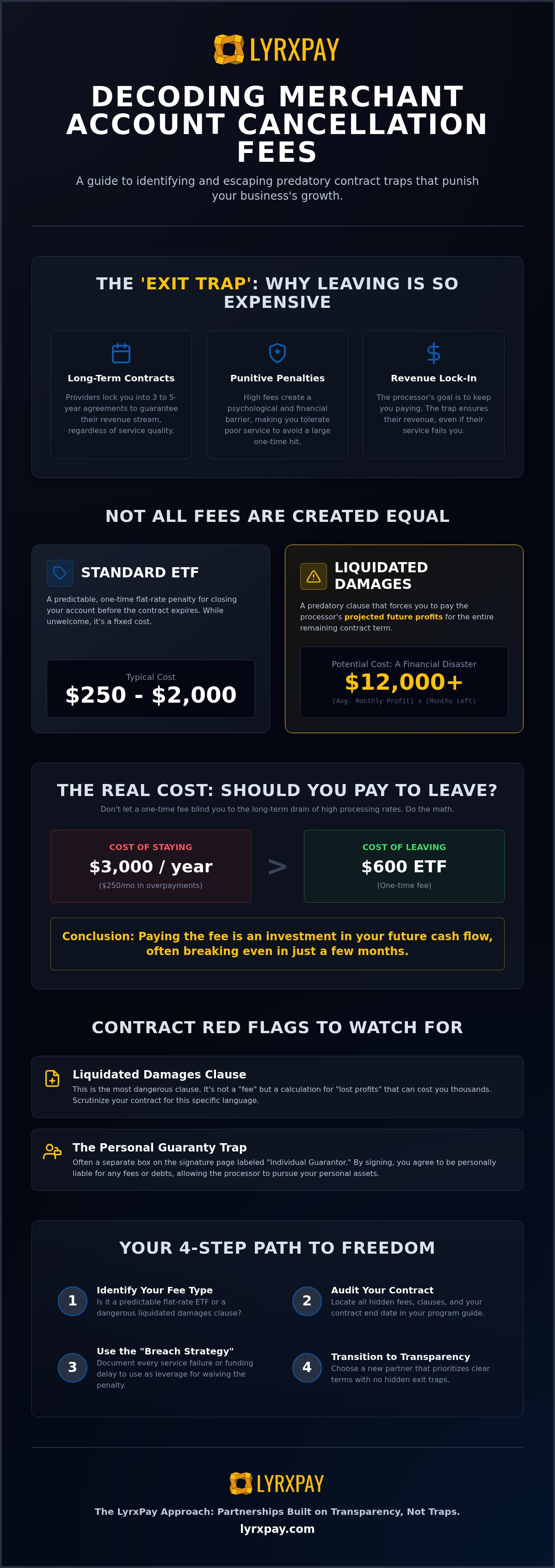
It is vital to distinguish merchant account cancellation fees from simple closing fees. A closing fee is usually a small, administrative charge, often under $100, to cover final paperwork. An ETF is a punitive measure. Depending on your contract, these penalties can range from a flat $500 to upwards of $2,000. When these fees hit your ledger unexpectedly, they disrupt your business liquidity and can force you to delay payroll or inventory purchases. Why should you pay a penalty for simply wanting better service?
Why Processors Use the "Exit Trap"
Processors argue that these fees are necessary to recoup the initial costs of setting up your account, such as hardware subsidies or underwriting labor. In reality, these "exit traps" serve a much simpler purpose: they keep you locked into high rates. By favoring 3 to 5 year contracts, providers ensure a steady stream of revenue even if their service quality declines. If the cost of leaving is high enough, many merchants will simply tolerate poor service rather than take the financial hit. It's a psychological barrier designed to make a better deal feel out of reach.
The Real Cost: ETFs vs. Long-Term Overpayment
Don't let a one-time penalty blind you to the long-term drain of high processing rates. If you're overpaying by just $250 every month, staying with your current provider for another year costs you $3,000. In this scenario, paying a $600 cancellation fee is actually the more profitable move. Utilizing business liquidity management tools helps you see the bigger picture of processing costs by comparing immediate exit hits against future savings. If the math shows a break-even point within four to six months, the "sting" of leaving is actually an investment in your future cash flow. You'll often find that staying with a predatory provider costs significantly more than the exit fee itself within a single fiscal quarter.
Decoding the Fine Print: Common Types of Termination Penalties
Not all merchant account cancellation fees carry the same weight. Some are simple administrative hurdles; others are designed to be total financial roadblocks. The most straightforward version is the flat-rate Early Termination Fee. These typically range from $250 to $500. They are predictable, even if they're unwelcome. However, the industry has seen a rise in more complex penalties that can turn a standard exit into a fiscal disaster. Understanding these variations is the first step toward reclaiming your independence.
Understanding Liquidated Damages Clauses
If your contract includes a liquidated damages clause, you aren't just paying a fee; you're paying for the processor's future vacations. The formula is often calculated by taking your average monthly profit for the processor and multiplying it by the number of months left in your contract. For example, if a processor makes $400 a month from your account and you have 30 months left, your exit fee could skyrocket to $12,000. These are notoriously difficult to fight because you technically agreed to "make the provider whole" upon signing. Recent regulatory guidance on cancellation has begun to target these types of deceptive, high-cost barriers, but many B2B contracts still slip through the cracks. If you're worried about these hidden monsters, we can help you analyze your current agreement to see what you're truly up against.
The Personal Guaranty Trap
Why would a processor care if your business goes under? They don't, as long as they have your personal guaranty. This is a specific block on the signature page, often labeled "Individual Guarantor," that links your personal assets to the business contract. If your company refuses to pay an exit fee, the processor can legally pursue your personal bank accounts or property to settle the debt. Many owners sign these documents in a hurry without realizing they've bypassed the "corporate veil" that usually protects them. You should always look for opportunities to sign as an "Authorized Representative" of the entity rather than as an individual to keep your personal finances safe.
Finally, don't overlook equipment return fees. If you use proprietary hardware, the provider may charge "restocking" or "refurbishment" fees that add several hundred dollars to your final bill. These small "gotchas" often act as secondary merchant account cancellation fees, ensuring that even if you escape the big penalties, the processor still gets one last bite of your revenue.
The Contract Audit: Identifying Red Flags Before You Cancel
Before you pick up the phone to cancel, you need to arm yourself with facts. Most providers won't volunteer the specific details of your exit costs; you have to dig them out yourself. This process starts by gathering two critical documents: your Merchant Service Agreement (MSA) and the often-overlooked Program Guide. While the "Merchant Service Agreement" is the legally binding framework for your processing relationship, the Program Guide is where the most aggressive merchant account cancellation fees are usually buried in fine print. If you don't have these on hand, request them from your representative immediately.
Keywords to Look For in Your MSA
Open your digital contract and use the search function to map out your exit strategy. You aren't just looking for dollar signs; you're looking for the logic that governs your departure. Focus your search on these specific phrases:
- "Early Termination" or "ETF": This confirms the flat-rate penalty for leaving.
- "Exclusive Provider": This clause may prevent you from running a second processor in parallel to test the waters.
- "Survival of Obligations": This indicates which terms, such as indemnity or fee disputes, stay active even after the account is closed.
- "Auto-Renewal": This is the most common trap. Many contracts lock you into a new 12 or 24 month term if you don't provide written notice within a specific window, often 30 to 90 days before the anniversary date.
Does your contract say it's month-to-month? Check the "Term" section anyway. Many "no-contract" offers actually have a hidden "initial term" of three years that must be completed before the month-to-month status actually kicks in.
Performing a DIY Merchant Statement Fee Audit
Your monthly statement is a living record of your contract's health. It often contains clues that your processor has already breached their own agreement. Performing a merchant statement fee audit helps you identify hidden costs before they become massive exit penalties. Look for sudden rate hikes or new "PCI Non-Compliance" fees that appeared without a clear explanation.
In 2026, with the strict enforcement of PCI DSS 4.0, some processors have added "junk fees" ranging from 0.10% to 0.50% of your total volume under the guise of security. If your processor has raised your rates without the contractually required notice period, they may have triggered a "Material Change" clause. This is your golden ticket. A material change often allows you to terminate the agreement and bypass merchant account cancellation fees entirely because the provider changed the deal without your consent. Spotting these discrepancies proves your current processor isn't acting in your best interest and gives you the leverage needed to walk away clean.
Strategic Exit: 5 Steps to Negotiate or Waive Your Cancellation Fees
You have identified the traps. Now, you need a tactical plan to dismantle them. Negotiating merchant account cancellation fees requires a shift in mindset; you are no longer a customer to be served, but a revenue source they are trying to retain. By following a structured exit strategy, you can often reduce or entirely eliminate the cost of switching. Start by documenting every service failure, from technical downtime to unauthorized rate hikes. This "Breach Strategy" builds a case that the provider failed to uphold their end of the bargain first.
- Leverage the "Material Change" clause: Most contracts allow you to leave if the processor changes the terms, such as increasing fees.
- Clean Equipment Return: Offer to return all proprietary hardware immediately and in perfect condition in exchange for a signed fee waiver.
- Explore Switching Incentives: Ask a transparent partner like LyrxPay about "buyout" credits that can offset the cost of your current exit penalty.
- Formalize the Departure: Never rely on a phone call. Send a formal "Notice of Non-Renewal" via certified mail to start the legal clock.
The "Material Change" Loophole
This is often the most effective way to bypass merchant account cancellation fees. When a processor sends a 30 day notice of a rate increase, they are technically altering your original agreement. This creates a small window where you can terminate the contract without penalty. You must act quickly and draft a letter stating: "Since you have altered the terms of our agreement via the rate increase on [Date], I am exercising my right to terminate without penalty." If you miss the specific timeframe mentioned in your fine print, you lose this leverage, so monitor your statements closely for any price adjustments.
Negotiating with the Retention Department
The first person who answers your call is trained to say no. You must ask to speak with the "Retention" or "Merchant Relations" department. These representatives have the actual authority to waive fees, but their goal is to keep you at any cost. Stay firm in your objective. Use phrases like, "I am not looking for a lower rate; I am looking for a confirmed termination date." If they try to offer a discount, show them competitive quotes for cc processing to prove that even their "new" rate is still a bad deal. If you want a partner that skips the games and focuses on your growth, schedule a cost savings audit with our team today.
Moving Toward Transparency: The LyrxPay Approach to Merchant Partnerships
Leaving a predatory contract is only half the battle. The other half is finding a partner that won't lead you back into the same cage. At LyrxPay, we believe that if a processor has to lock you into a multi-year contract with massive merchant account cancellation fees, they probably aren't confident in the value they provide. Our philosophy is simple: we earn your business every single month. By removing the "exit trap" entirely, we shift the focus from legal enforcement to operational excellence. If you aren't happy, you should have the freedom to move without a financial penalty hanging over your head.
Transitioning to a new provider often brings up fears about cash flow. We solve this by providing next-day deposits as a standard feature for improved liquidity. While traditional "exit trap" providers might hold your funds for three to five business days, we prioritize your access to capital. This ensures that the transition doesn't just lower your fees; it actually improves your day-to-day cash position. Our "concierge" switch service handles the heavy lifting of the transition, helping you audit your current statement and plan a move that avoids double-billing or service gaps.
Beyond Processing: Integrated Bookkeeping and Payroll
A merchant account shouldn't exist on a digital island. When your processing is disconnected from your accounting software, you're forced into hours of manual data entry and reconciliation. By choosing all in one business financial solutions, you eliminate the friction between making a sale and seeing it on your P&L. We specialize in expert QuickBooks and Xero integration, ensuring that every transaction flows directly into your books with real-time accuracy. When you bring your payroll and credit card processing under one roof, you reduce administrative headaches and gain a holistic view of your business health.
Ready to Stop Overpaying?
You don't have to guess whether you're getting a fair deal. We offer a comprehensive statement audit to identify exactly where your current provider is hiding their margin. If we find that you're trapped by predatory merchant account cancellation fees, we will help you map out the most cost-effective exit strategy. Our goal is to provide a clear, transparent path toward lower fees and a long-term professional relationship built on integrity rather than fine print. Don't let another month of overpayment drain your resources. Audit your statement with LyrxPay today and take the first step toward a partnership that actually defends your bottom line.
RECLAIM YOUR FINANCIAL FREEDOM
Breaking free from a predatory processor is more than just a cost-saving measure; it is a vital step toward reclaiming your operational independence. You now have the tools to audit your Merchant Service Agreement, identify the "monster" of liquidated damages, and leverage material changes to protect your bottom line. Understanding the mechanics of merchant account cancellation fees ensures that you never have to tolerate poor service simply because the exit cost feels too high. If your current provider relies on legal traps to keep your business, it's time to move toward a more transparent partnership.
We are here to help you navigate this transition with total clarity. By choosing a partner that offers next-day deposits and seamless QuickBooks or Xero integration, you improve your liquidity and eliminate administrative friction. We don't believe in predatory long-term lock-in contracts; we believe in earning your business every month through expert care and lower transaction costs. Take the first step toward a cleaner financial future today. Get a Free Statement Audit and Stop Overpaying. You've done the heavy lifting by educating yourself; now let us handle the transition so you can focus on your craft.
Frequently Asked Questions
Can I cancel my merchant account if I close my business?
Closing your business doesn't always release you from your contract obligations. Most providers still expect you to pay the early termination fee unless your agreement contains a specific business failure or death and disability clause. You should review the Term and Termination section of your Merchant Service Agreement to see if these exceptions apply. If they don't, you might still be liable for the remaining balance even after your doors close.
How much is a typical early termination fee for a merchant account?
Typical flat-rate penalties usually fall between $250 and $500 in 2026. However, if your contract includes a liquidated damages clause, the cost could be significantly higher. These formulas multiply the processor's average monthly profit by the number of months left in your term. It's vital to identify which type of fee you have before you send a cancellation notice to avoid a massive surprise on your final statement.
What happens if I just close the bank account linked to my processor?
Closing your bank account is a risky move that won't stop the processor's collection efforts. They will likely attempt to draft the funds several times before sending the unpaid balance to a collections agency. Since most contracts include a personal guaranty, you could face individual legal action or damage to your personal credit score. It's always better to negotiate a waiver or a settlement than to simply cut off access to your funds.
Is a "Liquidated Damages" clause legally binding in all states?
Liquidated damages clauses are generally legal and enforceable across most states. Courts usually uphold them if the amount is a reasonable estimate of the processor's lost profits rather than a purely punitive charge. Specific state laws and recent regulatory shifts may offer some protection if the fees are deemed excessive. You may need a professional contract review to challenge a particularly aggressive five-figure penalty if the math seems unfair.
Can my new processor pay my old cancellation fee for me?
Many modern providers offer buyout incentives to help you switch. While they rarely pay the old processor directly, they often provide a credit to your new account that offsets the merchant account cancellation fees you had to pay. You typically need to provide a final statement from your previous provider showing the paid penalty to qualify for this reimbursement. This makes the transition much easier on your business liquidity.
How much notice do I need to give to avoid an auto-renewal?
You usually need to provide written notice between 30 and 90 days before your contract expires. If you miss this window of opportunity, the agreement often triggers an auto-renewal clause for another 12 to 24 months. We recommend setting a calendar alert six months before your contract anniversary. This gives you plenty of time to review your options and send your notice via certified mail to ensure it's received.
Will canceling my merchant account hurt my business credit score?
Canceling an account in good standing has no negative impact on your credit. Problems only arise if you leave an unpaid balance or refuse to pay the merchant account cancellation fees stipulated in your contract. If the provider reports a default to the credit bureaus, it can affect your ability to secure future business loans or equipment leases. Paying your final fees on time is the best way to protect your financial reputation.
What is the difference between a cancellation fee and a restocking fee for POS equipment?
These are two distinct charges that often appear on a final bill. A cancellation fee is a penalty for ending the service agreement before the term is up. A restocking fee is an administrative charge for returning proprietary hardware like card readers or terminals. These hardware fees are usually charged per item and cover the cost of refurbishing the equipment. Make sure you return all gear promptly to avoid these extra costs.