
Guide to Level 3 B2B Credit Card Processing Rates

Did you know that your business might be losing up to 40% of its potential profit on every large contract to unnecessary processing fees? It is frustrating to watch your margins shrink because of opaque merchant statements and high fees on corporate card transactions. You shouldn't be penalized for landing big B2B contracts, yet processing costs exceeding 3% often feel like a tax on your success. We understand the headache of manual data entry and the stress of managing complex operational tasks while trying to grow your bottom line.
This guide explores how to qualify for Level 3 business-to-business rates to significantly reduce your interchange costs. You'll learn how providing detailed transaction data can lower your Visa rates to 1.90% plus $0.10 and help you avoid the 0.40% penalty rates introduced by the Commercial Enhanced Data Program. We'll also show you how to automate data capture to improve your cash flow and protect your margins without adding to your administrative workload. By the end of this article, you'll have a clear path to reclaiming your revenue and simplifying your B2B payments.
Key Takeaways
- Understand how providing high-tier transaction data triggers lower interchange costs from major card networks.
- Learn the specific line-item requirements needed to secure Level 3 business-to-business rates and avoid costly transaction downgrades.
- Calculate your savings potential, such as reducing the effective rate on a $10,000 corporate card transaction by 1.00% or more.
- Discover how modern payment gateways eliminate manual data entry by automatically populating the complex fields required for compliance.
- See how a proactive partner can audit your merchant account to reclaim lost margins and optimize every B2B transaction.
What Are Level 3 Business-to-Business Rates?
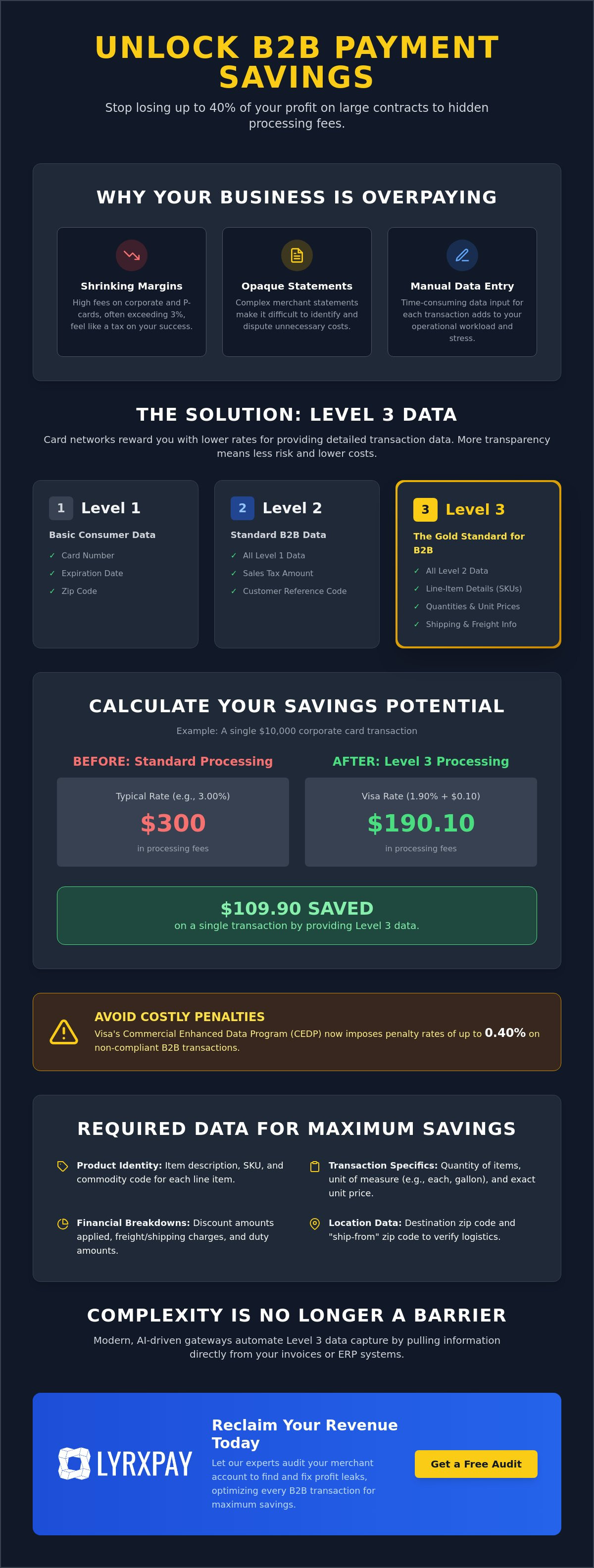
Think of Level 3 processing as a reward for transparency. When you sell to another business or a government agency, the card networks want to see exactly what is being purchased. Level 3 business-to-business rates represent the lowest possible interchange costs available for commercial transactions. These rates aren't a special discount you have to negotiate with your bank; they are a standardized incentive from Visa and Mastercard for providing detailed line-item data. By sharing more information about the sale, you reduce the perceived risk of fraud and disputes, which allows the networks to lower their fees.
Why do these rates matter so much for your bottom line? Most B2B buyers use corporate purchasing cards (P-cards) or business credit cards. These cards carry higher base costs than the debit card used at a local grocery store. At the core of every transaction is the Interchange fee, which is the non-negotiable price set by the card brands. If you process a high-ticket B2B transaction without providing Level 3 data, you're essentially paying a "laziness tax" that can eat up to 1% or more of your total contract value. For a business handling six-figure contracts, this isn't just a minor fee; it's a significant drain on your annual profit.
The Three Tiers of Interchange Data
The card networks categorize transactions into three distinct levels based on how much data you provide at the point of sale. Each level acts as a step toward better margins:
- Level 1: This is the standard for consumer transactions. It requires basic info like the card number, expiration date, and zip code.
- Level 2: This tier is for business cards and requires additional fields like the sales tax amount and a customer reference code.
- Level 3: This is the gold standard for B2B. It requires comprehensive line-item details including SKUs, item descriptions, quantities, and unit prices.
Why 2026 is the Year for B2B Optimization
The push for efficiency has never been more urgent. As of June 2026, interchange costs continue to fluctuate, and programs like Visa's Commercial Enhanced Data Program (CEDP) now impose penalty rates of up to 0.40% on non-compliant B2B transactions. You can't afford to ignore these costs anymore. Fortunately, the complexity that once made Level 3 processing a chore has vanished. Modern, AI-driven payment gateways now automate the capture of Level 3 business-to-business rates by pulling data directly from your invoices or ERP systems. This shift toward digital procurement means your customers expect professional, detailed reporting, and your business deserves the savings that come with it.
The Mechanics of Level 3 Data: How Line-Item Detail Slashes Costs
Achieving Level 3 business-to-business rates isn't just about checking a box; it's about providing a digital receipt that the card networks can audit. While a standard consumer transaction only requires the total amount and a zip code, commercial transactions demand a much deeper look into the shopping cart. This transparency is exactly what allows Visa and Mastercard to offer lower rates. They view these detailed transactions as lower risk because the line-item data makes fraud significantly harder to hide.
Your Merchant Category Code (MCC) plays a vital role in this process. This four-digit number tells the card networks what industry you operate in. If your MCC isn't classified as a B2B or B2G provider, you might find yourself locked out of these lower rates entirely. For those who do qualify, the data requirements are strict. These details are essential because large organizations and government purchase cards rely on this granular reporting to track internal spending and reconcile budgets. If you're unsure if your current setup is optimized for your specific MCC, a quick audit of your merchant account can reveal exactly where your profits are leaking.
Required Level 3 Data Fields
To secure the best rates, your payment gateway must transmit several specific pieces of information. It's no longer enough to just send the total. You need to include:
- Product Identity: Item description, SKU, and a specific commodity code for each line item.
- Transaction Specifics: The quantity of items, the unit of measure (e.g., each, gallon, hour), and the exact unit price.
- Financial Breakdowns: Any discount amounts applied, freight or shipping charges, and duty amounts for international sales.
- Location Data: The destination zip code and the "ship-from" zip code to verify the logistics of the sale.
The Downgrade Trap: Avoiding Higher Fees
The most frustrating part of B2B processing is the "downgrade." This happens when your system attempts to process a commercial card but fails to provide even one of the required Level 3 fields. When this occurs, the transaction defaults to Level 1 rates. The financial sting is immediate. According to 2026 data, a qualified Visa Level 3 transaction might cost 1.90% plus $0.10, while a downgraded transaction could jump to 2.95% plus $0.10. That 1.05% difference on a $20,000 order is $210 gone in an instant.
Many businesses fall into this trap because they use outdated POS systems or generic gateways that aren't built for Level 3 business-to-business rates. If your software doesn't have the "buckets" to hold this extra data, it simply won't be sent. This creates a hidden drain on your margins that often goes unnoticed on complex monthly statements. Protecting your profit requires a system that doesn't just accept cards, but actively manages the data behind them. It's about ensuring every transaction has the best possible chance to qualify for the lowest tier of fees.
Level 1 vs. Level 2 vs. Level 3: Calculating the Savings Potential
Numbers don't lie, but they often hide in the fine print of your monthly statements. When you look at the cost of accepting payments, the difference between the three tiers of data is stark. Level 1 is the most expensive because it provides the least security for the bank. Level 2 offers a slight reprieve. But it's Level 3 that truly transforms your margins. For most commercial transactions, the gap between these levels is significant, often creating a spread of 100 to 150 basis points. These savings aren't just theoretical; they represent capital you can reinvest into your team or your inventory.
| Data Level | Typical Interchange Rate | Required Information |
|---|---|---|
| Level 1 | 2.70% - 2.95% | Basic Card & Zip Code |
| Level 2 | 2.05% - 2.20% | Tax Amount & Customer Code |
| Level 3 | 1.75% - 1.90% | Full Line-Item Detail |
The Real-World Impact on Your Bottom Line
Let's look at a single $10,000 transaction. On a standard corporate card without enhanced data, you might pay a 2.95% interchange rate, totaling $295. By qualifying for Level 3 business-to-business rates, that same transaction could drop to 1.95% or lower. That's a $100 saving on just one sale. If your business processes $5 million in commercial cards annually, moving from Level 1 to Level 3 could save you $50,000 every single year. This isn't a small adjustment; it's a fundamental shift in your profitability. Optimizing these tiers is the most effective way to lower merchant fees and protect your hard-earned revenue from unnecessary network costs.
Who Benefits Most from Level 3 Rates?
While any business accepting corporate cards can save money, certain industries see a much higher return on investment for data optimization. If you deal with high-ticket orders or recurring contracts, the cumulative effect of Level 3 business-to-business rates is transformative. The primary beneficiaries include:
- Wholesalers and Manufacturers: High-volume suppliers who often deal with tight margins and large-scale procurement orders.
- Professional Service Firms: Law firms, marketing agencies, and consultancies that bill corporate clients for project-based work.
- Government Contractors: Any business selling to federal or local agencies, as government purchase cards almost always require Level 3 data for reconciliation.
- Industrial and Medical Suppliers: Companies providing specialized equipment where single transactions can easily exceed five figures.
If you fall into these categories, you're likely paying more than you should. It's time to stop letting these fees erode your growth and start treating your payment processing as a strategic asset rather than a fixed expense.
Overcoming the Complexity of B2B Payment Optimization
If you've ever looked at the list of data fields required for Level 3 qualification and felt a sense of dread, you aren't alone. Many business owners believe that capturing Level 3 business-to-business rates requires a dedicated staff member to manually type in SKUs and commodity codes for every invoice. This is a myth that keeps many companies stuck paying higher fees than necessary. The reality is that technology has caught up with the requirements of the card networks. You don't need to change your workflow; you just need to update your tools.
Modern payment gateways are designed to do the heavy lifting for you. By leveraging intelligent "auto-fill" features, these systems can identify a commercial card the moment it's entered. Once the card is recognized, the gateway pulls the necessary line-item detail from your existing database to satisfy Visa and Mastercard's requirements. This level of automation is a cornerstone of all-in-one business financial solutions. Instead of fighting with your software, you can focus on your craft while the system ensures you're always qualifying for the lowest possible interchange tier.
Automation via QuickBooks Integration
We've found that the biggest hurdle for most businesses is the gap between their accounting software and their merchant account. LyrxPay solves this by pulling line-item data directly from your QuickBooks invoices. When you process a payment, the system automatically maps your item descriptions, quantities, and unit prices to the transaction record. This eliminates manual entry entirely while maintaining full compliance for Level 3 business-to-business rates. You get the benefit of real-time reconciliation, meaning your books and your bank account stay in perfect sync without any extra effort from your bookkeeping team.
Selecting the Right B2B Merchant Gateway
Choosing a gateway is about more than just security. It's about finding a partner that understands the nuances of B2B commerce. You need a virtual terminal that supports Level 3 data fields natively rather than trying to "bolt them on" as an afterthought. Look for features like PCI-compliant tokenization, which allows you to store corporate card data securely for future orders without increasing your liability. The right gateway shouldn't just process payments; it should act as a filter that catches potential downgrades before they happen. If you're ready to stop guessing and start saving, you can request a free audit of your current B2B processing setup to see exactly how much revenue you're leaving on the table.
Integrating these systems might feel like a technical hurdle, but it's often a simple "plug-and-play" process with the right support. We handle the configuration of your ERP and accounting links so that the transition is seamless. You'll see the impact on your very first statement through reduced fees and simplified reporting. It's about moving from a state of administrative stress to one of operational clarity.
Optimizing Your B2B Merchant Account with LyrxPay
LyrxPay isn't just another processor; we're your dedicated partner in reclaiming lost revenue. We act as a concierge for your payment strategy, taking the heavy lifting off your plate so you can focus on running your business. While other providers might leave you to figure out the complexities of interchange tiers on your own, we take a proactive approach. We don't just set up your account and walk away. We continuously monitor your transactions to ensure you're consistently hitting those Level 3 business-to-business rates. This managed care approach means we're constantly looking for ways to protect your margins from fee creep and network changes.
Cash flow is the lifeblood of any B2B operation. When you combine the savings from optimized interchange with our next-day deposits, the impact on your operational health is immediate. Improving your business liquidity management allows you to pay vendors faster, invest in new equipment, or simply rest easy knowing your money is where it belongs: in your bank account. Our transparent model ensures you always know what you're paying and why, with no hidden markups or "junk" fees to cloud your vision. We believe in advocacy, positioning ourselves as defenders of your time and resources.
The LyrxPay B2B Advantage
We've built our reputation on straightforward service and technical excellence. Our proprietary technology is specifically engineered to bridge the gap between your sales and your accounting. We offer:
- Automated Data Capture: Our systems recognize commercial cards and populate the required line-item data without manual intervention.
- Dedicated Support: You'll have access to a Texas-based team that understands the unique needs of national B2B accounts.
- Wholesale Pricing: We believe in transparency, which is why we offer wholesale rates combined with expert optimization to keep your costs as low as possible.
Get Started with a B2B Fee Audit
If you're tired of opaque statements and high processing costs, the first step is clarity. We provide a comprehensive analysis of your current merchant statements to identify exactly where you're missing out on Level 3 business-to-business rates. Our team looks for "downgrade" patterns and technical errors that are costing you money every month. The onboarding process is simple and designed to minimize disruption to your daily operations. We handle the integration with your existing QuickBooks or bookkeeping workflows, ensuring a seamless transition to a more profitable payment environment. Don't let another month of profit slip away to unnecessary fees. Request your free B2B fee audit from LyrxPay today and see the difference that a true partnership can make for your bottom line.
RECLAIM YOUR MARGINS AND SIMPLIFY YOUR GROWTH
High-ticket B2B contracts shouldn't come with a 3% penalty on your hard-earned revenue. By leveraging Level 3 business-to-business rates, you're taking a proactive step to protect your bottom line from unnecessary network fees. You've seen how providing line-item detail transforms your interchange costs, and you now know that modern automation makes this compliance effortless. It's about moving from administrative stress to operational clarity.
It's time to stop the manual data entry and start focusing on your business. With expert QuickBooks and Xero integration, we handle the technical heavy lifting so you don't have to. You'll benefit from next-day deposits that fuel your liquidity and a Texas-based team that acts as your advocate in a complex financial landscape. We're ready to show you exactly where your margins are leaking and how to fix them for good.
Stop overpaying for B2B transactions—get a LyrxPay audit today. We look forward to helping you turn your payment processing into a strategic advantage for your company's future.
Frequently Asked Questions
What is the difference between Level 2 and Level 3 processing?
Level 3 processing requires full line-item details like SKUs and unit prices, while Level 2 only requires the sales tax amount and a customer reference code. This extra transparency provides the card networks with a clear view of what was purchased. While Level 2 offers some savings, Level 3 is the highest tier of data and provides the most significant reduction in interchange fees for commercial transactions.
Do I need a special merchant account to qualify for Level 3 rates?
You don't need a different type of merchant account, but your payment gateway must be capable of transmitting enhanced data. Many standard terminals aren't built to handle the complex fields required for Level 3 business-to-business rates. We help you configure your existing setup or provide hardware that automates this process so you don't have to manually enter data for every sale.
How much can I actually save with Level 3 business-to-business rates?
You can save as much as 1.50% per transaction by qualifying for Level 3 business-to-business rates. For example, a corporate card transaction that usually costs 2.95% plus $0.10 can drop to 1.95% plus $0.10 when you provide the correct data. On large B2B contracts, these savings can represent thousands of dollars in reclaimed profit every single month for your business.
Which credit cards qualify for Level 3 processing data?
Corporate, business, and purchasing cards (P-cards) are the primary card types that qualify for Level 3 processing. Standard consumer credit cards, like those used for personal shopping, don't have these data tiers and won't see a rate reduction from extra information. This is why Level 3 optimization is specifically targeted at wholesalers, manufacturers, and professional service firms that deal with other organizations.
Is Level 3 data required for consumer credit card transactions?
No, Level 3 data is not required or beneficial for consumer credit card transactions. Card networks like Visa and Mastercard only offer these incentives for commercial and government spending. Adding extra data to a personal card transaction won't lower your fees, so it's best to focus your optimization efforts on your business-to-business and business-to-government sales where the savings are actually available.
How does QuickBooks integration help with Level 3 B2B rates?
QuickBooks integration helps by automatically pulling line-item data from your invoices and sending it directly to the payment gateway. Instead of typing in SKUs and quantities for every payment, the system maps these fields to the transaction record for you. This ensures you consistently qualify for the lowest rates without adding any extra steps to your daily administrative or bookkeeping workflow.
Can I qualify for Level 3 rates on a mobile POS system?
Yes, you can qualify on a mobile POS if the software is specifically designed to capture or auto-fill enhanced data fields. Most basic mobile swipers aren't equipped for this level of detail. If your team processes large B2B orders in the field, you'll need a professional-grade mobile solution that can sync with your back-office data to ensure every transaction qualifies for the best rates.
Why do Visa and Mastercard offer lower rates for Level 3 data?
Card networks offer lower rates because the extra data reduces the risk of fraud and makes reconciliation easier for corporate buyers. When a corporation can see exactly what was purchased, they are less likely to dispute the charge or file a chargeback. This transparency makes the transaction safer in the eyes of the bank, which passes those savings on to you through lower interchange costs.