
How to Audit Credit Card Processing Statements & Save

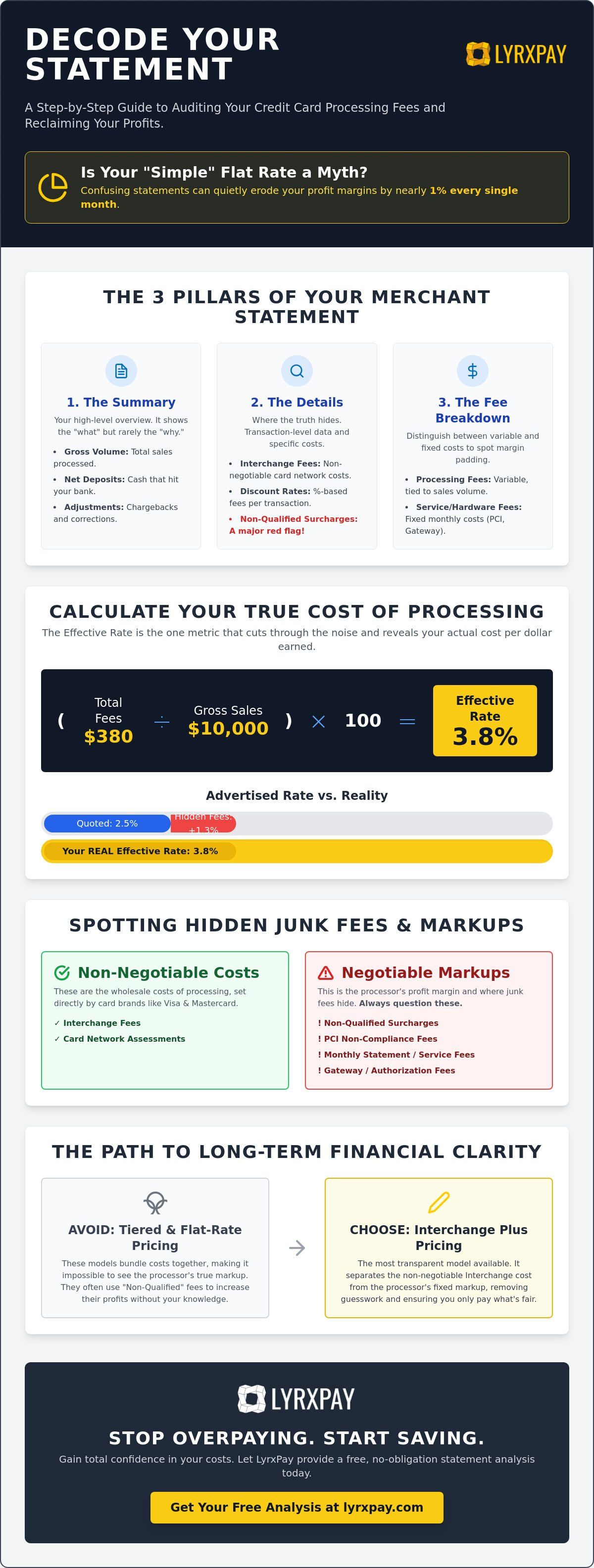
What if the "simple" flat rate you signed up for is actually quietly eroding your profit margins by nearly 1% every single month? You shouldn't need a finance degree just to understand where your hard-earned money is going. We know how frustrating it is to stare at a wall of jargon and confusing numbers while trying to reconcile your books. Between the varying formats across processors and the constant stream of new fees, like the June 2026 Visa Digital Commerce Service updates, keeping track of your true costs feels like an uphill battle.
The good news is that you don't have to be a victim of complex billing. This guide will show you exactly how to audit credit card processing statements to strip away the mystery and reclaim your margins. You'll learn how to calculate your true effective rate, identify sneaky junk fees instantly, and create a streamlined process that fits perfectly into your bookkeeping workflow. We'll break down the latest industry changes so you can move from a state of curiosity to a state of total confidence. Let's turn that confusion into clarity and put your resources back where they belong.
Key Takeaways
- Simplify your monthly review by focusing on the three core pillars of every merchant statement: the summary, deposit details, and the fee breakdown.
- Master how to audit credit card processing statements by calculating your "Effective Rate" to reveal exactly what you are paying per dollar earned.
- Protect your margins by learning to distinguish between non-negotiable interchange costs and the negotiable markups where hidden fees often hide.
- Eliminate manual data entry and accounting errors by reconciling your processing fees directly with bookkeeping software like QuickBooks or Xero.
- Gain long-term financial clarity by moving toward a transparent Interchange Plus pricing model that removes the guesswork from your processing costs.
Understanding the Anatomy of Your Merchant Statement
Your merchant statement is more than just a bill; it's a monthly report card detailing every transaction your business processed and exactly what it cost you to accept those payments. At its core, this document tracks the flow of money from your customers' bank accounts to your own. However, if you've ever felt like you needed a decoder ring to make sense of the pages, you aren't alone. Many processors intentionally use dense layouts and inconsistent terminology to obscure high-margin markups. They know that if the data is hard to read, you're less likely to question the costs. Learning how to audit credit card processing statements begins with peeling back these layers to see the truth behind the numbers.
To master your audit, you must distinguish between two primary types of costs. First, there are processing fees, which are the variable costs tied directly to your transaction volume. Second, you'll find service and hardware fees. These are typically fixed monthly costs for things like PCI compliance, gateway access, or equipment leases. While processing fees fluctuate with your sales, service fees should remain predictable. If these "fixed" costs start creeping up without explanation, it's a clear signal that your provider is padding their margins at your expense.
The Summary Section: Your High-Level Overview
Most statements lead with a summary section designed to give you a quick glance at your monthly activity. Here, you'll find your total gross volume, which is the total amount of sales you ran. You'll also see your net deposits, the actual cash that hit your bank account after fees were stripped away. It's vital to look for the "Chargebacks and Adjustments" line item here. This represents disputed transactions or corrected errors that can quietly drain your revenue. Don't let a clean-looking summary fool you. While it shows you the "what," it rarely explains the "why" behind your total costs. Relying solely on this page is the fastest way to miss hidden fee hikes.
The Detail Section: Where the Truth Hides
The detail section is where the real work happens. This area breaks down transaction-level data and batch headers, showing you the specific cost for every card type you accepted. You'll see a mix of percentage-based discount rates and flat per-transaction fees. A major component of these costs involves Understanding interchange fees, which are the non-negotiable rates set by card networks like Visa and Mastercard.
When you know how to audit credit card processing statements, you'll specifically look for "Non-Qualified" surcharges in this section. These are extra penalties applied when a transaction doesn't meet specific security or data requirements. If your detail section is littered with these surcharges, it usually means your point-of-sale system isn't optimized or your processor is using a "Tiered" pricing model to hide their true markup. Identifying these flags is the first step toward reclaiming your business margins and ensuring you only pay what's fair.
Calculating the Effective Rate: Your True Cost of Processing
Your effective rate is the single most important number on your statement. While your processor might highlight a low teaser rate on the front page, this one metric tells you the actual percentage of every dollar you processed that went toward fees. It's the "truth" metric that cuts through the noise of complicated billing structures. If you want to know how to audit credit card processing statements effectively, you must start here. Comparing this rate month-over-month is the best way to spot "fee creep," where small, unexplained charges begin to erode your profits over time.
To find this number, you only need one universal formula. Take your total fees (every single charge, including monthly subscriptions and PCI fees) and divide them by your total gross sales. Multiply that result by 100 to get your percentage. This Guide to credit card processing fees explains why including every line item is crucial for an accurate audit. If you only look at the transaction fees and ignore the "statement fees" or "gateway costs," you're not getting the full picture of your operational health.
Step-by-Step Calculation Example
Let's look at a hypothetical $10,000 sales month. Imagine your processor quotes a 2.5% rate, but after you add up the batch fees, monthly service charges, and a $30 PCI non-compliance penalty, your total fees hit $380. Even though you were promised a 2.5% rate, your math looks like this:
- ($380 Total Fees / $10,000 Gross Sales) x 100 = 3.8% Effective Rate
That 1.3% difference might seem small, but on $10,000, it's $130 of profit you didn't expect to lose. Working with a transparent processing partner can help you identify where these gaps are coming from so you can keep your numbers in check.
Why One Rate Doesn’t Fit All
It's vital to set realistic benchmarks based on how you do business. Industry data shows that retail businesses typically see an effective rate between 1.8% and 2.5%, while ecommerce merchants often pay between 2.9% and 3.5% due to the higher risk of card-not-present (CNP) transactions. Your rate will also shift if you accept many corporate or high-rewards cards, as these carry higher base costs. When you learn how to audit credit card processing statements, you'll see that your "mix" of cards matters just as much as the rate you negotiated. If your rate is consistently higher than these industry averages, it's time to dig deeper into the specific markups being applied to your account.
Identifying Hidden Junk Fees and Markup Padding
When you sit down to learn how to audit credit card processing statements, the most critical distinction you'll make is between non-negotiable costs and negotiable markups. Interchange fees and assessment fees are set by the card networks and banks; they are the "wholesale" cost of doing business. Everything else on your statement is a markup added by your processor. This is where the profit lives for them, and where the savings live for you. If you don't know which fees are set in stone, you can't effectively negotiate for a better deal.
One of the most common avoidable penalties is the PCI Non-Compliance Fee. This charge often ranges from $20 to $100 per month and is essentially a "fine" for not completing your annual security questionnaire. It provides zero value to your business. While the Regulation of credit card penalty fees often focuses on consumer protections, business owners must be equally vigilant about these recurring penalties. Similarly, "Statement Fees" and "Batch Header Fees" are often remnants of legacy billing. In a modern partnership, these should be bundled into your standard markup or waived entirely. If you see these as separate line items, it's a sign your processor is nickel-and-diming your account.
Red Flags in Your Fee Breakdown
Watch out for "Interchange Padding." This is a subtle tactic where a processor claims to offer Interchange Plus pricing but adds a few basis points to the actual wholesale rates. To spot this, you must compare the rates on your statement against the publicly available schedules from Visa and Mastercard. Other red flags include "Regulatory Product Fees" or "Annual Fees." These are often just pure profit for the processor disguised as official requirements. If your statement uses "Tiered Pricing" (Qualified, Mid-Qualified, and Non-Qualified), you're likely overpaying. This structure allows processors to bucket your transactions into higher-cost tiers at their own discretion, making it nearly impossible to track your true costs.
Negotiating with Your Current Provider
Once you've identified these markups, use your audit findings as leverage. Call your representative and ask specifically about your "basis point" markup over interchange. Use clear, direct logic: "I noticed we're being charged for PCI non-compliance and a monthly statement fee; can we waive these and move to a transparent Interchange Plus model?" A provider that values a long-term professional relationship will be willing to simplify your billing. However, if they hide behind complex terminology or refuse to remove junk fees, it's a clear signal to start looking for a more transparent ally. Knowing how to audit credit card processing statements gives you the confidence to walk away from a bad deal and secure the margins your business deserves.
Bridging the Gap: Reconciling Statements with Your Bookkeeping
Auditing your fees is only half the battle. If those numbers don't sync perfectly with your accounting software, you're still flying blind. Many business owners treat their merchant statement as a separate island, but it's actually a core component of your financial truth. When you understand how to audit credit card processing statements from an accounting perspective, you stop seeing fees as a vague expense and start seeing them as a line item that must be reconciled. Manual entry is the enemy here. It leads to transposition errors, missed fees, and hours of wasted time during your month-end close.
The most efficient way to manage this is through direct integration with platforms like QuickBooks or Xero. By linking your processing data to your general ledger, you gain real-time visibility into your cash flow. Next-day deposits further simplify this process by ensuring that the transactions on your statement match the deposits in your bank account without the confusing lag of traditional 48-hour windows. This alignment allows you to link your merchant statements directly to your profit and loss (P&L) statement, giving you a crystal-clear view of your actual margins after every swipe.
Automating the Audit Process
Modern integrated software does the heavy lifting for you. It maps specific fee categories, like interchange and markups, directly to your Chart of Accounts. This level of detail is essential for a "Gross vs. Net" settlement reporting style. Instead of just seeing a lump sum deposit, you see the total sale and the associated fee as separate entries. This transparency drastically reduces the time your bookkeeping team spends hunting down discrepancies. If your goal is to scale, you need all in one business financial solutions that treat your processing data as an extension of your books.
The Role of Expert Accounting Support
Having a processor that understands the nuances of bookkeeping is a massive competitive advantage. It's why we focus on ensuring your ACH and credit card data sync perfectly with your existing systems. When your processor and your bookkeeper speak the same language, the "hidden" fees we discussed earlier have nowhere to hide. They're surfaced automatically in your financial reports. If your current setup feels like a disjointed mess of spreadsheets and manual entries, it might be time to upgrade to a streamlined financial workflow. When you master how to audit credit card processing statements through automation, you reclaim your time to focus on growing your craft instead of chasing pennies in a ledger.
Securing a Transparent Processing Partnership
You've done the heavy lifting. You've learned the math, identified the red flags, and uncovered the hidden markups. Now comes the most important realization: transparency shouldn't be something you have to fight for every month. It should be the baseline requirement for any merchant service provider you trust with your revenue. While some auditors claim you can simply stay with a predatory processor and negotiate, the reality is that sometimes switching is the only way to escape contracts designed to drain your margins. A true partner doesn't just process transactions; they advocate for your operational health.
The gold standard for this advocacy is the Interchange Plus pricing model. By separating the non-negotiable costs set by card networks from the processor's markup, you gain a level of clarity that tiered or flat-rate models simply can't provide. If your provider is unwilling to show you exactly what they are making on every swipe, they aren't a partner; they're a middleman. When you understand how to audit credit card processing statements, you realize that the most valuable thing a processor can offer is an honest look at your data. This foundation of integrity allows you to stop worrying about "fee creep" and start focusing on your business growth.
The LyrxPay Advantage
We believe in a concierge approach to financial services. This means moving beyond the cold, clinical feel of traditional banking toward a relationship that actually supports your daily workflow. Our focus is on removing obstacles through next-day deposits and lower transaction fees that respect your bottom line. We create synergy between your Point of Sale hardware and your back-office needs, ensuring that your payroll and bookkeeping sync effortlessly with your processing data. This isn't just about credit cards; it's about a managed care ecosystem for your business finances. By integrating directly with QuickBooks, we ensure that the audit process is essentially automated, saving your team hours of manual reconciliation every month.
Taking the Next Step
Transitioning to a transparent model doesn't have to be a disruptive event. If you're tired of guessing what your effective rate will be this month, it's time for a professional statement review. We can help you map out a path that lowers your costs while upgrading your technology suite. If you want to dive deeper into the tactics of cost reduction, check out our how to lower merchant fees guide for 2026. Mastering how to audit credit card processing statements is your first step toward financial freedom. The next step is choosing a partner who values your partnership more than a single transaction. Let's reclaim your margins together.
- Demand Interchange Plus: Never settle for "tiered" pricing that hides markups.
- Prioritize Integration: Ensure your processor speaks the same language as your bookkeeping software.
- Verify Deposit Speed: Next-day deposits should be a standard, not a luxury.
- Look for Advocacy: Choose a provider that proactively flags new industry fees, like the June 2026 Visa updates, before they hit your statement.
RECLAIM YOUR MARGINS AND SECURE YOUR FINANCIAL FUTURE
You now have the tools to transform your merchant statement from a source of confusion into a roadmap for savings. By mastering your effective rate and identifying avoidable markups like PCI non-compliance fees, you've taken control of your profit margins. Learning how to audit credit card processing statements is more than a simple cost-cutting task; it's a fundamental shift toward operational excellence and financial clarity.
We are here to act as your defender and advocate. Our Texas-based team provides the personal attention you deserve, combining national reach with a human-centric approach. With next-day deposits to boost your liquidity and expert QuickBooks or Xero integration to streamline your bookkeeping, we ensure your financial data works as hard as you do. Don't let hidden fees erode your success for another month.
Get a Free Statement Audit and See How Much You Can Save with LyrxPay. You've already done the heavy lifting of educating yourself. Now it's time to put that knowledge into action and keep your resources where they belong.
Frequently Asked Questions
What is a typical effective rate for a small business in 2026?
Typical effective rates vary significantly based on your industry and how you accept payments. Retail businesses generally see rates between 1.8% and 2.5%, while ecommerce merchants typically average between 2.9% and 3.5%. The average effective swipe fee across major card networks in 2025 was 2.36%. Knowing these benchmarks is the first step in determining if your current processor is overcharging you through excessive markups.
Can I negotiate my credit card processing fees without switching providers?
You can absolutely negotiate with your current provider by using your audit findings as leverage. Ask your representative to move your account to a transparent Interchange Plus model or to waive legacy charges like monthly statement fees. Many processors are willing to reduce their "basis point" markup to retain a merchant who demonstrates a clear understanding of their effective rate and true processing costs.
What is the difference between Interchange Plus and Tiered pricing?
Interchange Plus is a transparent model that separates the non-negotiable wholesale costs from the processor's fixed markup. Tiered pricing, on the other hand, groups transactions into categories like "Qualified" or "Non-Qualified." This structure is often a trap, as it allows processors to bucket more of your sales into higher-cost tiers at their discretion, making it nearly impossible to track where your money is actually going.
Why do I see a PCI non-compliance fee on my statement every month?
A PCI non-compliance fee is a monthly penalty for not completing your required annual security questionnaire. These fees often range from $20 to $100 and provide no actual service or value to your business. Completing the simple compliance assessment is a critical part of how to audit credit card processing statements, as it instantly eliminates one of the most common junk fees found in the industry.
How often should I audit my merchant processing statements?
You should perform a high-level review of your statement every month to catch "fee creep" before it compounds. A more thorough deep dive is recommended quarterly to ensure you are protected from network-wide changes. For instance, staying informed about the June 2026 Visa and Mastercard fee revisions prevents your processor from using industry updates as a cover for increasing their own profit margins.
What are the most common hidden fees to look for in 2026?
In 2026, watch for "Regulatory Product Fees," "Interchange Padding," and the new 0.10% Mastercard Fallback Fee for magnetic stripe transactions. You should also be vigilant about the revised Visa Digital Commerce Service fees on card-not-present transactions. These small, technical charges can quietly erode your profit margins if they aren't clearly identified and accounted for during your monthly reconciliation process.
Do ACH transactions have the same fee structure as credit cards?
ACH transactions operate on a much simpler and more affordable fee structure than credit cards. Instead of the complex interchange percentages and assessment fees associated with card networks, ACH is typically billed as a small flat fee per transaction. This makes it an ideal solution for high-ticket business-to-business payments where credit card percentage fees would otherwise be prohibitively expensive.
How does QuickBooks integration help with auditing my fees?
QuickBooks integration automates the audit process by syncing your processing data directly with your general ledger. This eliminates manual data entry and maps specific fees directly to your Chart of Accounts. It's a vital tool for how to audit credit card processing statements because it provides real-time visibility into your true net profit, allowing you to spot deposit discrepancies or fee hikes the moment they occur.