
Visa AI Updates: How It Works and Impact on Payments

What if the next customer to visit your store isn't a person at all, but an AI agent authorized to complete a purchase on their behalf? With Visa predicting that millions of consumers will use these agents to shop by the 2026 holiday season, the way we handle payments is changing forever. It's natural to feel a bit of "buzzword fatigue" or worry that your current point of sale system is becoming obsolete. You've worked hard to build your business, and you shouldn't have to be a software engineer to understand how you're getting paid.
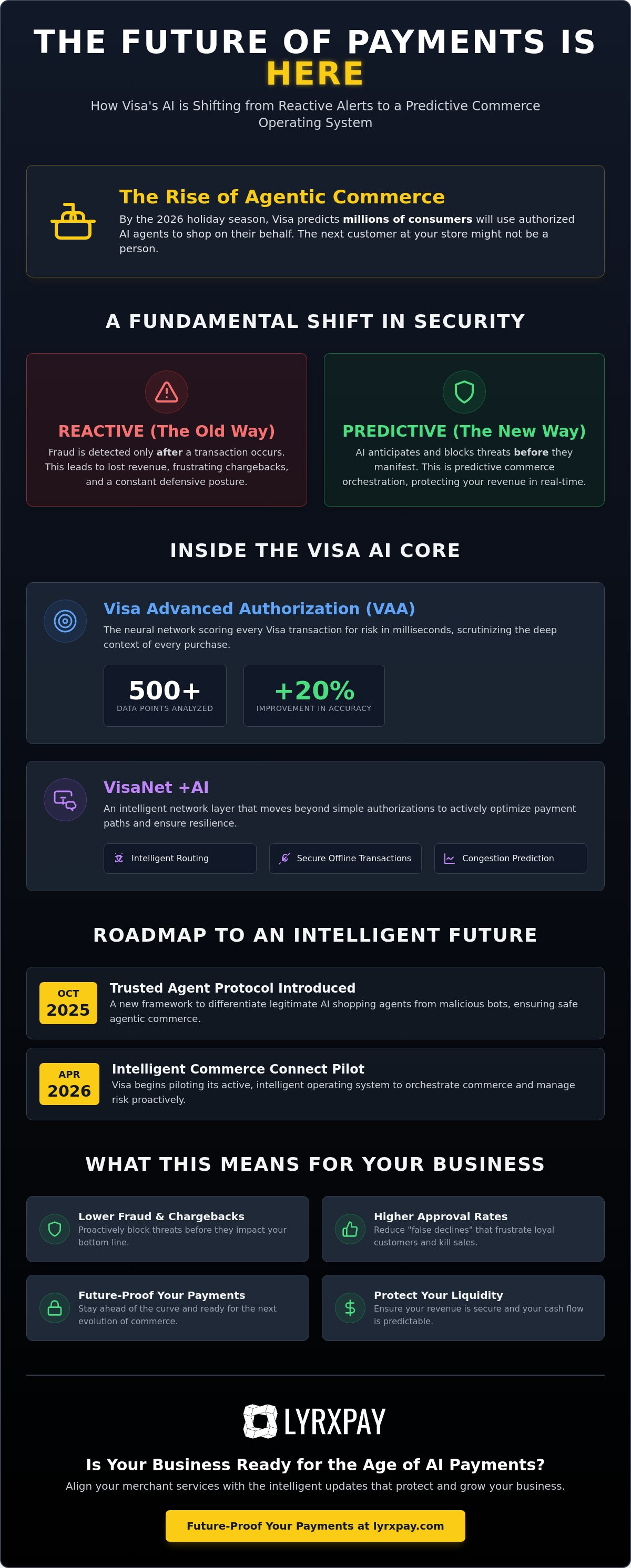
If you're asking, how does it work and what changes with AI has Visa recently made? then you're already taking the first step toward a more secure future. Since the introduction of the Trusted Agent Protocol in October 2025 and the pilot of Intelligent Commerce Connect in April 2026, Visa has shifted from a passive network to an active, intelligent operating system. This guide will clarify how these breakthroughs transform payment security and efficiency for your daily operations. You'll discover how to leverage these new tools to lower fraud rates and ensure your payment stack is ready for the age of agentic commerce.
Key Takeaways
- Learn how Visa uses trillions of data points to move from reactive fraud alerts to predictive commerce orchestration.
- Get a clear answer to the question, how does it work and what changes with AI has Visa recently made? to keep your operations ahead of the curve.
- Prepare for the rise of agentic commerce by understanding how the new Trusted Agent Protocol distinguishes real buyers from malicious bots.
- Identify the specific ways AI security can lower your costs by reducing chargebacks and improving transaction approval rates.
- See how aligning your merchant services with these intelligent updates can future-proof your payment stack and protect your liquidity.
Demystifying AI in Payments: What Visa is Actually Building
Forget the common idea of a chatbot helping you pick a credit card. In the world of Financial technology (Fintech), AI is the silent, high-speed engine powering every transaction. It's a real-time decision engine that evaluates risk before the receipt even prints. This technology doesn't just sit on the sidelines; it's integrated into the very fabric of the payment network to ensure your business stays liquid and secure.
Many merchants wonder: how does it work and what changes with AI has Visa recently made? Historically, fraud detection was reactive. You would find out a transaction was bad only after the money was gone. Now, Visa uses AI to orchestrate predictive commerce. This means the system anticipates threats before they manifest, moving the network from a simple gatekeeper to an active defender of your revenue. It's about shifting the focus from "what happened?" to "what is likely to happen next?"
The goal is simple. Visa wants to stop sophisticated digital theft without blocking your real customers. We've all seen "false declines" kill a sale and frustrate a loyal patron. By using deep learning, Visa aims to make those errors a thing of the past. As we approach the 2026 holiday season, these AI-native protocols will become the industry standard. If your payment stack isn't aligned with these changes, you might find yourself dealing with higher fraud costs than your competitors.
The Evolution of Visa Advanced Authorization (VAA)
Visa Advanced Authorization (VAA) is the neural network that scores every Visa transaction for risk. It doesn't just look at the dollar amount; it scrutinizes the context of the buy. It analyzes over 500 different data points, including device fingerprinting, geographic location, and historical spending patterns, all in just milliseconds. Because of recent updates, the accuracy of VAA has improved by over 20%. This means more "yes" answers for your customers and fewer headaches for your back office. If the model sees a familiar device in a familiar location, the transaction flows through instantly.
VisaNet +AI: The Intelligent Network Layer
The network is getting smarter. VisaNet +AI moves beyond simple "yes or no" authorizations. It now uses intelligent routing to find the fastest, most reliable path for a payment. If a local connection goes down, the network uses AI-driven risk modeling to handle offline transactions securely. This ensures you never miss a sale due to technical glitches. Deep learning also predicts network congestion, optimizing speed so your checkout line keeps moving. By managing these technical hurdles in the background, Visa allows you to focus on the customer in front of you.
How Visa AI Works: Under the Hood of a Transaction
Understanding the technical side of a swipe helps remove the mystery for business owners. At the heart of this system is what experts call a "Data Moat." Visa processes trillions of transactions, and each one feeds a massive library of historical data. This library serves as the training ground for the network's models. By comparing a current transaction against billions of previous ones, the AI can spot anomalies that a human or a traditional rules-based system would miss entirely.
You might be asking, how does it work and what changes with AI has Visa recently made? One of the biggest shifts is the move toward "feature engineering." This involves identifying specific, subtle behaviors that signal a legitimate customer. For example, the AI might look at the time of day, the type of device used, and even the speed of the checkout process. Every single transaction receives a real-time risk score before it ever reaches your point of sale. If the score is too high, the system steps in to protect your revenue.
A major driver of these capabilities is the integration of Featurespace, a recent acquisition that brought advanced behavioral analytics into the fold. This allows the network to adapt to new fraud tactics as they emerge. By modernizing your payment stack, you can ensure your business benefits from these enterprise-level defenses without having to manage the complexity yourself.
Biometric and Identity Verification
AI is also changing how we prove who we are. Modern mobile wallets use AI-driven facial and fingerprint recognition to secure payments instantly. Beyond physical traits, behavioral biometrics analyze how a user interacts with their device. This technology can distinguish between a human thumb and a malicious bot trying to scrape your checkout page. These Visa's AI and Token Innovations mean less friction for your customers and higher security for your store.
Predictive Fraud Prevention
Stopping fraud before it happens is the ultimate goal. New self-learning models can now identify "friendly fraud" patterns, which occur when a customer disputes a legitimate charge. This reduces the number of expensive chargebacks you have to fight. Most impressively, the system can now flag stolen credentials before a single purchase is even attempted by recognizing patterns in how the data was accessed. This shift from reactive rules to proactive learning keeps your business safe in an increasingly digital world.
The 2025-2026 Visa AI Roadmap: Agentic Payments and Beyond
Visa’s strategy for the next two years signals a departure from traditional "swipe and sign" commerce. We are moving toward a world where transactions are programmable and autonomous. This shift is led by the Visa Intelligent Commerce initiative, which opens the network to AI developers. By partnering with leaders like OpenAI, Visa is ensuring that the next generation of shopping apps can securely access the payment rails they need to function. If you've been following the news, you might be wondering, how does it work and what changes with AI has Visa recently made? The most significant update is the transition from a network that merely moves money to one that manages "agentic" relationships.
New services like Visa Pay and Visa Accept are also rolling out to bridge the gap between digital wallets and physical storefronts. Visa Pay connects various digital wallets to the global Visa network, creating a unified experience for the consumer. Meanwhile, Visa Accept allows any NFC-enabled smartphone to function as a high-security POS terminal. This removes the need for specialized, expensive hardware for many small businesses. It’s a proactive step toward making high-level security accessible to everyone, from mobile vendors to established retail shops.
The Rise of the Agentic Economy
The "agentic economy" refers to a future where AI agents buy on behalf of consumers. Imagine a customer’s personal AI negotiating a price for a bulk order and completing the checkout without the human ever lifting a finger. To make this work, Visa provides the "trust layer" through the Trusted Agent Protocol (TAP), introduced in October 2025. This protocol uses cryptographic standards to help you distinguish between a legitimate AI agent and a malicious bot. By using tokenization, Visa ensures that these agents have specific permissions to spend only what is necessary, protecting the customer's primary account data.
Visa Accept and Micro-Merchant Empowerment
The ability to turn a smartphone into a secure terminal is a massive win for service businesses and mobile vendors. AI allows for sophisticated risk modeling even on unspecialized hardware, ensuring that "Tap to Pay" transactions are just as secure as those on a traditional terminal. If you are looking to scale, integrating this logic into all-in-one business financial solutions can help you manage your growth without the friction of legacy systems. These updates mean your business is ready for the 2026 holiday season, where AI-driven traffic is expected to surge.
What These Changes Mean for Your Business Operations
While the global technology is impressive, the real question for any owner is simple: how does this affect my daily cash flow? The shift toward an AI-driven network isn't just a security update. It’s a fundamental change in how your business interacts with the banking system. You might ask, how does it work and what changes with AI has Visa recently made to specifically protect my margins? The answer lies in the reduction of "silent costs" that have plagued merchants for decades.
Lower fraud rates translate directly into lower operational costs. When Visa's predictive engines flag a stolen credential before the purchase happens, you avoid the loss of inventory and the subsequent chargeback fee. Simultaneously, improved approval rates mean you stop losing sales to over-aggressive fraud filters. If a legitimate customer is traveling and makes an unusual purchase, the AI now has enough context to approve the transaction instead of declining it. This leads to a smoother, "invisible" checkout experience that keeps your customers coming back. By understanding how does it work and what changes with AI has Visa recently made, you can position your business to capture more sales with less risk.
Beyond security, these updates provide actionable data. You can now use AI-driven insights to see exactly when and where your customers are buying, allowing you to staff your store or stock your shelves more efficiently. If you want to ensure you're capturing every cent of these new efficiencies, it’s time to speak with a specialist about your processing core.
Auditing Your Current Processing Setup
Don't assume your current processor is passing these AI-driven savings on to you. Many legacy providers still charge rates based on outdated risk models, even though the actual risk of the transaction has decreased. It’s vital to check if your provider uses the latest Visa AI security protocols or if they're still relying on basic, expensive rules. To get a clear picture of your current costs, performing a merchant statement fee audit is the most effective way to identify where you're overpaying for obsolete protection.
Preparing for AI-Driven Consumer Behavior
As agentic payments become mainstream by the 2026 holiday season, your point of sale system must be ready to handle "invisible" transactions. This means your hardware needs to support the latest tokenization and biometric standards. One of the biggest benefits of this high-speed verification is the shift toward next-day deposits. Because AI verifies the risk of a transaction in milliseconds, banks can release funds much faster. Modern business liquidity management tools thrive in this environment, giving you more control over your cash flow than ever before.
Future-Proof Your Merchant Services with LyrxPay
Staying ahead of global payment shifts shouldn't be a burden you carry alone. At LyrxPay, we’ve already done the heavy lifting by integrating the latest Visa AI advancements directly into our processing core. While the technical details of the network are complex, our goal is to make the benefits simple for you to access. If you are still asking, how does it work and what changes with AI has Visa recently made? the most important takeaway is that these updates allow us to defend your revenue more aggressively than ever before.
Our commitment to your growth starts with lower fees. Because we leverage superior fraud management and tech efficiency, we can reduce the risk profile of your transactions. This allows us to pass those savings directly to you. We don't just process payments; we act as a defender of your resources. By moving away from reactive security to the predictive models discussed earlier, we help you maintain better liquidity and avoid the sting of unnecessary chargebacks.
Efficiency doesn't stop at the checkout line. Our solutions feature seamless QuickBooks integration, allowing AI to handle the repetitive tasks of bookkeeping while you focus on your craft. This "concierge" approach to merchant services means we manage the administrative stress of your business, providing a clear path forward in a rapidly changing market. We view our clients as equal partners in a shared mission to build a more resilient, future-proof operation.
Integrated POS and AI Security
Your hardware needs to be as smart as the network it connects to. We provide Point of Sale software and hardware solutions that are fully prepared for the 2026 Visa Intelligent Commerce era. Our systems support the NFC and biometric payments that consumers now expect, ensuring your checkout process is "invisible" and frictionless. Having a partner who understands both the technical side of payments and the practical side of accounting gives you a significant competitive advantage. We ensure your POS isn't just a tool for today, but a foundation for the agentic economy of tomorrow.
Get Started with Modern Processing
Switching your processing shouldn't feel like a risk. When you move to LyrxPay, you gain immediate access to next-day deposits and a suite of tools designed for cash flow optimization. We handle the technical transitions for you, ensuring your payroll solutions and bookkeeping are perfectly synced from day one. This gives you the peace of mind to grow without looking over your shoulder at rising fraud rates or obsolete tech. To see the difference a modern partner can make, Contact LyrxPay for a transparent fee audit and AI-ready processing today.
Master the New Era of Intelligent Payments
The shift from simple transaction processing to predictive commerce orchestration is more than just a technical upgrade; it's a fundamental change in how your business stays liquid and secure. By embracing the agentic economy and utilizing the Trusted Agent Protocol, you can stop fraud before it happens while ensuring your real customers enjoy a frictionless experience. You now have the answers to the question, how does it work and what changes with AI has Visa recently made? and you can use that knowledge to gain a significant competitive edge.
Ready to turn these insights into higher margins? You can Upgrade to AI-Ready Payment Processing with LyrxPay to start benefiting from lower transaction fees through AI-driven fraud reduction and the speed of next-day deposits. Our team ensures your transition is seamless with expert QuickBooks and Xero integration so you can focus on your craft. You've done the hard work of building your business; let us do the heavy lifting of keeping it future-proof and profitable.
Frequently Asked Questions
What are Visa Agentic Payments?
Agentic payments allow AI bots to negotiate and complete purchases for consumers without human intervention. Visa acts as the trust layer for these transactions using the Trusted Agent Protocol (TAP). This cryptographic standard helps you distinguish between a helpful shopping bot and a malicious scraper. By the 2026 holiday season, these agents are expected to handle a significant portion of retail traffic. It lets technology handle the chores of shopping while you focus on fulfillment.
How does Visa use AI to prevent fraud in 2026?
Visa uses predictive orchestration to stop fraud before a purchase is even attempted. The system evaluates "Agent Scores" to determine if a website is ready for secure AI commerce. This moves the network from reactive alerts to proactive defense. By analyzing behavioral biometrics and historical patterns, the AI identifies stolen credentials instantly. This shift ensures that your revenue stays protected without blocking legitimate, high-value customers who may be shopping in new ways.
Will Visa’s new AI changes increase my merchant fees?
These updates are designed to lower your costs by reducing the risk profile of your transactions. If you're asking, how does it work and what changes with AI has Visa recently made? then you should know that more accurate risk scoring leads to fewer chargebacks. By stopping expensive fraud attempts, the system preserves your liquidity. This efficiency allows modern processors to offer more competitive rates because the "cost of fraud" is significantly lower across the network.
What is Visa Intelligent Commerce?
Visa Intelligent Commerce is a strategic initiative that opens the payment network to AI developers and platforms like OpenAI. It allows for "programmable commerce" where payments are embedded into AI-driven workflows. This initiative includes tools like Intelligent Commerce Connect, which entered a pilot phase in April 2026. It aims to modernize both the front-end shopping experience and the back-end money movement, ensuring your business is ready for a digital-first, autonomous economy.
How does the Featurespace acquisition help small businesses?
The Featurespace acquisition brings advanced real-time behavioral analytics to the merchant level. Small businesses benefit from enterprise-grade security that adapts to new criminal tactics in milliseconds. This technology looks for subtle changes in how a user interacts with a device to spot anomalies. It levels the playing field, giving smaller vendors the same level of protection as global retailers without the need for a massive internal security team or expensive custom software.
Do I need new POS hardware to support Visa’s AI updates?
You don't always need entirely new hardware, but your system must support NFC and modern tokenization to be fully compatible. Software updates often handle the "intelligent" side of the network. However, to fully leverage biometric and "invisible" payments, having a modern POS terminal is a smart investment. If your current equipment is more than a few years old, it might struggle to handle the high-speed data exchange required for the 2026 agentic commerce standards.
How does AI help with credit card chargebacks?
AI reduces chargebacks by identifying "friendly fraud" patterns where a customer disputes a legitimate transaction. The system analyzes historical data to see if the user has a history of making false claims. It also ensures that the person making the purchase is actually the account holder through biometric verification. This proactive approach saves you the time and money usually spent on manual dispute management and the expensive fees associated with fighting illegitimate claims.
Can AI payments work with my QuickBooks or Xero setup?
Yes, AI payments integrate seamlessly with accounting software like QuickBooks and Xero. Modern processing partners ensure that every AI-verified transaction is automatically categorized and synced with your books. If you're asking how does it work and what changes with AI has Visa recently made? to simplify your back office, the answer is automated, real-time reconciliation. This eliminates manual data entry and reduces the risk of human error in your financial reporting, allowing you to focus on growth.