
Mastering Xero Payment Integration: 2026 Merchant Guide

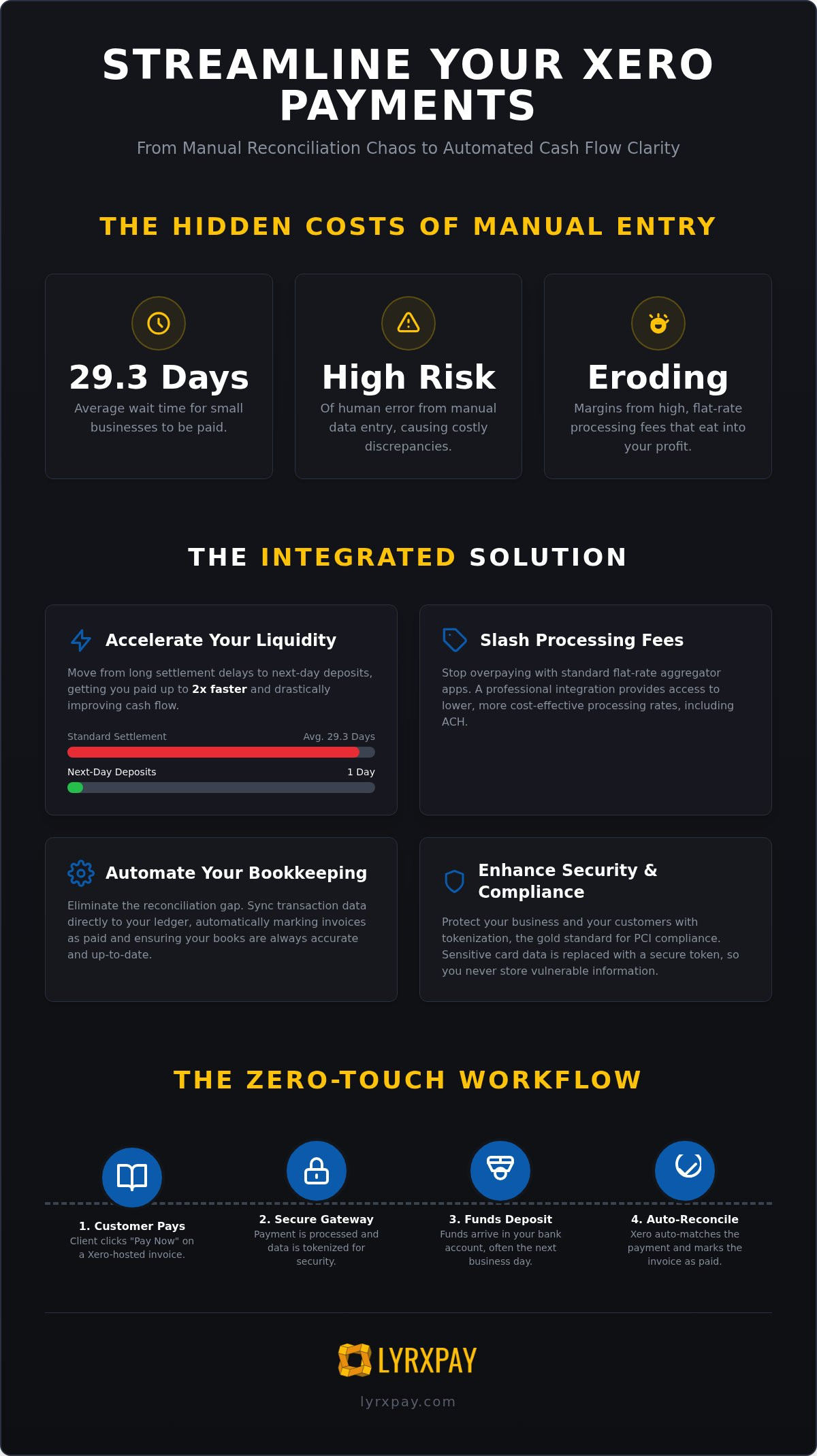
Did you know that by the second quarter of 2026, small businesses waited an average of 29.3 days to be paid? It's a staggering delay that puts unnecessary pressure on your daily operations. You likely find it frustrating to manage the reconciliation gap where manual data entry consumes hours of your week. A professional xero payment processing integration is the key to closing that gap, especially if you're tired of watching high flat-rate fees eat your margins while you wait days for funds to clear.
This guide will show you how to reclaim your time and your resources through smart automation. We'll explore how to slash transaction fees and ensure next-day deposits arrive in your business bank account. You'll learn how to automate your bookkeeping so invoices mark themselves as paid the moment a client settles their bill. By the end of this article, you'll have a clear roadmap to move from manual data entry to a streamlined system that gets you paid twice as fast.
Key Takeaways
- Bridge the reconciliation gap by syncing transaction data directly to your ledger, eliminating the risk of human error in your financial reporting.
- Optimize your bottom line with a professional xero payment processing integration that offers lower fees than standard flat-rate aggregator apps.
- Accelerate your liquidity by moving beyond standard settlement times to secure next-day deposits and cost-effective ACH processing.
- Shift from a self-service struggle to a concierge-managed setup where experts handle the heavy lifting of your back-office automation.
The Reconciliation Gap: Why Manual Payment Entry is Costing Your Business
The Reconciliation Gap isn’t just a buzzword; it’s the silent friction between your bank balance and your accounting ledger. In 2026, where small businesses wait an average of 29.3 days to be paid, every second spent on manual entry is a second you aren't growing. If you're still typing payment amounts from a merchant statement into an invoice, you're living in the past. A professional xero payment processing integration removes this friction, turning a high-stress administrative burden into a background process that just works.
The Real Cost of Human Error in Bookkeeping
Manual data entry is the natural enemy of accuracy. A single transposed digit can trigger a chain reaction of financial frustration, leading to duplicate entries or missed invoices that ghost your cash flow. These mistakes don't just mess up your records; they inflate your professional bookkeeping fees as your accountant spends billable hours hunting for discrepancies. Is your team chasing shadows instead of focusing on growth?
Consider these common pitfalls of non-integrated systems:
- Duplicate entries that distort your revenue reports.
- Invoices that remain marked as "unpaid" despite funds being in the bank.
- Settlement delays that hide your true cash position.
Real-time data is no longer a luxury. It is a core component of business liquidity management tools, providing the clarity you need to make fast, confident decisions. If your system doesn't update instantly, you're making choices based on yesterday's news.
Bridging the Gap Between Sales and Accounting
Why is there always a mismatch between your merchant statement and your bank feed? Often, it's because the data is fragmented. When you use a robust payment gateway that talks directly to your accounting software, that fragmentation disappears. This connection creates a single source of truth for your CPA, ensuring that every transaction aligns perfectly across all platforms.
Instead of reactive firefighting at the end of the month, you move toward proactive financial management. You gain the psychological relief of a zero-touch workflow, where your xero payment processing integration handles the heavy lifting. By automating the link between sales and accounting, you ensure that every dollar is accounted for without lifting a finger. It’s about more than just speed; it’s about the integrity of your financial data in an increasingly fast-paced market.
The Mechanics of Xero Payment Processing Integration
At its core, a xero payment processing integration is a secure, digital bridge that syncs transaction data directly into your ledger. It isn't just a convenience; it's a technical handshake between your invoicing software and your financial institution. When you connect these systems, you eliminate the need to manually export CSV files or hunt for missing entries. Instead, the integration ensures that every transaction is recorded with precision, reflecting your actual bank balance in real-time. It's the difference between guessing your cash position and knowing it with absolute certainty.
To understand how this works, you must distinguish between the payment gateway and the merchant account. The gateway acts as the secure messenger that captures and encrypts customer data, while the merchant account is where your funds are actually held before being deposited. A professional integration manages the flow between these two, ensuring that fee allocation is handled automatically. This means when a customer pays a $1,000 invoice, the system correctly identifies the net deposit and the processing fee, keeping your books clean without any manual intervention.
How the Sync Works: From Click to Ledger
The magic starts when your customer interacts with a Xero-hosted invoice. By clicking the "Pay Now" button, they enter a secure checkout environment where their payment is processed instantly. This interaction triggers the "Auto-Match" feature within Xero. Once the funds hit your bank feed, Xero identifies the corresponding invoice and reconciles the deposit. If you're dealing with complex billing, a robust system also handles partial payments and credit notes, ensuring that the remaining balance is always accurate. If you want to see how this looks in practice, exploring modern merchant services can help you visualize a truly automated workflow.
Security and PCI Compliance in 2026
Security standards have evolved, and in 2026, tokenization is the non-negotiable gold standard. This process replaces sensitive card data with a unique identifier, or "token," so your business never actually stores vulnerable information. By off-loading these security risks to a professional provider, you protect your brand and your customers from potential breaches. It's essential to ensure your integration meets the latest credit card processing security standards. This proactive approach to compliance doesn't just satisfy regulations; it builds a foundation of trust with your clients, letting them know their data is handled with the highest level of care.
Beyond the "Pay Now" Button: Slashing Processing Fees
Many business owners treat payment fees as a fixed cost of doing business. They accept the standard 2.9% plus 30 cents per transaction because it's the default option in most app stores. This is what we call the "Convenience Tax." While aggregator apps make it easy to start, they often charge some of the highest rates in the industry. A professional xero payment processing integration gives you the power to choose your own pricing model, potentially saving you 1% or more on every dollar processed. Why settle for a one-size-fits-all rate when your business has unique needs?
Moving beyond the default button is a strategic financial move. By integrating a direct merchant account, you bypass the middlemen who take a cut of every transaction. This shift doesn't just lower your costs; it provides a level of transparency that flat-rate providers simply cannot match. You'll see exactly where every penny goes, allowing you to optimize your margins as your volume grows.
Interchange-Plus vs. Flat-Rate Pricing
To understand where your money goes, you have to look at the three components of a merchant fee: interchange, assessments, and the processor's markup. Interchange fees go to the card-issuing bank, while assessments go to the card networks like Visa or Mastercard. Flat-rate pricing bundles these into a single high number. This is often a bad deal for high-ticket businesses because you pay the same high percentage regardless of the actual wholesale cost of the card used.
Choosing an interchange-plus model provides total transparency. You pay the direct wholesale cost of the transaction plus a small, fixed markup. If you want to see how this compares to your current situation, you should learn how to lower merchant fees by auditing your monthly statements. Identifying these hidden costs is the first step toward reclaiming your revenue and improving your bottom line.
Maximizing Savings with B2B Level 3 Data
If you primarily serve other businesses, you have access to a massive discount that many processors never mention. Level 3 processing involves sending enhanced data, such as tax IDs and commodity codes, back to the card networks. Card brands view these transactions as lower risk because of the extra detail provided. By passing line-item detail such as tax amounts and product codes, Level 3 data can reduce B2B processing costs by up to 40%. This technical requirement is handled by a sophisticated xero payment processing integration, ensuring every B2B invoice is optimized for the lowest possible rate without extra manual work from your team.
Optimizing Cash Flow: Next-Day Deposits and ACH Integration
Cash flow is the heartbeat of your business. In 2026, small businesses wait an average of nearly 30 days to be paid, a delay that can stifle growth and create unnecessary stress. While your xero payment processing integration automates the data entry, it should also accelerate the actual movement of money. If your current processor holds funds for three days or more, they're essentially using your capital for their own liquidity. You need a system that prioritizes your access to cash so you can reinvest in your operations without delay.
Managing settlement windows is the final piece of the reconciliation puzzle. When your merchant provider aligns their deposit schedule with your Xero bank feed, your books stay clean and your reporting stays accurate. It's about more than just speed; it's about having a clear, real-time view of your financial health.
The Power of Next-Day Deposits
Speed matters in a competitive market. Standard settlement delays of 48 to 72 hours create a "liquidity lag" that hinders your ability to pay vendors or cover payroll. By integrating high-speed settlement into your Xero workflow, you ensure that today’s sales become tomorrow’s working capital. This level of speed is a hallmark of all in one business financial solutions that focus on operational agility. When your bank feed reflects deposits within 24 hours, you gain the freedom to make fast, confident business decisions.
ACH Integration for B2B Success
For professional services and high-ticket B2B transactions, credit card fees can quickly erode your profit margins. This is where ACH processing shines as a lower-cost alternative. By setting up bank-to-bank payments directly within the Xero interface, you offer your clients a secure, professional way to pay without the high overhead of card networks. ACH is often the preferred method for large-scale contracts because it’s reliable and easy to track.
When you perform a cost-benefit analysis of credit cards vs. ach services, the savings on a single high-value invoice can be substantial. A robust xero payment processing integration also streamlines recurring billing for retainers or subscriptions. Automating the ACH pull ensures you get paid on time, every time, without the need to chase clients for payment. Ready to stop waiting for your funds to clear? You can optimize your cash flow with next-day deposits here and take control of your business liquidity today.
The LyrxPay Concierge Approach to Xero Integration
Why settle for a self-service "trial and buy" model when your business deserves managed care? Many providers claim you can set up a xero payment processing integration in minutes, but they often disappear the moment a complex reconciliation error occurs. At LyrxPay, we believe that growing businesses need an ally, not just an app. Our concierge approach means we take the burden of technical setup off your shoulders, allowing you to focus on your craft while we ensure your financial data flows perfectly into your ledger. We don't just provide a link; we provide a partnership.
Our team acts as a defender of your time and resources. We monitor your account for fee creep and technical glitches, providing ongoing advocacy that most automated platforms simply cannot offer. If you've ever felt like a number in a support ticket queue, you'll find our human-centric interaction refreshing. We handle the heavy lifting of back-office automation so your accounting stays clean and your stress levels stay low.
Managed Integration vs. DIY
The peace of mind that comes with professional setup is invaluable. A DIY approach often leads to messy charts of accounts or misaligned tax settings that take months to uncover. When we manage your xero payment processing integration, we customize the sync to match your specific merchant data and accounting requirements. We test every connection before it goes live, ensuring that your first deposit reconciles as smoothly as your hundredth. Our support team acts as a seamless extension of your back office, answering questions and resolving issues before they impact your financial reporting.
Scaling Your Business with LyrxPay
Your payment needs will change as your business grows. You might start with simple digital invoicing but eventually require complex retail solutions or specialized merchant services for medical offices. LyrxPay is built to scale with you, merging payments, POS hardware, and bookkeeping into one Xero-centric hub. We help you future-proof your payment stack for 2026 and beyond, ensuring you always have access to the latest security standards and lowest possible rates. Ready to move away from the frustration of self-service apps? It's time to Get a custom Xero integration quote from LyrxPay and experience the difference that professional managed care makes for your bottom line.
RECLAIM YOUR TIME AND YOUR REVENUE
Managing your back office shouldn't feel like a second job. You've seen how a professional xero payment processing integration bridges the gap between your sales and your ledger, effectively eliminating the manual errors that drain your resources. By moving beyond the default "Pay Now" button, you unlock access to wholesale interchange-plus pricing and the liquidity of next-day deposits. This transition is about more than just software; it's about shifting from a reactive state of bookkeeping to a proactive state of strategic growth.
You don't have to navigate these complex technical waters alone. Whether you're looking for ACH services to lower B2B costs or need hands-on concierge integration support to get your chart of accounts exactly right, the right partner makes all the difference. It's time to stop letting high fees and delayed settlements hold your business back from its full potential. Slash your fees and automate your Xero workflow with LyrxPay today. We're here to do the heavy lifting so you can focus on building the business you've always envisioned. Your future cash flow will thank you for making the switch.
Frequently Asked Questions
How does Xero payment processing integration save time on bookkeeping?
A xero payment processing integration automates the reconciliation process by syncing transaction data directly with your ledger. Instead of manually matching bank statements to open invoices, the system identifies the payment and marks the invoice as "Paid" the moment funds are captured. This eliminates the need for manual data entry and reduces the risk of human error. You'll spend less time on administrative tasks and more time focusing on your core business operations.
Can I use my existing merchant account with Xero?
You can use your existing merchant account if your provider offers a compatible payment gateway that links with Xero. Many business owners prefer this over using a default aggregator because it allows them to keep their established banking relationships and negotiated rates. If you're unsure about compatibility, a professional integration partner can help you bridge the technical gap. This ensures your current financial infrastructure works seamlessly with your accounting software without requiring a total overhaul of your systems.
What are the fees for accepting credit card payments through Xero?
Fees depend on whether you use a flat-rate aggregator or an interchange-plus pricing model. While many default apps charge a standard percentage for every transaction, a direct xero payment processing integration often provides access to lower wholesale rates. These fees typically include an interchange cost set by card networks plus a small processor markup. By choosing a transparent pricing structure, you can significantly reduce your effective rate as your monthly transaction volume increases.
Is ACH processing cheaper than credit card processing for Xero invoices?
ACH processing is almost always cheaper than credit card processing because it bypasses the expensive card networks. Instead of paying a percentage that can exceed 2.5 percent, ACH transactions often involve a small flat fee or a significantly lower percentage cap. This makes it the ideal choice for professional services or high-value B2B invoices where card fees would consume too much profit. It’s a strategic way to offer secure bank-to-bank payments while protecting your margins.
How long does it take for money to reach my bank account after a Xero payment?
Settlement times vary based on your merchant provider and the payment method used. While standard settlement windows often range from two to three business days, professional integrations can offer next-day deposits for improved liquidity. ACH transfers generally take slightly longer than credit card payments, though modern systems have significantly reduced these wait times. Ensuring your processor prioritizes fast settlements is essential for maintaining a healthy cash flow and having immediate access to your working capital.
Does Xero payment integration handle PCI compliance for my business?
A robust payment integration handles the heavy lifting of PCI compliance through a process called tokenization. This technology ensures that sensitive cardholder data never touches your local servers or Xero account directly. Instead, the data is encrypted and stored by the payment gateway, which reduces your liability and security risk. By off-loading these requirements to a professional provider, you satisfy strict security standards while protecting your customers' information from potential digital threats.
Can I automate recurring payments with a Xero integration?
You can automate recurring payments by setting up repeating invoices within Xero and linking them to a compatible payment gateway. This is particularly useful for businesses that operate on subscription models or monthly retainers. Once the customer provides their payment information, the system securely stores a token to charge them automatically on the invoice due date. This automation ensures you get paid on time without having to chase clients for manual payments every month.
What is the difference between Stripe and a direct merchant account for Xero?
The primary difference lies in the pricing structure and level of service. Stripe is an aggregator that offers a quick setup with a flat-rate fee for every transaction, which can be expensive for high-volume businesses. A direct merchant account uses interchange-plus pricing, providing more transparency and lower overall costs. Additionally, direct accounts often come with personalized concierge support and faster deposit times, making them a more scalable choice for businesses focused on long-term operational efficiency.