
How to Set Up ACH Payments: The 2026 Strategic Guide

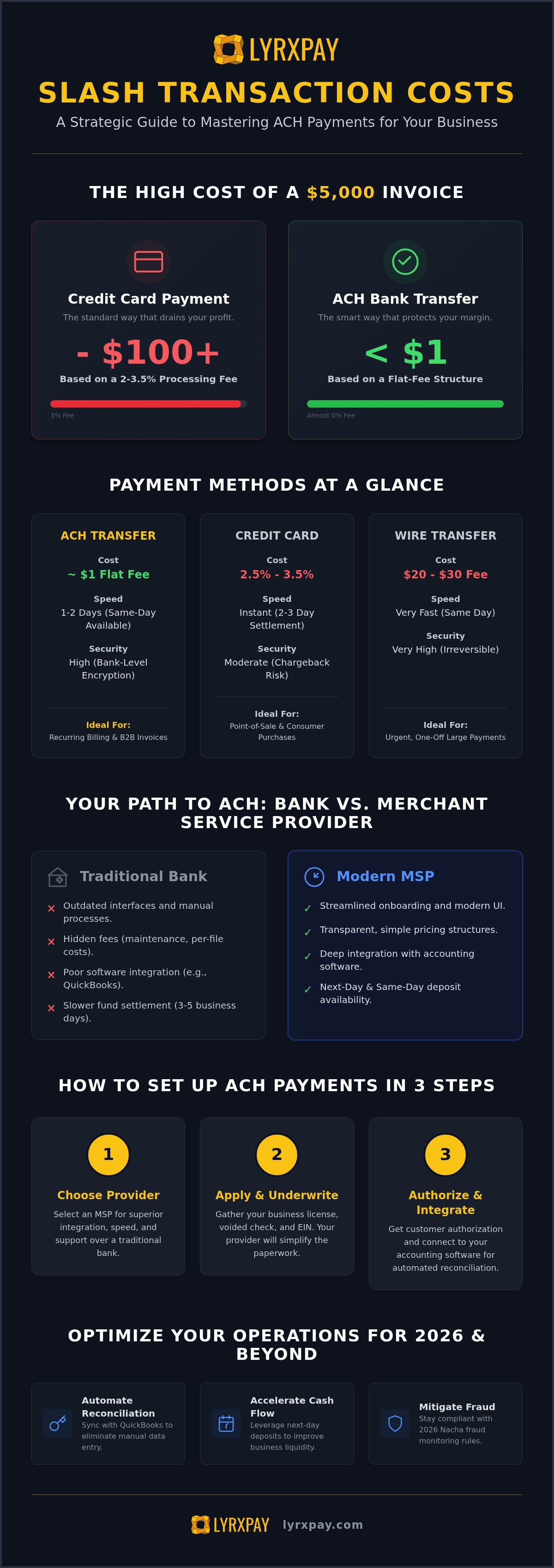
Did you know that a $5,000 invoice paid by credit card can cost your company over $100 in processing fees, while that same transaction via the ACH network often costs less than a dollar? It's a staggering difference that directly impacts your bottom line. You work too hard to let 3% of every sale vanish into thin air, and you shouldn't have to wait an entire week for a paper check to clear just to protect your margins.
We understand the stress of manual data entry and the headache of unpredictable cash flow. If you've been wondering how to set up ach payments for my business to stop the "margin bleed," you're in the right place. This strategic guide will teach you how to slash transaction costs and stabilize your daily operations. We'll move beyond the basics to cover the 2026 Nacha fraud monitoring requirements, next-day deposit secrets, and the exact steps to sync your payments with QuickBooks for a hands-off accounting experience. It's time to trade administrative hurdles for a streamlined, professional payment strategy that keeps more money in your pocket.
Key Takeaways
- Understand the massive cost advantage of bank-to-bank transfers over credit cards and how flat-fee structures protect your profit margins.
- Master the exact process of how to set up ach payments for my business, including the specific documentation and legal authorizations required for a smooth application.
- Learn how to eliminate manual data entry by integrating your payment processing directly with QuickBooks for automated, hands-off reconciliation.
- Navigate the 2026 Nacha fraud monitoring rules with confidence while leveraging next-day deposits to solve the common "slow settlement" myth.
- Evaluate the pros and cons of direct bank setups versus Merchant Service Providers to find the most efficient path for your operational health.
UNDERSTAND THE ADVANTAGE: Why ACH Payments are Essential in 2026
The Automated Clearing House (ACH) network serves as the invisible engine for the U.S. financial system. It's a bank-to-bank transfer network that bypasses the expensive toll roads of credit card associations. While you might be familiar with direct deposit for payroll, learning how to set up ach payments for my business unlocks a powerful way to collect revenue without the heavy tax of traditional processing. It's about moving money directly from one account to another, cutting out the middlemen who eat into your margins.
In 2026, the ACH network is more vital than ever. Recent data from the second quarter of 2026 shows that the network processed 9.3 billion payments, a 6.2 percent increase over the previous year. This growth is driven by businesses like yours looking for stability. You can utilize ACH in two ways: ACH Credits, where you "push" funds to a vendor or employee; and ACH Debits, where you "pull" funds from a customer's account. Both methods offer a level of control and predictability that paper checks simply can't match.
ACH vs. Wire Transfers vs. Credit Cards
Cost is the primary driver for switching to bank transfers. Wire transfers are fast, but they're expensive, often costing $20 to $30 per transaction. Credit cards offer convenience, but they demand 2.5 to 3.5 percent of your gross revenue. ACH wins for recurring billing and high-value B2B invoices because it typically uses a flat-fee or capped-percentage model. Modern processors have also closed the speed gap. With Same-Day ACH volume growing by 29.5 percent in early 2026, the network now offers the liquidity of a wire with a fraction of the overhead. Security is another pillar; paper checks are vulnerable to interception and forgery, whereas ACH transactions use encrypted, bank-level protocols that significantly lower your risk profile.
The Impact on Your Bottom Line
Let's look at the math. If you process a $10,000 transaction via credit card, you might lose $300 or more to processing fees. That same transaction through the ACH network could cost you less than a dollar. This isn't just a small saving; it's a fundamental shift in your profitability. Beyond the direct costs, ACH payments reduce the risk of "friendly fraud" chargebacks that often plague credit card transactions. When you understand how to lower merchant fees through strategic payment routing, you reclaim control over your resources. If you're tired of watching margins disappear, figuring out how to set up ach payments for my business is the most effective operational move you can make this year.
CHOOSE YOUR PATH: Bank vs. Merchant Service Provider
Deciding where to anchor your payment processing is a pivotal moment for your operational health. Many owners instinctively look to their local bank, but while traditional institutions offer perceived stability, they often struggle with the technical agility required in 2026. If you're researching how to set up ach payments for my business, you'll quickly find that the "how" depends entirely on the "who." Choosing between a direct bank relationship and a specialized Merchant Service Provider (MSP) is the difference between an automated engine and a manual process.
The Limitations of Traditional Banking ACH
Banks often treat ACH as a legacy treasury service rather than a modern growth tool. This leads to outdated user interfaces and a frustrating lack of real-time data synchronization. You might find "hidden fees" buried in monthly maintenance charges or per-file transmission costs that aren't immediately obvious. Most importantly, banks rarely prioritize the deep software integrations that modern businesses need to stay lean. If your payment system doesn't talk to your ledger, you're just creating more work for yourself. Looking for all-in-one business financial solutions is often a better path than trying to force a legacy bank portal to work with modern tech.
The Concierge Approach to Merchant Services
This is where the "concierge" model shines. A dedicated provider doesn't just give you a login; they act as an advocate for your resources. They simplify the complex underwriting process, doing the heavy lifting so you don't have to navigate endless paperwork alone. In 2026, the gold standard for any provider is the ability to offer next-day deposits. While standard ACH can take days to settle, a proactive partner ensures your liquidity remains high. Compatibility with QuickBooks and Xero should be a non-negotiable requirement. If a provider can't promise a seamless sync with your accounting software, they aren't the right partner for your long-term health. Finding a provider that offers secure ACH processing ensures your cash flow remains as steady as your growth. When you choose a partner that values your time as much as you do, the administrative burden of payment collection simply disappears.
STEP-BY-STEP: How to Set Up ACH Payments for Your Business
Transitioning from manual invoicing to automated bank transfers is a straightforward process when you have a clear map. While every provider has slight variations, the core requirements remain consistent across the industry. If you're ready to learn how to set up ach payments for my business, follow these five essential steps to ensure a compliant and efficient launch.
Gathering Your Documentation
Before you begin the application, you'll need to collect your business vitals. This stage is where many owners feel overwhelmed, but a proactive partner will handle the heavy lifting for you. You will typically need:
- Your Federal Tax ID (EIN).
- A verified physical business address.
- Ownership details, including Social Security numbers for significant stakeholders.
- A voided check or bank letter for your business bank account.
Processors require a dedicated business bank account rather than a personal one to maintain clear liability boundaries and professional reporting. As of 2026, Know Your Customer (KYC) requirements mandate that all originating businesses implement risk-based monitoring processes to verify identities and detect unusual activity from day one. This ensures that the network remains secure for everyone involved.
The Legal Side: Authorization Forms
You cannot simply pull funds from a client's account without their explicit permission. Obtaining a signed ACH authorization form is a non-negotiable legal requirement that protects you from potential disputes. These forms must clearly state the transaction amount, the frequency of the pull, and the specific terms for how a customer can revoke their permission.
In 2026, the industry has shifted almost entirely toward digital signatures and e-authorizations. You can choose between one-time authorizations for specific projects or recurring authorizations for subscription-based services. If you're handling employee compensation, remember that a new Nacha rule effective March 20, 2026, requires all payroll-related ACH entries to include the word "PAYROLL" in the Company Entry Description field. Keeping these forms organized and accessible is your best defense against future chargebacks.
Once your documentation is approved, the next phase involves technical configuration. You'll connect your business bank account to your payment gateway using secure API keys or a merchant portal. Don't rush into large batches immediately. Run a micro-deposit test first; this involves sending two small deposits (usually just a few cents) to a test account to verify that the connection is active and accurate. When the test clears, you're ready to go live. You can now initiate your first ACH Debit to collect revenue or an ACH Credit to pay your vendors, all while enjoying the stability of a streamlined cash-flow engine.
INTEGRATE FOR SUCCESS: Connecting ACH to Your Accounting Workflow
Setting up the technical plumbing is only half the battle. If you've figured out how to set up ach payments for my business but still find yourself manually typing transaction IDs into a spreadsheet, you haven't truly solved the problem. Manual data entry is the silent killer of business growth. It steals hours from your week, introduces human errors that can derail your bookkeeping, and prevents you from seeing your true financial position in real time. The real magic happens when your payment processor and your ledger speak the same language.
QuickBooks and Xero Integration
Imagine a workflow where the software does the heavy lifting. You send an invoice, the customer pays via a secure ACH link, and the invoice is marked as "Paid" in your system without you lifting a finger. This "Auto-Reconcile" feature ensures your cash flow data is always current. Beyond simple reconciliation, integrated systems allow you to capture the data required for integrating level 3 B2B rates directly into your QuickBooks invoices. This level of detail is essential for optimizing your processing costs on large commercial transactions, potentially saving you significant annual overhead. If you're ready to automate your ledger, you can get started with integrated ACH processing today.
Managing Recurring Billing
For subscription-based models or retainer services, automation is non-negotiable. You can implement "set it and forget it" billing that pulls funds on a specific date every month, ensuring you never have to chase a client for a routine payment again. But what happens when a payment fails? Modern integrated systems use automated retry logic to handle Non-Sufficient Funds (NSF) alerts, attempting the transaction again after a short delay to account for timing differences in bank deposits. This proactive approach keeps your accounts receivable healthy without requiring a single phone call. Some industry reports suggest that these automated reminders and nudges can reduce late payments by as much as 30 percent. By removing the friction of manual follow-ups, you protect your time and your professional relationships.
Integration isn't just a technical convenience; it's a strategic shield for your resources. When your payments sync seamlessly with your accounting software, you gain a level of clarity that allows for better decision-making. You stop being a data entry clerk and start being a business owner again. By choosing a partner that prioritizes these connections, you ensure that every dollar you save on transaction fees isn't lost to administrative labor costs.
SECURE AND SPEED UP: Optimizing Your ACH Strategy with LyrxPay
The biggest hurdle for most owners isn't the paperwork; it's the fear of waiting five days for their money to clear. If you've been researching how to set up ach payments for my business, you've likely seen the same old warnings about slow settlement times and rigid bank portals. LyrxPay shatters this myth by offering a high-speed, secure alternative that prioritizes your liquidity. We don't just provide a gateway; we act as a dedicated defender of your resources, ensuring that your transition to electronic payments is both profitable and painless.
Improving Liquidity with Next-Day Deposits
In the traditional banking world, ACH is often synonymous with "slow." Most institutions still force a three to five day wait before funds hit your account. This delay can cripple your ability to manage inventory or meet payroll obligations. LyrxPay solves this by providing next-day deposits for qualified merchants, giving you the speed of a credit card transaction with the low overhead of the ACH network. Faster access to your revenue means you can reinvest in your growth immediately. When you combine this speed with modern business liquidity management tools, you gain a level of financial agility that your competitors simply can't match. It's about making your money work for you the moment it's earned.
Security is the other side of the optimization coin. As of 2026, Nacha requires robust, risk-based fraud monitoring for all originators. LyrxPay exceeds these standards with advanced account validation and identity verification protocols. We verify the "health" of the customer's bank account before the transaction is even initiated, which drastically reduces the instances of returned items and administrative headaches. Additionally, our "Lower Fee" commitment includes a thorough audit of your current processing statements. We find the bloat and eliminate it, ensuring that your move to ACH delivers the maximum possible savings to your bottom line.
The Support You Deserve
Most business owners are tired of being treated like a ticket number by generic bank call centers. When you partner with us, you gain access to a dedicated national merchant advocate who understands the complexities of nationwide growth. We believe in a concierge style of service where your questions are answered by experts, not automated scripts. This personal attention ensures that your specific workflow, from QuickBooks sync to recurring billing cycles, remains uninterrupted. If you're tired of the "do-it-yourself" struggle and want a partner who does the heavy lifting, it's time to experience a higher standard of care. Ready to switch? See how LyrxPay streamlines your ACH setup today.
SECURE YOUR REVENUE AND SIMPLIFY YOUR OPERATIONS
You've done the hard work of building your brand; now it's time to protect the revenue you generate. By moving away from high credit card percentages and toward a flat-fee ACH model, you're choosing long-term operational health over avoidable overhead. The key to success in 2026 isn't just about the transaction itself. It's about the automation that follows. When your payments sync perfectly with QuickBooks and Xero, you reclaim the hours once lost to manual data entry and accounting errors. This transition moves your business from a state of administrative friction to a state of streamlined efficiency.
If you've been wondering how to set up ach payments for my business without the typical multi-day wait for funds, LyrxPay is here to act as your dedicated advocate. We provide the next-day deposits and lower-fee structures you need to keep your liquidity high and your stress levels low. Don't let outdated banking portals or manual bookkeeping hold your growth hostage any longer. Get Started with Secure ACH Processing and Next-Day Deposits today. The most efficient version of your business is just one strategic setup away, and we're ready to do the heavy lifting for you.
Frequently Asked Questions
How long does it take to set up ACH payments for my business?
The initial setup typically takes between two and five business days once you submit your documentation. This window allows your provider to complete the underwriting process and verify your business vitals, such as your EIN and ownership details. If you're working with a concierge partner, they handle the heavy lifting to ensure your application is approved without unnecessary delays. Once your gateway is configured and the micro-deposit test is successful, you can begin processing transactions immediately.
What are the typical fees for ACH processing in 2026?
ACH processing fees are significantly lower than credit card rates, typically structured as a flat fee per transaction or a small percentage with a maximum cap. While credit cards might take 3 percent of your gross revenue, an ACH transaction often costs a fraction of that amount. These savings are particularly impactful for high-ticket B2B invoices. By auditing your current statements, a provider can often identify hidden bloat and implement a more transparent, lower-fee structure for your business.
Is ACH safer than accepting credit cards or checks?
Yes, ACH is considered one of the most secure payment methods available because it uses encrypted, bank-to-bank protocols. Unlike paper checks, which can be intercepted or forged, ACH transactions are processed through the secure Nacha network. In 2026, new fraud monitoring rules require businesses to implement risk-based monitoring, which adds another layer of protection. This makes it a safer alternative to both checks and credit cards, where "friendly fraud" chargebacks are more common.
Can I use ACH for both one-time and recurring customer payments?
Absolutely. You can use the network for both one-time payments and automated recurring billing models. This flexibility is ideal for subscription services or retainer-based contracts where you want to "set it and forget it." When you learn how to set up ach payments for my business for recurring billing, you also gain access to automated retry logic. This ensures that if a payment fails due to timing, the system can automatically re-attempt the pull.
What is the difference between ACH Debit and ACH Credit?
The difference lies in the direction of the funds. An ACH Debit occurs when you "pull" money from a customer's account after they have provided legal authorization. This is the primary method for collecting revenue. Conversely, an ACH Credit is when you "push" money from your account to another, such as when you pay vendors or handle employee payroll. Both methods are essential for maintaining a healthy, automated cash-flow engine in a modern business.
Do I need a special bank account to accept ACH payments?
You do not need a new bank account at a specific institution, but you must have a dedicated business bank account rather than a personal one. Processors require this to maintain clear liability boundaries and to comply with Know Your Customer (KYC) regulations. Your business account will connect directly to your merchant gateway. This setup allows for seamless transfers and ensures that your professional revenue is never commingled with your personal finances during the reconciliation process.
How do next-day deposits work for ACH transactions?
While the standard ACH network can take several days to settle, next-day deposits are an accelerated service provided by specialized merchant partners. Your provider essentially advances the funds to your account the day after the transaction is initiated, rather than making you wait for the full clearing cycle. This significantly improves your liquidity, allowing you to manage inventory and payroll without the "slow money" bottleneck often associated with traditional banking treasury services.
Will ACH payments integrate with my existing QuickBooks software?
Yes, modern ACH solutions are designed to sync directly with QuickBooks and Xero. This integration is a critical step when you research how to set up ach payments for my business. Once connected, your invoices are automatically marked as paid the moment a transaction clears. This eliminates the need for manual data entry, which is often a source of accounting errors. It provides a real-time view of your ledger, allowing you to focus on growth instead of bookkeeping.