
Next Day Deposit Merchant Accounts: Accelerating Your Business Cash Flow in 2026

Why are you forced to wait three business days for the money you earned yesterday while your payroll deadline is staring you in the face? It's a common frustration to watch your hard-earned revenue sit in a "pending" state when you need to restock inventory or cover immediate expenses. Many business owners feel the same anxiety when settlement delays disrupt their cash flow. You deserve a solution that treats your revenue with the urgency it deserves. By securing a next day deposit merchant account, you can finally align your bank balance with your daily sales and eliminate the stress of waiting.
We understand that liquidity is the lifeblood of your operations. This guide shows you exactly how to eliminate settlement delays and access your revenue within 24 hours through strategic account management. We will explore how to synchronize batch times for predictable funding, navigate the latest PCI DSS 4.0 standards to avoid rate increases, and implement automatic reconciliation to keep your bookkeeping simple. It's time to take control of your liquidity and stop paying unnecessary fees for the speed your business requires in 2026.
Key Takeaways
- Stop letting the standard 72-hour settlement cycle drain your cash reserves and disrupt essential payroll or inventory schedules.
- Learn how to leverage a next day deposit merchant account by mastering batch cutoff times to ensure funds hit your bank by the next business morning.
- Compare the cost-to-speed ratios of various funding models to protect your margins from the high fees typical of "instant" payout services.
- Identify and navigate the fine print obstacles, such as bank holidays and risk-based manual reviews, that can unexpectedly delay your revenue.
- Streamline your operations by aligning your daily batching cycle with your bookkeeping software for effortless financial reconciliation.
The Liquidity Gap: Why Standard Merchant Settlement Fails Modern Businesses
The gap between a customer's swipe and the money appearing in your bank account is more than just a minor delay. In a high-inflation 2026 economy, this 48 to 72-hour waiting period represents a significant hidden cost. Every hour your revenue sits in a "pending" status, its purchasing power diminishes while your operational expenses continue to climb. Standard processors often view this delay as an industry norm, but for a proactive business owner, it's a barrier to essential operations. Legacy banking models were designed for a slower era. Modern businesses require immediate access to their capital to remain competitive and agile.
Why does 2026 demand a different approach? The speed of commerce has outpaced the speed of traditional banking. Inventory turnover happens in hours, not days. Payroll systems are increasingly integrated with real-time data. When your funds are trapped in the clearing process, you lose the ability to respond to market shifts or capitalize on bulk-purchase discounts from vendors. You aren't just waiting for money; you're losing momentum.
Understanding the 'Float': Where Your Money Goes for 3 Days
When you process a transaction, it doesn't move directly from the customer to your vault. It travels through a complex chain involving the issuing bank, the card brand, and the acquiring bank. Standard settlement often relies on the Automated Clearing House (ACH) network, which was built for batch processing rather than real-time speed. During this time, legacy processors essentially use your "float" to their own advantage, holding onto your capital while you wait for authorization and clearing to finalize into settlement. This delay isn't just an administrative quirk. It's a structural barrier that prevents you from reinvesting your own money immediately. While the bank clears the funds, your business is the one bearing the risk and the cost of the wait.
Identifying the Tipping Point for Your Cash Flow
How do you know when your current system is holding you back? If you've ever had to delay a vendor payment or felt payroll anxiety while waiting for a deposit to clear, you've reached the tipping point. Transitioning to a next day deposit merchant account acts as a powerful growth lever. It allows you to turn inventory faster and negotiate better terms with suppliers who value prompt payment. By improving cash flow with next day deposits, you move from a reactive state of "managing gaps" to a proactive state of "managing growth." This shift provides a level of psychological relief that legacy models simply cannot match. You stop being a spectator of your own finances and start acting as the pilot. In 2026, waiting three days for your own revenue is no longer a standard business practice. It's an unnecessary obstacle to your success that can be solved with the right strategic partnership.
The Mechanics of Speed: How Next-Day Deposit Merchant Accounts Work
A next day deposit merchant account ensures that funds from transactions batched by a specific cutoff time are available in your bank account by the next business morning. This isn't a courtesy; it's a technical optimization of the traditional payment pipeline. While legacy systems wait for days to verify and clear funds, modern processors have streamlined their back-end infrastructure to bypass traditional multi-day clearinghouse cycles. Next Day Funding is a contractual agreement between the processor and merchant to accelerate settlement within 24 hours.
Evolution in fintech has allowed for a more direct route from the customer's bank to yours. According to the Federal Reserve Payments Study, the sheer volume of electronic transactions has forced a shift toward more efficient settlement windows. By leveraging advanced data standardization, processors can now clear batches in a fraction of the time it took just a decade ago. This shift moves your business away from the "wait-and-see" approach of legacy banking into a more predictable 24-hour cycle.
Batch Cutoff Times: The Make-or-Break Factor
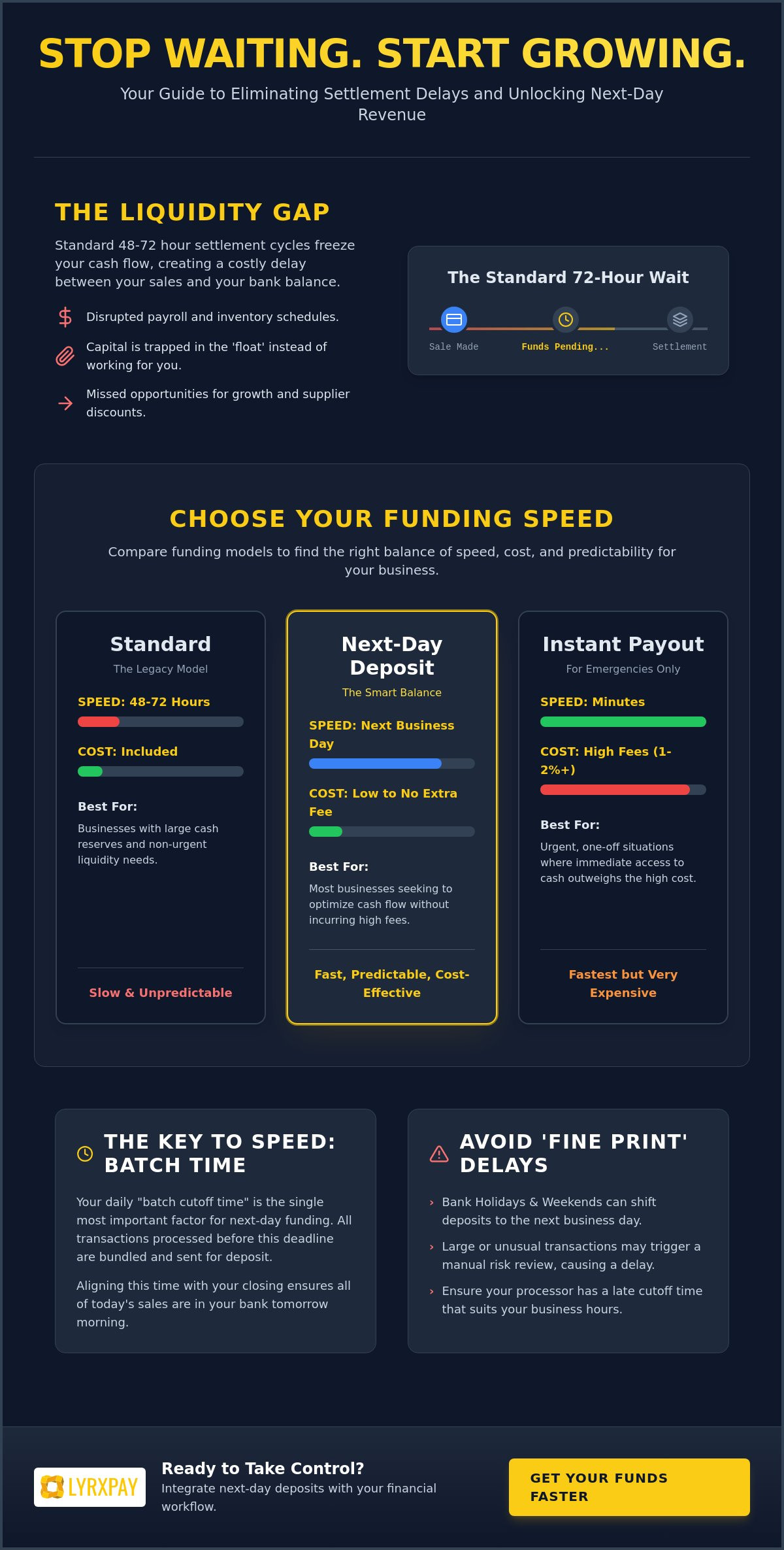
Your closing time is the most important variable in the funding equation. A standard 6 PM cutoff might work for a B2B wholesaler, but it fails a restaurant that does 40% of its business during the dinner rush. If you batch at 9 PM, those dinner sales are pushed to the following day's cycle, effectively negating the "next day" benefit. To maximize liquidity, look for the "Late Night" advantage. Some processors offer 10 PM or 11 PM EST cutoffs, which are essential for West Coast businesses or late-night hospitality venues. Synchronizing your POS system to auto-batch five minutes before the hard cutoff ensures you never miss a funding window. If your current provider can't match your operating hours, it might be time to explore a more flexible processing partner.
The Settlement Window: From Terminal to Bank Account
Understanding the difference between a "Business Day" and a "Calendar Day" is vital for accurate accounting. Transactions processed on a Friday typically settle on Monday morning, as banks do not process standard ACH transfers over the weekend. The cycle follows a strict path: Transaction, Batch, Settlement, and finally, Deposit. You should also verify which card brands are included in your agreement. While most next-day accounts cover Visa and Mastercard, some legacy setups still settle American Express separately unless they use a modern program like OptBlue. Ensuring all card types are unified in a single 24-hour settlement window is the final step in securing true financial agility.
Next-Day vs. Same-Day vs. Instant Funding: Which Is Right for You?
Choosing between settlement speeds isn't just about how fast you want the money. It's about protecting your profit margins. While a next day deposit merchant account has become the baseline for professional operations in 2026, many providers still try to upsell "Instant" or "Same-Day" options that can quietly erode your bottom line. This trend mirrors the growing market for merchant cash advances, where businesses are increasingly willing to pay a premium for liquidity. But is that premium always justified?
Instant funding sounds attractive on paper. Who doesn't want revenue available in seconds? However, this convenience often carries surcharges ranging from 1.5% to 1.75% per transfer. For a business processing $50,000 monthly, that could mean nearly $900 in extra fees just to access your own money a few hours earlier. Next-day deposits provide the "sweet spot" for most SMBs. They offer the 24-hour liquidity needed for payroll and inventory without the predatory percentage-based fees that eat into your hard-earned revenue.
The True Cost of Speed
Are you paying for a service that should be standard? In 2026, transparent pricing is more important than ever. If you're on an interchange-plus model, look closely at your statement for "expedited funding" line items. Some providers use these speed traps to pad their margins on what should be a basic service. You can use our guide on how to lower merchant fees to audit your current agreement. Transparent pricing means knowing exactly what you pay for processing versus what you pay for speed. Don't let a "convenience" fee become a permanent tax on your sales.
Operational Requirements for Each Tier
Speed often comes with technical strings attached. Instant funding typically requires "push-to-debit" technology and is frequently capped at daily limits between $5,000 and $10,000. If you're a high-ticket B2B merchant with $20,000 invoices, instant funding often isn't even an option due to these caps. Next-day deposits handle these larger volumes with ease and don't require specialized hardware. If your risk profile includes larger transactions, the 24-hour window remains the most stable and scalable choice for your operations. It balances the need for speed with the reality of high-volume financial management.
Avoiding the 'Fine Print': Auditing Your Next-Day Deposit Agreement
Securing a next day deposit merchant account is a major win for your cash flow, but the agreement's effectiveness depends on your understanding of the banking system's limitations. Many providers market "speed" while burying the actual mechanics in the fine print. 'Next Day' refers to the next business day, excluding weekends and federal holidays. If you expect funds on a Sunday morning, you'll likely be disappointed by traditional banking structures. Transparency is the foundation of a healthy partnership, and knowing these constraints allows you to plan with precision rather than hope.
Beyond the calendar, your internal business activity plays a role in funding speed. High-ticket transactions or sudden, unusual spikes in sales volume can trigger manual risk reviews. These aren't meant to be punitive, but they can pause the "next-day" promise while the processor verifies the legitimacy of the funds. Additionally, new accounts typically undergo a probation period of 30 to 90 days. During this window, the processor monitors your chargeback ratios and transaction patterns before fully lifting the speed gates. Understanding these stages moves you from a state of frustration to a state of strategic preparation.
The 2026 Reality Check: Weekends and Holidays
How does your processor handle a Friday evening batch? Traditional legacy banks often leave those funds in limbo until Tuesday, while modern, agile processors ensure they hit your account by Monday morning. The Federal Reserve's holiday schedule remains the ultimate arbiter of liquidity. If the banks are closed for a federal holiday, the ACH network doesn't move. To manage cash flow during long holiday weekends, you must ensure your batching is synchronized with these closures. Proactive planning is the only way to avoid the liquidity crunch that often follows a three-day weekend. You need a partner who alerts you to these shifts before they impact your payroll.
Red Flags in Merchant Service Contracts
Are you paying a hidden "speed tax"? Some contracts include tiered funding clauses where only specific card types or small transaction amounts qualify for accelerated settlement. Others might hide "expedited funding" as a monthly subscription fee on the second page of your statement. You should also watch for agreements that don't offer a dedicated support line for funding issues. In the complex world of 2026 finance, you deserve a processor that acts as a defender of your resources. If your current provider feels more like a hurdle than a help, it's time to switch to a merchant service advocate that prioritizes your operational health. Don't let the fine print dictate your business's potential.
LyrxPay: Integrating Next-Day Deposits with Your Financial Workflow
LyrxPay understands that a next day deposit merchant account is only as good as the support system behind it. We don't just provide a terminal; we provide a curated financial strategy. Our concierge approach means we take the time to align your batch times with your actual business hours. If you're a medical practice or a professional law firm, your liquidity needs for high-ticket invoices are different from a coffee shop's. We ensure those larger settlements are prioritized so your cash flow remains fluid. Fast funding isn't a standalone feature. It's a critical component that feeds into your total all in one business financial solution, allowing you to focus on growth rather than administrative delays.
The synergy between low-fee processing and reliable speed is what sets our partnership apart. We've removed the obstacles that traditionally slow down the funding pipeline, ensuring your revenue is accessible when you need to make strategic moves. In the competitive environment of 2026, waiting for your own money is a liability you can't afford. By treating your processing as a strategic asset rather than a utility, we help you maintain the momentum necessary to scale.
QuickBooks & Xero Integration: Closing the Loop
Manual data entry is a relic of the past. By integrating your processing directly with QuickBooks or Xero, we eliminate the tedious task of matching deposits to invoices. This automatic reconciliation prevents the common bookkeeping errors that lead to "missing" funds on your balance sheet. When your next day deposit merchant account communicates directly with your accounting software, your records stay updated in real time. We also provide professional bookkeeping support to ensure your 2026 tax filings are accurate and audit-ready. This managed care for your finances gives you back hours of your week and provides total clarity on your cash position.
Switching to LyrxPay: A Seamless Transition
Changing your processing partner shouldn't cause a headache. We offer a 24-hour approval process for qualified merchants to ensure you can start accelerating your cash flow immediately. Our hardware setup is designed for zero disruption, whether you're a retail storefront or a service-based business. You won't be navigating a generic call center. Instead, you'll have direct contact with Texas-based experts who understand the nuances of national business needs. We pride ourselves on making the complicated feel manageable, acting as a reliable ally for your operational health. From payroll solutions to point-of-sale hardware, we provide the tools that allow you to focus on your craft while we handle the heavy lifting of your financial infrastructure.
Take Control of Your Business Liquidity Today
Transitioning to a next day deposit merchant account isn't just about getting paid faster; it's about reclaiming the momentum your business needs to thrive. You've seen how mastering batch cutoff times and auditing the fine print of your processing agreement can eliminate the "pending" status that holds your capital hostage. By aligning your operational hours with modern settlement windows, you turn your payment processing from a passive utility into a proactive growth tool. Speed is no longer a luxury in the 2026 economy; it's a strategic requirement for healthy cash flow.
We specialize in making this transition effortless by offering transparent, low-fee processing that scales with your national business. You don't have to navigate these technical waters alone. Our team provides Texas-based expert support and seamless QuickBooks or Xero integration to ensure your bookkeeping stays as fast as your funding. Stop waiting for your money and get next-day deposits with LyrxPay today. Your revenue belongs in your bank account, not in a clearinghouse queue. Let's start accelerating your cash flow together.
Frequently Asked Questions
What is a next day deposit merchant account?
A next day deposit merchant account is a specialized processing agreement where funds from your daily transactions are deposited into your bank account by the next business morning. Unlike standard accounts that hold revenue for 48 to 72 hours, this model prioritizes speed. It ensures that the capital you generate on a Monday is available for use by Tuesday, provided you meet the processor's batching requirements.
Does next day funding cost more than standard 2-day funding?
Next-day funding doesn't always cost more, as many modern processors now offer it as a standard feature for qualified businesses. However, some legacy providers still treat it as a premium service and may apply monthly subscription fees or small per-transaction surcharges. It's essential to review your agreement to ensure you aren't paying "convenience" fees for what has become a standard 2026 industry practice.
What is the typical batch cutoff time for next day deposits?
Typical batch cutoff times generally range from 6 PM to 11 PM EST, depending on your specific processor and industry. For instance, a wholesaler might have an earlier cutoff, while a restaurant requires a late-night window to capture its full dinner rush. Selecting a provider that offers a cutoff time aligned with your actual closing hours is the most important factor in ensuring your funds arrive on time.
Will I get my funds on Saturdays and Sundays with next day funding?
You won't receive funds on Saturdays or Sundays because the banking system only operates on business days. If you batch your transactions on a Friday evening, those funds typically arrive in your account on Monday morning. This schedule is governed by the Federal Reserve, meaning even the fastest next day deposit merchant account is still subject to weekend and federal holiday closures.
Can high-risk businesses get next day deposit merchant accounts?
High-risk businesses can qualify for next-day deposits, though they often face stricter initial vetting and may require a clean processing history. Processors might implement a temporary 30 to 90-day probation period or a rolling reserve to mitigate risk before granting accelerated settlement. Once a high-risk merchant proves they have a low chargeback ratio, many providers are willing to move them to a faster funding cycle.
Do I need a specific bank account to receive next day deposits?
You don't need a specific type of bank account to receive next-day deposits; a standard business checking account is sufficient. The speed of the deposit is determined by your merchant processor's technology and their relationship with the clearinghouse, not by your local bank. As long as your bank can receive ACH transfers, you're equipped to handle accelerated funding without changing your existing financial setup.
How do next day deposits affect my QuickBooks reconciliation?
Next-day deposits simplify QuickBooks reconciliation by ensuring your bank deposits match your daily sales records more closely. When funds land in your account within 24 hours, it's easier for your accounting software to pair the incoming cash with the original invoices or POS batches. This reduces the time spent hunting for "missing" funds that would otherwise be stuck in a multi-day clearing cycle.
What happens if I miss the batch cutoff time?
If you miss your batch cutoff time, those transactions are automatically pushed into the following day's settlement cycle. This means your funds will arrive 24 hours later than expected. To prevent this, most modern point-of-sale systems can be programmed to auto-batch five to ten minutes before the hard cutoff, ensuring you never miss a funding window due to a busy closing shift.