
Point of Sale Systems for Restaurants: The 2026 Strategic Evaluation Guide
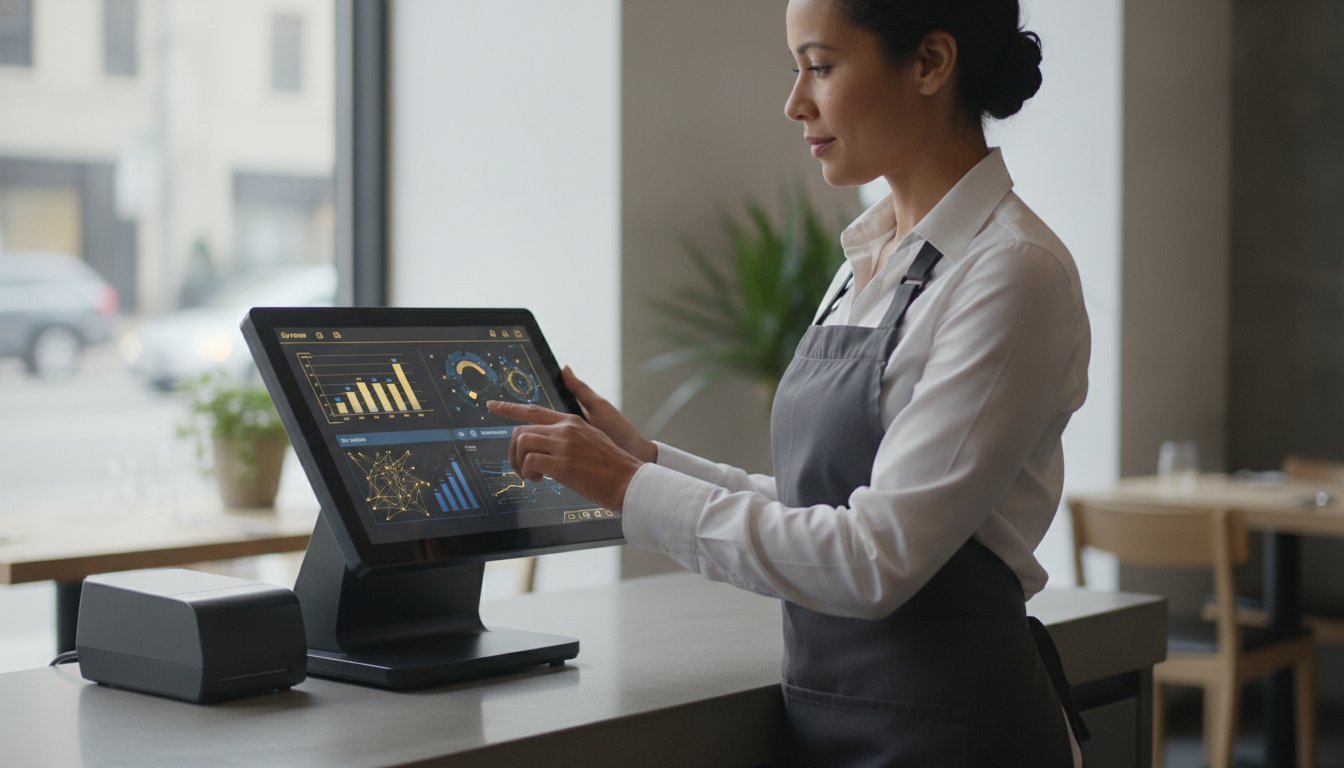
Is your current point of sale system actually a silent partner in your business, or is it just a drain on your daily cash flow? You already know that razor thin margins are the reality of this industry, so it is deeply frustrating when hidden transaction fees eat away at your hard earned profit. If your current point of sale systems for restaurants do not talk to your accounting or payroll software, you are likely wasting hours on manual data entry that could be spent on your craft. You deserve a setup that works as hard as your kitchen staff does.
We have done the heavy lifting to help you evaluate the complex technology landscape of 2026. This guide will show you how to find a solution that maximizes efficiency and minimizes those predatory processing fees. You will learn how to secure next day deposits for better liquidity and implement seamless QuickBooks integration to eliminate administrative headaches. We will also look at reliable hardware built to survive the most demanding shifts. By the end of this evaluation, you will have a clear path to a system that protects your time and your resources.
Key Takeaways
- Learn how to transform your terminal from a simple cash register into a centralized data hub that manages your entire operation in real time.
- Identify the hidden trade-offs within popular point of sale systems for restaurants to ensure you aren't trapped in a restrictive or overpriced processing contract.
- Decode the complex layers of your merchant statement to distinguish between necessary interchange costs and the avoidable markups that inflate your monthly bill.
- Boost your kitchen's speed and accuracy by leveraging advanced automation features like ingredient-level inventory mapping and automated menu updates.
- Streamline your back office by integrating your hardware directly with QuickBooks or Xero to eliminate manual data entry and reduce human error.
The Evolving Role of Point of Sale Systems for Restaurants
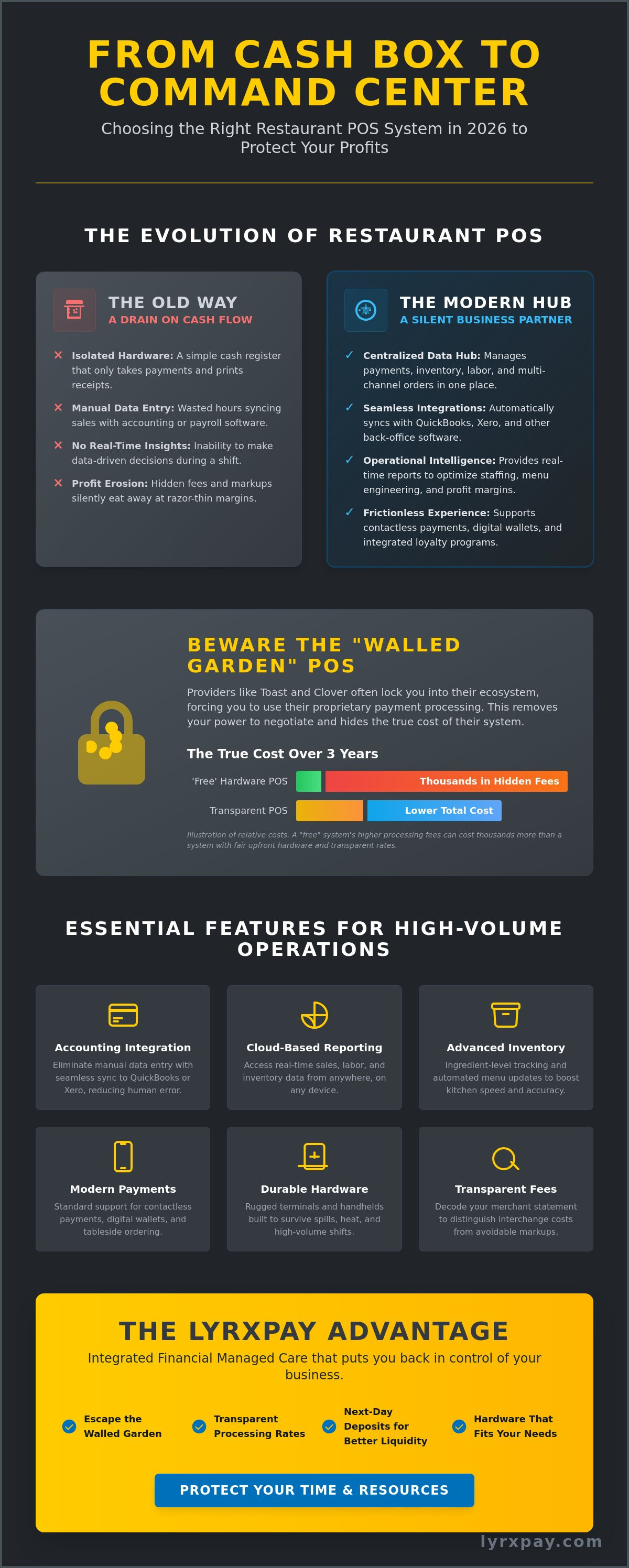
Gone are the days when a cash register simply held paper bills and printed receipts. In 2026, the most effective point of sale systems for restaurants serve as a centralized data and payment hub. It's the engine that powers every transaction, from a quick coffee at the counter to a complex catering order placed online. If your technology still feels like a "dumb" terminal, you are likely losing money on every shift. You need a system that acts as an advocate for your time, not another obstacle to manage.
The industry has moved away from isolated hardware toward integrated cloud-based ecosystems. A modern Point of Sale (POS) system doesn't just process a card; it updates your inventory, adjusts your labor forecast, and syncs with your bookkeeping software simultaneously. This shift toward multi-channel ordering, including in-person, mobile, and kiosk, means your system must be flexible enough to handle a flood of data from every direction without slowing down your kitchen. Data-driven decision making is no longer a luxury reserved for massive chains. It's a daily requirement for any operator who wants to protect their margins from rising costs and hidden fees.
From Order Entry to Operational Intelligence
Modern systems do more than take orders; they provide the intelligence needed to survive in a competitive market. By tracking real-time labor costs against live sales data, you can make immediate decisions about cutting or adding staff as the rush fluctuates. Granular reporting allows for precise menu engineering, showing you exactly which dishes are driving profit and which are simply taking up space in your pantry. For multi-unit owners, cloud access is non-negotiable. You shouldn't have to be physically present to know your labor percentages or top-selling items; you need that clarity delivered to your phone in real time.
Meeting the 2026 Consumer Expectation
Your guests expect more than just a meal. They want a frictionless experience. This means supporting contactless payments and digital wallets as standard features, not afterthoughts. Integrating loyalty programs directly into the checkout flow ensures you capture valuable customer data without making the process feel like a chore for your servers. High-performance point of sale systems for restaurants ensure that every guest interaction is fast and secure. A point of sale system is a comprehensive business management tool that bridges the gap between front-of-house service and back-office financial health. When your hardware and software work in harmony, you can finally focus on the craft of hospitality instead of fighting with your technology.
Evaluating the Major Players and Their Hidden Trade-offs
Toast and Clover dominate the conversation for a reason, but their market share doesn't always translate to the best deal for your bottom line. While their hardware is undeniably sleek and their software is feature-rich, these point of sale systems for restaurants often hide a restrictive financial structure. Most of these providers operate on a "walled garden" model. If you want their software, you are forced to use their proprietary payment processing. This lack of choice removes your ability to negotiate better rates as your volume grows, effectively locking you into whatever fees they decide to charge.
Hardware durability is another critical factor. A tablet that looks great in a showroom might not survive a spill in a high-volume kitchen or the heat of a patio shift. As you track evolving restaurant technology trends, it's clear that flexibility is becoming the most valuable asset for an operator. You need hardware that fits your specific environment, whether that's a rugged handheld for tableside ordering or a stationary terminal with a customer-facing display. If you're tired of the "walled garden" approach, we can help you find integrated financial care that fits your specific business model.
The 'Big Tech' POS Dilemma
Big tech providers often use low upfront hardware costs as a loss leader to get you into a long-term contract. They subsidize these "deals" by charging higher processing fees on every transaction. Over a three-year period, a "free" POS system can actually cost you thousands more than a system with a higher upfront price and lower, transparent processing rates. If you feel stuck in a cycle of high fees and rigid contracts, it's worth exploring Clover alternatives for small business that offer more transparency and better cash flow. These big tech models also rely on faceless support queues. When your system goes down on a Saturday night, a chatbot or a ticket number is a poor substitute for a real human partner who understands your business.
Niche Solutions for Specialized Concepts
One-size-fits-all software rarely works in the diverse world of hospitality. Your point of sale systems for restaurants must match the specific flow of your service model. Each concept has unique requirements that a generic system might miss:
- Bars and Taverns: You need robust pre-authorization capabilities to secure payments before a tab is even opened, protecting you from walk-outs.
- Quick Service (QSR): Speed is the only metric that matters. You require intuitive kiosks and Kitchen Display Systems (KDS) that keep the line moving.
- Full Service (FSR): Your staff needs sophisticated table management, coursing logic, and the ability to handle complex split-check requests without breaking their stride.
Choosing a system that doesn't natively support these functions leads to "workarounds" that frustrate your staff and slow down your guest experience. Don't settle for a system that forces you to change how you run your restaurant; find one that adapts to your existing workflow.
The True Cost of Processing: Beyond the Monthly Software Fee
You have likely looked at the monthly subscription for your point of sale systems for restaurants and thought you had a handle on the budget. In reality, the software fee is often just the tip of the iceberg. While the top restaurant POS systems look great on a spec sheet, the real financial impact is buried deep within your monthly processing statement. If you don't understand the "Merchant Service" backbone of your system, you are essentially writing a blank check to your processor every month.
A standard merchant statement is composed of three distinct pillars. First is Interchange, which is the non-negotiable fee set by the card networks like Visa and Mastercard. Second are Assessments, which are small fees paid directly to the card brands. Finally, there are Markups. This third category is the only one you can actually influence. It's where the processor adds their profit margin; it's where most "hidden" costs live. Many big tech providers use a flat-rate model to simplify things, but this often results in you paying a premium for every transaction, regardless of the card type used.
Operators often tell us that switching processors feels like too much work. They worry about downtime or the hassle of retraining staff. However, when you look at the ROI of lower fees, the math is hard to ignore. If a strategic move saves you even 0.5% on your total volume, that could represent thousands of dollars back into your pocket annually. We believe in Merchant Advocacy. This means we act as your defender, negotiating the complexities of fee structures so you don't have to. You deserve a partner who fights for your margins rather than just taking a cut of them.
How to Audit Your Current Merchant Statement
To find the truth, you must look for "junk fees" that provide zero value to your operation. These often appear as PCI non-compliance fees, statement fees, or vague "regulatory" charges. You can find your true cost by calculating your effective rate; simply divide your total monthly fees by your total sales volume. Interchange-plus is the most transparent pricing model because it separates the actual cost of the card network from the processor's markup, ensuring you only pay a fixed, honest margin on top of wholesale rates.
The Impact of Next-Day Deposits on Cash Flow
Waiting three to five business days for your funds to clear is an unnecessary burden on your liquidity. In a high-volume environment, that delay can affect your ability to pay vendors or meet payroll during a busy week. LyrxPay prioritizes your cash flow by facilitating next-day deposits, ensuring your hard-earned money is available when you need it most. If you want to stop the drain on your profits, learning how to lower merchant fees is the first step toward reclaiming your financial health. Better liquidity combined with lower fees creates a foundation for long-term growth.
Must-Have Features for High-Volume Restaurant Operations
High-volume restaurants operate on a razor's edge where one lost ticket or an unannounced ingredient shortage can derail an entire service. To maintain control, you need point of sale systems for restaurants that offer more than just a "pay" button. You need operational control that anticipates problems before they hit the dining room floor. For instance, advanced inventory tracking with "Auto 86" capabilities ensures that if you run out of a key ingredient, that dish is instantly removed from every ordering channel, including your online menu and self-service kiosks.
Ingredient-level mapping takes this a step further by deducting every ounce of protein or produce as orders are placed. This level of precision isn't just about order accuracy; it's about protecting your bottom line. When your POS connects these inventory movements directly to your bookkeeping, you gain a real-time view of your food costs without spending hours on manual spreadsheets. Managing a large staff is equally demanding, so your system should handle complex tip pooling and performance tracking natively. If you can't see who your top sellers are or automate your scheduling, your technology is failing you. Reliable hardware must also include a robust offline mode. The internet will eventually fail, but your ability to process payments and send orders to the kitchen shouldn't depend on a router.
Kitchen Display Systems (KDS) and Flow Management
Digital order routing through a KDS eliminates the "lost paper ticket" syndrome that plagues busy kitchens. Instead of shouting over a hot line, your staff receives clear, color-coded instructions that prioritize orders based on prep time. This data is a goldmine for managers. It helps you identify exactly where the bottlenecks live. Is the grill station overwhelmed, or is the expo line the real problem? By analyzing these ticket times, you can refine your kitchen layout and staffing levels for maximum efficiency.
Integrated ACH and B2B Payment Options
For large catering orders, credit card fees can be a massive drain on your profit. Integrated ACH processing allows you to accept these large payments securely for a fraction of the cost of traditional card processing. This financial flexibility is part of a "managed care" approach to your business, where every dollar is protected. You can even streamline your vendor payments through the same financial portal, keeping your cash flow organized and transparent. If you're ready to upgrade to a system that handles the heavy lifting, explore our integrated restaurant solutions today.
The LyrxPay Advantage: Integrated Financial Managed Care
Most point of sale systems for restaurants leave you stranded the moment the hardware is plugged in. You are often left to bridge the gap between your daily sales reports and your actual bank deposits. LyrxPay operates as a concierge alternative to the faceless corporations that dominate the market. We don't just sell you a terminal; we provide a defensive shield for your margins and your time. By positioning ourselves as an advocate for your operational health, we ensure that your technology serves your business goals rather than creating new administrative burdens.
The true power of a modern system lies in the synergy between your payment processing, payroll, and bookkeeping. When these elements are siloed, you spend your limited free time chasing data across different platforms. We break those silos by combining high-performance POS hardware with professional financial services. This integrated approach means your labor costs, ingredient expenses, and transaction fees are all visible in one clear picture. You deserve a partner who has already done the heavy lifting, allowing you to return your focus to the craft of hospitality.
Eliminating Manual Accounting Data Entry
Manual data entry is a silent killer of restaurant productivity. It's prone to error and consumes hours that could be spent training staff or refining your menu. Our integration pushes your daily sales totals directly to your accounting ledger every night. This automated flow reduces human error in bank reconciliations and ensures your financial statements are always accurate. You gain the peace of mind that comes with professional bookkeeping support, knowing that your back office is as organized as your front-of-house service. If your current point of sale systems for restaurants don't talk to your ledger, you're working harder than you need to.
A Partnership Built on Transparency
We believe that honesty is the only foundation for a long-term professional relationship. This is why we are committed to transparent pricing, lower transaction fees, and the next-day deposits that keep your cash flow healthy. You will never be just a ticket number in a support queue. Our proactive personality means we anticipate your needs, from PCI compliance updates to hardware refreshes, before they become urgent problems. We invite you to take a low-friction first step toward better financial health. Ready to see how much you can save? Get your free statement audit today. We will analyze your current merchant statement to find every hidden fee and show you exactly where your money is going.
SECURE YOUR RESTAURANT'S FINANCIAL FUTURE
Your choice of technology determines whether you spend your nights fighting with spreadsheets or growing your brand. Modern point of sale systems for restaurants must do more than just process cards; they should act as a bridge between your front-of-house service and your total financial health. By auditing your merchant statement and choosing integrated hardware that talks to your accounting software, you reclaim both your time and your hard-earned profit. You've seen how hidden fees and delayed deposits can drain your liquidity, but you now have the tools to stop that leak.
You don't have to navigate these complexities alone. LyrxPay offers a concierge-style partnership that includes next-day deposits for improved liquidity, seamless QuickBooks and Xero integration, and expert bookkeeping and payroll support. We've done the heavy lifting so you can return your focus to the hospitality your guests love. It's time to stop settling for "good enough" and start demanding a system that works as hard as your kitchen staff does. We are ready to act as your advocate in an increasingly complex industry.
Streamline your restaurant and lower your fees with LyrxPay
Frequently Asked Questions
What is the average cost of a restaurant POS system in 2026?
Upfront hardware for a modern system typically ranges from $500 to over $2,500 per terminal, while monthly software fees generally fall between $50 and $300 per location. These costs depend on your specific needs, such as Kitchen Display Systems or handheld devices. Under current 2026 tax laws, you can often deduct 100% of these equipment costs in the first year through permanent bonus depreciation.
Can I use my own credit card processor with most restaurant POS software?
Most "big tech" providers require you to use their proprietary processing, but many independent point of sale systems for restaurants allow for third-party integration. Choosing an independent system often provides more room to negotiate better transaction rates as your volume grows. This flexibility prevents you from being locked into a "walled garden" where your software and processing are inseparable.
How do POS systems handle tip pooling and distribution for staff?
Modern systems automate tip pooling by applying pre-set percentages to specific roles or hours worked during a shift. This feature eliminates the need for manual spreadsheets and reduces errors that can lead to staff frustration. You can set custom rules for support staff, such as food runners or bussers, ensuring that distribution is transparent and remains compliant with your local labor laws.
What happens to my restaurant POS if the internet goes down?
High-quality systems include a robust offline mode that allows you to continue taking orders and processing payments even when your router fails. Transactions are stored locally on the device and automatically sync to the cloud once your connection is restored. This ensures your kitchen doesn't stop running and you don't lose sales during an unexpected service interruption.
Is it possible to integrate my POS with my current QuickBooks setup?
Yes, professional point of sale systems for restaurants should sync directly with your QuickBooks or Xero setup to automate daily sales entries. This integration pushes your revenue data, tax totals, and labor costs into your ledger without any manual input. It simplifies your bank reconciliations and provides your bookkeeper with clean, real-time data for more accurate financial reporting.
How long does it take to switch to a new POS system without closing the restaurant?
A standard transition usually takes between two to four weeks for menu programming, staff training, and hardware installation. Most providers can perform the final "cutover" during your off-hours to avoid any downtime during service. Proper planning ensures your team is comfortable with the new interface before you process your first live order on the new equipment.
What is the difference between a cloud-based POS and a legacy system?
Cloud-based systems store your data on remote servers, allowing you to access reports and manage menus from any device with an internet connection. Legacy systems are locally hosted on a back-office computer, which limits your mobility and makes remote management nearly impossible. In 2026, cloud platforms are the industry standard due to their ability to integrate with third-party apps and provide instant updates.
How do next-day deposits actually work for my restaurant's bank account?
Next-day deposits work by settling your daily batch and initiating a transfer to your bank account within 24 hours of the transaction. This process drastically improves your liquidity compared to the traditional three to five day waiting period. Faster settlement ensures you have the cash on hand to pay vendors, meet payroll, and manage the daily operational costs of a busy restaurant.