
Understanding Merchant Settlement Timelines

Why does your hard-earned revenue feel like it's trapped in a digital limbo every Friday afternoon? If you've ever watched a "pending" balance sit idle while your own bills come due, you know that merchant settlement timelines can feel more like a hurdle than a service. It's frustrating to realize that while modern technology moves at the speed of light, your cash flow still seems tied to traditional banking hours and weekend delays.
We believe you shouldn't have to guess when your money will arrive. In this guide, we'll help you master the mechanics of payment cycles and discover how to accelerate your business liquidity with optimized settlement strategies. You'll learn exactly why ACH takes longer than credit cards and how to manage those hidden hold periods that often trigger on high-ticket transactions. By the end, you'll have the tools to create a predictable deposit schedule that integrates perfectly with bookkeeping software like QuickBooks. This clarity allows you to stop worrying about "pending" funds and start focusing on your next big move.
Key Takeaways
- Learn the critical difference between transaction authorization and actual funding to gain total control over your business cash flow.
- Identify how your industry risk profile and payment types directly impact your merchant settlement timelines to avoid unexpected delays.
- Compare the advantages of standard T+2 cycles against accelerated next-day funding models to determine the best fit for your liquidity needs.
- Discover how simple adjustments to your daily batching schedule can shave days off your wait time and get funds into your account faster.
- Explore how syncing your processing with tools like QuickBooks can eliminate manual bookkeeping and provide a real-time view of your available capital.
What is Merchant Settlement and Why Does it Matter?
Seeing a green "Approved" message on your terminal is a win, but it isn't the finish line. For most business owners, the real victory happens when those funds actually land in their operating account. Settlement is the formal process where funds move from the acquiring bank to your business bank account. It's the bridge between a customer's promise to pay and your ability to spend that money on inventory or payroll. Without this final step, your sales are just numbers on a screen.
Why does "pending" feel like such a trap? It's because there is a fundamental gap between authorization and settlement. Authorization is simply the "yes" from the customer's bank, confirming they have the funds. Settlement is the actual "money" arriving in your hands. Understanding merchant settlement timelines is vital because your business runs on liquidity, not just digital promises. If your settlement cycle is slow, your cash flow is effectively held hostage by banking protocols. This delay can create a ripple effect, making it difficult to cover immediate expenses even when sales are high.
To navigate these temporary liquidity challenges, you can discover QuickCashDirect and explore their short-term funding solutions that provide a financial bridge during settlement delays.
The Lifecycle of a Transaction
The journey begins the moment a card is swiped or dipped. Your Point of Sale (POS) system sends a request to the issuing bank to verify funds. Once verified, card associations like Visa or Mastercard act as the traffic controllers for the data. Even in our 2026 digital economy, these networks still operate within specific "banking windows." This means if you miss a daily cutoff, your transaction might wait until the next business day just to start its journey. This reliance on 20th-century banking schedules is exactly why weekend sales often don't show up in your account until Tuesday or Wednesday.
Authorised vs. Settled Funds
Have you ever noticed your POS dashboard shows a much higher balance than your bank statement? This happens because your dashboard tracks "Authorised" funds, which are essentially placeholders. To move these funds, your system must "batch" them. A batch is a collection of authorized transactions sent to the processor for final clearance. What is a Merchant Account and how does it function here? It serves as the temporary staging ground where your batch sits while the banks communicate. A transaction is only "settled" the moment the funds are released from this staging area and deposited into your primary bank account.
If you can't predict when your funds will arrive, you can't effectively manage your business. Slow merchant settlement timelines can lead to missed payroll or late vendor payments, creating unnecessary stress. By mastering this cycle, you transform your payment processing from a passive expense into a proactive tool for growth. When you align your internal batching with the bank's schedule, you unlock a level of financial clarity that allows you to focus on your craft rather than your bank balance.
Factors Influencing Your Settlement Timeline
Why does one transaction clear by tomorrow while another takes three days? It's not a mystery; it's a matter of risk and infrastructure. Your merchant settlement timelines are shaped by a specific set of variables that banks use to protect themselves from fraud and errors. By understanding these levers, you can better predict your cash flow and avoid the anxiety of waiting for funds. When you know what the banks are looking for, you can position your business to move through the system much faster.
Payment Method Disparities
Credit cards and ACH payments live on entirely different tracks. Most credit card transactions settle within 24 to 48 hours because the networks are designed for rapid verification. Standard ACH, however, often takes longer because it relies on older, batch-processed systems that move in slower cycles. While the 2026 financial environment is seeing a rise in Real-Time Payments (RTP), many traditional banks still cling to these legacy windows. If you find yourself juggling multiple deposit dates, LyrxPay bridges the gap between payment types by streamlining how these diverse funds hit your account.
The "Risk" Variable
Your industry matters more than you might think. Every business is assigned a Merchant Category Code (MCC), which tells the processor how much "risk" you carry. If you're in a high-ticket industry or handle "card-not-present" transactions, you're statistically more likely to face chargebacks. Processors use settlement delays as a financial buffer to ensure funds are available if a dispute arises. According to the Comptroller's Handbook on Merchant Processing, this risk management is a standard part of how acquiring banks manage their exposure. Maintaining a clean processing history with low dispute rates is the best way to eventually shorten these hold periods.
Beyond risk, your own habits play a role. Banking "cut-off" times are the silent killers of fast funding. If your business closes at 9:00 PM but your processor's cut-off is 7:00 PM, those late-night sales won't even begin processing until the following day. When you add federal holidays and weekends into the mix, a simple two-day window can easily stretch into five. It's helpful to audit your daily operations to ensure your batching schedule aligns with these banking realities. If you're tired of the guesswork, switching to a provider that prioritizes liquidity-first merchant services can give you the transparency you've been looking for.
Standard vs. Accelerated Settlement Cycles
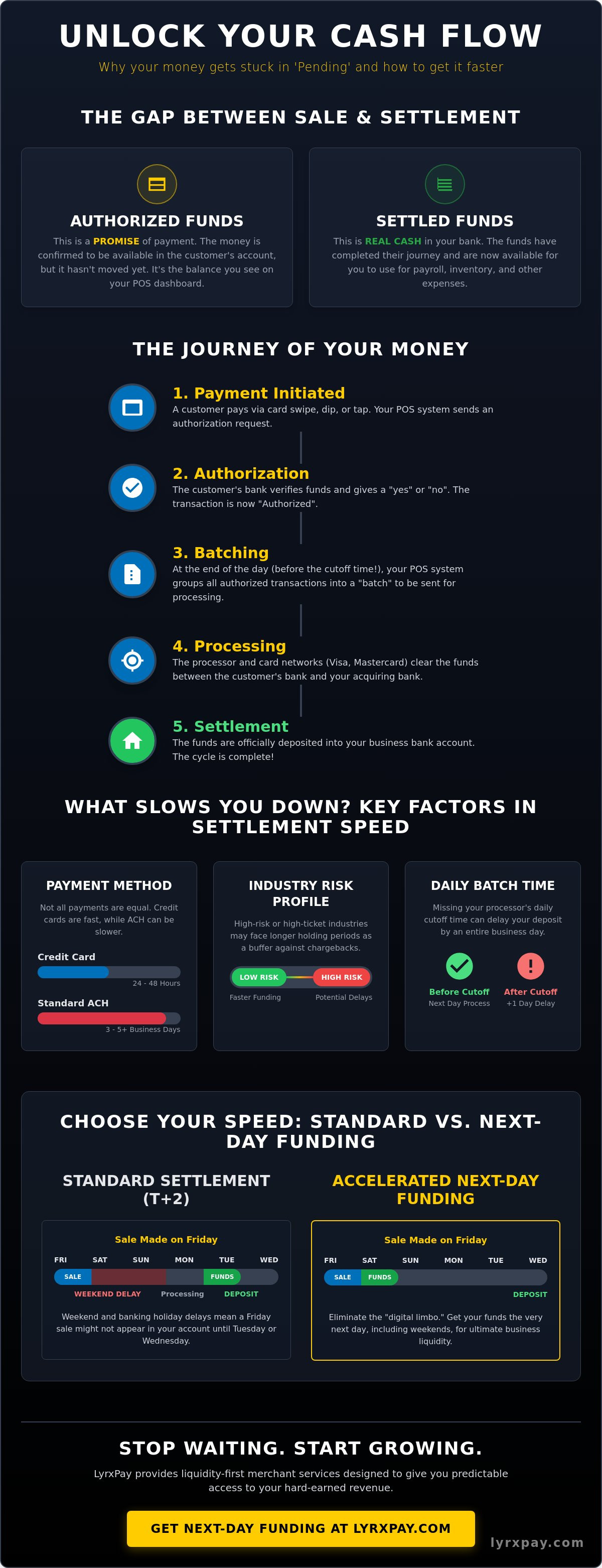
Choosing the right funding speed is a strategic decision that directly impacts your month-end reconciliation and overall growth. While standard cycles might work for businesses with deep cash reserves, most growing companies need their capital available much faster. Standard funding, often referred to as T+2, means your money arrives two business days after the transaction. Understanding the Lifecycle of Online Payment Processing helps clarify why these tiers exist and how you can move between them to find the right balance of speed and cost.
Standard funding models often prioritize the processor's safety over your operational needs, making merchant settlement timelines feel unnecessarily long. If you're operating on thin margins, those extra 48 hours are more than just a delay; they're an opportunity cost. For new or high-risk businesses, processors might even implement "Reserve Accounts," where a percentage of your sales is held for a set period to cover potential disputes. This can significantly slow down your access to capital during your most critical growth phases.
Next-Day Funding Explained
Next-day funding, or T+1, is the gold standard for retail and hospitality businesses that need to replenish inventory daily. The secret to making this work is the "cutoff time." If you batch your transactions before your processor’s specific deadline, the funds arrive in your bank account the very next morning. LyrxPay provides next-day deposits specifically to improve immediate business liquidity, ensuring your Friday sales aren't trapped in the system until the following Tuesday. It's a proactive way to keep your cash moving without the stress of a weekend gap.
The Hidden Costs of "Instant" Payouts
You've likely seen "Instant Payout" buttons on many big tech platforms. While the speed is tempting, these services often come with "convenience fees" ranging from 1% to 3% of the total transaction. Over a month, these surcharges can quietly erode your profitability. Many owners don't realize they're paying a premium for speed that could be achieved through a better-structured settlement plan. You should regularly audit your merchant statements for "funding acceleration" surcharges to see exactly how much you're paying for instant access.
For a complete look at how to balance speed with expenses, check out our guide on how to lower merchant fees. By optimizing your merchant settlement timelines alongside your fee structure, you ensure that your processing setup supports your bottom line rather than draining it. Transitioning from a standard cycle to a transparent, accelerated model is one of the fastest ways to stabilize your daily operations and regain control over your financial health.
Best Practices for Optimizing Your Funding Speed
While industry standards and risk profiles set the baseline, you have more control over your merchant settlement timelines than you might realize. Many delays aren't caused by banking regulations but by small operational gaps that are easy to fix. By auditing your internal processes, you can remove friction and ensure your money moves as fast as your sales. It's about aligning your business rhythm with the digital heartbeat of the financial system. When you take a proactive approach, you turn your payment processing into a reliable engine for growth.
The Art of the Batch
Does your team manually close out the register at 11:59 PM? While this feels like a clean way to end the day, it might actually be delaying your funds by a full 24 hours. Most processors have a specific daily cutoff time, often earlier in the evening. If you miss that window by even five minutes, your batch won't begin processing until the following day's cycle. Transitioning to "Auto-Batching" ensures your transactions are submitted at the optimal time every single night, regardless of how late your staff stays to clean up. For multi-location businesses, coordinating these batch times across all sites creates a unified deposit schedule that makes reconciliation much simpler.
Reducing Settlement Friction
Administrative errors are a common, yet avoidable, cause of "pending" funds. If your legal business name is "Southwest Holdings LLC" but your customer sees "The Daily Grind" on their statement, the mismatch can trigger bank holds. Ensure your "Doing Business As" (DBA) name is consistent across your bank account and your processing profile. Additionally, if your processor sends a "Request for Information" (RFI) regarding a specific transaction, you must respond immediately. Delays in providing documentation are seen as a red flag, which can lead to extended hold periods. Maintaining a low chargeback ratio is the most effective way to build a trust-based relationship with your provider, eventually leading to more favorable merchant settlement timelines.
Monitoring your "Pending vs. Settled" reports daily allows you to catch anomalies before they become cash flow crises. When you use integrated accounting tools, you can see these settlements reflected in real-time, giving you a clear picture of your actual available capital. If you're ready to stop waiting and start growing, optimize your cash flow with LyrxPay and get the speed your business deserves. It's time to treat your liquidity as a priority, not an afterthought. By focusing on these small but impactful details, you ensure that your hard-earned revenue is always right where it belongs: in your bank account.
LyrxPay: Liquidity-First Merchant Services
At LyrxPay, we don't believe you should have to pay a premium just to access your own revenue. We've built our services around the fundamental understanding that liquidity is the lifeblood of your business. While other processors might treat merchant settlement timelines as a static banking constraint, we view them as a configurable lever for your success. We act as your advocate, ensuring that the path from a customer's swipe to your bank balance is as short and transparent as possible. By stripping away the complexity of traditional banking windows, we offer a "concierge" experience that prioritizes your cash flow above all else.
Next-Day Deposits as Standard
For many big-tech processors, next-day funding is a "value-add" service that comes with hidden costs or high-risk labels. At LyrxPay, we've made it our baseline. We prioritize early-morning fund availability so that professional offices, retail shops, and hospitality venues can start their day with a clear financial picture. If you ever have questions about a specific batch or an unexpected delay, our support team is ready to provide immediate clarity. You aren't just another account number in a database; you're a partner in a shared mission. We've done the heavy lifting to ensure your funds are ready when you are, allowing you to focus on your craft rather than your bank statement.
Seamless Accounting Integration
The real power of faster funding is unlocked when your processing and your bookkeeping speak the same language. Our platform ensures that settlement data flows directly into your QuickBooks or Xero software without the need for manual data entry. This creates "reconciliation-ready" deposits that match your sales reports perfectly every single time. You won't have to spend your Sunday nights hunting for missing pennies or trying to figure out why a deposit doesn't align with your POS totals. This synergy between Credit Card & ACH Processing and your internal bookkeeping allows you to scale your operations with total confidence.
Stop waiting for your money and start growing with a partner that values speed and transparency. When you combine our lower fee structures with optimized merchant settlement timelines, you gain a competitive edge that traditional banks simply can't match. It's time to move away from the stress of "pending" funds and toward a state of predictable, manageable growth. Optimize your settlement timeline with LyrxPay today and experience the relief of a merchant service provider that actually works for you.
RECLAIM YOUR TIME AND LIQUIDITY
Mastering your merchant settlement timelines is about more than just knowing when money arrives; it's about reclaiming the resources you need to grow. By now, you've seen how aligning batch schedules and choosing the right funding model can eliminate the "pending" limbo that stalls daily operations. If you integrate these payment cycles directly with your bookkeeping, you remove the administrative friction that often holds small businesses back.
You don't have to navigate these complex banking windows alone. With a partner who values your time as much as you do, you can secure next-day deposits and expert QuickBooks or Xero integration to keep your records reconciliation-ready. This approach combines lower transaction fees with transparent reporting, ensuring you always have a clear view of your available capital. You've done the hard work of building your business; your payment processor should do the hard work of securing your cash flow.
Get Started with Next-Day Deposits from LyrxPay today. It's time to stop chasing deposits and start focusing on the craft that made you successful in the first place. Your business deserves a cash flow strategy that works as hard as you do.
Frequently Asked Questions
How long does a typical merchant settlement take in 2026?
Most standard merchant settlement timelines range from one to three business days (T+1 to T+3). This duration represents the time needed for funds to move from the customer's issuing bank through the network to your acquiring bank. While legacy systems still lean toward the longer end of that window, modern processors often facilitate next-day deposits for eligible transactions. This speed allows you to reinvest your revenue almost immediately.
Why does my merchant settlement take longer on weekends?
Settlement pauses on weekends because the Federal Reserve and traditional banking institutions don't process transactions on non-business days. If you batch your sales on a Friday evening, the clock often doesn't start ticking until Monday morning. This gap is a relic of legacy banking windows that require manual clearance steps. To avoid this, you can look for providers offering weekend funding or accelerated cycles that bridge the Saturday divide.
What is the difference between next-day funding and same-day funding?
Next-day funding delivers your capital on the following business morning, while same-day funding provides access to funds on the very same day the transaction occurs. Same-day funding usually requires a strict early-afternoon cutoff time to ensure the bank can process the credit before their daily close. While same-day is faster, it often carries higher convenience fees compared to the standard efficiency of a next-day deposit model.
Can I speed up my ACH settlement timeline?
Yes, you can accelerate ACH by utilizing Same-Day ACH or switching to a processor that supports Real-Time Payments (RTP). Standard ACH can take three to five days because it moves in slow, infrequent batches. By verifying your bank account and ensuring it supports accelerated protocols, you can often cut this wait time in half. It's a simple technical adjustment that provides an immediate boost to your daily liquidity.
Why is some of my money being held in a merchant reserve?
A merchant reserve acts as a financial safety net that processors use to mitigate the risk of potential chargebacks or fraud. If you operate in a high-risk industry or handle high-ticket transactions, the bank may hold a percentage of your sales to ensure funds are available for disputes. These holds are typically temporary. You can often reduce or remove these reserves by maintaining a clean processing history over several months.
Does my POS hardware affect how fast I get paid?
Your POS hardware impacts funding speed primarily through its batching capabilities and connectivity to the processor's network. Some older terminals might experience software lag or connectivity issues that prevent a successful end-of-day batch. If your hardware fails to communicate with the bank at the scheduled time, your funds will be delayed until the next cycle. Modern, integrated POS systems automate this process to ensure you never miss a cutoff.
What time do I need to batch my transactions to get next-day deposits?
Most processors require you to batch your transactions by a specific cutoff time, which usually falls between 5:00 PM and 9:00 PM EST. Missing this window by even a few minutes means your sales won't start processing until the next business day. It's helpful to audit your specific provider's schedule. Aligning your Auto-Batch settings with these banking windows is the most reliable way to ensure your money arrives every morning.
Will a high chargeback rate delay my settlement timeline?
A high chargeback rate is a major red flag that will almost certainly extend your merchant settlement timelines. When disputes rise, processors become cautious and may implement longer hold periods to protect the network from financial loss. If your ratio exceeds industry benchmarks, you might face a permanent reserve or even account suspension. Keeping your dispute levels low is the fastest way to earn trust and secure the fastest possible funding.