
Risks of Consumer Payment Apps for Business: 2026 Guide

You wouldn't use a child’s plastic toolkit to build a skyscraper, so why are you trusting your company’s entire cash flow to a payment app designed for splitting a dinner tab? While it’s tempting to stick with what is familiar, the risks of using consumer payment apps for business have reached a critical level in 2026. What started as a convenient way to avoid complex setups has evolved into a landscape of potential IRS audits and sudden account freezes that can paralyze your operations without any human support to call for help.
We know why you use them. They’re fast, they’re ubiquitous, and they promise a level of simplicity that is hard to ignore when you’re busy growing a brand. But as the IRS monitors the $20,000 and 200-transaction reporting threshold for the 2026 tax year, that shortcut is often leading straight into a manual reconciliation nightmare. You deserve a payment strategy that acts as an advocate for your time. This guide shows you how to stay compliant and automate your bookkeeping without losing the speed you need. We will explore the latest CFPB oversight rules, the reality of FDIC insurance gaps, and how professional merchant services can provide the managed care your business deserves.
Key Takeaways
- Understand the legal distinction between C2C apps and merchant accounts to prevent a "Terms of Service" violation from shutting down your revenue.
- Navigate the 2026 IRS 1099-K landscape and learn why "Friends and Family" payments are often treated as red flags for tax audits.
- Uncover the primary risks of using consumer payment apps for business, specifically the danger of faceless algorithms freezing your funds without warning or recourse.
- Eliminate the "reconciliation gap" by learning how to automate your bookkeeping and stop the manual fat-fingering of data into QuickBooks.
- Prioritize your liquidity with next-day deposits and professional fee structures that keep more profit in your pocket during high-volume months.
The Convenience Trap: Why Consumer Apps Fail Professional Businesses
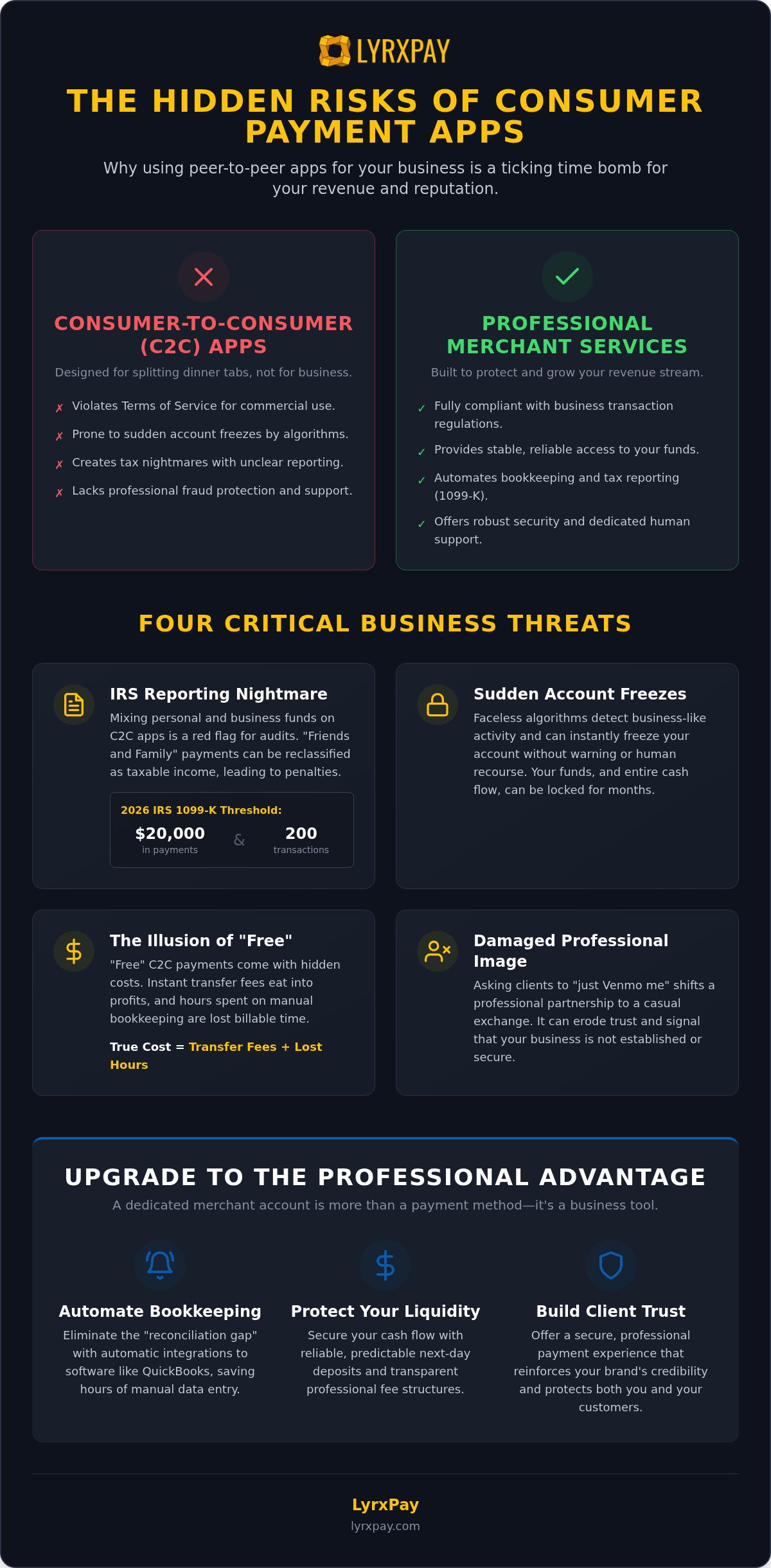
Many entrepreneurs start their journey by accepting payments through the same apps they use to pay back a friend for lunch. It feels easy. It feels free. However, the risks of using consumer payment apps for business often stay hidden until your volume grows. These Consumer-to-Consumer (C2C) platforms are legally and operationally distinct from a professional Payment Service Provider (PSP). While a PSP is built to protect your revenue, a consumer app is built for social convenience. This creates a fundamental mismatch. If you treat a social app like a business tool, you aren't just taking a shortcut; you're building your foundation on a ticking time bomb.
Think about the message you send when you ask a high-value client to "just Venmo me." It shifts the relationship from a professional partnership to a casual transaction. Professional payment methods build immediate trust. They signal that your business is established, compliant, and secure. If your payment process feels like an afterthought, your clients might wonder if your service is, too.
Violating Terms of Service (ToS)
Personal accounts are for personal use. It is that simple. Algorithms now monitor your account for business-like patterns such as high transaction frequency, specific keywords in memos, or a sudden spike in volume. Once the system flags your personal profile for commercial activity, the consequences are swift. You risk a permanent account ban. This isn't just a temporary pause; it often results in "blacklisting" where your phone number and identity are blocked from the platform entirely. You can't just open another account. If your funds are caught in the middle of a ban, getting them back can take months of fighting with automated support bots.
The Illusion of 'Free' Payments
The "free" price tag on consumer apps is a marketing mirage. When you need that money in your bank account immediately, you often pay "instant transfer" fees. These small percentages add up quickly, sometimes even exceeding standard merchant processing rates. Then, there is the hidden cost of your time. If you spend hours every weekend manually entering data into your accounting software, you aren't saving money. You are losing billable hours. If you want to scale, you need to learn how to lower merchant fees through professional channels that offer automated QuickBooks integration. This moves you away from manual entry and toward a streamlined, profitable operation.
IRS Compliance and the 1099-K Reporting Nightmare
Tax season shouldn't feel like a forensic interrogation. If you are currently using personal accounts to collect revenue, you are likely creating a paper trail that is difficult to defend. The risks of using consumer payment apps for business become painfully clear when the IRS begins looking for discrepancies between your reported income and your actual bank deposits. When you mix personal gifts with professional sales, you aren't just making bookkeeping harder. You are waving a red flag at auditors. Professional merchant accounts solve this by creating a clean, undeniable wall between your life and your livelihood.
The core of the problem lies in classification. Many business owners ask clients to send money via "Friends and Family" to avoid small fees. This is a dangerous gamble. The IRS is increasingly aware of this tactic. If your account shows a high frequency of "gifts" that happen to match your invoice amounts, an auditor will likely reclassify that entire pool of money as taxable income. This can lead to back taxes, interest, and heavy penalties that far outweigh any fees you thought you were saving.
The 1099-K Threshold Explained
Understanding the IRS Form 1099-K requirements is essential for your 2026 planning. For this tax year, third-party settlement organizations are required to issue a 1099-K to any user who receives over $20,000 in payments for goods and services and exceeds 200 transactions. While this threshold is higher than the previously proposed $600 limit, it still catches many growing businesses off guard. Consumer apps often struggle with accuracy. They might over-report your revenue by including reimbursed expenses or personal transfers, leaving you to prove to the IRS what was actually a sale and what was just a split dinner bill.
Professional Tax Documentation
Messy CSV exports are the enemy of a low-cost tax return. When you hand your CPA a stack of inconsistent reports from three different apps, your billable hours skyrocket. Professional processing provides standardized, monthly statements that align perfectly with your bank deposits. This level of transparency doesn't just save money; it provides a sense of "managed care" for your administrative health. By using integrated bookkeeping and processing, you ensure that every dollar is accounted for before tax season even begins. This proactive approach turns a potential nightmare into a simple, end-of-year checkmark, allowing you to focus on your craft instead of your spreadsheets.
Account Freezes and the Lack of Fraud Protection
Imagine waking up to find your business balance at zero. Not because you spent it, but because an algorithm decided your recent success looked like a security threat. One of the most paralyzing risks of using consumer payment apps for business is the sudden, unexplained account freeze. These platforms are built for low-stakes personal transfers. When they encounter professional-level volume or high-dollar invoices, their security bots often default to a "freeze first, ask questions later" policy. For a small business, this isn't just an inconvenience. It's a total shutdown of your liquidity.
This lack of protection extends to chargebacks and fraud. Consumer apps rarely side with the seller in a dispute. If a customer claims they didn't receive a service, the app might claw back the funds from your account instantly, even if the payment was marked as "completed" days ago. You are left with no revenue and no product. Because there is no human to review your evidence, the loss is often permanent. You are essentially operating without a safety net.
The 21-Day Hold Reality
Routine reviews can lead to funds being held for 21 days or longer. If a $5,000 payment for a major project is flagged as suspicious, that money stays in the app’s ecosystem while your bills continue to pile up. This delay creates a ripple effect. It impacts your ability to meet payroll and satisfy vendor obligations. Without a human advocate to verify the transaction, you are at the mercy of a timeline you cannot control. The government has recognized these systemic failures, leading to stricter Federal oversight of payment apps to combat illegal "debanking" and improve fraud resolution for users.
Merchant Advocacy vs. App Automation
Professional merchant services offer a fundamentally different experience. Instead of fighting a faceless bot, you have a partner who acts as a defender of your resources. At LyrxPay, we use proactive risk management to identify potential issues before they lead to a freeze. If a question does arise, you don't wait for an automated email response. You call our Texas-based support team and speak to a person who understands your business model. This human-centric approach transforms payment processing from a liability into a managed service, ensuring your revenue remains accessible when you need it most.
Operational Friction: The Hidden Cost of Manual Bookkeeping
While previous sections explored legal and security threats, the daily grind of accounting is where the risks of using consumer payment apps for business often take their highest toll. You might feel like you are saving money on fees, but you are likely losing hours to the "Reconciliation Gap." Consumer app balances rarely align perfectly with your bank statements because of how they batch transfers or hold funds. This forces you to spend your Sunday nights manually entering transaction data into your ledger. One typo can throw off your entire month of reporting, leading to costly errors that your CPA will have to charge you to fix later.
Scaling is another major hurdle that consumer tools can't clear. These apps are designed for the occasional lunch reimbursement, not for a growing brand processing 50 or more transactions a month. Once you hit that volume, the lack of multi-user access becomes a bottleneck. Your bookkeeper or accountant can't easily audit your app history without you handing over your personal device or login credentials. This creates a massive security hole and stops your team from doing their jobs efficiently.
Seamless QuickBooks and Xero Integration
Adopting all-in-one business financial solutions changes the game for your back office. Instead of manual entry, you get a real-time sync that updates your ledger the moment a card is swiped or an ACH payment clears. This "One Source of Truth" philosophy ensures your business health is always visible. You can see your actual cash flow in seconds rather than waiting for a manual export at the end of the week. It's about moving away from the "financial toy" model and toward a professional infrastructure that supports your growth.
Audit-Proofing Your Business
Clean, integrated data is your best defense against a financial audit. When your processing and bookkeeping are linked, you create a transparent trail that is easy for any professional to verify. This lowers your CPA costs during tax season and gives you the peace of mind that your records are 100% accurate. You move from a reactive state of fixing mistakes to a proactive state of managing your revenue. If you are ready to stop the manual entry madness, our integrated bookkeeping and processing services can help you reclaim your time and professionalize your operations.
Liquidity Management: Upgrading to Professional Merchant Services
Speed of capital is the lifeblood of your business. If your revenue is locked behind an app's withdrawal limit or stuck in a 21-day review, it isn't working for you. While we have already explored the legal and operational risks of using consumer payment apps for business, the final piece of the puzzle is liquidity. Moving to a professional merchant service provider isn't just about avoiding a freeze. It's about gaining a strategic partner who prioritizes your cash flow. Next-day deposits ensure that today’s sales are in your bank account tomorrow morning, providing the fuel you need for payroll, inventory, and growth.
You can also learn how to lower merchant fees by moving away from the predatory "instant transfer" percentages found in consumer wallets. These apps often hide their true cost behind a facade of simplicity, but those small percentages eat your margins over time. Switching to a relationship-based model gives you access to a "concierge" level of service where your operational health is the priority. You aren't just another user in a database; you're a partner with a dedicated defender of your resources.
Optimizing Your Cash Flow
Forecasting your growth requires precision. By using business liquidity management tools, you can see exactly when funds will clear and plan accordingly. For high-ticket B2B transactions, ACH processing is often a superior choice. It offers lower fees and higher security than a credit card swipe. Unlike the "instant" transfers in consumer apps that charge high percentage premiums, next-day funding through a professional merchant account is a standard feature designed to keep your capital moving without the "convenience tax."
Professionalizing the Client Experience
Your payment portal is often the last interaction a client has with your brand. Why finish a professional project by asking someone to find you on a social app? Branded invoices and secure payment links create a sense of security and permanence. When you offer multiple options like Credit, Debit, and ACH in one secure place, you're seen as an established enterprise. This trust is a long-term asset that consumer apps simply cannot provide. It moves the conversation from a casual transaction to a serious professional relationship.
Migrating your clients is a straightforward process. Start by sending a brief, professional update to your recurring customers. Explain that you are upgrading to a more secure payment portal to better protect their financial data. Provide them with a branded link and highlight the new options available to them. Most clients will appreciate the professional upgrade and the added security of an established financial system. You'll stop chasing payments and start building a more resilient, scalable business.
SECURE YOUR REVENUE AND SCALE WITH CONFIDENCE
You've worked hard to build your business. Don't let a social app's algorithm tear it down. We've explored how the risks of using consumer payment apps for business extend far beyond simple transaction fees. From the complexity of 2026 IRS reporting to the paralyzing reality of sudden account freezes, staying with a consumer platform is a liability your growth can't afford. It's time to trade manual entry and "Friends and Family" red flags for a system that actually works as hard as you do.
You deserve a partner who acts as a defender of your resources. By moving to a professional merchant model, you gain access to next-day deposits and expert QuickBooks integration that turns hours of bookkeeping into seconds of automated sync. If an issue arises, you won't be stuck talking to a bot; you'll have access to our Texas-based human support team ready to help. Stop risking your cash flow—upgrade to professional merchant services with LyrxPay today. Your future self will thank you for the clarity and security you build today.
Frequently Asked Questions
Can I get in trouble for using my personal Venmo for business?
Yes, you can face serious consequences. Using a personal profile for commercial activity is a direct violation of most apps' Terms of Service. If an algorithm detects business patterns, your account can be permanently banned and your funds frozen for months. It also makes you a target for IRS scrutiny because it's nearly impossible to prove which transfers were gifts and which were taxable sales.
What is the 2026 IRS 1099-K reporting threshold for payment apps?
For the 2026 tax year, the IRS requires third-party networks to issue Form 1099-K to users who receive over $20,000 and have more than 200 transactions. This is a significant change from the previously planned $600 threshold. You should still check your specific state requirements, as some local jurisdictions enforce much lower reporting limits that could catch your business off guard during tax season.
Why do consumer apps freeze business accounts so often?
Consumer apps rely on faceless algorithms to manage risk at a massive scale. If your business experiences a sudden spike in sales or uses keywords that trigger security bots, the system defaults to a freeze to protect the platform. One of the primary risks of using consumer payment apps for business is that you have no human advocate to call when these automated holds paralyze your cash flow.
Are merchant account fees actually lower than Venmo's instant transfer fees?
In many cases, professional merchant services are more cost-effective than the "convenience" fees of social apps. While a consumer app might seem free, their "instant" transfer fees are often higher than standard merchant processing rates. When you factor in the value of your time lost to manual bookkeeping and the cost of potential audit errors, the professional route usually saves you more money in the long run.
How do I move my business customers away from Zelle or Cash App?
Start by sending a branded email to your client list explaining that you are professionalizing your payment experience. Tell them you are moving to a secure portal to better protect their data and offer more flexible payment options. Most B2B clients prefer a professional invoice over a personal handle because it fits better with their own internal accounting and expense tracking processes.
What is the difference between a consumer payment app and a merchant account?
A consumer app is a social tool designed for splitting dinner tabs between friends. A merchant account is a professional infrastructure built for business health. The main differences include next-day deposits, automated bookkeeping, and human support. While apps offer instant convenience, merchant accounts provide the long-term stability and legal compliance necessary for a scaling enterprise that needs to manage high transaction volumes.
Is ACH processing safer than using a consumer payment app?
ACH processing is significantly more secure for high-ticket business transactions. It operates on a bank-to-bank level with established fraud protections that consumer apps simply don't match. Unlike social apps that might "claw back" funds without warning, professional ACH services offer a transparent dispute process and proactive risk management to ensure your liquidity remains stable and your revenue is protected from fraudulent claims.
Can my bookkeeper integrate my personal payment app with QuickBooks?
Integration is a major hurdle for personal profiles. Most consumer apps don't offer direct, real-time sync with accounting software like QuickBooks or Xero. Your bookkeeper would have to manually export messy CSV files and enter the data into your ledger. Professional processing eliminates this operational friction by automating the sync, ensuring your records are always audit-proof and accurate without the risk of manual entry errors.